
Home Health Star Rating: How Does It Work?
CMS publishes two separate Home Health Star Ratings on Care Compare. Learn what each rating measures, how OASIS and HHCAHPS affect the scores, and what agencies can improve.
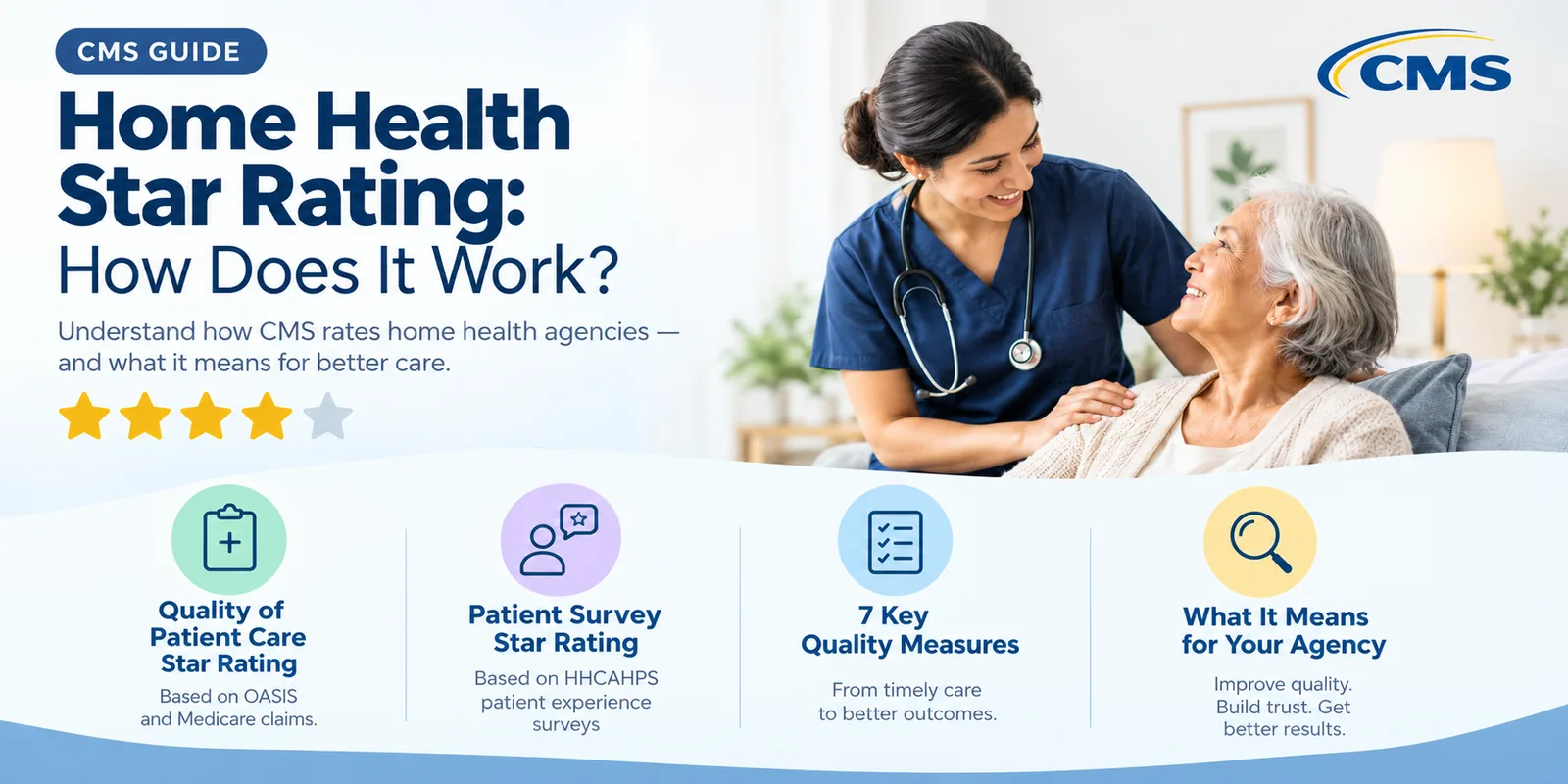
Key Takeaways
- CMS publishes separate Quality of Patient Care and Patient Survey Star Ratings, and the two scores measure different aspects of performance.
- The Quality of Patient Care rating uses seven measures drawn from OASIS assessments and Medicare claims.
- An HHA needs enough qualifying data for at least five of the seven quality measures before CMS can calculate an overall Quality of Patient Care Star Rating.
- The Patient Survey rating uses HHCAHPS patient-experience data and requires at least 40 completed surveys during the reporting period.
- Both rating systems are updated quarterly and reflect historical reporting periods rather than real-time performance.
- Agencies improve the processes behind their ratings through accurate assessments, strong documentation, timely care, clinical outcomes, communication, and continuous quality review.
✓ Quick answer: CMS publishes two separate Home Health Star Ratings on Medicare Care Compare. The Quality of Patient Care Star Rating uses selected clinical measures based on OASIS assessments and Medicare claims. The Patient Survey Star Rating uses patient-experience data from HHCAHPS. Both are five-star systems, are updated quarterly, and should be reviewed with the individual measures behind them.
A home health agency's star rating is easy to see, but the number compresses multiple measurement and reporting processes into one public score. Agency leaders need to understand which rating they are reviewing, which data feeds it, and how long operational changes can take to appear on Care Compare.
What Is the Home Health Star Rating?
The Home Health Star Rating is a CMS quality-reporting system that gives consumers another way to compare Medicare-certified home health agencies on Medicare Care Compare. CMS presents star ratings as summaries of selected provider-performance measures, not as complete evaluations of everything an agency does.
CMS publishes two types of home health star ratings: the Quality of Patient Care Star Rating and the Patient Survey Star Rating. The ratings answer different questions and use different data sources.
What Are the Two Types of Home Health Star Ratings?
| Rating | What it measures | Main data source |
|---|---|---|
| Quality of Patient Care Star Rating | Selected clinical process and patient outcome measures | OASIS assessments and Medicare claims |
| Patient Survey Star Rating | Patients' experiences with the agency | Home Health Consumer Assessment of Healthcare Providers and Systems (HHCAHPS) |
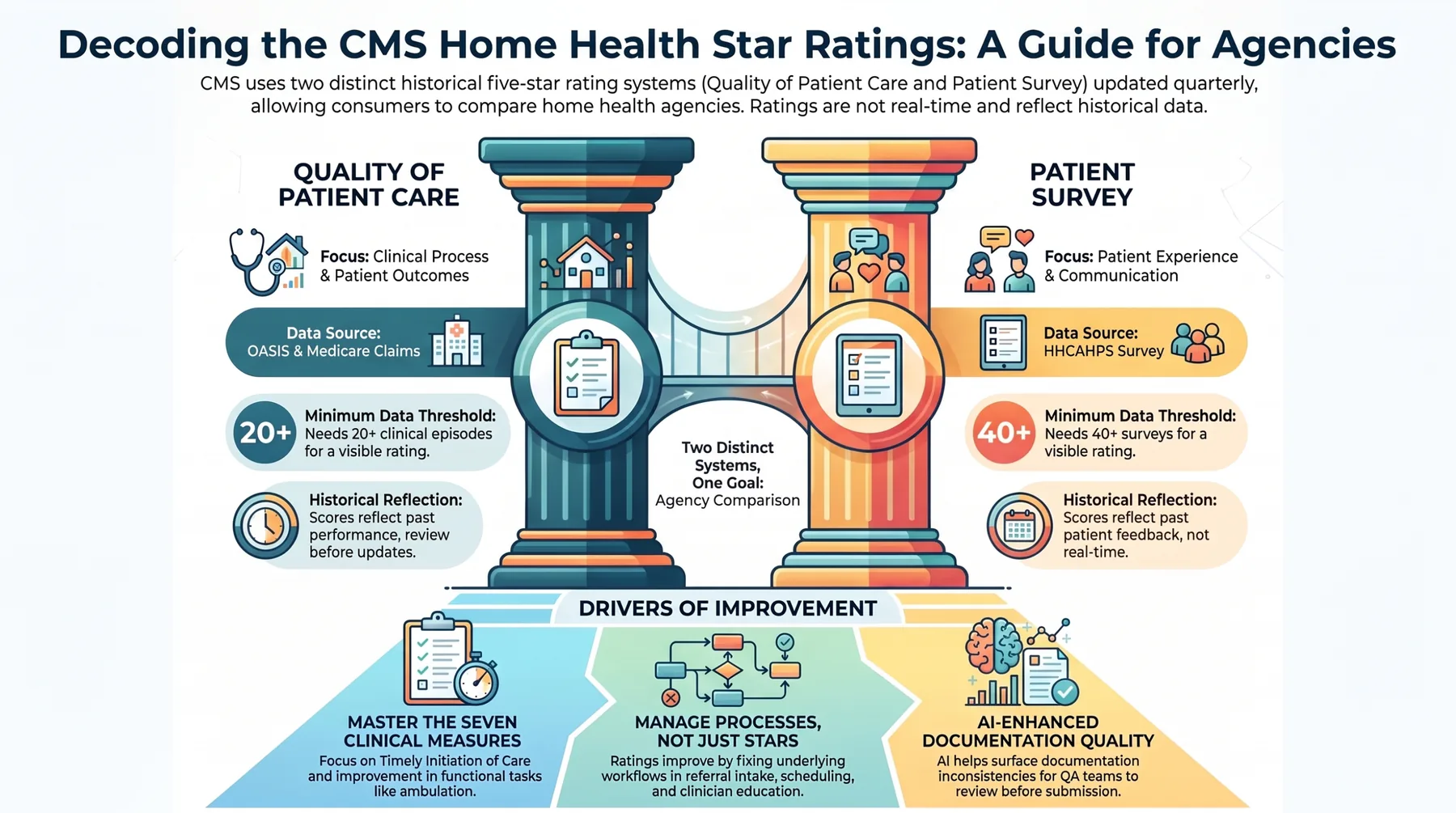
The two CMS rating systems use different evidence: clinical and claims data for Quality of Patient Care, and HHCAHPS responses for patient experience.
The Quality of Patient Care rating focuses on selected clinical performance and outcomes. The Patient Survey rating focuses on how patients experienced the care they received.
CMS recommends using these ratings alongside the underlying quality information rather than treating either score as a complete assessment of an agency.
How Is the Quality of Patient Care Star Rating Calculated?
CMS calculates the Quality of Patient Care Star Rating from seven measures currently reported on Care Compare. One is a process measure, five are OASIS-based outcome measures, and one is a Medicare claims-based outcome measure.
- Timely Initiation of Care.
- Improvement in Ambulation.
- Improvement in Bed Transferring.
- Improvement in Bathing.
- Improvement in Shortness of Breath.
- Improvement in Management of Oral Medications.
- Home Health Within-Stay Potentially Preventable Hospitalization (PPH).
CMS selects measures based on factors including clinical relevance, data availability, stability, variation among agencies, and whether an agency can demonstrate improvement. The PPH measure replaced the former Acute Care Hospitalization measure in the star-rating methodology beginning with the October 2024 Care Compare refresh.
What Does Each Quality of Patient Care Measure Tell You?
Timely Initiation of Care
This process measure looks at whether the agency began care within the applicable timeframe. Referral intake, eligibility verification, staffing, scheduling, orders, and start-of-care workflows can all affect timely initiation.
Improvement in Ambulation
This outcome measure evaluates improvement in the patient's ability to walk or move around during the home health episode.
Improvement in Bed Transferring
This outcome measure evaluates improvement in the patient's ability to transfer in and out of bed.
Improvement in Bathing
This outcome measure evaluates improvement in the patient's ability to bathe safely and effectively.
Improvement in Shortness of Breath
This outcome measure looks at whether the patient's shortness of breath improved during the quality episode.
Improvement in Management of Oral Medications
This outcome measure evaluates improvement in the patient's ability to manage oral medications safely.
Home Health Within-Stay Potentially Preventable Hospitalization
This Medicare claims-based measure examines potentially preventable hospitalizations that occur while a patient is receiving home health care.
How Does OASIS Affect the Home Health Star Rating?
OASIS supplies the data for several measures in the Quality of Patient Care Star Rating. CMS creates a complete quality episode by pairing a start or resumption of care OASIS assessment with an applicable end-of-care assessment, such as discharge, transfer, or death.
The end-of-care date must fall within the applicable reporting period, regardless of when the episode began. That means OASIS accuracy affects more than an individual chart.
It becomes part of the data CMS uses to calculate and publicly report quality performance. For an overview of the assessment, read What Is OASIS-E in Home Health?.
→ The measurement chain: Care delivered → assessment completed → clinical information documented → OASIS data submitted → quality measure calculated → CMS reports performance
How Many Patient Episodes Does an HHA Need for a Quality Rating?
For an individual measure to be reported on Care Compare, CMS requires an HHA to have data for at least 20 complete quality episodes for each OASIS-based measure or at least 20 home health stays for an applicable claims-based measure. To calculate an overall Quality of Patient Care Star Rating, the agency must have reportable data for at least five of the seven measures.
ℹ️ No rating does not automatically mean poor performance. An agency may simply lack enough qualifying data for CMS to calculate a statistically reliable rating.
How Is the Patient Survey Star Rating Calculated?
The Patient Survey Star Rating uses HHCAHPS, the national standardized survey of patients receiving care from Medicare-certified home health agencies. CMS's star-rating page identifies four areas in the Patient Survey Star Rating:
- Care of Patients.
- Communication Between Providers and Patients.
- Specific Care Issues.
- Overall Rating of Care Provided by the Home Health Agency.
The willingness-to-recommend result is publicly reported, but CMS does not include it in the Patient Survey Star Rating because its results are very similar to the overall rating of care.
Did the Home Health Patient Survey Change in 2026?
Yes. CMS introduced a revised HHCAHPS survey beginning in April 2026. The revised survey contains 25 questions, compared with 34 questions in the version administered before April 2026.
The revision changes parts of the Care of Patients and Communication composites and adds standalone measures for talking about home safety, reviewing medicines, and talking about medication side effects. Agencies comparing current results with older periods should confirm which survey version produced the data.
How Many Surveys Does an HHA Need for a Patient Survey Star Rating?
CMS displays Patient Survey Star Ratings for agencies with at least 40 completed home health patient surveys during the four-quarter reporting period. Agencies below that threshold may still have HHCAHPS information publicly reported without receiving a Patient Survey Star Rating.
How Often Are Home Health Star Ratings Updated?
CMS updates both home health star-rating systems quarterly as new data becomes available on Care Compare. A current public rating represents a defined historical reporting period.
It does not necessarily reflect changes made by an agency during the most recent weeks or months.
Why Can Current Improvements Take Time to Appear?
The reporting process includes defined measurement periods, data submission, calculation, agency preview, and public release. CMS provides an HHA with a Provider Preview Report for the Quality of Patient Care Star Rating about three and a half months before the rating is posted on Care Compare.
The agency then has several weeks to review the calculation and request a review if it believes CMS made a calculation error.
A workflow improvement implemented this month will not immediately change the rating visible to consumers. Leadership should track leading operational indicators while waiting for the public reporting cycle to catch up.
Can an HHA Review Its Rating Before Publication?
Yes. CMS provides Quality of Patient Care and Patient Survey preview information before public reporting.
Agencies can review their results and request CMS review when they believe there is a calculation error. This creates a useful quality-management sequence: review → validate → identify a possible calculation issue → submit supporting evidence when appropriate → monitor the public release.
Does a Star Rating Measure the Entire Quality of an Agency?
No. A star rating summarizes performance on selected measures.
It does not measure every aspect of clinical care, staffing, care coordination, specialty services, community relationships, operational performance, or every individual patient's needs and outcomes.
Two agencies can have the same overall rating while performing differently on individual measures. An agency without a rating may simply lack enough qualifying episodes or surveys.
Patients, families, referral partners, and agency leaders should review the component measures and other relevant information in addition to the summary score.
Does Documentation Affect Home Health Star Ratings?
Documentation can affect the data used for quality measurement, particularly for OASIS-based measures. The relationship is not as simple as better documentation automatically producing a higher rating.
Documentation must accurately reflect the patient's status and the care provided so the resulting assessment and quality data are reliable.
✓ Accurate workflow: Care delivered → supporting documentation → accurate assessment → valid quality data → reliable public reporting
Recurring inconsistencies, unsupported assessment responses, or missing information can weaken data quality and make it harder for an agency to understand what is driving its results. See the common OASIS documentation mistakes that lead to payment delays for practical examples.
Does the Patient Survey Rating Measure Patient Satisfaction?
It is more precise to describe HHCAHPS as measuring patient experience. The survey asks about how care was provided, communication, specific care issues, and overall rating of care.
A CMS-approved survey vendor administers the survey rather than the HHA reporting its own results.
Can Home Health Star Ratings Affect Medicare Payment?
The public star rating is not a simple reimbursement multiplier in which a five-star agency automatically receives more Medicare payment. However, CMS states that HHCAHPS is used in home health quality incentive payment programs, and some quality measures or data can also be relevant to models such as expanded Home Health Value-Based Purchasing.
Agency leaders should distinguish public quality reporting from payment methodology. The concepts can overlap, but they are not identical.
Can Home Health Star Ratings Affect Referrals?
Star ratings are publicly visible on Care Compare and can be considered by consumers, families, and referral stakeholders when comparing agencies. A rating can therefore contribute to an agency's public quality profile, but it does not prove that one agency is the best match for every patient.
For a nurse leader's perspective on referrals, survey readiness, and the operational consequences of ratings, read A Nurse Leader's Guide to Medicare Star Ratings and Surveys.
How Can Home Health Agencies Improve the Processes Behind Their Ratings?
Improve timely initiation of care
- Review referral intake and eligibility verification.
- Monitor staffing availability and scheduling capacity.
- Track ordered start dates, exceptions, and delays.
- Escalate unresolved start-of-care barriers promptly.
Improve OASIS-related quality
- Strengthen assessment accuracy and clinical support for responses.
- Review timeliness and internal consistency.
- Use focused QA processes and clinician education.
- Track recurring documentation and assessment issues.
Improve patient outcomes
- Set clear functional goals and track progress.
- Evaluate care-plan effectiveness.
- Improve interdisciplinary coordination.
- Identify patients at risk of deterioration or hospitalization.
Improve patient experience
- Review communication and responsiveness.
- Strengthen medication education and safety discussions.
- Create reliable processes for handling patient concerns.
- Analyze HHCAHPS trends by measure and workflow.
→ Do not chase stars. Improve the care, assessment, documentation, communication, and quality-management processes that produce the measures.
How Can AI Support Home Health Quality Improvement?
AI can help teams work with the large volume of documentation generated during home health care. Appropriate uses can include identifying missing information, surfacing inconsistencies between notes and assessments, organizing records for QA review, identifying recurring patterns, summarizing clinical information, and routing records that need human attention.
✓ Human-in-the-loop model: AI surfaces → QA reviews → clinician validates → agency acts
AI should not independently alter OASIS responses or decide a patient's clinical outcome. Its value is helping qualified teams find and review relevant information more consistently while clinicians and QA staff remain responsible for final decisions.
Can Copper AI Help With Home Health Quality Workflows?
Copper AI can support the documentation, QA, and workflow processes that sit underneath home health quality measurement. A practical workflow is: clinical visit → documentation → AI identifies missing or inconsistent information → QA review → clinician validation → finalized record.
The objective is not to have AI increase a star rating. It is to help agencies build more consistent documentation and review workflows while keeping clinical and QA teams responsible for the final record.
What Should Agencies Monitor Besides Their Star Rating?
- Individual Quality of Patient Care measures.
- OASIS-based and claims-based quality measures.
- HHCAHPS results.
- Patient complaints and service-recovery trends.
- QA findings and documentation error patterns.
- Hospitalization trends.
- Timely initiation of care.
- Care coordination and QAPI initiatives.
- Staff competency and patient outcomes.
A broader dashboard gives leadership more actionable information than a single five-star number. The useful question is not only, What is our rating? It is, What is driving each measure, and which workflow should we improve?
What Should Home Health Leaders Take Away From the Star Rating?
A Home Health Star Rating is the visible result of multiple underlying processes: patient care → assessment → documentation → OASIS or claims data → quality measures → CMS reporting → Care Compare. For patient experience, the chain is patient experience → HHCAHPS → measure calculation → Patient Survey Star Rating.
If timely initiation is a concern, examine referral and scheduling workflows. If OASIS-based outcomes are changing, examine care processes, assessment accuracy, and supporting documentation.
If patient-experience measures are declining, examine communication and responsiveness. The rating is the output.
Daily workflow is where quality is built.
Official CMS Resources
- CMS Home Health Star Ratings.
- CMS Home Health Care CAHPS Survey.
- CMS Home Health Quality Measures.
- Medicare Care Compare.
ℹ️ Disclaimer: This article is for general educational purposes and is not legal, billing, clinical, or regulatory advice. CMS can revise measures and methodologies. Agencies should verify current requirements and guidance before making operational decisions.
What Should I Document? 100 OASIS Situations Home Health Nurses Face Every Day
100 real OASIS scenarios, worked end to end — clinical situation, common mistake, better approach, and key takeaway. Built around OASIS-E2 (effective April 1, 2026) to turn what you assess into accurate, defensible documentation.
Bottom Line
A Home Health Star Rating is the public result of underlying care, assessment, documentation, OASIS, claims, and patient-experience workflows, so agencies should manage the processes behind the score rather than chase the number alone.
Inside Home Health Podcast
Watch Kathy Duckett: Star Agency or Compliance Disaster? Understanding Home Health Ratings

Arvind Sarin is the founder of Copper Digital. He works inside home health agencies to build AI documentation workflows that help clinicians finish OASIS and visit notes sooner, with a nurse reviewing and approving every note. He writes about home health documentation, Medicare compliance, and applying AI responsibly in clinical workflows.
Frequently asked
Frequently asked questions
A Home Health Star Rating is a CMS five-star quality-reporting score displayed through Medicare Care Compare. CMS publishes separate Quality of Patient Care and Patient Survey Star Ratings.
Join the conversation
Leave a comment
No comments yet. Be the first to share your thoughts.
Related reading
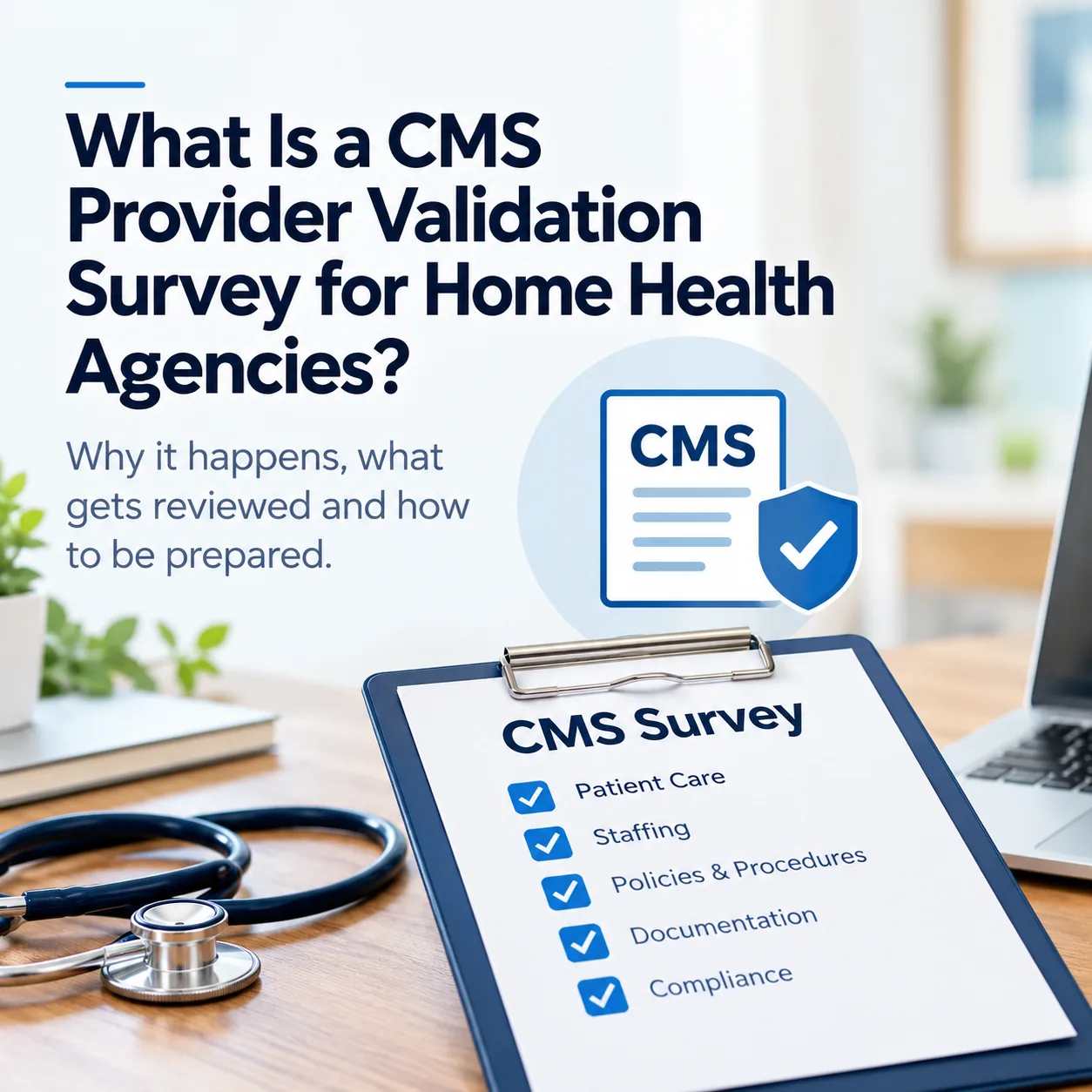
What Is a CMS Provider Validation Survey for Home Health Agencies?
A CMS provider validation survey checks whether a deemed-status home health agency actually meets Medicare health and safety requirements. Here is what CMS reviews and how an HHA can stay ready.
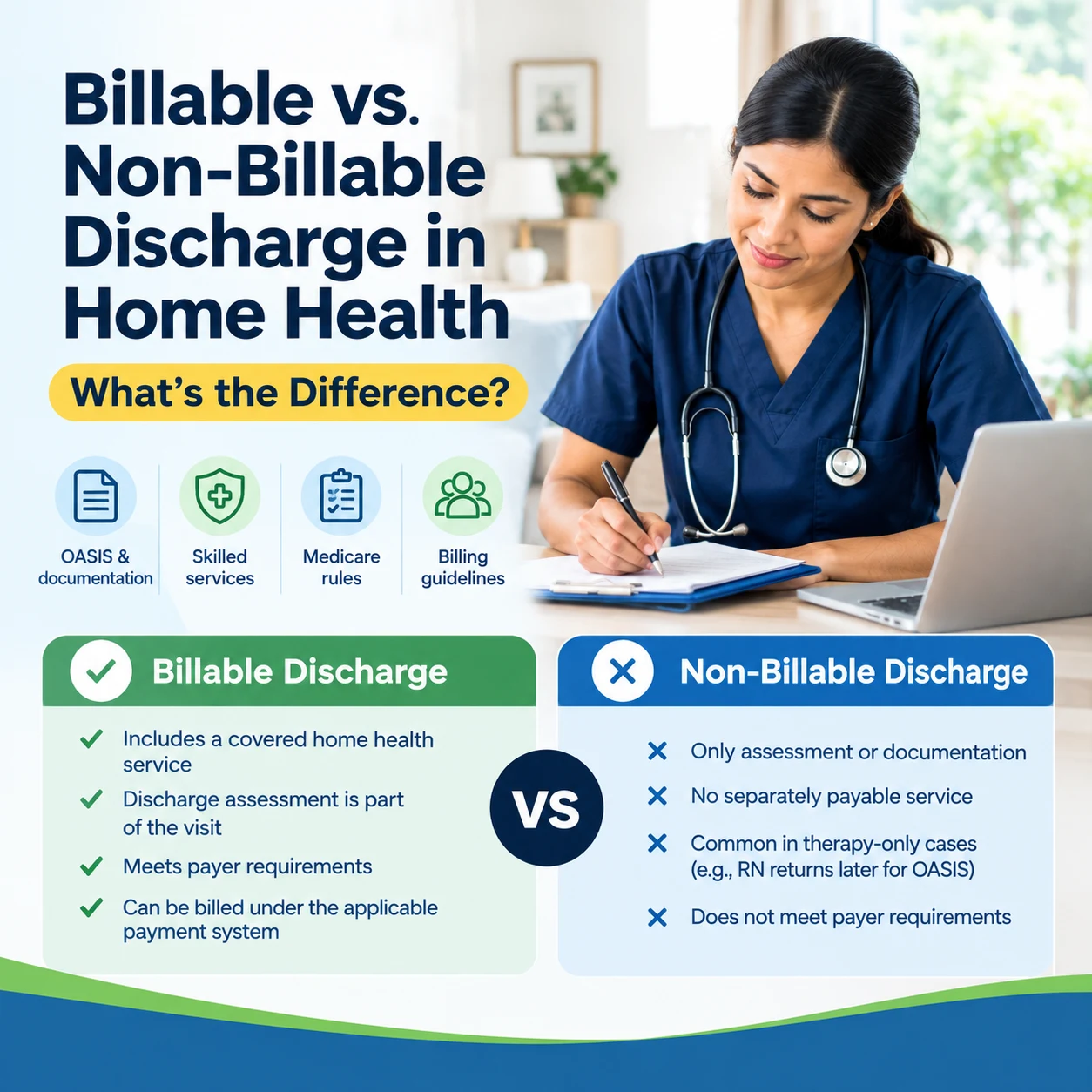
Billable vs. Non-Billable Discharge in Home Health: What's the Difference?
A discharge OASIS does not automatically make a home health visit billable. Learn how covered skilled services, payer rules, documentation, and the final clinician determine whether a discharge encounter may be payable.
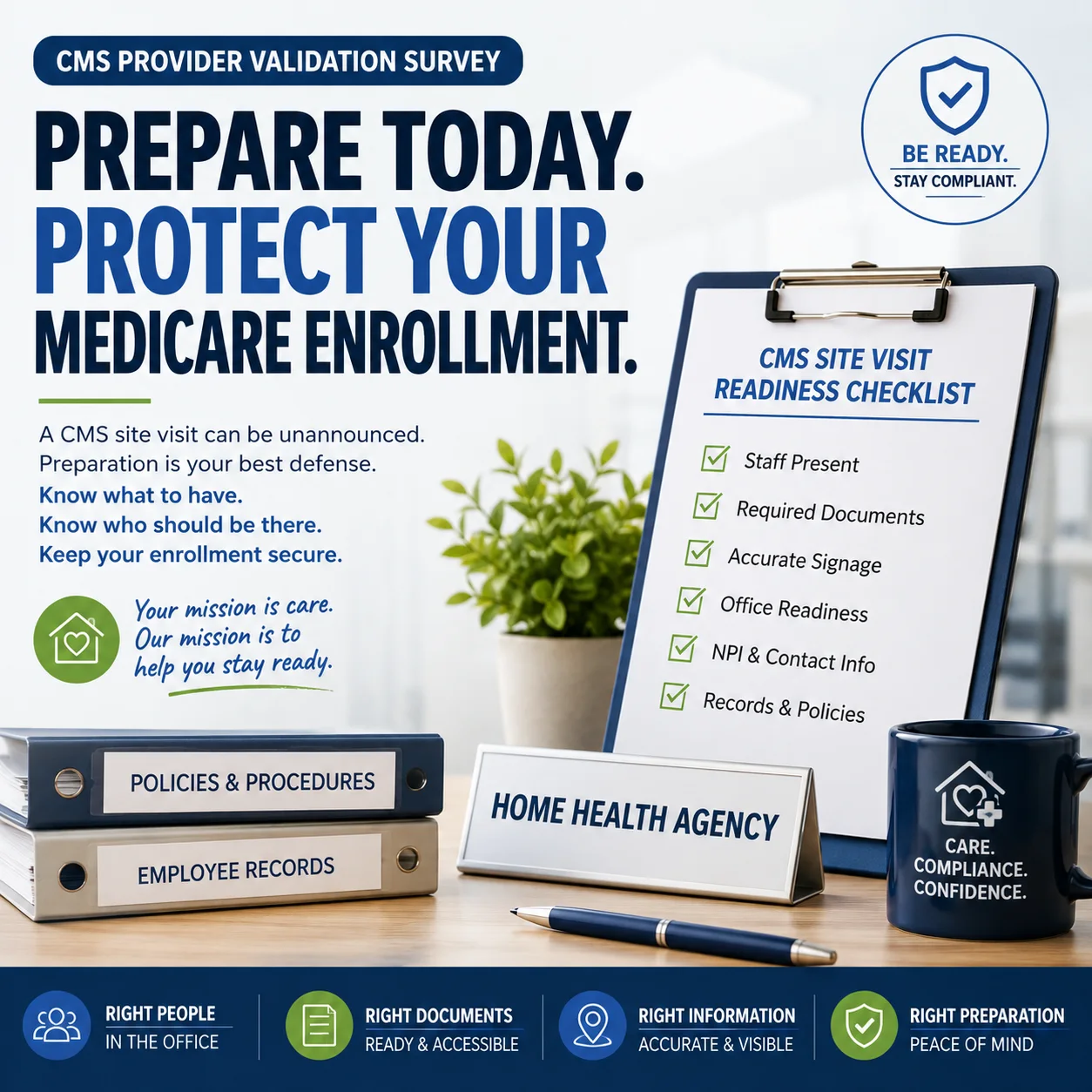
How Should Medicare Home Health Agencies Prepare for a CMS Provider Validation Survey?
A CMS provider enrollment site visit may be unannounced. Prepare your people, office, records, signage, and enrollment information before an inspector arrives.