Why Are Home Health Agencies Struggling With Documentation Backlogs?
A home health visit may last an hour. The documentation that follows can take considerably longer.
After seeing patients, clinicians still need to complete visit notes, update assessments, document changes in condition, reconcile medications, review care plans, and address missing information. Administrative teams may also be following up on unsigned orders, incomplete records, referral documents, and other outstanding paperwork.
When these tasks accumulate, the result is a documentation backlog.
For agencies, the consequences can extend beyond unfinished charts. Delayed documentation can slow billing and claims workflows, create additional work for quality assurance teams, make it harder to track patient progress, and increase pressure on clinicians.
Hiring more staff may seem like the obvious solution. But adding people does not necessarily fix inefficient workflows, repetitive data entry, or documentation processes that require information to be entered more than once.
The better starting point is to understand where the backlog comes from and remove the work that does not need to happen.
What Causes Documentation Backlogs in Home Health?
Documentation backlogs rarely come from one problem. They usually develop when several workflow issues combine.
Why Does Documentation Continue After the Patient Visit?
Clinicians often finish a visit with documentation still to complete. They may need to organize handwritten notes, recall details, enter observations into the EMR, complete required assessment fields, and make sure the narrative supports the clinical record.
When several visits are scheduled in one day, documentation can accumulate quickly.
Some clinicians finish their notes between visits. Others complete them after returning home or at the end of the day. Either way, unfinished documentation can become tomorrow's workload.
How Does Duplicate Data Entry Increase the Backlog?
Information may already exist in an agency's EMR, referral packet, medication list, or previous visit documentation. Yet staff may still need to locate it, review it, and enter relevant details into another section or document.
Repeatedly entering the same information creates unnecessary work and increases the possibility of inconsistencies.
A better workflow reuses available information where appropriate, while ensuring that clinicians verify its accuracy and relevance.
Why Do Incomplete Notes Create More Work for QA Teams?
A note may be saved but still require corrections.
Missing details, unclear descriptions, inconsistent information, or unanswered assessment fields can send documentation back to the clinician for review. Each correction creates another task for both clinical and administrative teams.
The backlog therefore includes more than notes that have not been started. It also includes documentation waiting for clarification, correction, review, or approval.
How Do Manual Follow-Ups Add to Administrative Work?
Agencies often need to track pending notes, unsigned orders, incomplete assessments, and records awaiting clinician action.
When these items are tracked through spreadsheets, emails, messages, or manual reminders, staff spend time finding out what is pending instead of resolving it.
Without a clear view of outstanding work, some items may be followed up repeatedly while others are overlooked.
How Can Staffing Pressure Make Documentation Delays Worse?
When teams are already managing full schedules, documentation competes with patient visits, coordination, and other responsibilities.
A few delayed notes can become a larger backlog when clinicians have limited time to catch up. Administrative staff then spend more time chasing records, and clinical leaders have less visibility into where support is needed.
How Can Home Health Agencies Reduce Documentation Backlogs Without Hiring More Staff?
Reducing a backlog does not always require additional headcount. Agencies can often make meaningful progress by improving how work is captured, assigned, reviewed, and completed.
Can Agencies Identify Which Documentation Tasks Are Causing the Most Delays?
Start by understanding where documentation gets stuck.
Review outstanding records and group them by status:
- Visit not documented.
- Draft started but not completed.
- Note completed but awaiting clinician approval.
- Note returned for correction.
- Assessment or required field incomplete.
- Order awaiting signature.
- Record awaiting administrative review.
Look for patterns. Are notes consistently delayed after a particular type of visit? Are clinicians spending too much time entering the same information? Are records frequently returned for the same missing details?
A backlog becomes easier to address when the agency can identify its actual causes rather than treating every pending record as the same problem.
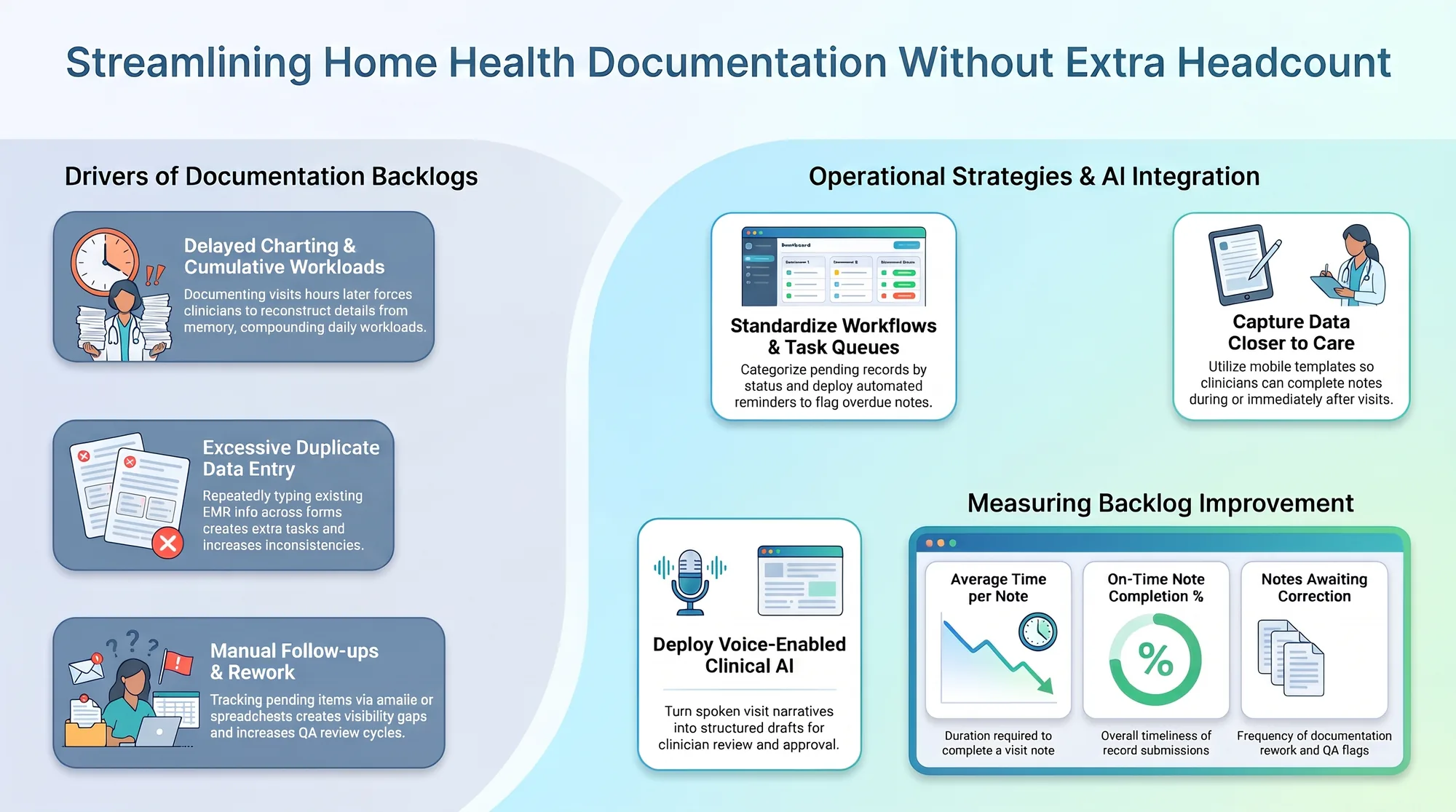
Most backlogs come from workflow friction, not headcount. Fix where records get stuck, then measure timeliness and quality together.
Can Documentation Be Completed Closer to the Time of Care?
Yes. One practical way to reduce backlogs is to make documentation easier to complete during or immediately after the visit.
When clinicians rely entirely on memory hours later, they may need extra time to reconstruct details and organize their notes.
Agencies can support timely documentation by:
- Making mobile documentation workflows easier to use.
- Reducing unnecessary navigation between screens.
- Providing clear templates and documentation expectations.
- Allowing clinicians to capture relevant observations during the visit.
- Making it easier to review and complete notes before moving on to the next task.
The goal is not to rush documentation. It is to reduce the amount of work clinicians must reconstruct later.
How Can Agencies Reduce Duplicate Data Entry?
Review where information is being entered more than once.
For example, if vital signs or relevant patient information are already documented in the EMR, staff should not have to re-enter them unnecessarily when that information can be accessed and reused appropriately.
Agencies should look for opportunities to:
- Reuse verified patient information.
- Pull relevant details from existing records where supported.
- Reduce repeated entry across forms.
- Standardize how information moves between workflows.
- Avoid copying information without checking whether it is current and relevant.
The important distinction is that information reuse should not replace clinical verification. Clinicians must still confirm that the information accurately reflects the current visit.
Can Agencies Standardize Documentation Workflows?
Yes. Consistent workflows make it easier for clinicians, QA teams, and administrators to understand what needs to happen next.
Agencies should establish clear expectations for:
- When visit notes should be completed.
- Which information must be documented.
- Who reviews and approves each record.
- How incomplete notes are returned for correction.
- How pending orders and assessments are tracked.
- When unresolved documentation issues are escalated.
Standardization does not mean every patient receives identical documentation. It means the process for completing and reviewing documentation is clear and consistent.
How Can Automated Reminders Help Clear Pending Documentation?
Manual follow-ups consume time, particularly when staff have to check multiple systems to identify overdue items.
Automated reminders and work queues can help agencies identify pending documentation and notify the appropriate person.
For example, a workflow may flag:
- Notes that remain incomplete.
- Records awaiting clinician approval.
- Documentation returned for correction.
- Orders awaiting signature.
- Items that have remained pending beyond the agency's defined timeframe.
Automation should make outstanding work visible and easier to manage. It should not replace clinical review or assume that a reminder means the underlying issue has been resolved.
How Can AI Help Reduce Home Health Documentation Backlogs?
AI can help reduce the manual effort involved in creating, organizing, and reviewing documentation.
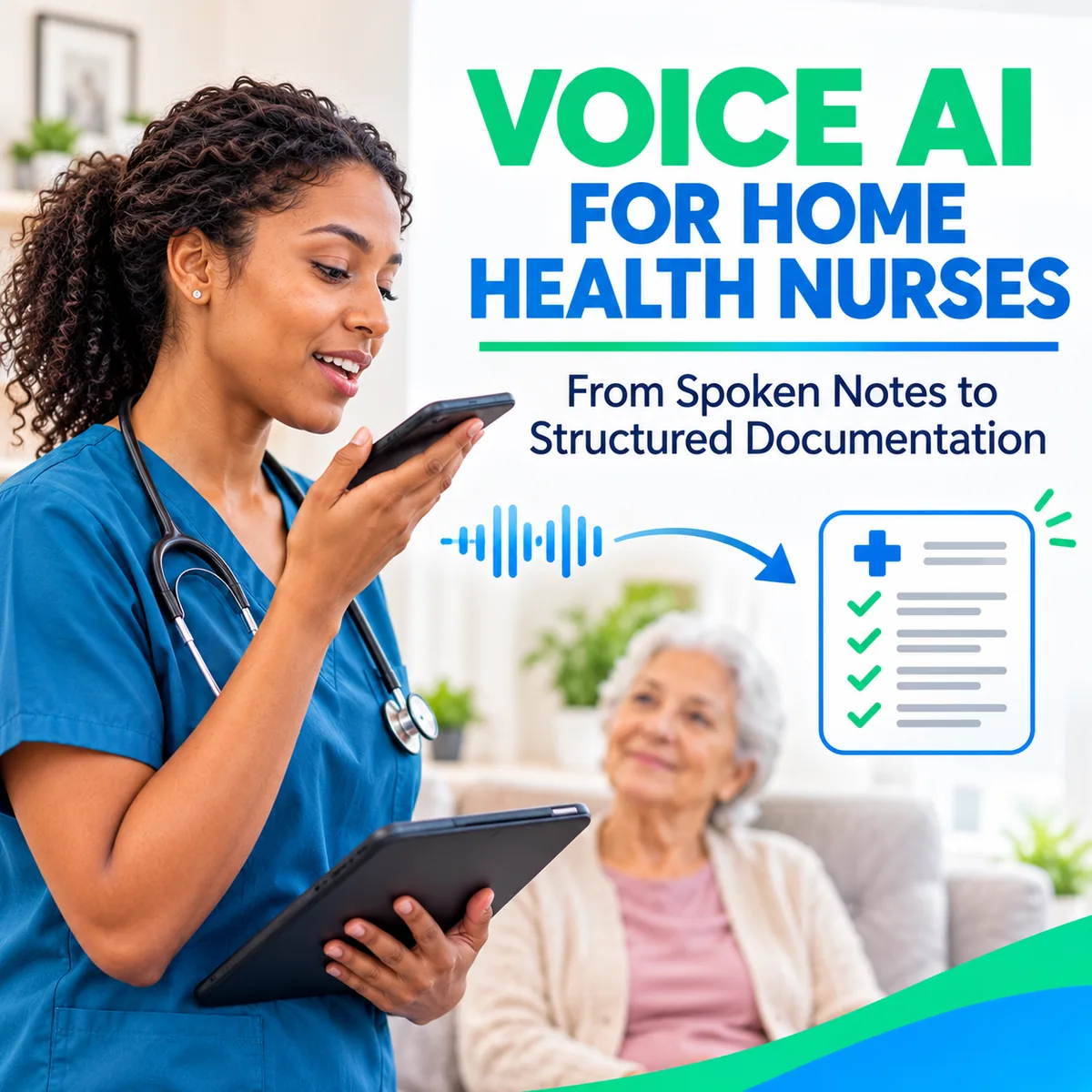
Instead of asking clinicians to type every detail from scratch, voice-enabled AI can turn spoken visit narratives into structured documentation drafts. Other AI-supported workflows can help organize information from existing records and identify items that may need attention.
The value depends on how well the technology fits the agency's existing processes.
How Does Voice AI Help Clinicians Complete Visit Notes?
Voice AI allows clinicians to describe a visit in natural language rather than typing every detail.
For example, a nurse might describe the patient's general condition, vital signs, wound observations, medication concerns, interventions, and education provided.
The AI processes the spoken information and organizes it into a structured draft. The clinician can then review the content, correct inaccuracies, add missing details, and approve the documentation.
This can reduce the effort involved in turning visit observations into written notes.
However, voice AI is not simply speech-to-text. A useful clinical workflow must account for medical terminology, context, structured documentation requirements, and the need for clinician oversight.
Can AI Help Reduce Repeated Documentation Work?
AI-supported workflows may help organize relevant information already available in the patient's record.
For example, where an integration supports it, an AI tool may retrieve existing EMR documentation and use relevant details to prepare a clinical summary.
This can reduce repeated data entry and help clinicians work with information already recorded.
The agency should confirm that the technology supports its EMR and workflow, and that reused information is reviewed for accuracy before it becomes part of the final record.
Can AI Help Identify Incomplete Documentation?
AI can also support documentation review by flagging missing information, inconsistencies, or sections that may need attention.
For example, a system may identify that a required field has not been addressed or that two parts of a draft appear inconsistent.
These flags should guide the clinician or reviewer. They should not be treated as clinical decisions or proof that a record is complete.
The clinician remains responsible for verifying the documentation and approving the final record.
How Does Copper AI Help Home Health Agencies Reduce Documentation Backlogs?
Copper AI is designed to help home health agencies reduce the administrative work surrounding clinical documentation without requiring them to replace their existing EMR workflows.
One of its voice-enabled agents, Joy, allows clinicians to describe a patient visit conversationally. Instead of starting with a blank page and typing every detail, the clinician can speak through the visit and let Joy organize the information into a structured documentation draft.
The clinician then reviews the draft, makes corrections where needed, and approves it. Copper AI does not remove the clinician's responsibility for the accuracy or approval of the documentation.
Copper AI also supports Spanish spoken input converted into English documentation, helping agencies accommodate clinicians who prefer to communicate verbally in Spanish.
Where supported by the agency's workflow and EMR integration, Copper AI can also work with information already entered in the patient's record, helping reduce unnecessary duplicate entry.
The objective is straightforward: make documentation easier to complete, reduce repetitive administrative work, and give clinicians more time to focus on patient care.
How Should Agencies Measure Whether Their Documentation Backlog Is Improving?
A reduction in the number of pending notes is useful, but agencies should look beyond the backlog total.
Track a few practical measures before and after workflow changes:
| Metric | What it helps measure |
|---|---|
| Average time to complete a visit note | How much time documentation takes |
| Percentage of notes completed on time | Whether documentation is becoming more timely |
| Number of notes awaiting correction | How often records need rework |
| Average time records remain pending | How long documentation stays unfinished |
| After-hours documentation time | Whether work is following clinicians home |
| Duplicate data-entry frequency | How much repetitive work remains |
| Clinician feedback | Whether the workflow is actually easier to use |
Review these measures regularly. A process that reduces pending notes but increases correction rates may not be solving the underlying problem.
The objective should be to improve both timeliness and documentation quality.
What Should Home Health Agencies Avoid When Trying to Clear a Documentation Backlog?
When a backlog becomes urgent, agencies may be tempted to focus only on getting records completed quickly. That can create new problems.
Avoid:
- Pressuring clinicians to complete notes without adequate review.
- Copying information from previous records without verifying it.
- Treating saved drafts as approved documentation.
- Using automation to make clinical decisions.
- Introducing new tools that require unnecessary changes to established workflows.
- Measuring success only by the number of closed records.
A faster process is useful only when documentation remains accurate, complete, and appropriately reviewed.
Can Home Health Agencies Reduce Documentation Backlogs Without Increasing Headcount?
Yes. Agencies can often reduce documentation backlogs by addressing workflow inefficiencies before adding more staff.
The most effective approach combines better visibility into pending work, consistent documentation processes, less duplicate data entry, timely follow-ups, and technology that reduces repetitive tasks.
AI can support this effort by helping clinicians turn spoken observations into structured drafts and by organizing information that would otherwise require manual effort. But technology should support the clinical team, not bypass its judgment.
Home health agencies do not simply need more people entering information. They need workflows that make it easier for the people they already have to complete documentation accurately and on time.
Care should happen in the home, not be followed by hours of charting at home.