Nurses are already finding ways to use artificial intelligence to make their work easier. They may use an AI chatbot to organize information, summarize lengthy text, draft a message, or simplify repetitive documentation tasks.
But what happens when those tools have not been approved by their healthcare organization?
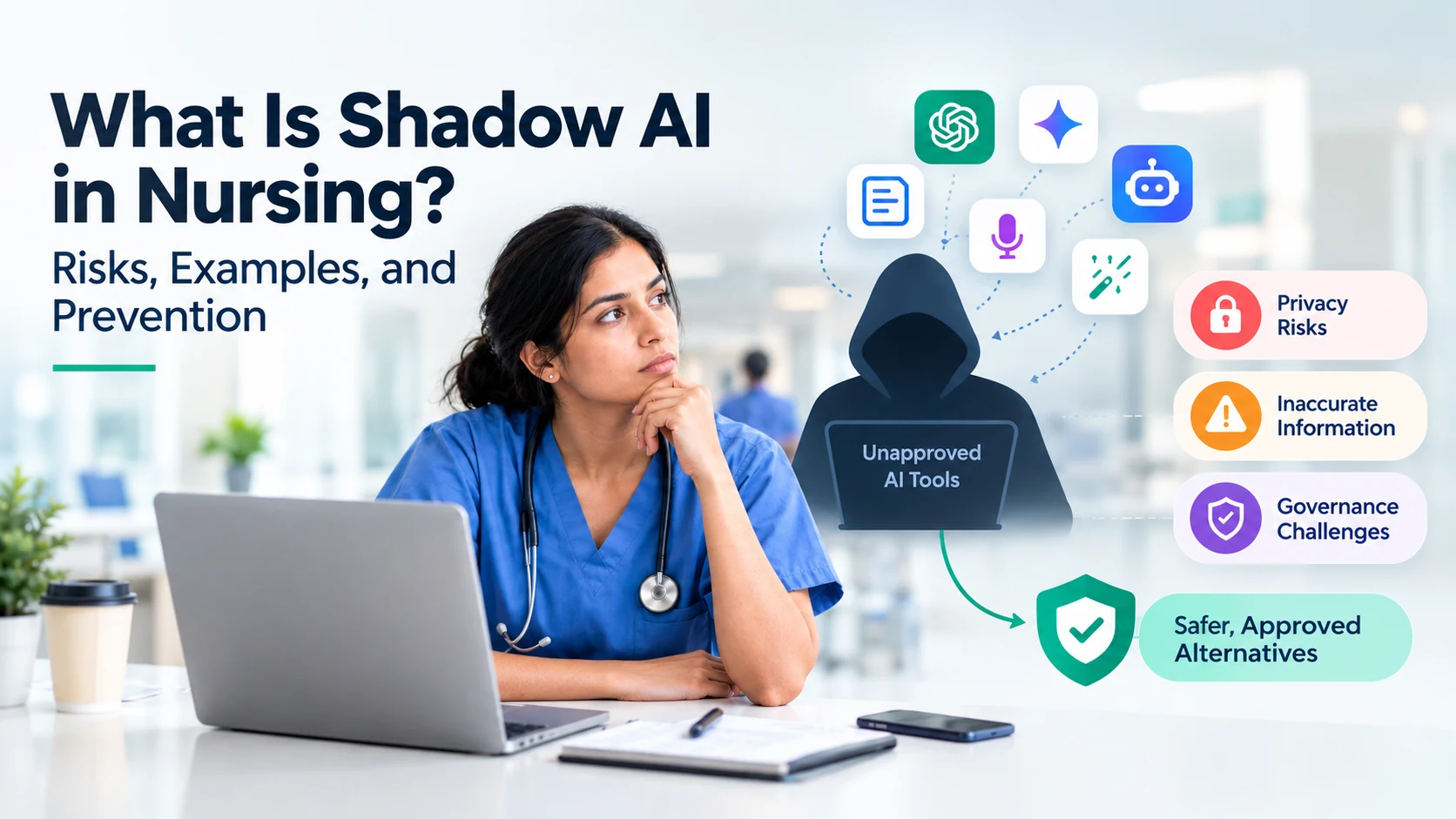
This is known as shadow AI in nursing. It refers to the use of AI tools outside an organization’s approved processes, policies, or oversight.
The issue is bigger than which applications nurses use. Unapproved tools can create patient privacy risks, introduce inaccurate information into clinical workflows, and make it harder for healthcare leaders to understand how AI is being used.
At the same time, nurses may turn to these tools because they are under pressure to complete documentation, manage administrative work, and spend more time with patients.
Addressing shadow AI requires more than telling staff not to use AI. Healthcare organizations need to understand why it is happening, establish practical safeguards, and provide approved alternatives that fit the realities of clinical work.
What Is Shadow AI in Nursing?
Shadow AI in nursing is the use of artificial intelligence tools by nurses or nursing teams without the appropriate approval, oversight, or governance of their healthcare organization.
These tools may include public AI chatbots, transcription applications, AI note generators, summarization tools, or features built into existing software that have not been reviewed through the organization’s approval process.
For example, a nurse might use a personal AI account to summarize a lengthy clinical document because the approved systems do not offer that functionality.
The nurse may intend to save time, not bypass security controls. However, the tool could process sensitive information in ways the organization has not assessed.
Shadow AI can occur in hospitals, outpatient clinics, long-term care facilities, and home health agencies.
It can also be difficult to detect. Unlike a formally implemented clinical application, an employee’s personal AI account may not be visible to the organization’s IT or compliance teams.
What Are Examples of Shadow AI in Nursing?
Shadow AI can appear in both clinical and administrative work.
Common examples include:
- Clinical documentation: Pasting visit notes into an unapproved AI chatbot to create a summary.
- Transcription: Using a personal AI application to transcribe patient conversations.
- Patient communication: Asking an unapproved tool to draft discharge instructions or patient messages.
- Clinical research: Using a public chatbot to interpret medical information without an approved process for verification.
- Administrative tasks: Summarizing reports, preparing handover notes, or organizing shift information with an unapproved tool.
- Care planning: Using AI-generated suggestions to help prepare a care plan without checking them against patient-specific information and organizational protocols.
- Embedded AI features: Using a newly introduced AI feature in an existing application before the organization has reviewed its data handling and intended use.
Not every use of AI is shadow AI. If an organization has approved a tool for a defined purpose and the nurse follows the applicable policies, that use falls within the approved workflow.
The important distinction is whether the tool and its use have been appropriately reviewed and authorized.
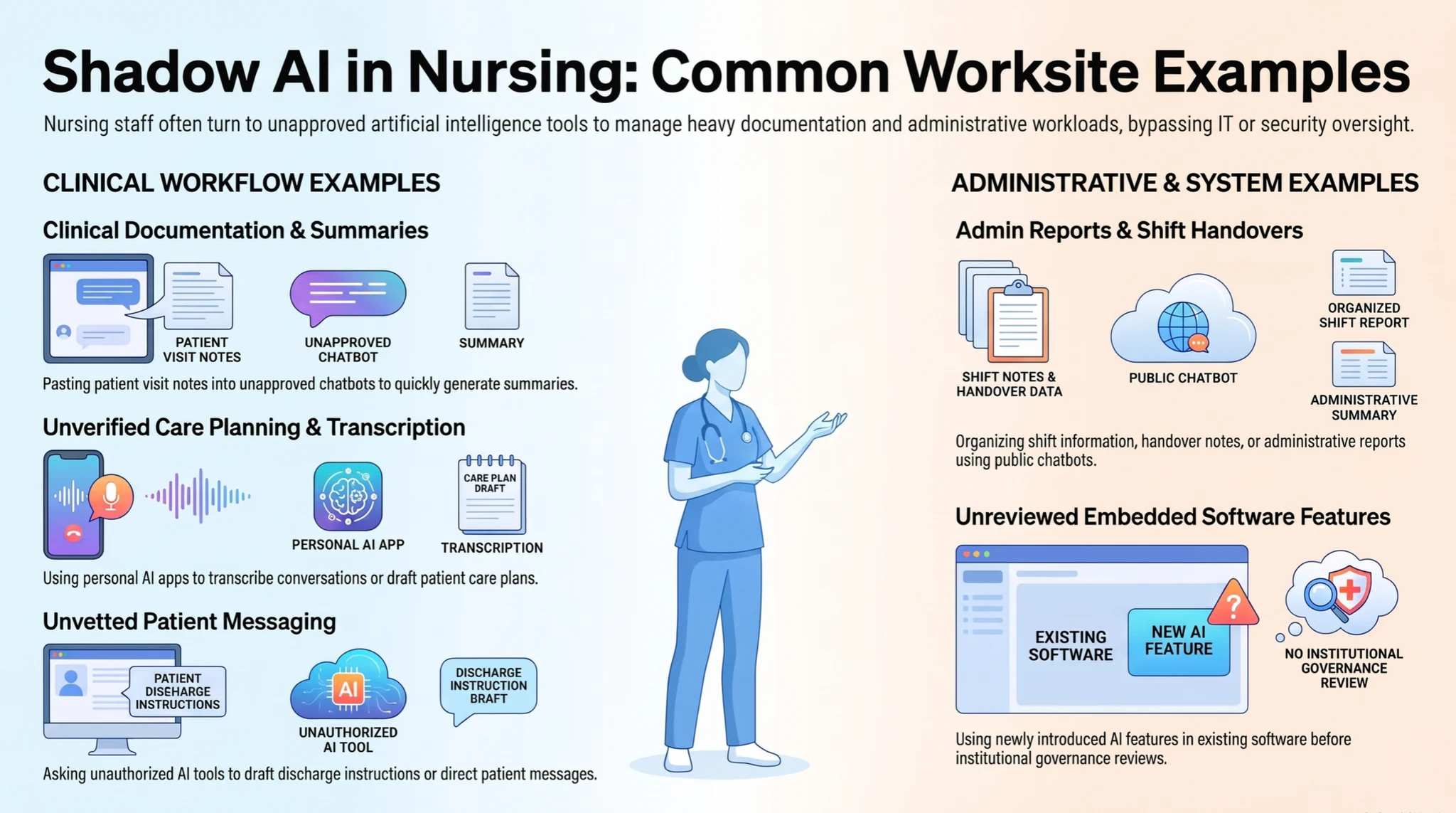
Illustrative examples of AI use outside an organization’s approved processes. Whether a use is authorized depends on the tool, task, and applicable organizational policies.
Why Are Nurses Using AI Tools Without Hospital Approval?
Shadow AI often develops because the work needs are already there, while approved solutions may be limited, difficult to access, or unavailable.
Nurses may be looking for ways to reduce repetitive work, organize information, and complete documentation more efficiently.
Common reasons include:
- Documentation pressure: Clinical notes and administrative requirements can extend beyond patient-facing work.
- Limited approved options: Staff may not have access to an AI tool that addresses their specific task.
- Convenience: Public AI tools are easy to access and often require little setup.
- Time constraints: Nurses may be looking for faster ways to complete routine administrative tasks.
- Unclear policies: Staff may not know which AI tools are permitted or what information they can safely enter.
- Limited training: Employees may understand how to use a chatbot but not how its data handling, limitations, or retention policies work.
- Bottom-up experimentation: Nurses may discover a useful workflow before their organization has evaluated whether it can be adopted safely.
These reasons do not make unapproved use automatically acceptable. They do, however, help explain why restrictive policies alone may not solve the problem.
Healthcare leaders should examine whether the organization has provided safe, usable alternatives for the tasks staff are trying to complete.
What Are the Risks of Shadow AI in Nursing?
The risks depend on the tool, the information entered, the intended use, and how the output is used.
How Can Shadow AI Put Patient Privacy at Risk?
A nurse who enters identifiable patient information into an unapproved AI service may expose sensitive data to a system that has not been assessed for the organization’s privacy and security requirements.
Depending on the service and its terms, information may be stored, retained, processed by third parties, or handled in ways that differ from the organization’s expectations.
Healthcare organizations need to understand where information goes, who can access it, how long it is retained, and whether appropriate agreements and safeguards are in place.
Can Shadow AI Introduce Errors Into Clinical Documentation?
Yes. Generative AI can produce statements that sound plausible but are inaccurate, incomplete, or unsupported by the source information.
For example, a tool summarizing a nursing note might omit an important observation or introduce a detail that was never documented.
If the nurse copies the output into the clinical record without adequate review, the error can become part of the patient’s documentation.
AI-generated text should not be treated as verified clinical information simply because it reads well.
Can Shadow AI Affect Patient Safety?
It can, particularly when an unapproved tool is used to support clinical decisions, interpret patient information, or prepare instructions that influence care.
Potential problems include missing context, incorrect recommendations, outdated information, and outputs that do not align with the patient’s current condition.
The level of risk depends on the task. Summarizing a general administrative announcement is different from generating patient-specific clinical guidance.
Why Does Shadow AI Create Governance Problems?
When AI use happens outside approved systems, organizations may not know which tools are being used, what information they process, or how their outputs influence clinical work.
This can make it harder to investigate an incident, assess the accuracy of generated content, apply consistent policies, and determine who is responsible for different parts of a workflow.
Without appropriate visibility, an organization may underestimate how much AI is already influencing its operations.
Is Using ChatGPT for Nursing Documentation Allowed?
There is no single answer that applies to every organization or every use of ChatGPT.
Whether a nurse can use a particular AI tool depends on organizational policy, the intended task, applicable professional requirements, and the tool’s approved data-handling arrangements.
A nurse using a public chatbot to rewrite a general, non-confidential email presents a different situation from a nurse entering identifiable patient details to generate a clinical note.
Before using ChatGPT or another AI assistant for nursing documentation, staff should establish:
- Whether the organization permits the tool for that purpose.
- Whether patient information may be entered into it.
- Whether the service has undergone the required privacy and security review.
- Whether appropriate contractual safeguards are in place when required.
- Whether the generated content must be reviewed, corrected, and approved before use.
- Whether the workflow preserves required documentation and audit records.
Nurses should not assume that removing a patient's name automatically makes clinical information safe to share. Combinations of details may still identify an individual.
When approval is unclear, the safer course is to check with the organization’s designated IT, privacy, compliance, or clinical leadership team before using the tool with patient information.
Does Shadow AI Violate HIPAA?
Not every use of an unapproved AI tool automatically constitutes a HIPAA violation. The outcome depends on the information involved, the parties handling it, the applicable safeguards, and the circumstances of its use.
However, entering electronic protected health information into a service that has not been appropriately assessed can create significant compliance and privacy risks.
Under HIPAA, covered entities and business associates must meet applicable requirements for protecting electronic protected health information. HHS guidance explains that cloud service providers handling such information may have obligations under the HIPAA Rules, including in circumstances where the provider cannot view the encrypted data.
Healthcare organizations should assess the actual service, its contractual arrangements, security controls, data retention, access, and permitted uses. A vendor’s general claim that its product is secure is not a substitute for that assessment.
For nursing teams, practical safeguards include:
- Do not enter identifiable patient information into unapproved AI tools.
- Use only services authorized for the intended task.
- Follow the organization's privacy, security, and documentation policies.
- Report suspected exposure of patient information through established incident channels.
- Ask for guidance when a tool's data-handling practices are unclear.
Organizations should review applicable requirements with their privacy and compliance professionals rather than relying on a blanket rule that all AI use is either prohibited or safe.
Who Is Responsible When a Nurse Uses an Unapproved AI Tool?
Responsibility depends on the circumstances, including the nurse’s role, organizational policies, the nature of the task, and the consequences of the use.
A nurse may have professional obligations to protect patient information and follow applicable documentation requirements. The organization is responsible for establishing appropriate policies, training, oversight, and reporting processes. Technology vendors may have contractual or other responsibilities relating to their products and services.
These responsibilities are not interchangeable.
For example, if a nurse enters patient information into an unapproved public chatbot, the organization may need to investigate both the individual action and the conditions that allowed it to occur.
Questions to consider include:
- Was the policy clear and accessible?
- Had the nurse received relevant training?
- Was an approved alternative available?
- Did the tool process sensitive information?
- Did the AI-generated output enter the clinical record?
- Did the organization have a process for reporting and investigating the incident?
The purpose of an investigation should be to establish what happened, meet applicable reporting obligations, protect patients, and prevent recurrence.
Accountability should be based on the facts, not assumptions about why someone used the tool.
How Can Hospitals Prevent Shadow AI Without Discouraging Innovation?
Healthcare organizations need to manage risk without ignoring the practical reasons employees are experimenting with AI.
A policy that simply says “do not use AI” may not address the workflow problems that led staff to seek it out. A more effective approach combines clear boundaries with accessible, approved options.
What Should a Shadow AI Policy Include?
A useful policy should explain:
- Which AI tools are approved and for what purposes.
- What categories of information may be entered into each tool.
- Which uses are prohibited or require additional review.
- How AI-generated clinical documentation must be checked.
- Who is authorized to approve new tools or use cases.
- How staff should report an error, privacy concern, or unapproved use.
- How approved tools and policies will be reviewed as technology changes.
The policy should be written in language that nurses can apply during a busy shift, not only in a lengthy technical document.
How Can Nurse Leaders Identify Unapproved AI Use?
Leaders can begin by asking staff what tools they use and which tasks they are trying to simplify.
Other steps may include reviewing software procurement, assessing AI features in existing applications, consulting IT and security teams, and using authorized technical controls to identify unapproved services where appropriate.
Monitoring should be proportionate, transparent, and consistent with organizational policies and applicable law.
The objective is to understand the organization's actual AI use, identify risks, and develop safer workflows.
Why Should Nurses Be Involved in AI Governance?
Nurses understand the practical demands of clinical work. They can identify where documentation is repetitive, where systems create unnecessary steps, and where an AI tool might introduce risks that are not obvious during a technical review.
Involving nurses in testing and governance can help organizations choose tools that are both useful and safe.
It also gives frontline staff a channel to raise concerns before informal workarounds become established.
How Can Healthcare Organizations Encourage Safe AI Adoption?
Safe AI adoption requires more than purchasing an approved application. The organization needs to establish how the tool fits into real work.
A practical approach includes:
- Identify the task. Understand what staff want AI to help them accomplish.
- Assess the risk. Determine whether the task involves patient information, clinical recommendations, or other sensitive activities.
- Evaluate the tool. Review security, privacy, accuracy, intended use, integration, and vendor arrangements.
- Test with frontline staff. Evaluate realistic scenarios, including missing information, conflicting records, and incorrect outputs.
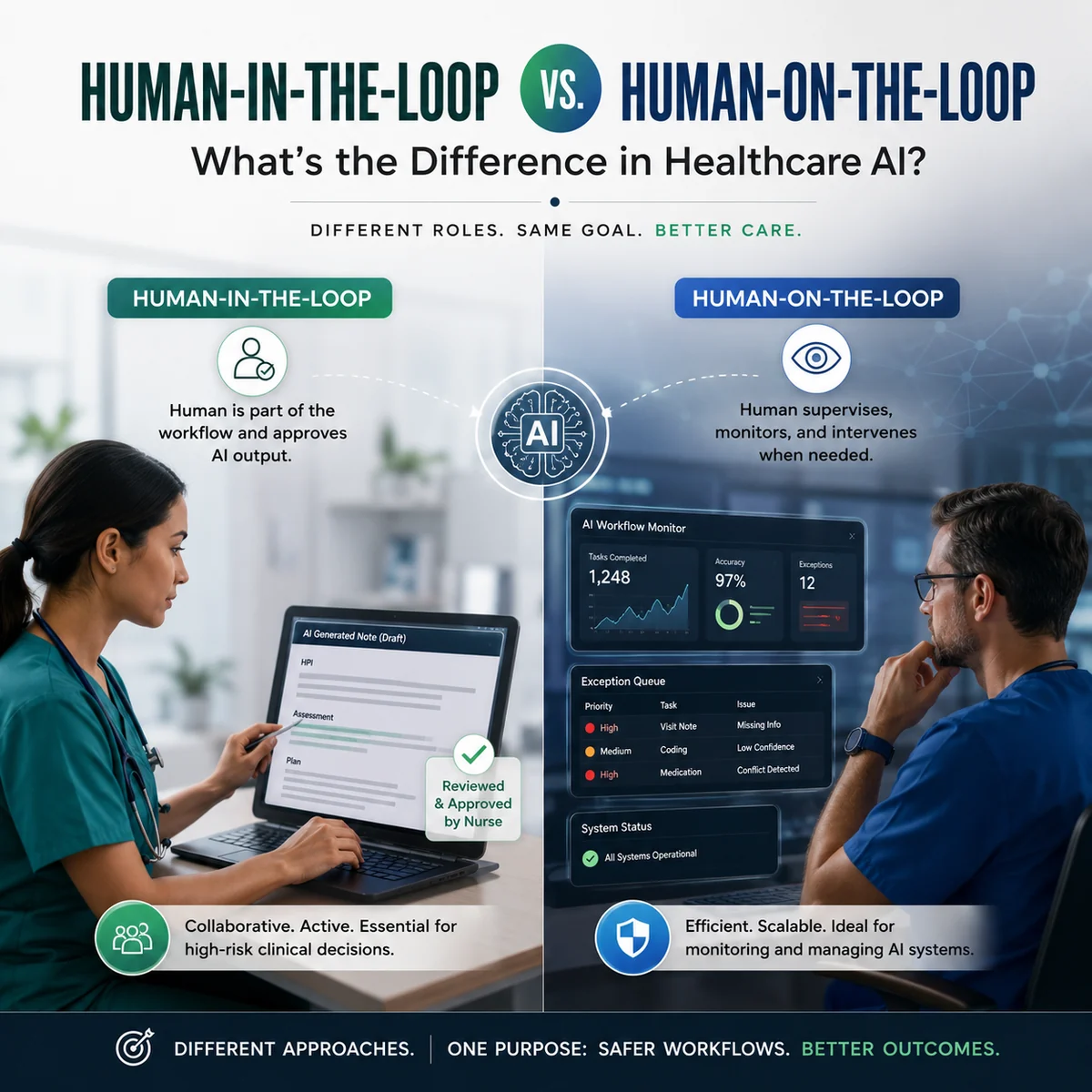
- Define human oversight. Make clear which outputs require review and who can approve or finalize them.
- Train users. Explain appropriate use, limitations, data handling, and incident reporting.
- Monitor performance. Review errors, staff feedback, and changes in how the tool is used.
- Update governance. Reassess the workflow when the tool, its features, or its intended use changes.
The National Institute of Standards and Technology's AI Risk Management Framework provides a voluntary framework organizations can use to structure AI risk management. Its Generative AI Profile offers additional guidance on risks specific to generative AI.
The appropriate controls will depend on the system and its use. A tool that helps organize non-sensitive administrative text does not necessarily require the same safeguards as a tool used to generate patient-specific clinical recommendations.
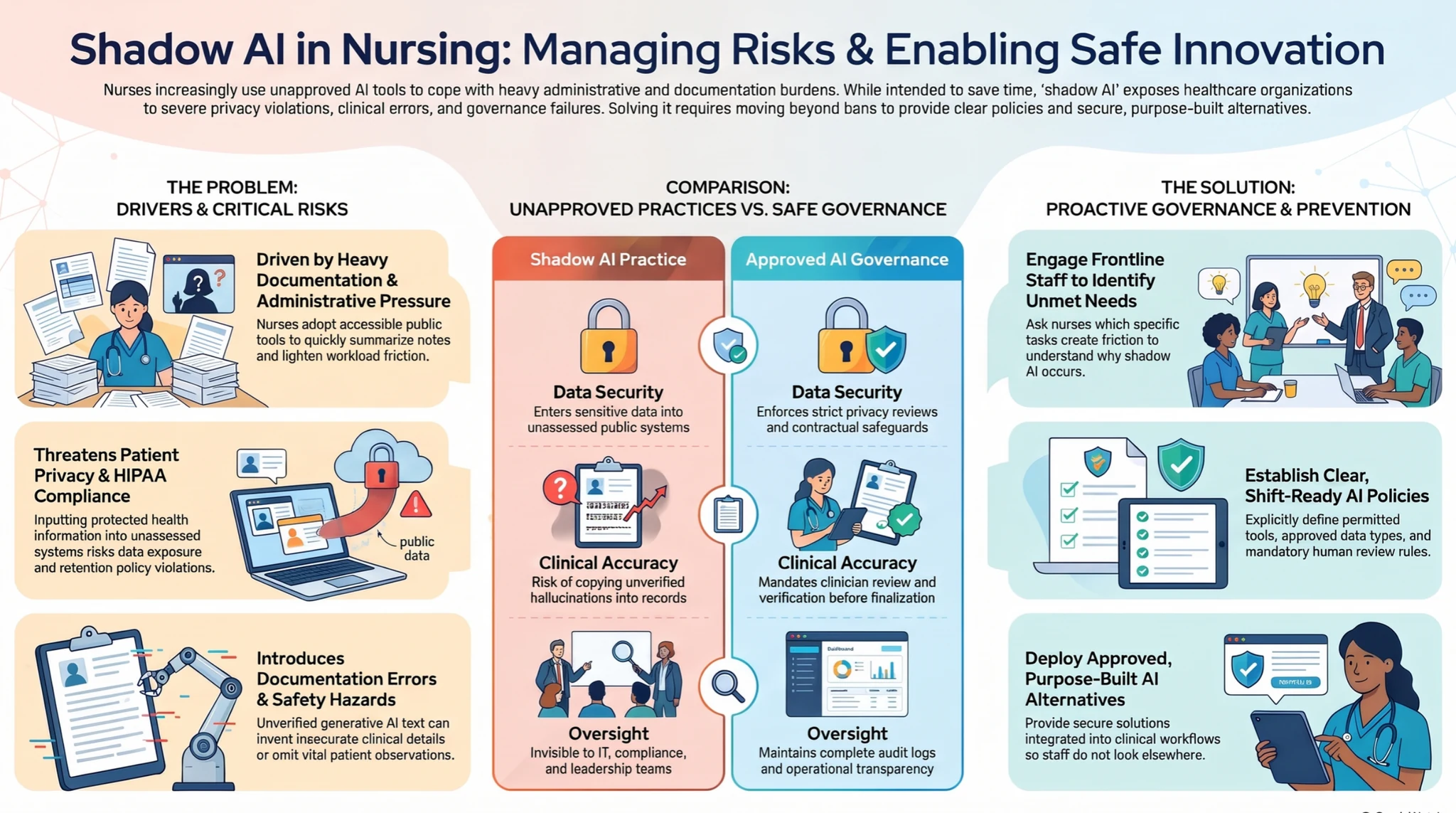
Risk-management considerations, not a finding that every unapproved AI use violates HIPAA. Safeguards and review requirements depend on the data, task, tool, and applicable obligations.
What Does Shadow AI Mean for Home Health Agencies?
Home health agencies face a distinctive workflow challenge. Nurses provide care in patients' homes and may complete documentation between visits, after returning home, or outside normal working hours.
When documentation demands compete with patient care, staff may look for ways to summarize visit information, draft notes, or organize administrative tasks more quickly.
That creates a potential setting for shadow AI.
A nurse might use a personal chatbot to turn rough notes into a visit summary. Another might try an unapproved transcription tool to reduce typing. An administrator might use a public AI service to organize referral information.
These workflows may appear convenient, but they can create risks if patient information is shared with an unapproved service or generated content is copied into a clinical record without appropriate verification.
Home health leaders should pay particular attention to:
- Visit documentation: Are AI-generated summaries accurate and supported by the nurse’s actual observations?
- Patient information: Are approved tools being used to process sensitive information?
- Clinical review: Can nurses inspect and correct generated content before it is finalized?
- Existing systems: Does the tool fit the agency’s EHR and documentation workflow?
- Field usability: Can nurses use the approved solution reliably while working across different locations?
- Accountability: Are responsibilities for review, approval, corrections, and incident reporting clearly defined?
An agency should not assume that an AI tool is suitable simply because it saves time. It should evaluate whether the tool supports the intended workflow, protects information, and gives clinicians appropriate control over the final record.
Can Purpose-Built AI Tools Help Reduce Shadow AI in Nursing?
Purpose-built AI tools can be part of the solution when they address a specific, documented need and are approved for the intended use.
For example, an organization that identifies clinical documentation as a major source of administrative burden might evaluate a tool designed for that workflow rather than expecting staff to use general-purpose chatbots.
The evaluation should consider whether the tool:
- Fits the existing clinical workflow.
- Has been reviewed for applicable privacy and security requirements.
- Clearly identifies generated content.
- Supports appropriate clinician review and approval.
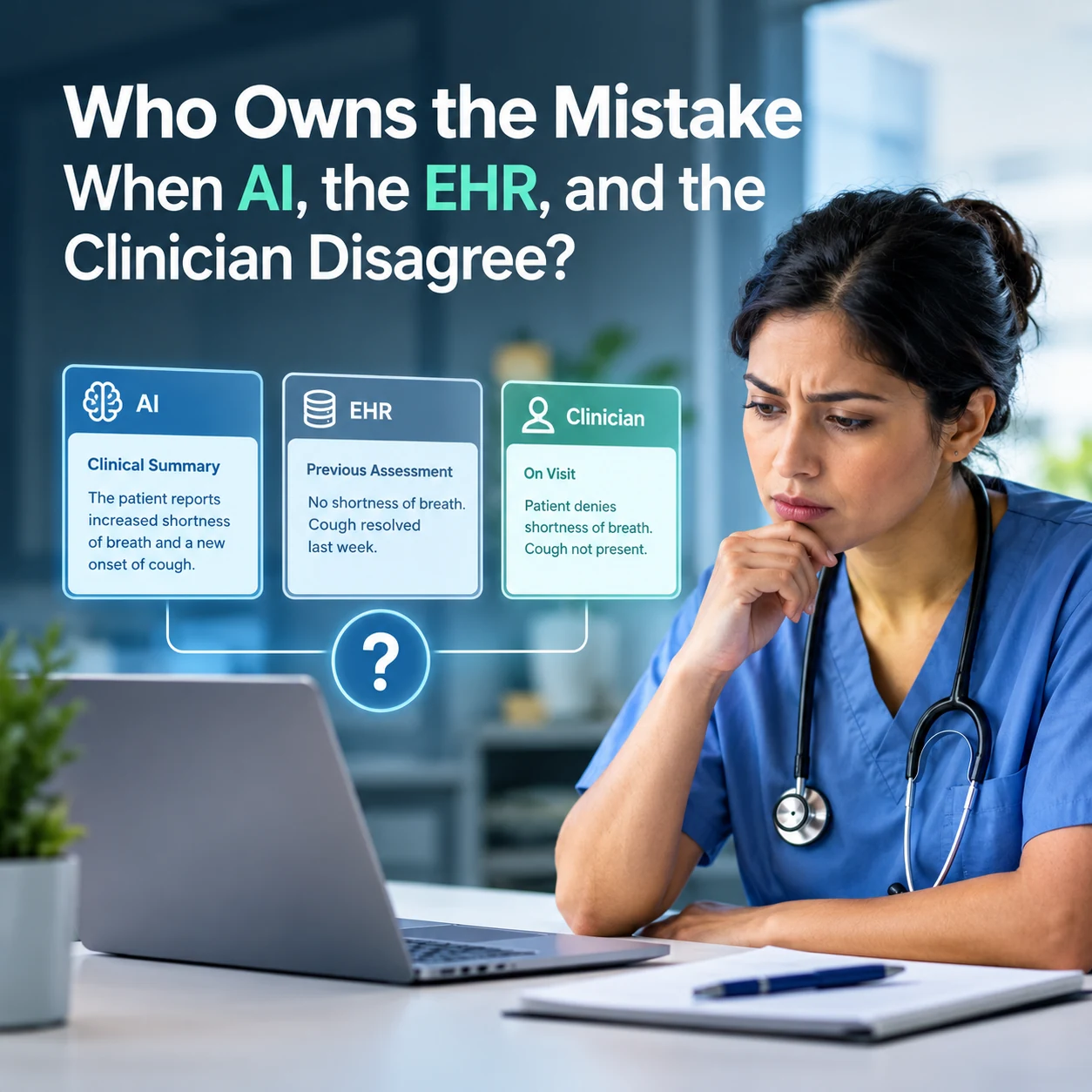
- Handles incomplete or conflicting information safely.
- Provides the records and logs needed for oversight.
- Has a defined process for reporting and resolving errors.
For home health agencies, Copper AI is one example of a solution focused on documentation and administrative workflows. As with any technology, an agency should evaluate its capabilities, security arrangements, intended use, and fit with its own requirements before deployment.
The broader principle is that approved AI should solve a real operational problem. If a tool is difficult to access or does not fit the work, staff may continue looking elsewhere.
What Should Nursing Leaders Do First About Shadow AI?
Nursing leaders do not need to begin with a large technology program. They can start by understanding what is already happening.
A practical first step is to ask nurses and administrators three questions:
- Which repetitive tasks are you trying to make easier?
- Are you currently using AI tools to help with those tasks?
- What would an approved, safe alternative need to do to fit your workflow?
The answers can help leaders distinguish between risky practices, unmet workflow needs, and opportunities for responsible adoption.
From there, organizations can review existing policies, assess the tools staff are using, prioritize the highest-risk situations, and test approved alternatives with the people who will use them.
The goal is not to eliminate curiosity about AI. It is to make sure that experimentation does not expose patients, clinicians, or the organization to avoidable risks.