
Why Healthcare Teams Don't Adopt AI Even When They Know They Need It
Explore why change fatigue, trust, fear of errors, training, ownership, and workflow design can prevent healthcare teams from adopting AI.
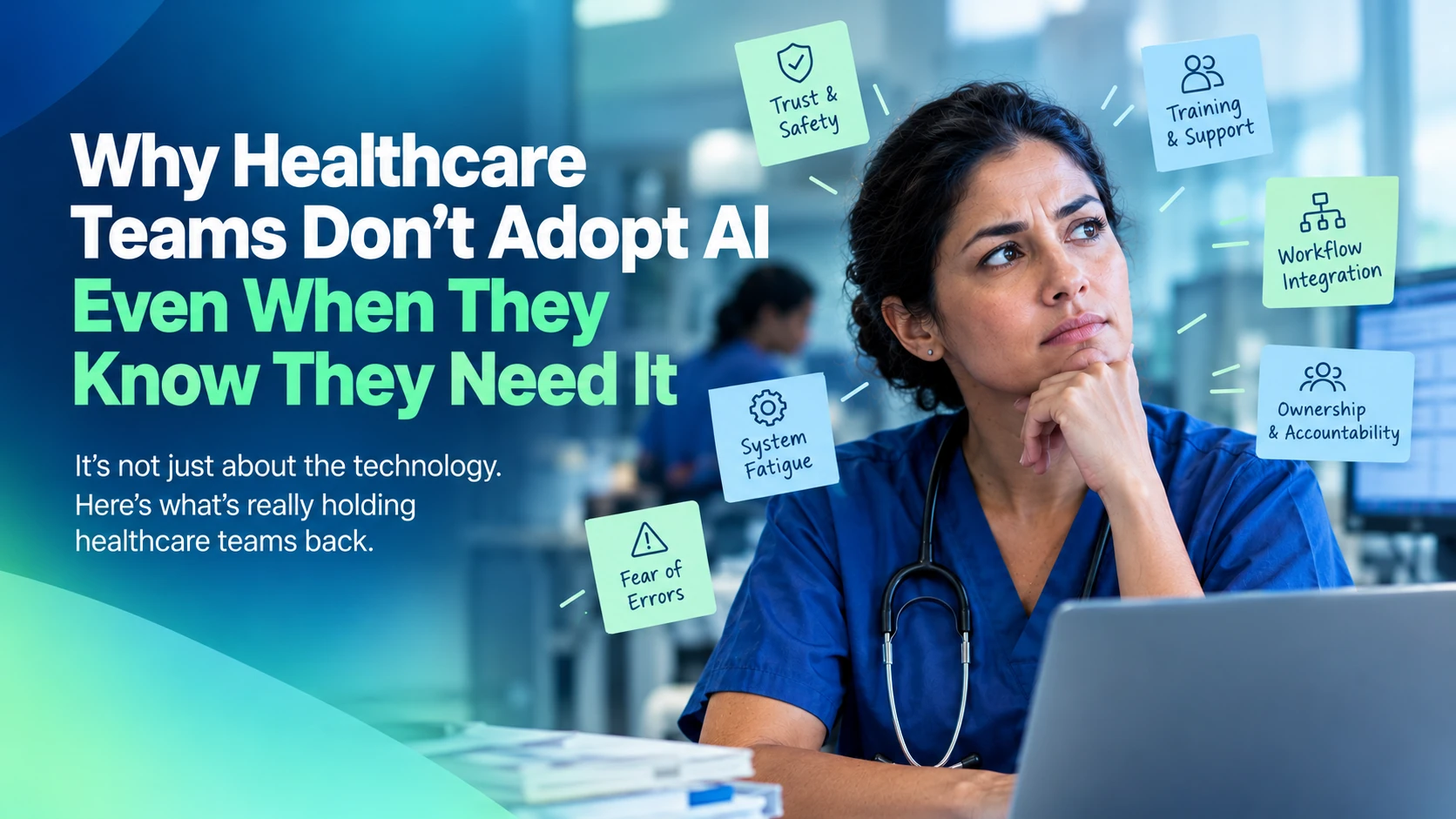
Key Takeaways
- What looks like resistance may reflect real concerns about workload, accuracy, and accountability.
- Build trust by making AI outputs reviewable, correctable, and clear about their limitations.
- Train people around their actual tasks and define who owns decisions, exceptions, and improvements.
- Redesign the whole workflow so AI removes work instead of adding another step.
- Measure completion time, rework, quality, and frontline feedback, not just logins or generated drafts.
Sometimes the person resisting your AI tool is the person who understands its risks better than anyone in the room.
That is worth thinking about.
Healthcare organizations know they need to reduce administrative work, improve efficiency, manage staffing pressures, and give clinicians more time for patients. AI appears to offer a way forward.
Yet adoption often stalls.
A tool gets introduced. A few people try it.
Training sessions happen. Leadership expects the team to start using it regularly.
Then usage drops. Staff return to familiar processes.
The organization starts wondering why people are resisting a technology that was supposed to make their jobs easier.
But what if resistance is not the real problem?
What if the people expected to use the technology are responding to issues that the implementation team has overlooked?
AI adoption in healthcare is not just about whether a tool works. It is about whether people can trust it, understand it, fit it into their work, and use it without taking on new risks or responsibilities.
Why Do Healthcare Teams Resist AI Even When They Know They Need It?
Healthcare teams are not necessarily opposed to technology. Many have spent years adapting to new systems, updated regulations, changing documentation requirements, and shifting operational priorities.
The challenge is that every new tool asks for something from them.
Time to learn it. Attention to understand it.
Effort to change existing habits. And, sometimes, the responsibility of correcting problems when the technology does not work as expected.
Imagine introducing an AI tool to help a home health nurse complete documentation faster.
The tool may generate a useful clinical summary. But if the nurse still has to enter the same information into another system, verify every field, correct missing details, and learn a separate workflow, the overall burden may not have changed much.
From the organization's perspective, AI has been implemented.
From the nurse's perspective, another task has been added.
That difference matters.
Before labeling a team resistant, organizations should ask a more useful question: What is making the new way of working harder than the old one?
How Does Change Fatigue Affect AI Adoption in Healthcare?
Healthcare workers rarely experience technology changes in isolation.
A new AI tool may arrive after an EHR update, a revised documentation process, a staffing change, or another operational initiative. Even when each change has a reasonable purpose, the cumulative effect can be exhausting.
People must remember new steps, learn new interfaces, and figure out which process takes priority when instructions conflict.
Over time, teams may become skeptical of announcements that a new tool will simplify their work.
They have heard the promise before.
This skepticism is not always a judgment on the technology itself. It may be a response to previous implementations that created more work than they removed.
Organizations can address change fatigue by being specific about what will change and what will not.
Instead of announcing a broad AI transformation, explain which task is changing, which existing steps will disappear, how much training is required, and where staff can get help.
It is also important to avoid introducing too many workflow changes at once. A focused implementation that solves one persistent problem can be more useful than a large rollout that asks everyone to change everything.
Why Is Trust More Important Than AI Features in Healthcare?
An AI tool can demonstrate impressive capabilities and still struggle to earn a place in everyday clinical work.
That is because healthcare professionals need to understand not just what the system can do, but also when its output can be trusted and when it needs to be questioned.
A generated summary might omit an important detail. An extracted medication could be incorrect because the source document was unclear.
A suggested response might not reflect the patient's actual circumstances.
These are not merely product issues. They affect how people make decisions and carry responsibility for their work.
Trust does not come from telling clinicians that an AI model is accurate. It comes from making the system's behavior understandable and its output reviewable.
Healthcare teams need to know:
- What information did the AI use?
- What can the system generate, change, or recommend?
- Where are its limitations?
- How can staff correct an error?
- Who reviews the output before it is used?
- What happens when the system is uncertain?
For clinical documentation, for example, AI can help organize information and prepare a draft. The clinician should be able to review it, correct it, and retain responsibility for the final documentation and any required submission.
Trust grows when people can verify the work, not when they are asked to trust the technology blindly.
How Does the Fear of AI Errors Slow Down Adoption?
In healthcare, an error can have consequences beyond inconvenience.
Incorrect documentation, missing clinical information, or a poorly handled workflow can affect patient care, compliance, reimbursement, and the work of other team members.
The person who notices the risk may be the same person expected to use the tool.
Consider an intake coordinator reviewing a long referral packet. An AI system extracts the patient's information and flags missing documents.
But what happens if it misses a page containing an important instruction?
The coordinator may still be accountable for ensuring the referral is handled appropriately.
If the system's limitations are unclear, avoiding it may feel safer than relying on it.
This is why implementation teams need to distinguish between tasks that can be automated, tasks that require verification, and decisions that must remain with qualified people.
They should also define how errors are reported, investigated, corrected, and used to improve the process.
A useful question is not whether AI can make mistakes. It can.
The question is whether the organization has designed a workflow that identifies and handles those mistakes before they create unacceptable risk.
Why Does AI Training Often Fail to Change Everyday Behavior?
Many AI training sessions focus on product features.
Staff learn where to click, how to enter information, and how to generate an output. They may leave the session knowing how to operate the tool without understanding how it should fit into their actual responsibilities.
That gap becomes visible when they return to work.
What should they do if the AI output is incomplete? When should they correct it?
Which existing step can they skip? Who should they contact when something does not look right?
If the answers are unclear, staff may revert to the process they already know.
Effective training should therefore be built around real tasks rather than features alone.
For a home health agency, that could mean walking through an actual referral workflow: receiving a fax, identifying the required documents, reviewing extracted information, resolving missing details, and routing the referral to the right person.
For clinical documentation, it could mean showing how a nurse reviews an AI-generated draft, corrects it, and completes the required documentation steps.
Training should also reflect different roles. An intake coordinator, clinical manager, nurse, and IT administrator do not need the same instructions.
The objective is not simply to teach people how to use AI. It is to help them understand how to do their jobs with it.
How Does Unclear Ownership Create Problems During AI Implementation?
AI adoption often involves several groups: leadership, operations, clinical teams, IT, compliance, and the technology provider.
Each group may assume another is responsible for making the implementation successful.
Leadership approves the investment. IT handles access and integration.
The vendor demonstrates the product. Clinical staff is expected to use it.
But who owns the workflow when the AI output is wrong? Who decides whether a process is ready to change?
Who gathers feedback? Who resolves disagreements between the technology's behavior and the agency's requirements?
If those responsibilities are not defined, problems remain unresolved.
Staff may stop using the tool because they do not know whom to contact. Managers may assume adoption is progressing because the software is available.
Vendors may see a technical implementation as complete while the operational team is still struggling.
Successful adoption requires clear ownership at several levels:
- Executive leadership defines the business problem and the expected outcome.
- Clinical and operational leaders determine how the technology fits into real work.
- IT and compliance teams address security, access, integration, and applicable requirements.
- Frontline users identify practical issues and validate whether the process works.
- The technology provider supports the product and resolves issues within its responsibilities.
One person or team should also be accountable for monitoring adoption and coordinating improvements.
Installing the software is a milestone. It is not the same as implementing a new way of working.
Why Does AI Adoption Fail When Existing Workflows Remain Unchanged?
This may be one of the most overlooked barriers to AI adoption.
Organizations sometimes add AI to an existing process without reconsidering the process itself.
A manual task becomes an AI-assisted task, but all the original steps remain.
The employee still opens the same systems, copies the same information, checks the same fields, and routes the same documents. AI may speed up one part of the process, but the overall workflow continues to carry the same friction.
Consider a home health referral that arrives as a multi-page fax.
An AI system might extract patient demographics, diagnoses, medication details, and insurance information. That is useful.
But if the intake coordinator must still search for missing documents manually, re-enter extracted data, check multiple systems, and email colleagues to determine who owns the next step, the broader problem remains.
A better implementation examines the entire workflow:
- Where does the information enter the organization?
- Which steps require manual reading or data entry?
- Which information needs verification?
- Where do handoffs create delays?
- Which tasks can be eliminated, combined, or automated?
- Where must a person review or approve the result?
The same principle applies to clinical documentation, claims preparation, scheduling, and other healthcare operations.
AI adoption improves when the workflow changes around the technology, not when the technology becomes one more step in the workflow.
How Can Healthcare Organizations Tell Whether AI Is Actually Reducing Work?
Adoption should not be measured by software access alone.
The number of accounts created, training sessions completed, or AI-generated outputs produced can show activity. They do not necessarily demonstrate that the technology is improving work.
Organizations should measure outcomes tied to the problem they intended to solve.
For example:
- How much time does the task take before and after implementation?
- How many manual steps have been removed?
- How often does the work need to be corrected or repeated?
- How many handoffs are still required?
- Are outstanding tasks being resolved faster?
- Do employees feel the workflow is easier to complete?
- Are quality, compliance, and patient-care requirements being maintained?
For a documentation tool, the relevant measure might be the time required to complete and review a note, not just the time required to generate a draft.
For referral processing, it might be the time from receiving a referral to identifying missing information and routing the packet for review.
Measurement should also account for the additional time required for verification, training, and exception handling. Otherwise, a tool may appear efficient while shifting work to another person or another part of the process.
The goal is to understand the effect on the entire workflow.
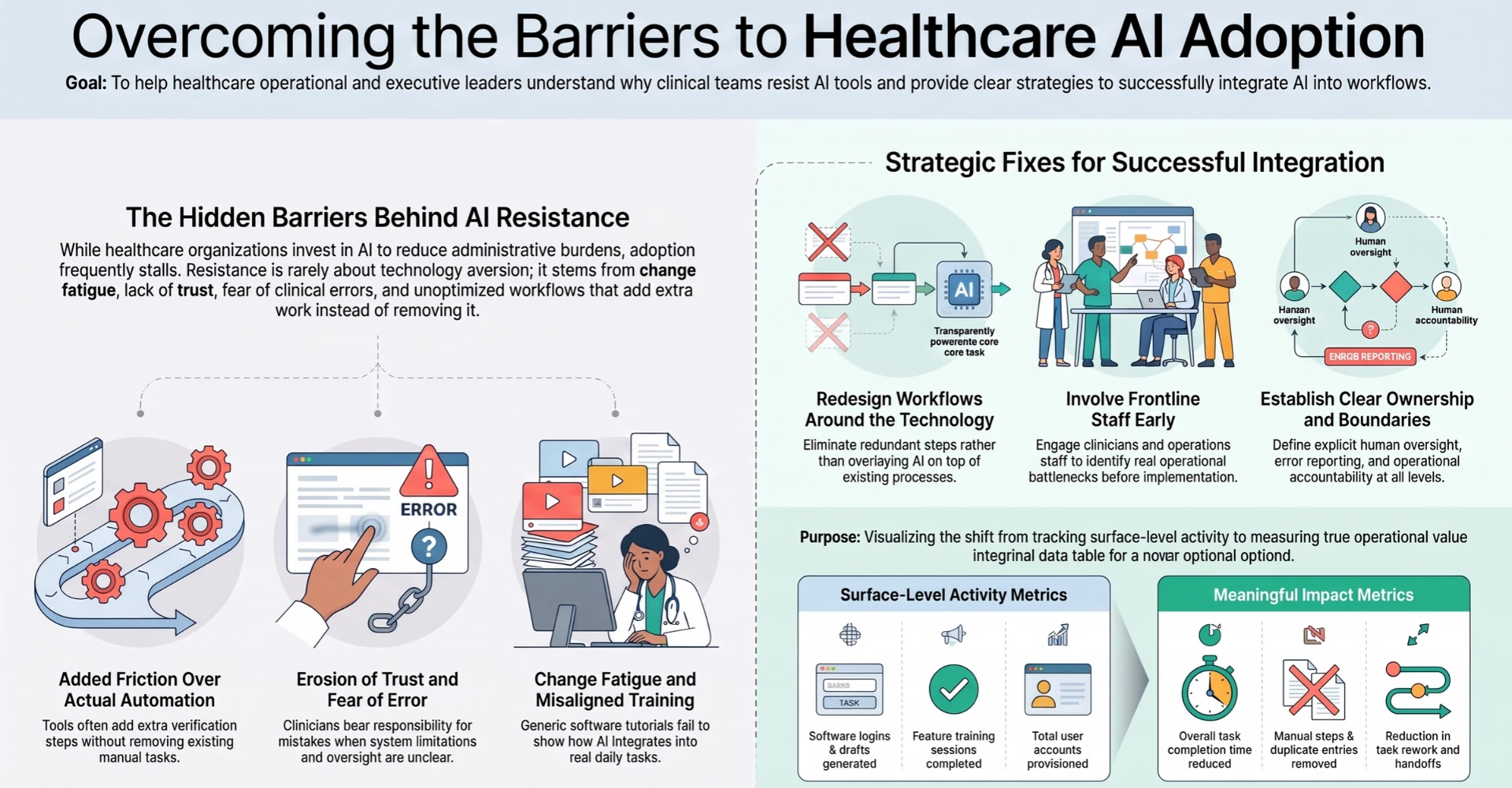
What Can Healthcare Leaders Do to Improve AI Adoption?
Healthcare organizations do not need to solve every adoption challenge at once. They can begin with a more focused implementation approach.
Start With a Specific Operational Problem
Identify a recurring task that consumes time, creates avoidable rework, or causes delays.
Avoid starting with the question, “Where can we use AI?” Start with, “Which problem should we solve, and how will we know if it is better?”
Involve Frontline Teams Before Selecting the Workflow
People who perform the work often understand its exceptions and constraints better than anyone reviewing it from a distance.
Ask nurses, intake coordinators, and operations staff where delays occur, which steps are difficult to remove, and what would make a tool genuinely useful.
Their input should influence the implementation, not just the training plan.
Define the Boundaries of the Technology
Be explicit about what the AI system can do, what requires human verification, and what remains outside its scope.
This is especially important when the work involves clinical documentation, eligibility decisions, or other tasks with compliance implications.
Make the New Process Easier to Follow
Review the entire workflow and remove unnecessary steps where appropriate.
If the AI tool creates a draft but leaves staff with the same manual copying, duplicate entry, and unclear handoffs, reconsider the design.
Assign Clear Ownership
Identify who is responsible for implementation, workflow decisions, user feedback, issue resolution, and outcome measurement.
Employees should know where to take a problem and what happens after they report it.
Measure Results and Improve the Process
Establish a baseline before implementation. Review time savings, rework, quality, adoption, and frontline feedback after rollout.
If the tool is not delivering the expected improvement, determine whether the issue is technical performance, training, workflow design, or a mismatch between the tool and the problem.
The answer may be to improve the implementation rather than ask staff to try harder.
What Does Successful AI Adoption in Healthcare Really Look Like?
Successful adoption is not when every employee uses AI simply because the organization has purchased it.
It is when the technology becomes a useful part of the work because it solves a real problem, fits the process, and earns the confidence of the people who depend on it.
That requires more than a capable model.
It requires a clear purpose, realistic expectations, practical training, defined responsibilities, and workflows designed to preserve appropriate human oversight.
It also requires leaders to listen when employees raise concerns. Sometimes those concerns reveal a weakness in the implementation that the organization needs to address.
Healthcare teams do not need another promise that AI will make everything easier.
They need to see which work will disappear, which responsibilities will change, how errors will be handled, and whether the new process will genuinely improve their day.
The real test of AI in healthcare is not whether people are willing to try it.
It is whether the technology earns a lasting place in the way they work.
What do you think is the biggest barrier to AI adoption in healthcare today: trust, workflow integration, training, change fatigue, or unclear ownership?
Related reading
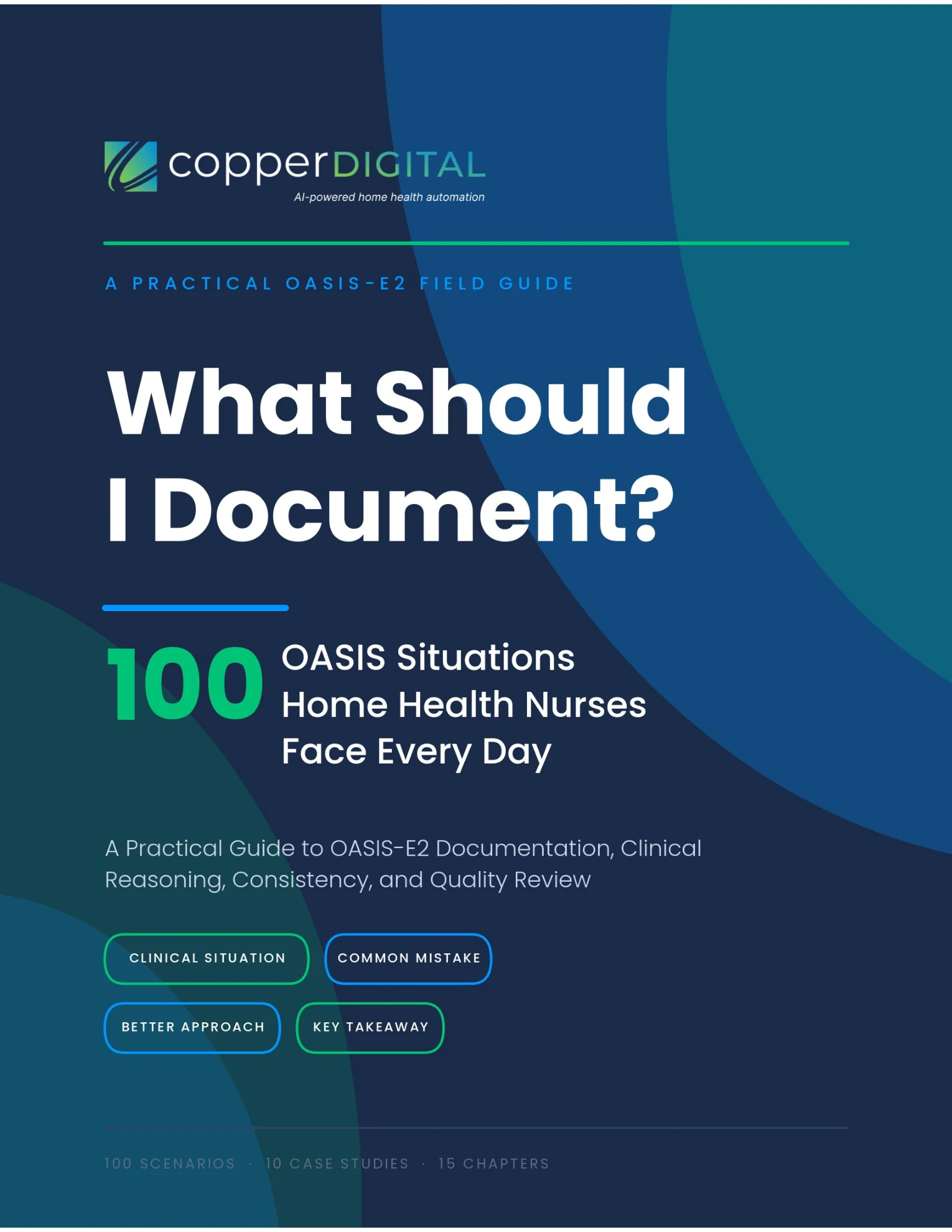
What Should I Document? 100 OASIS Situations Home Health Nurses Face Every Day
100 real OASIS scenarios, worked end to end — clinical situation, common mistake, better approach, and key takeaway. Built around OASIS-E2 (effective April 1, 2026) to turn what you assess into accurate, defensible documentation.
Bottom Line
Healthcare AI earns lasting adoption when it solves a specific problem, reduces work across the entire workflow, and gives staff clear training, ownership, and appropriate human oversight.
Inside Home Health Podcast
The Hidden Crisis in Home Health (and Why It’s Getting Worse)

Arvind Sarin is the founder of Copper Digital. He works inside home health agencies to build AI documentation workflows that help clinicians finish OASIS and visit notes sooner, with a nurse reviewing and approving every note. He writes about home health documentation, Medicare compliance, and applying AI responsibly in clinical workflows.
Frequently asked
Frequently asked questions
AI adoption in healthcare is the process of introducing and integrating artificial intelligence into clinical, administrative, or operational workflows. Successful adoption means the technology is used appropriately and delivers measurable value while meeting relevant safety, privacy, and compliance requirements.
Join the conversation
Leave a comment
No comments yet. Be the first to share your thoughts.
Related reading

Why Most Healthcare AI Fails: It's Rarely a Technology Problem
Healthcare AI projects usually fail because organizations implement AI before clearly defining the problem they're trying to solve. Success depends on understanding clinical workflows, involving frontline users, aligning business incentives, establishing governance, and designing around patients, not simply deploying more advanced technology.
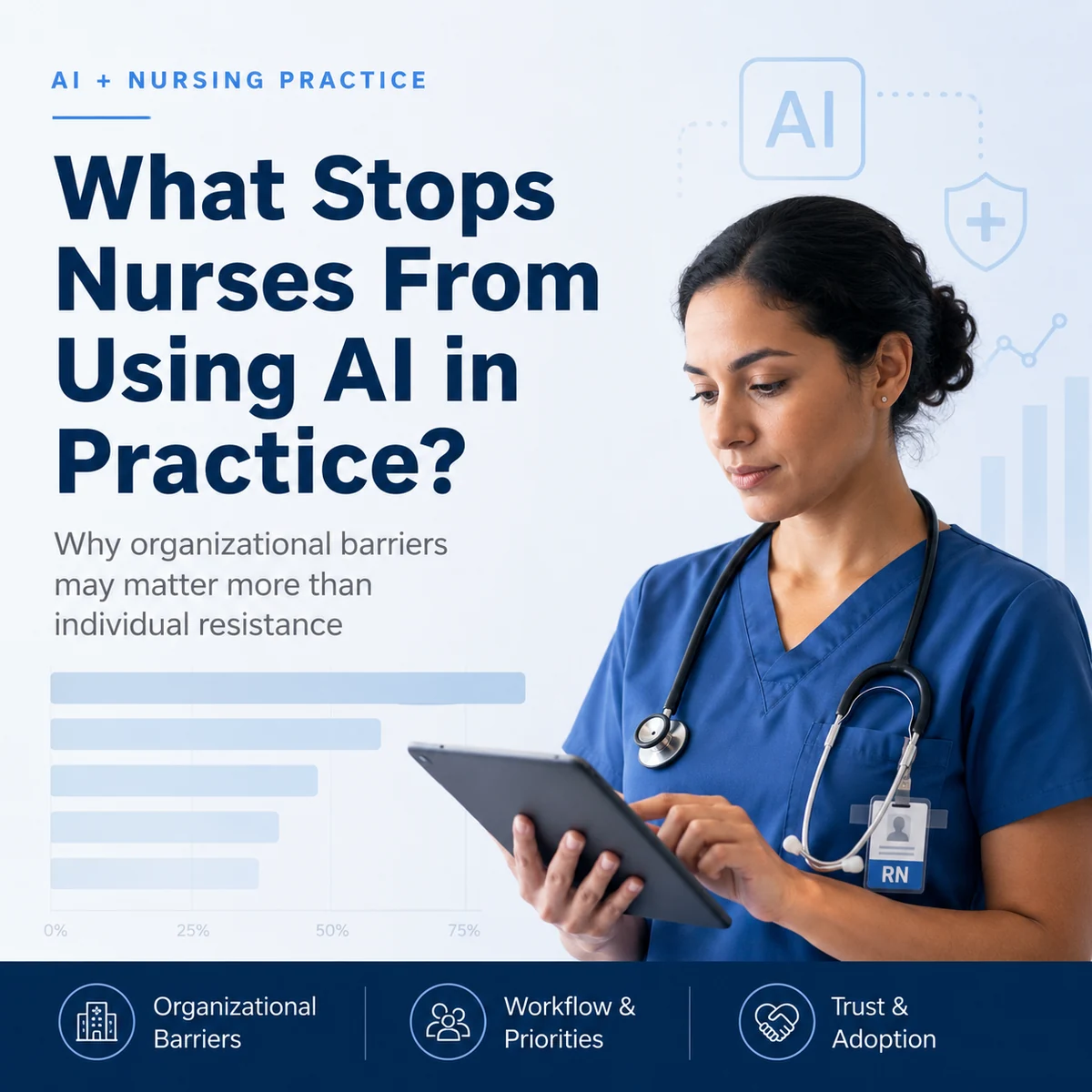
What Stops Nurses From Using AI in Practice?
AI adoption is usually framed as a clinician problem, but a 42-nurse course evaluation found the top barrier was organizational policy and IT restrictions (21 of 42), not distrust or fear. This guide breaks down 12 real barriers (governance, patient trust, competing priorities, time, workflow friction, privacy, burnout, and more) and the seven conditions that make nurses actually adopt AI.
How Can Home Health Agencies Determine Whether a Referral Is Ready for Admission?
A practical framework for checking clinical eligibility, payer requirements, staffing capacity, and documentation before accepting a home health referral.