
Home Care, Home Health, and Hospice: What's the Difference?
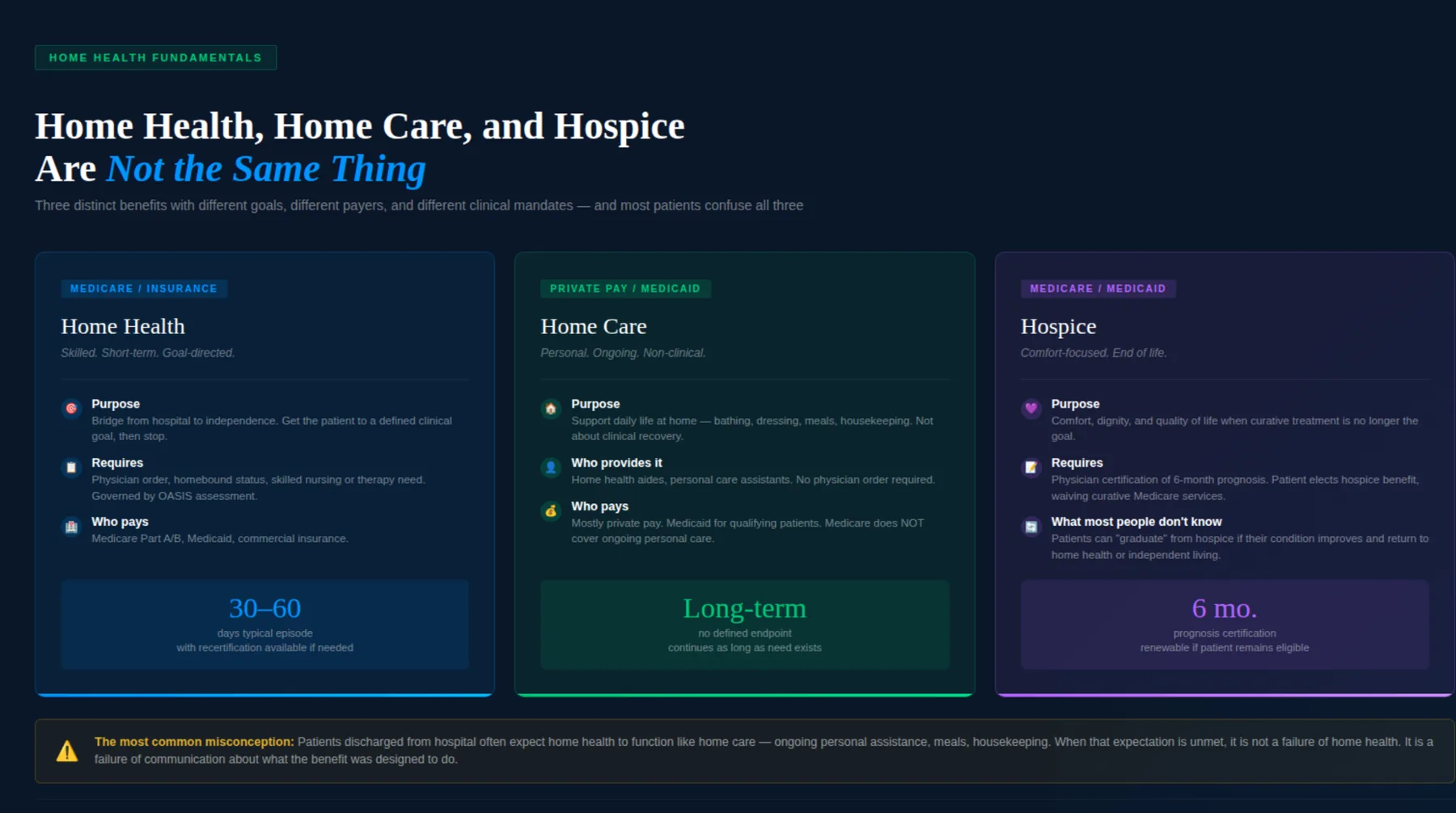
Home care supports daily life, home health provides skilled healthcare, and hospice focuses on comfort for terminal illness. Compare the services, eligibility, coverage, and goals of each model.
Key Takeaways
- Home care generally provides non-medical help with everyday activities and independence.
- Home health provides skilled, ordered healthcare in the home for eligible patients who need intermittent nursing or therapy.
- Hospice provides comfort-focused, interdisciplinary care for people with terminal illness who elect the hospice benefit.
- Medicare home health generally requires homebound status, while Medicare hospice does not.
- Medicare generally does not cover long-term custodial care when personal care is the only service needed.
- The correct care model depends on the person's clinical needs, functional needs, goals, eligibility, setting, and coverage.
✓ Quick answer: Home care generally provides non-medical support with everyday activities. Home health provides skilled nursing or therapy in a person's home. Hospice provides comfort-focused, interdisciplinary care for someone with a terminal illness. All three may occur where a person lives, but they have different purposes, providers, eligibility rules, documentation, and coverage.
Families researching care often encounter three similar terms: home care, home health, and hospice. Because each service can involve care where a person lives, the names are frequently used interchangeably.
That can create confusion about what help will arrive, who provides it, what Medicare covers, and what goal the care team is working toward.
What Is the Difference Between Home Care, Home Health, and Hospice?
- Home care: support with everyday activities and independence.
- Home health: skilled healthcare delivered at home.
- Hospice: comfort-focused care for people with terminal illness.
The differences extend beyond terminology. The services, professionals, eligibility requirements, plans of care, documentation, payment rules, and expected outcomes can all differ.
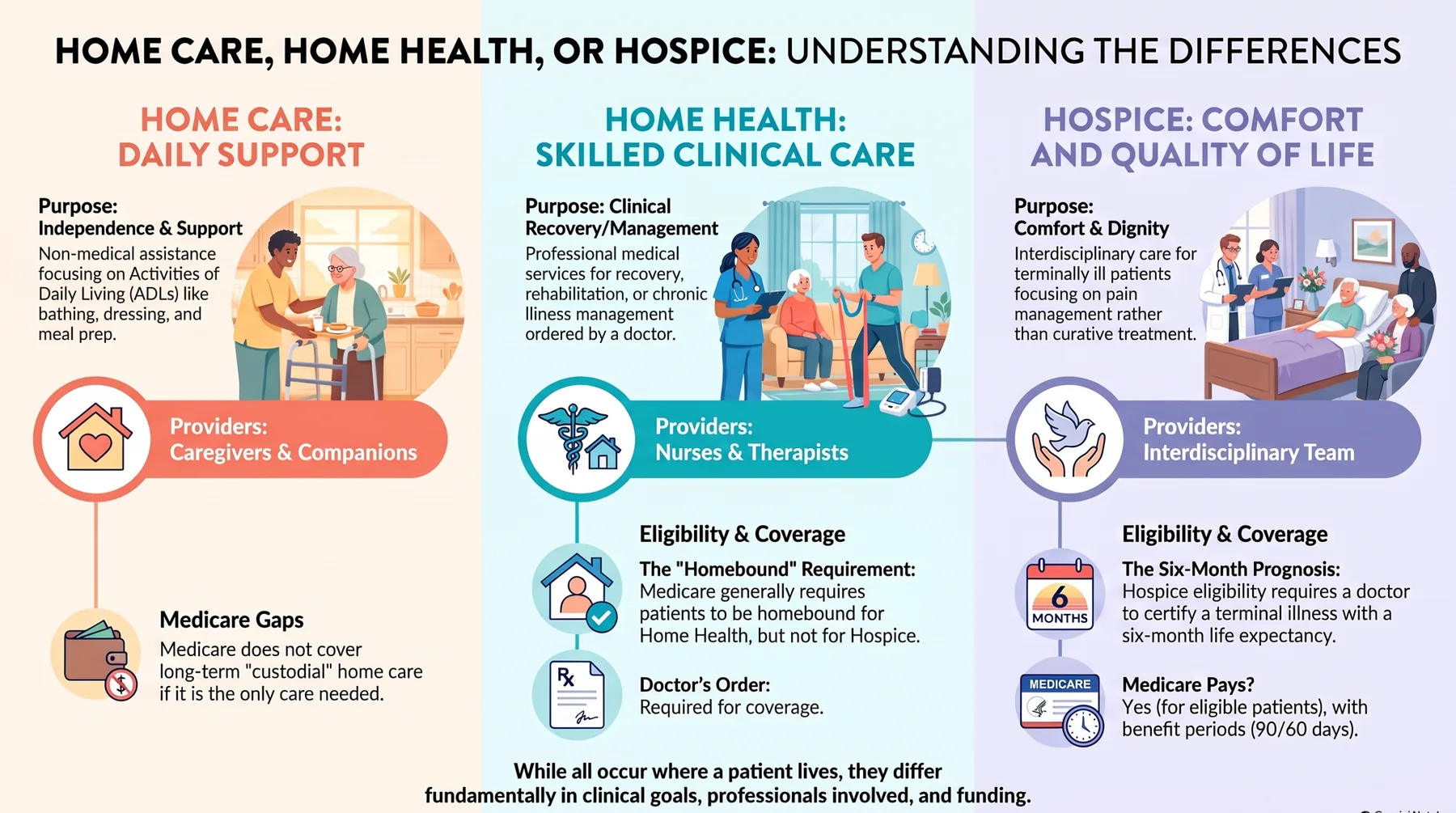
The same location can support three different care models. Purpose, clinical need, eligibility, and coverage determine which one applies.
| Feature | Home care | Home health | Hospice |
|---|---|---|---|
| Primary purpose | Daily support and independence | Skilled healthcare | Comfort and quality of life |
| Typical focus | ADLs and everyday routines | Recovery, rehabilitation, maintenance, or condition management | Pain, symptom management, and support |
| Medical care | Generally non-medical | Skilled clinical care | Clinical and supportive end-of-life care |
| Common providers | Caregivers and personal care aides | Nurses and therapists | Interdisciplinary hospice team |
| Can occur at home? | Yes | Yes | Yes |
| Homebound status? | Not inherently | Generally required for Medicare coverage | Not required |
| Six-month terminal prognosis? | No | No | Required for the Medicare hospice benefit |
| Primary goal | Help with daily life | Address skilled healthcare needs | Comfort, dignity, and support |
What Is Home Care and Who Is It For?
Home care generally refers to non-medical assistance that helps a person manage everyday activities and remain independent where they live. A person may need this support because of aging, disability, recovery, a chronic condition, or difficulty completing daily tasks safely.
- Bathing, grooming, dressing, and toileting assistance.
- Meal preparation and help with eating.
- Light housekeeping and laundry.
- Transportation and errands.
- Companionship.
- Medication reminders.
- Assistance with mobility and daily routines.
- Respite support for family caregivers.
Home care terminology, provider requirements, licensing, and covered services vary by state and program. The central goal is usually daily support, safety, and independence rather than skilled medical treatment.
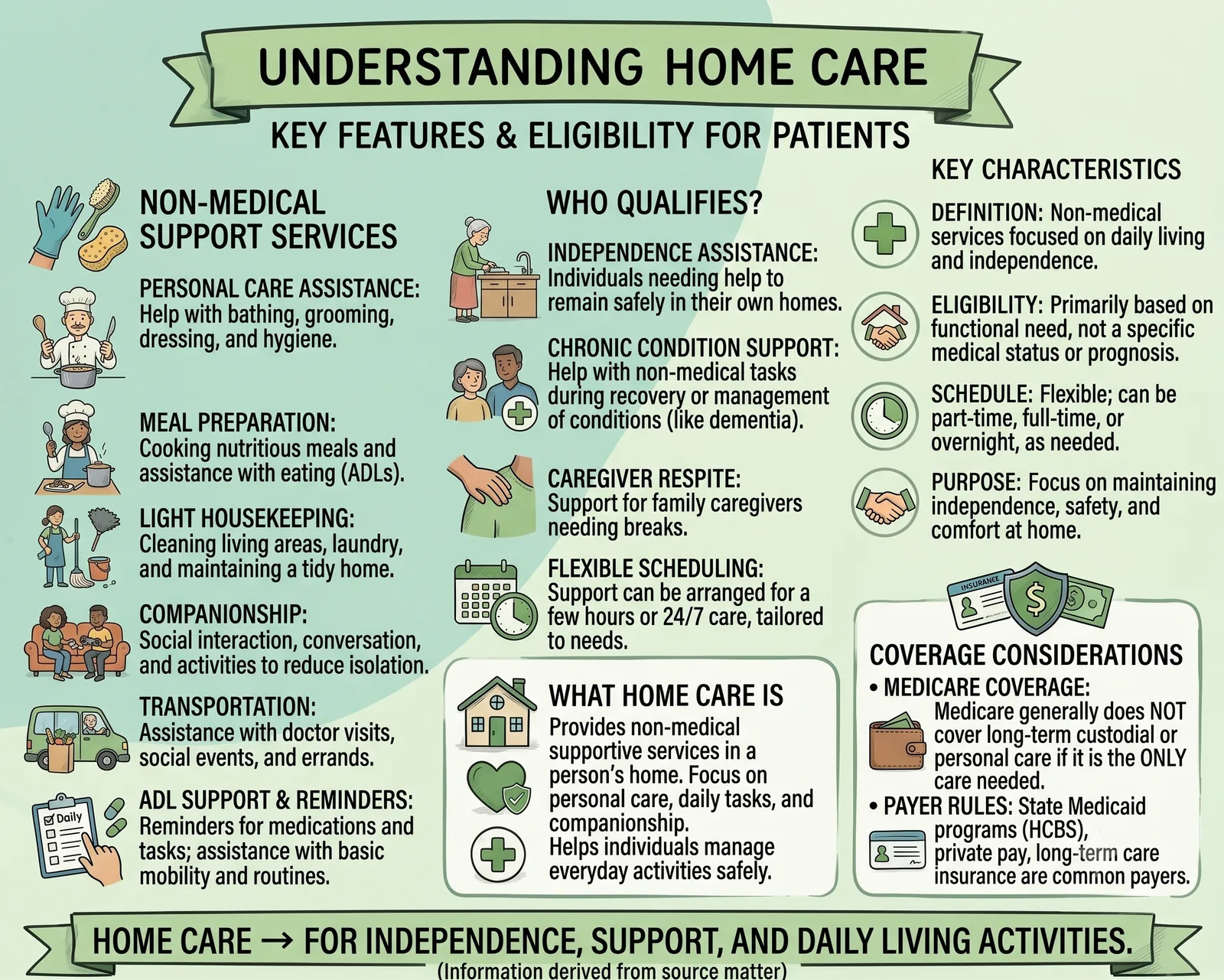
Home care is generally built around functional support and everyday life. Specific services, licensing, and payer rules vary by state and program.
What Are Activities of Daily Living in Home Care?
Activities of daily living, or ADLs, are basic tasks people perform as part of everyday life. Common examples include bathing, dressing, eating, toileting, transferring, and mobility.
Home care can help someone complete these activities safely when they cannot manage them independently.
Needing help with an ADL does not automatically mean a person qualifies for Medicare-covered home health. Medicare distinguishes personal or custodial care from qualifying skilled home health services.
What Is Home Health Care and Who Is It For?
Home health provides skilled healthcare services in a person's home. It can support recovery, rehabilitation, maintenance of function, management of a health condition, wound care, medication-related care, and patient or caregiver education.
For Medicare-covered home health, the patient generally must need qualifying part-time or intermittent skilled services and meet Medicare's homebound criteria. A doctor or other allowed practitioner must order the care, and a Medicare-certified home health agency must provide it under an established plan of care.
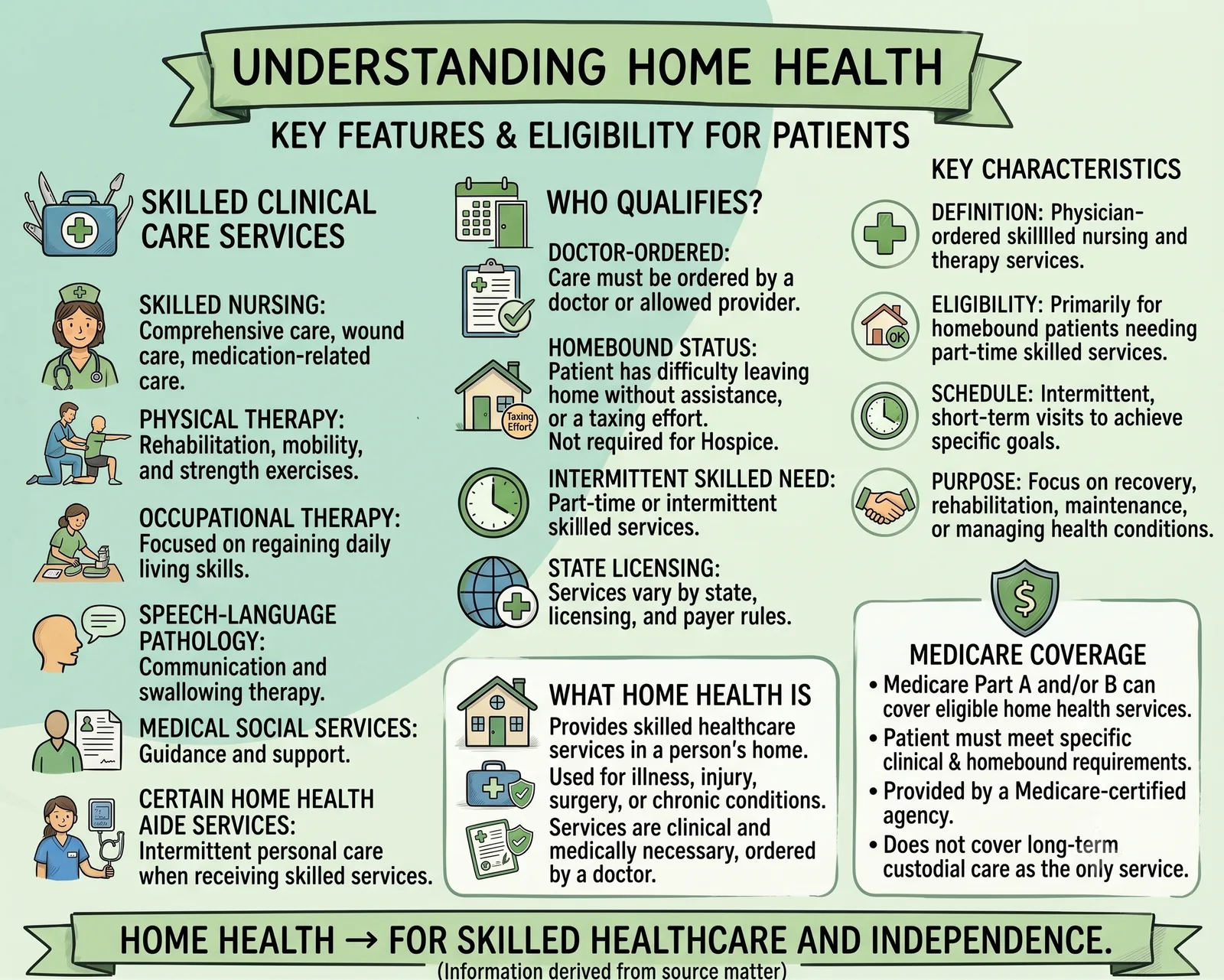
Medicare home health is a skilled benefit. Coverage depends on clinical need, homebound status, an ordered plan of care, and a Medicare-certified agency.
What Services Can Home Health Include?
- Part-time or intermittent skilled nursing.
- Physical therapy.
- Occupational therapy.
- Speech-language pathology.
- Medical social services when applicable.
- Part-time or intermittent home health aide services when coverage requirements are met.
- Certain medical supplies.
- Certain durable medical equipment.
Medicare may cover part-time or intermittent home health aide services when the patient is also receiving qualifying skilled care from the home health agency. It generally does not cover custodial or personal care when that is the only care a person needs.
ℹ️ The same task can appear in different care models. Bathing assistance may be non-medical home care, or it may be provided by a home health aide within a qualifying Medicare home health plan. The reason for the service, plan of care, provider, and coverage rules all matter.
Does Home Health Mean the Patient Is Recovering From Surgery?
Not necessarily. Recovery after hospitalization or surgery is a common use of home health, but it is not the only one.
Qualifying home health can support recovery, rehabilitation, maintenance of function, or management of an illness or health condition.
Does a Medicare Home Health Patient Have to Be Homebound?
Generally, yes. Medicare homebound criteria can be met when leaving home requires assistance, is medically inadvisable, or requires a considerable and taxing effort.
Homebound does not mean the person can never leave. Certain medical absences and short or infrequent non-medical outings can still be consistent with homebound status.
What Is Hospice Care and Who Is It For?
Hospice is designed for people with terminal illness who elect comfort-focused care instead of treatment intended to cure the terminal illness. Hospice addresses pain and symptoms, quality of life, emotional and spiritual needs, caregiver support, and coordinated end-of-life care.
Hospice uses an interdisciplinary approach. Depending on the patient's plan of care, the team may include physicians, nurses, social workers, counselors or chaplains, hospice aides, therapists, volunteers, and other professionals.
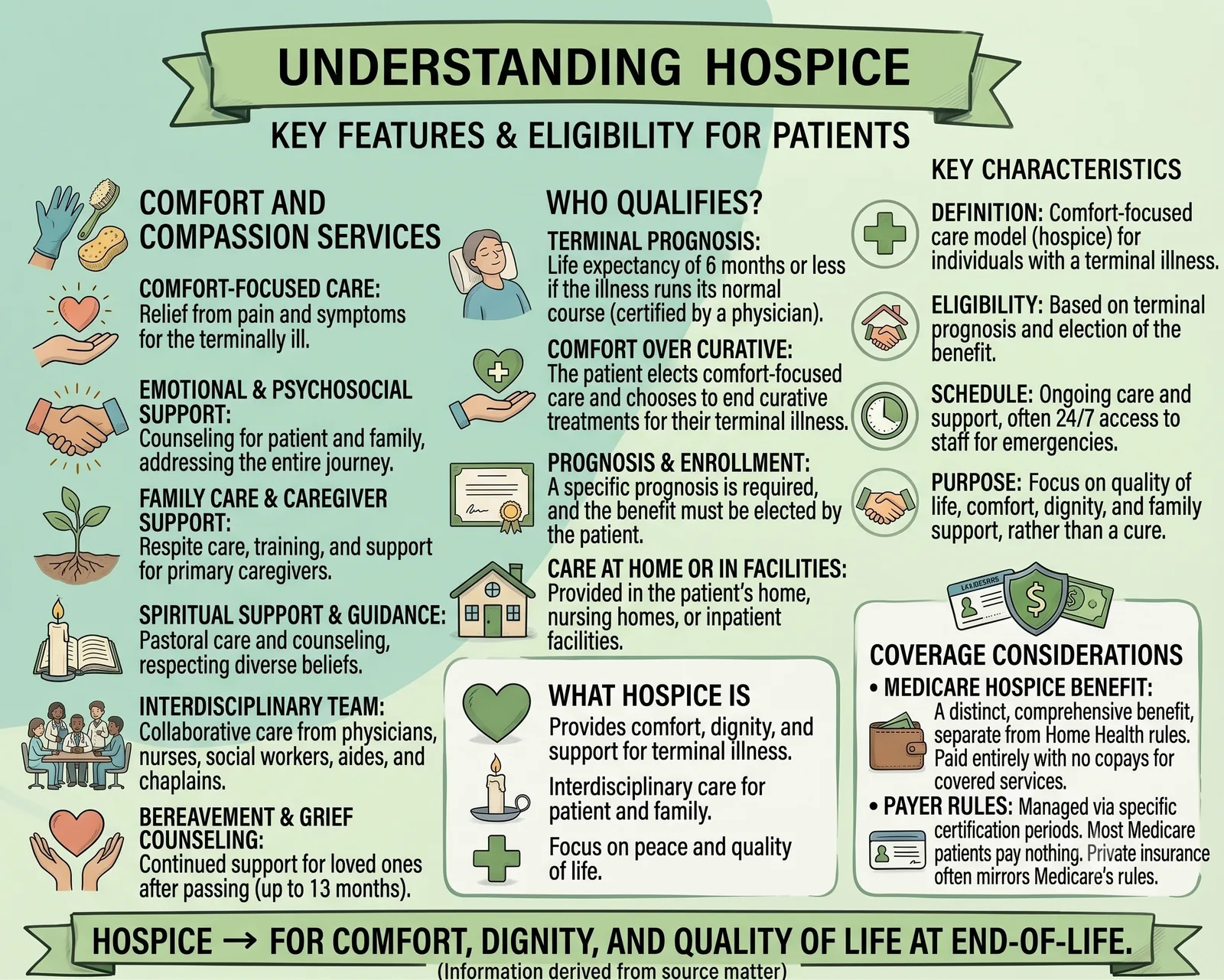
Hospice is a model of comfort-focused, interdisciplinary care for terminal illness. It is not limited to one physical setting.
Does Hospice Have to Be Provided at Home?
No. Medicare-approved hospice care can usually be provided in the patient's home or another place where the person lives, including an assisted living facility or nursing home.
Qualifying inpatient hospice care can also be arranged when needed. Home describes a location; hospice describes the type and purpose of care.
Who Qualifies for Medicare Hospice?
For the Medicare hospice benefit, the hospice doctor and the patient's regular doctor, if the patient has one, certify that the person is terminally ill with a life expectancy of six months or less if the illness follows its normal course. The patient must elect the hospice benefit and accept comfort-focused care instead of treatment intended to cure the terminal illness.
Can Hospice Continue for More Than Six Months?
Yes. Medicare hospice coverage includes two 90-day benefit periods followed by an unlimited number of 60-day benefit periods. Care can continue beyond six months when the hospice physician recertifies that the person remains terminally ill.
For the third benefit period and each later recertification, a hospice physician or nurse practitioner must conduct the required face-to-face encounter. Beginning October 1, 2025, CMS allows a signed and dated clinical note to satisfy the attestation requirement when it includes the required encounter information.
CMS has also issued instructions for reporting qualifying recertification encounters conducted by telecommunications technology on claims beginning January 1, 2027.
Does a Hospice Patient Have to Be Homebound?
No. Homebound status is associated with Medicare's home health benefit, not the Medicare hospice benefit.
Hospice eligibility centers on terminal illness, certification, election of the benefit, and the hospice plan of care.
Who Provides Home Care, Home Health, and Hospice?
| Type of care | Examples of caregivers and professionals |
|---|---|
| Home care | Personal care aides, caregivers, companions, and homemakers |
| Home health | Nurses, physical therapists, occupational therapists, speech-language pathologists, medical social workers, and home health aides when applicable |
| Hospice | Physicians, nurses, social workers, counselors or chaplains, hospice aides, and other interdisciplinary team members |
Does Medicare Cover Home Health?
Yes, when the patient and services meet Medicare's requirements. Medicare Part A and/or Part B can cover eligible home health services.
In general, the patient must be under the care of a doctor or allowed practitioner, be certified as homebound, need qualifying intermittent skilled care or therapy, receive services under an established plan of care, and use a Medicare-certified home health agency.
The doctor or allowed practitioner must also conduct the required face-to-face encounter before certifying the need for home health. Learn more about the assessment and care-planning workflow in What Is a Comprehensive Assessment in Home Health?.
Does Medicare Cover Home Care?
Medicare generally does not cover long-term custodial or personal care when that is the only care a person needs. It also generally does not cover around-the-clock care at home, meal delivery, or homemaker services unrelated to the Medicare home health plan of care.
Personal-care tasks can sometimes be covered through the Medicare home health benefit when the patient is also receiving qualifying skilled services and the other coverage requirements are met. The answer therefore depends on the full clinical and coverage context, not the task name alone.
Can Medicaid Help Pay for Home Care?
It can, depending on the state, program, and person's eligibility. Medicaid Home and Community-Based Services programs can include personal care, homemaker services, home health aide services, respite, case management, and other supports. States design their programs within federal requirements, so availability and eligibility vary.
For a broader payer comparison, see Medicaid vs. Medicare for Home Health.
Does Medicare Cover Hospice?
Yes. Medicare Part A covers hospice for eligible beneficiaries who elect the benefit and receive care from a Medicare-approved hospice.
Medicare states that covered hospice services generally have no charge, although limited cost-sharing and other costs can apply in specific situations, including certain prescriptions and room and board.
Can Someone Receive Home Care and Hospice at the Same Time?
Additional home-based support may be possible, but the source, payer, and relationship to the terminal illness matter. Hospice coordinates care related to the terminal illness and related conditions.
Families should ask the hospice what the benefit includes and whether additional support is available through private payment, Medicaid, long-term care insurance, or another source.
Can Someone Receive Home Health and Hospice at the Same Time?
This requires careful coordination. After a person elects the Medicare hospice benefit, the hospice is responsible for care related to the terminal illness and related conditions.
A separate home health service should not be assumed to operate alongside hospice for the same condition. Different coverage considerations may apply to unrelated conditions, and the providers and payer should determine how services are coordinated.
Can the Same Organization Provide Home Health and Hospice?
Yes, an organization can operate or be associated with both programs, but the services are not interchangeable. Home health and hospice have different eligibility rules, plans of care, clinical workflows, documentation, billing, quality programs, and regulatory requirements.
Shared ownership or technology does not eliminate the need for separate program-specific processes.
Why Are Home Health and Hospice Documentation Requirements Different?
The documentation differs because the purpose and regulatory framework of each care model differ.
Home health documentation may need to support
- Skilled need and medical necessity.
- Homebound status when required.
- Orders and the plan of care.
- Clinical assessments and OASIS when applicable.
- Visit services, progress, coordination, and outcomes.
Hospice documentation may need to support
- Terminal prognosis, certification, and recertification.
- Face-to-face encounters when required.
- Comprehensive assessments.
- Interdisciplinary group participation.
- An individualized plan of care.
- Pain and symptom management.
- Changes in patient and caregiver needs.
What Are Common Misconceptions About These Services?
Home care and home health are the same
They are not. Home care generally provides personal and everyday support, while home health provides qualifying skilled healthcare.
Home health is only for recovery after surgery
Surgical recovery is one use case. Home health can also support rehabilitation, maintenance of function, and management of health conditions when eligibility and coverage requirements are met.
Hospice means the patient has exactly six months to live
No. Six months or less is the prognosis requirement if the illness follows its normal course.
Eligible patients can continue receiving hospice after six months when they remain terminally ill and are recertified.
Hospice is only provided at home
No. Hospice can be provided in several settings.
Hospice describes the care model, not one required location.
Medicare pays for all care delivered at home
No. Medicare covers specific qualifying home health and hospice services.
It generally does not cover long-term custodial care simply because it is provided at home.
How Do You Know Which Type of Care a Loved One Needs?
- If the person primarily needs help with everyday activities, home care or another personal-care or HCBS service may fit.
- If the person needs skilled nursing or therapy at home and meets the requirements, home health may fit.
- If the person has a terminal illness and wants comfort-focused care, hospice may fit when the eligibility requirements are met.
When the answer is unclear, start with the person's healthcare provider to determine what care is clinically appropriate. Then confirm the services, eligibility, setting, network, and coverage requirements with the prospective provider and payer.
Kathy Duckett's map of the care continuum offers another practical way to frame the decision.
What Should Healthcare Organizations Know About the Differences?
The care model changes the entire operational workflow.
- Home health: referral → eligibility → clinical review → orders → assessment → plan of care → visits → documentation → QA → billing.
- Hospice: referral → hospice eligibility → election → assessment → certification → interdisciplinary plan of care → symptom management → recertification.
- Home care: needs assessment → service plan → caregiver matching → scheduling → ADL support → caregiver documentation → reassessment.
The workflows may share technology and administrative functions, but their underlying clinical, documentation, payer, and regulatory requirements are different.
How Can AI Support Home-Based Care Workflows?
AI can help reduce repetitive administrative work, but the workflow should reflect the care model. In home health, appropriate uses can include referral document extraction, information organization, eligibility and readiness checks, documentation support, missing-information identification, QA workflows, and EMR preparation.
In hospice, AI may help organize referral information, support documentation review, prepare care-plan information, route recertification work, and assist quality or compliance processes. Qualified professionals must remain responsible for eligibility, clinical judgment, care planning, and final documentation.
✓ The technology should follow the care model: receive → extract → validate → organize → document → review → push to the appropriate system
What Questions Should Families Ask Before Choosing Care?
- Does the person need personal support, skilled healthcare, or comfort-focused end-of-life care?
- Who will provide the care, and what services are included?
- Does the person meet the applicable eligibility requirements?
- What will Medicare, Medicaid, insurance, or another payer cover?
- What costs or services will remain the family's responsibility?
- Where can the care be provided?
- Who coordinates the overall plan of care?
- What happens if the person's condition or goals change?
- What documentation, assessment, or certification is required?
Official Coverage Resources
- Medicare home health services.
- Medicare hospice care.
- Medicaid Home and Community-Based Services.
- CMS Medicare payment systems, including hospice certification and recertification.
ℹ️ Disclaimer: This guide provides general education, not individualized medical, coverage, billing, legal, or regulatory advice. Eligibility and coverage depend on the person's circumstances, current program rules, state requirements, provider participation, and payer decisions.
Home Health Documentation Playbook
The complete guide to OASIS-E, Medicare compliance, PDGM, and AI-assisted documentation. Learn how top agencies reduce documentation time without sacrificing compliance.
Bottom Line
Home care supports daily life, home health delivers qualifying skilled healthcare, and hospice provides comfort-focused care for terminal illness, so families and organizations should match the service, workflow, and coverage rules to the person's actual needs and goals.
Inside Home Health Podcast
Watch Kathy Duckett: Home Health, Home Care, Hospice, and the Care Continuum

Arvind Sarin is the founder of Copper Digital. He works inside home health agencies to build AI documentation workflows that help clinicians finish OASIS and visit notes sooner, with a nurse reviewing and approving every note. He writes about home health documentation, Medicare compliance, and applying AI responsibly in clinical workflows.
Frequently asked
Frequently asked questions
Home care generally supports daily activities and independence, home health provides qualifying skilled nursing or therapy at home, and hospice provides comfort-focused interdisciplinary care for people with terminal illness.
Join the conversation
Leave a comment
No comments yet. Be the first to share your thoughts.
Related reading
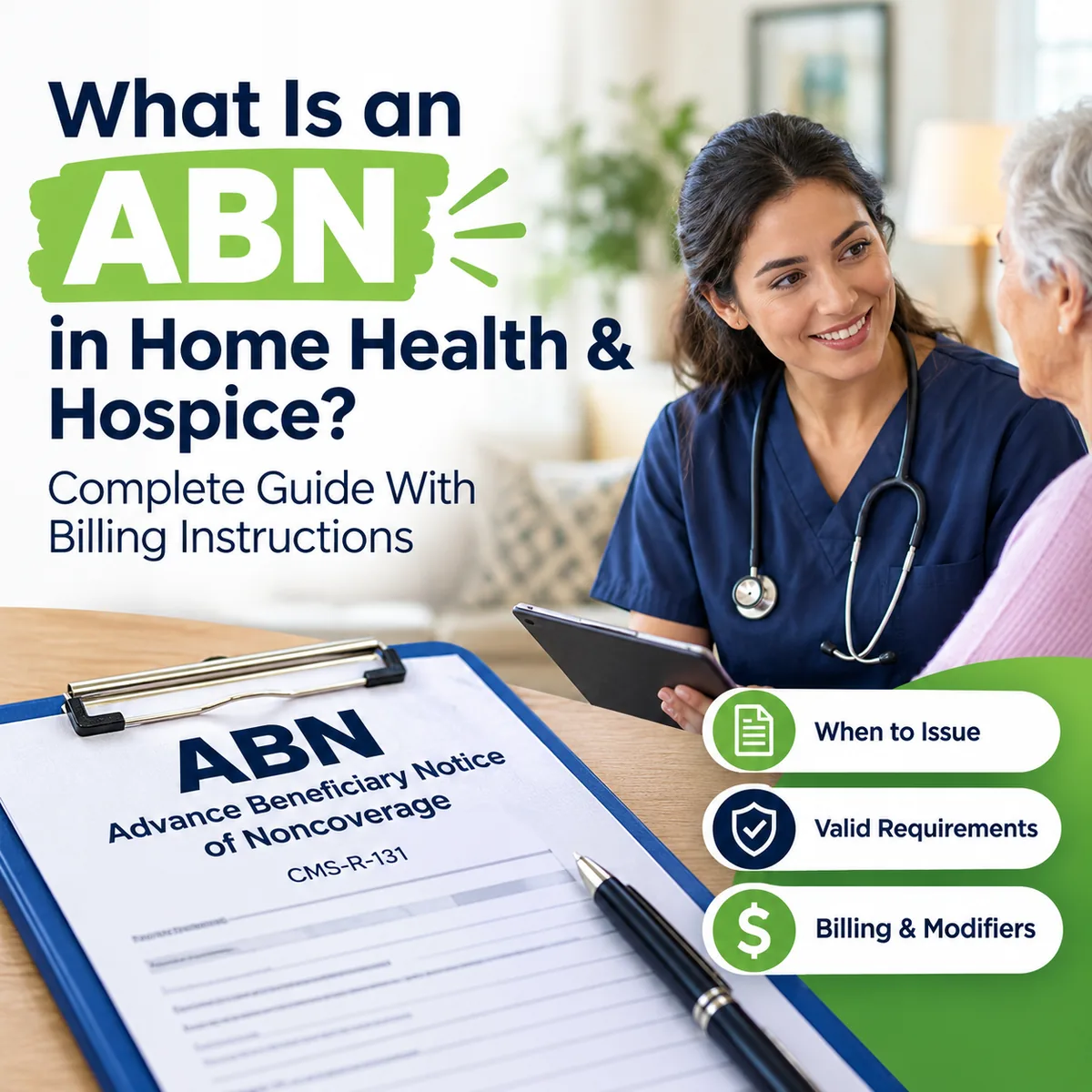
What Is an ABN in Home Health & Hospice? Complete Guide With Billing Instructions
A patient wants to continue care, but Medicare may not pay for it. Who owes the bill? That's where the Advance Beneficiary Notice of Noncoverage (ABN), Form CMS-R-131, comes in. Here's when it's required in home health and hospice, what makes it valid, the beneficiary's three choices, and how to bill it correctly.
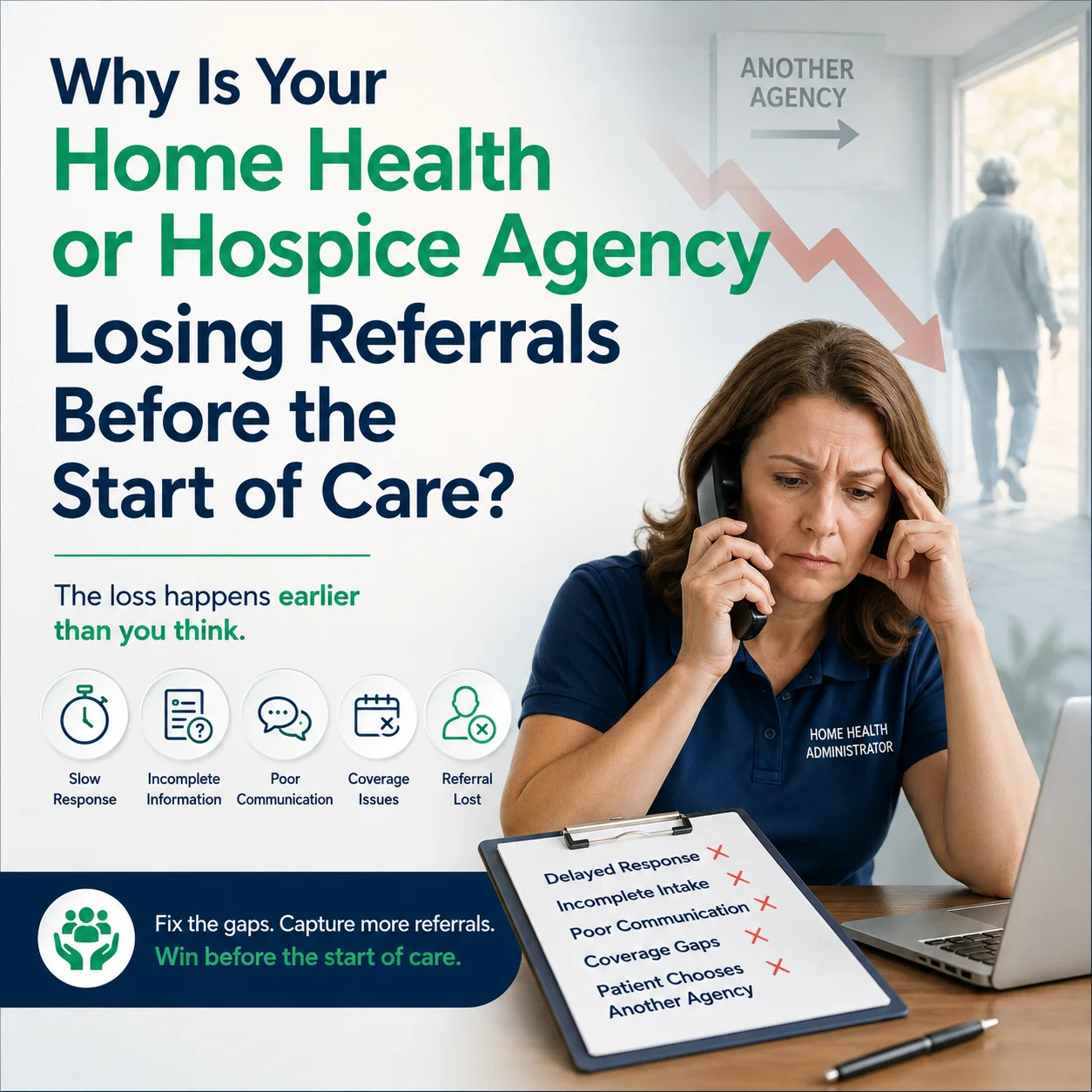
Why Is Your Home Health or Hospice Agency Losing Referrals Before the Start of Care?
A referral is not an admission. Learn where referrals stall between intake and Start of Care, and how ownership, visibility, and follow-up can prevent avoidable losses.
What Happens If My Home Health or Hospice Agency Fails a Survey?
A survey deficiency does not automatically mean closure. Learn what happens next, how corrective action works, and when survey problems can threaten Medicare participation.