
Medicaid vs. Medicare for Home Health: What's the Difference?
Medicare and Medicaid can both help cover care at home, but their eligibility, services, documentation, authorization, and billing rules differ. This guide explains what home health agencies need to verify for each payer.
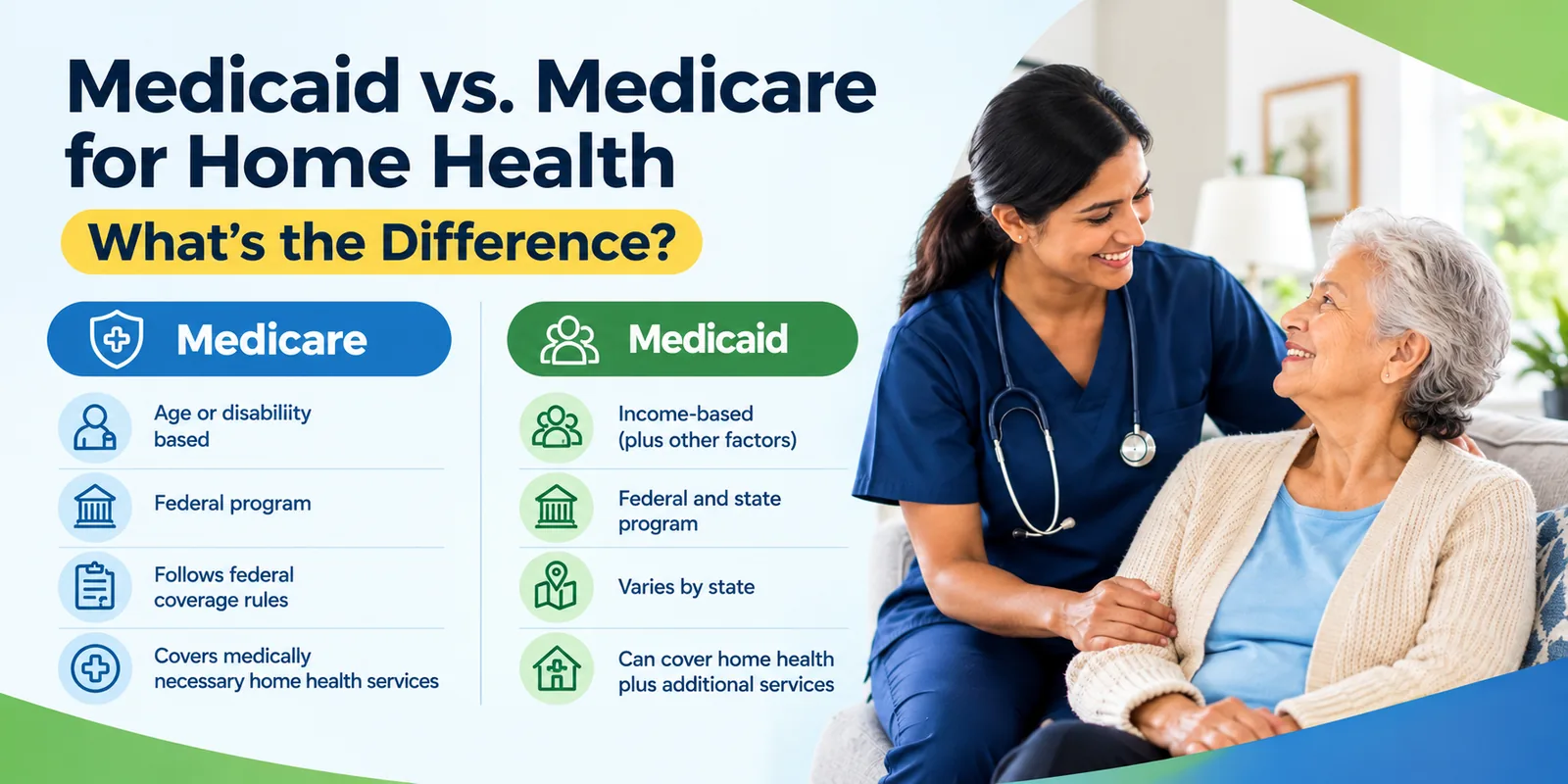
Key Takeaways
- Medicare is a federal health insurance program; Medicaid is jointly funded by federal and state governments and administered by states.
- Medicare home health requires qualifying skilled need, homebound status, a plan of care, a face-to-face encounter, and services from a Medicare-certified agency.
- CMS lists home health among mandatory Medicaid state plan benefits, but eligibility, amount, duration, scope, authorization, and operating rules can vary by state and program.
- Medicaid may cover personal care and other home and community-based services that are not part of Medicare's standard home health benefit.
- A person can have both programs. For items and services both cover, Medicare generally pays first and Medicaid may help with remaining costs under applicable state rules.
- Agencies should build separate payer-specific intake, authorization, documentation, EVV, and billing workflows instead of applying the Medicare process to every Medicaid patient.
✓ Quick answer: Medicare is a federal health insurance program with nationwide home health coverage requirements. Medicaid is a joint federal-state program administered by states, so eligibility, covered services, authorization, and operating rules can vary. A patient may qualify for one program or both.
Medicare and Medicaid can both help cover care delivered in the home, but they are not interchangeable. They differ in who qualifies, how coverage is structured, which services may be covered, and how much flexibility states have over Medicaid benefits.
For home health agencies, the distinction affects the entire workflow: eligibility, covered services, authorization, documentation, provider enrollment, billing, and the steps required to start and continue care. Medicare is primarily based on age, disability, or certain medical conditions.
Medicaid generally serves eligible low-income people and other qualifying populations under federal and state rules.
A person can also qualify for both. CMS calls these patients dually eligible individuals.
When both programs cover an item or service, Medicare generally pays first and Medicaid may help with remaining costs or services, subject to the person's eligibility and applicable state rules.
What Is the Difference Between Medicare and Medicaid for Home Health?
| Medicare | Medicaid |
|---|---|
| Federal health insurance program | Joint federal-state program administered by states |
| Primarily based on age, disability, or certain conditions | Generally based on income and other eligibility categories under federal and state rules |
| Core home health coverage follows federal Medicare requirements | Coverage and operational rules can vary by state and program |
| Covers qualifying medically necessary home health services | Includes a home health benefit and may include additional personal care or HCBS |
| Requires a Medicare-certified home health agency | Provider enrollment and participation requirements depend on the state and program |
| Focuses on part-time or intermittent skilled services | Can include skilled services and other home and community-based supports |
Medicare's home health benefit covers qualifying part-time or intermittent skilled nursing, physical therapy, speech-language pathology, continued occupational therapy, and certain related services and supplies. CMS lists home health services among Medicaid's mandatory state plan benefits, while states determine the type, amount, duration, and scope of benefits within federal guidelines.
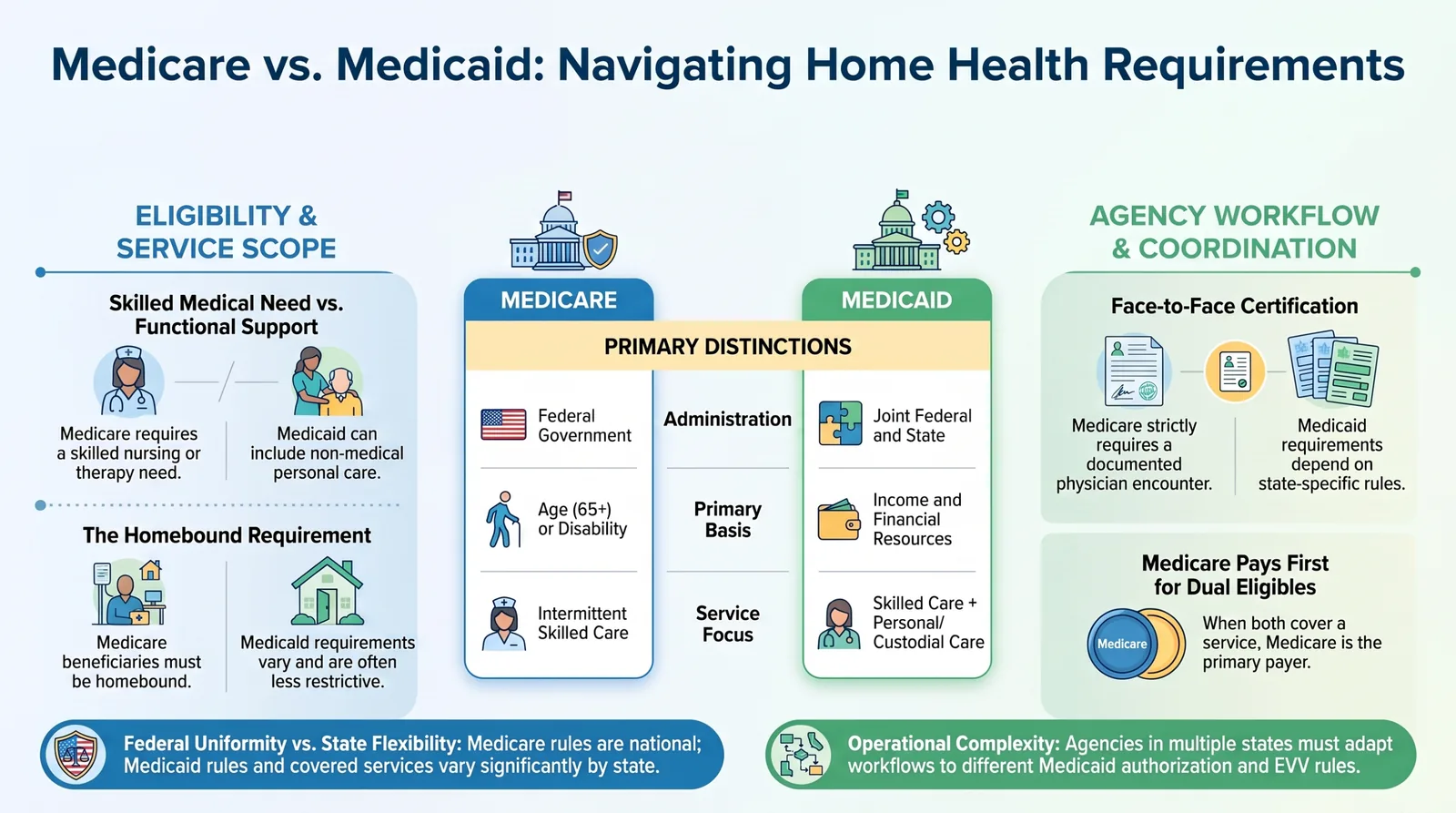
Medicare uses federal home health coverage requirements, while Medicaid rules depend on the state, eligibility pathway, service, and managed care arrangement. Medicaid requirements are not universally less restrictive and must be verified for each case.
Who Qualifies for Medicare Home Health?
Having Medicare does not automatically make every type of home care covered. Under the CMS Medicare home health requirements, a beneficiary generally must:
- Be under the care of a physician or allowed practitioner.
- Receive services under a plan of care that is established and periodically reviewed.
- Need qualifying part-time or intermittent skilled nursing, physical therapy, or speech-language pathology, or meet the requirements for continued occupational therapy.
- Meet Medicare's homebound requirement.
- Have a qualifying face-to-face encounter related to the primary reason for home health.
- Receive services from a Medicare-certified home health agency.
The supporting medical record must substantiate the patient's skilled need and homebound status. For agencies, verifying this evidence during intake can prevent delays and avoidable denials.
See the Medicare Home Health Benefit glossary entry for a concise coverage reference.
Who Qualifies for Medicaid Home Health?
Medicaid eligibility works differently because states establish eligibility pathways within federal requirements. Eligibility can depend on income, resources where applicable, age, disability, family circumstances, state residency, and other program-specific criteria.
! Operational difference: Medicare home health requirements are largely federal. Medicaid eligibility and service workflows can vary considerably by state, delivery system, managed care plan, and benefit authority.
An agency should verify the patient's active eligibility, specific Medicaid program or managed care plan, covered service, authorization, provider participation, service limits, documentation, and billing requirements before accepting the referral.
Does Medicare Cover Home Health Services?
Yes. Medicare covers qualifying medically necessary home health services when the beneficiary meets the applicable requirements.
Covered services can include:
- Part-time or intermittent skilled nursing.
- Physical therapy.
- Speech-language pathology.
- Continued occupational therapy when coverage conditions are met.
- Medical social services.
- Part-time or intermittent home health aide services when qualifying skilled services are also being provided.
- Certain durable medical equipment and medical supplies.
Medicare does not provide unlimited custodial or personal care simply because a person needs help at home. The benefit is tied to specific coverage, skilled-need, homebound, certification, and plan-of-care requirements.
Does Medicaid Cover Home Health Services?
Yes. CMS identifies home health as a mandatory Medicaid state plan benefit.
The federal Medicaid home health service categories include nursing, home health aide services, medical supplies, equipment and appliances, and certain therapy services under the applicable framework.
However, Medicaid is not one identical nationwide program. Medicaid explains that states determine the type, amount, duration, and scope of benefits within federal guidelines. Agencies should not assume that a workflow in one state, plan, or delivery system applies unchanged in another.
What Home Health Services Can Medicaid Cover?
Depending on the state, eligibility pathway, and program authority, Medicaid may cover services such as:
- Nursing and home health aide services.
- Medical supplies, equipment, and appliances.
- Physical therapy, occupational therapy, speech pathology, and audiology.
- Personal care.
- Private duty nursing.
- Respite and homemaker services.
- Case management.
- Other home and community-based services.
Not every Medicaid beneficiary receives every service. Coverage depends on the person's eligibility, medical or functional need, the approved state plan or waiver, authorization, service limitations, and other applicable requirements.
Does Medicaid Cover Personal Care That Medicare Does Not?
It can. CMS lists personal care as an optional Medicaid benefit, and states can provide personal assistance and other supports through several Medicaid authorities. These services may help with activities of daily living, such as bathing or dressing, even when the person does not meet Medicare's requirements for skilled home health.
Medicare's home health benefit is not a general long-term personal care benefit. Home health aide services under Medicare are limited and connected to a qualifying skilled home health episode.
Can Medicaid Cover Home and Community-Based Services?
Yes. States can use several Medicaid authorities to provide Home and Community-Based Services, commonly called HCBS.
These include Section 1915(c) waivers, the Section 1915(i) State Plan option, Section 1915(j) self-directed personal assistance services, and Section 1915(k) Community First Choice.
The services and eligibility criteria vary by state and authority. CMS reports state-level HCBS programs across these authorities, and its 1915(i) guidance explains how states can define needs-based criteria and included services within federal guidelines.
Do Medicare and Medicaid Use the Same Home Health Eligibility Rules?
No. Medicare home health uses federal requirements involving skilled need, homebound status, a face-to-face encounter, the plan of care, certification, and a Medicare-certified agency.
Medicaid eligibility and coverage depend on the person's eligibility category and the rules for the relevant state program and service.
This is why an agency should not apply its Original Medicare intake checklist to every Medicaid referral. A Medicaid patient may need a different authorization, service plan, provider enrollment status, EVV workflow, reassessment schedule, and claims process.
Does Medicaid Require the Same Documentation as Medicare?
Not necessarily. Some requirements come from federal Medicaid law or regulation; others depend on the state Medicaid program, benefit authority, managed care contract, provider agreement, and authorization rules.
A Medicaid workflow may include state or payer-specific requirements for:
- Prior authorization and reauthorization.
- Service plans, care plans, and medical necessity.
- Visit or service limits.
- Provider enrollment and contracting.
- Electronic visit verification, where applicable.
- Required forms and assessment tools.
- Managed care notifications and approvals.
- Claims submission and supporting documentation.
Agencies should verify the requirements for the specific state, payer, program, service, and patient rather than relying on a generic Medicaid checklist.
Does Medicare Require a Face-to-Face Encounter for Home Health?
Yes. Medicare requires a qualifying face-to-face encounter as part of home health certification.
CMS says the encounter must be related to the primary reason the patient needs home health and occur no more than 90 days before, or within 30 days after, the start of care. The certifying physician or allowed practitioner must document the encounter date.
The medical record must also support the patient's need for skilled services and homebound status. For intake teams, verifying the encounter and supporting documentation before Start of Care can reduce avoidable rework.
Is Face-to-Face Documentation the Same for Medicaid?
Not necessarily. Medicaid requirements can vary based on the state, service, program authority, and payer.
Agencies should check the applicable state plan or waiver, managed care contract, authorization rules, provider manual, and current payer guidance instead of automatically applying Medicare's face-to-face process.
Can a Patient Have Both Medicare and Medicaid?
Yes. A person entitled to Medicare and eligible for Medicaid is commonly called dually eligible.
CMS describes multiple categories of dual eligibility, including people with full Medicaid benefits and people who receive help with certain Medicare premiums or cost-sharing through a Medicare Savings Program.
Dual eligibility does not let an agency choose either payer for every service. Staff must determine whether the service is covered by Medicare, Medicaid, both, or neither, and follow the coordination and billing rules that apply.
Which Pays First When a Patient Has Medicare and Medicaid?
For items and services both programs cover, Medicare generally pays first. CMS explains that Medicare is the primary payer for covered services for dually eligible beneficiaries.
Medicaid may help with eligible Medicare cost-sharing or cover services Medicare does not cover, depending on the person's dual-eligibility category and state rules.
$ Important for QMB patients: Medicare providers may not bill Qualified Medicare Beneficiary patients for Medicare deductibles, coinsurance, or copayments. Agencies should confirm dual status and follow CMS billing protections.
How Do Medicare and Medicaid Workflows Differ for Home Health Agencies?
Typical Original Medicare home health workflow
Referral → Medicare eligibility → face-to-face verification → homebound and skilled-need review → orders and certification → Start of Care → OASIS and clinical documentation → plan of care → claim
Typical Medicaid home health workflow
Referral → Medicaid eligibility and program identification → state and payer coverage verification → authorization and service plan requirements → provider participation check → Start of Care → required documentation and EVV where applicable → reauthorization → claim
These are high-level examples. The exact steps depend on the service, state, payer, program, patient, and whether coverage is delivered through fee-for-service or managed care.
Does Medicaid Have State-Specific Home Health Rules?
Yes. State administration is a defining feature of Medicaid.
For an agency operating in multiple states, the workflow may need to change for each state's eligibility verification, authorization, service definitions, documentation, EVV, provider participation, managed care, and claims requirements.
Maintain a current payer matrix by state and plan, assign ownership for policy updates, and date every internal checklist. A process that was correct last year, or in a neighboring state, may not reflect today's requirement for the referral in front of the team.
Does Medicare Have State-Specific Home Health Coverage Rules?
Core Original Medicare home health coverage requirements are federal. Operational details can still involve the applicable Medicare Administrative Contractor, provider requirements, and claim-review programs.
Medicare Advantage also needs separate verification because plan networks, utilization management, and prior authorization processes can differ.
The 2026 Medicare & You handbook explains that Medicare Advantage plans are offered by Medicare-approved private companies, may use provider networks, and may require prior authorization for certain services. Always verify the patient's specific plan rather than treating Medicare Advantage exactly like Original Medicare.
Is Medicare or Medicaid Better for Home Health?
There is no universal answer because the programs serve different populations and cover different needs. A better set of operational questions is:
- Which coverage and plan does the patient have today?
- Is the patient eligible for the requested service?
- Which program is primary for that service?
- What orders, assessments, documentation, and authorization are required?
- Is the agency enrolled or contracted for the program and service?
- Are there state, plan, EVV, visit-limit, or reauthorization rules?
What Should Home Health Agencies Verify Before Starting Care?
Original Medicare intake checklist
- Active Medicare eligibility and whether coverage is Original Medicare or Medicare Advantage.
- Qualifying face-to-face encounter and supporting medical record.
- Homebound status and qualifying skilled-service need.
- Orders, certification, and plan-of-care requirements.
- Agency certification and any applicable payer or review requirements.
Medicaid intake checklist
- Active Medicaid eligibility and the specific state program or managed care plan.
- Covered service, eligibility pathway, and service limitations.
- Prior authorization, service plan, assessment, and documentation requirements.
- Agency enrollment, contracting, and clinician qualification requirements.
- EVV, reauthorization, billing, and state-specific claim requirements.
For Medicare referrals, agencies can also use our comprehensive assessment guide and [Start of Care vs. Resumption of Care vs.
Recertification guide](/blog/soc-vs-roc-vs-recertification-home-health) to connect coverage verification to the clinical workflow.
How Can Technology Help Manage Medicare and Medicaid Workflows?
The biggest opportunity is not simply automating documentation. It is helping staff identify which payer-specific step needs to happen next.
A connected workflow can organize the process:
Referral received → insurance identified → Medicare or Medicaid workflow selected → eligibility reviewed → required documents and authorization identified → missing information surfaced → clinical team assigned → visit completed → documentation reviewed → orders and authorization tracked → claim-ready record reviewed
AI can extract information from referral documents, faxes, emails, and the EMR; flag potentially missing items; route work; and support documentation review. It should not independently decide eligibility, coverage, medical necessity, or final billing.
Those determinations remain subject to current payer rules and qualified human review.
Medicaid vs. Medicare for Home Health: Key Takeaway
Medicare is a federal health insurance program with defined federal home health coverage requirements. Medicaid is a federal-state program with substantial state-level variation and can support home health as well as personal care and HCBS under applicable programs.
For agencies, the practical sequence is: who is eligible → what service is covered → what documentation is required → whether authorization is needed → which payer is responsible → what the state or plan requires. Building that payer-specific workflow into intake, clinical operations, and billing helps teams move referrals forward without treating unlike programs as interchangeable.
Home Health Documentation Playbook
The complete guide to OASIS-E, Medicare compliance, PDGM, and AI-assisted documentation. Learn how top agencies reduce documentation time without sacrificing compliance.
Bottom Line
Medicare and Medicaid can both support care at home, but agencies must verify who is eligible, which service is covered, what documentation or authorization is required, which payer is responsible, and what the applicable state or plan requires before starting care.
Inside Home Health Podcast
Watch: Medicare and Medicaid Explained

Arvind Sarin is the founder of Copper Digital. He works inside home health agencies to build AI documentation workflows that help clinicians finish OASIS and visit notes sooner, with a nurse reviewing and approving every note. He writes about home health documentation, Medicare compliance, and applying AI responsibly in clinical workflows.
Frequently asked
Frequently asked questions
Medicare is a federal health insurance program primarily serving people age 65 and older and certain younger people with disabilities or specific conditions. Medicaid is a joint federal-state program for eligible low-income people and other qualifying groups, with eligibility and program rules that can vary by state.
Join the conversation
Leave a comment
No comments yet. Be the first to share your thoughts.
Related reading
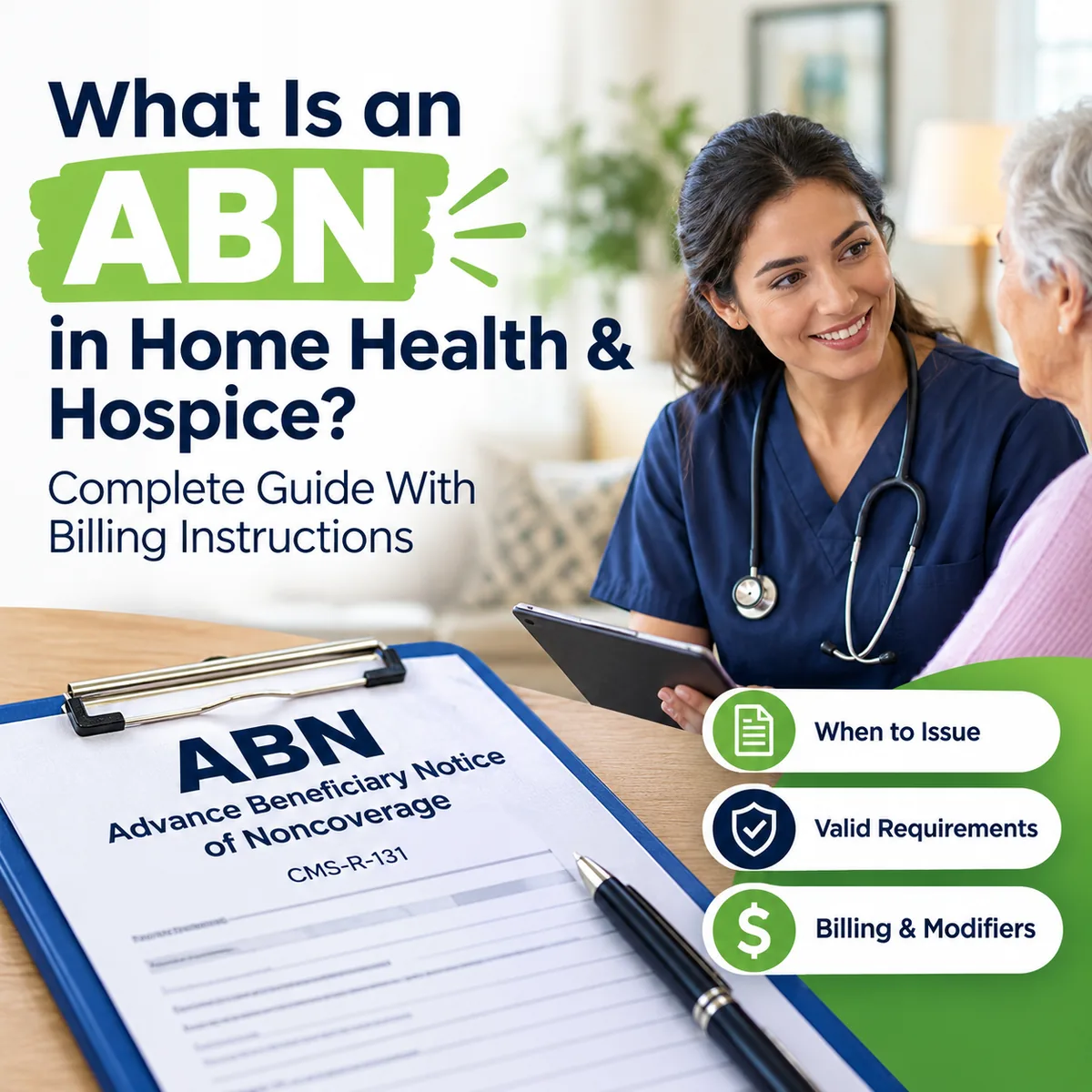
What Is an ABN in Home Health & Hospice? Complete Guide With Billing Instructions
A patient wants to continue care, but Medicare may not pay for it. Who owes the bill? That's where the Advance Beneficiary Notice of Noncoverage (ABN), Form CMS-R-131, comes in. Here's when it's required in home health and hospice, what makes it valid, the beneficiary's three choices, and how to bill it correctly.
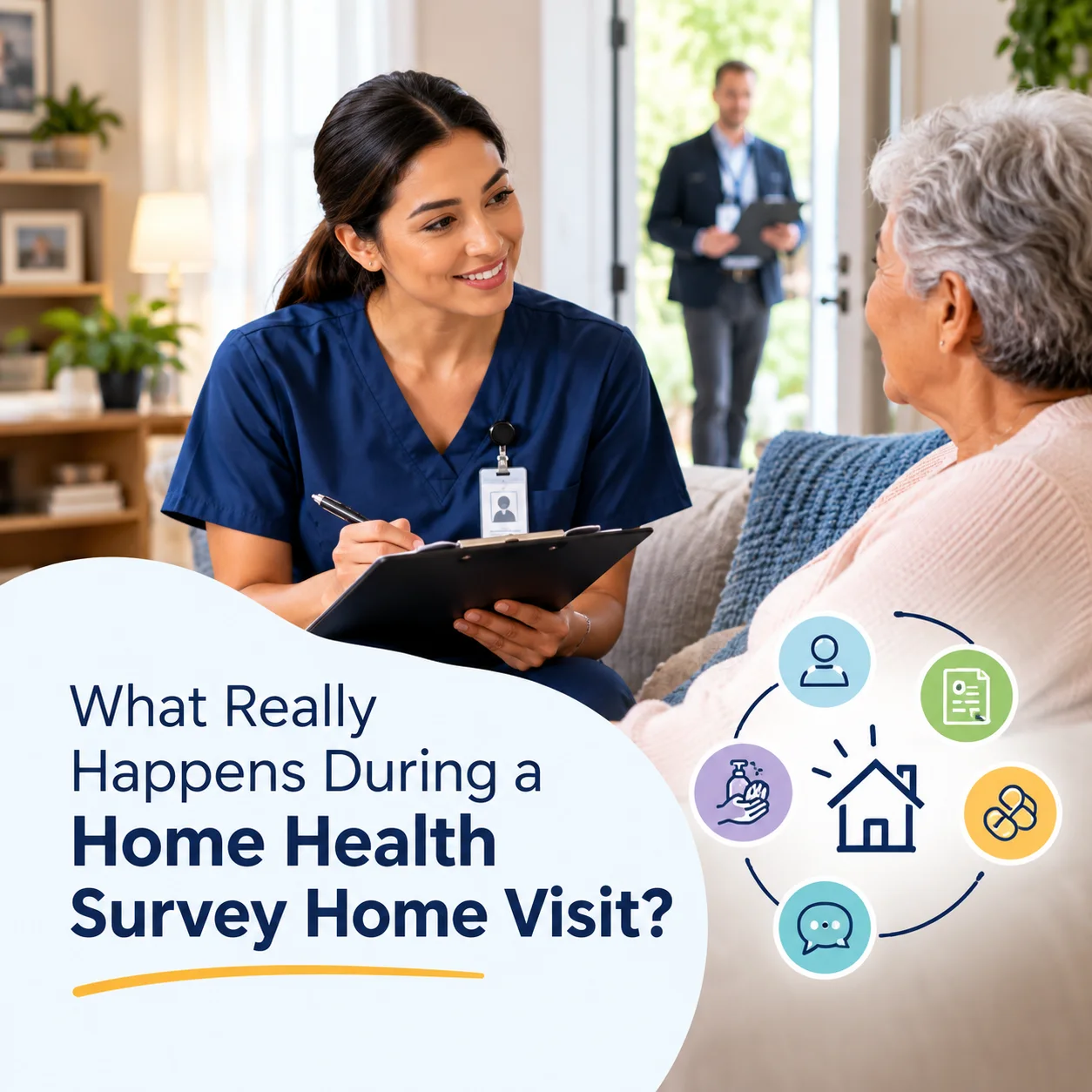
What Really Happens During a Survey Home Visit for Home Health?
A home health survey visit lets a surveyor observe care in the patient's home and compare real-world practice with the plan of care, clinical record, agency policies, and Medicare requirements.
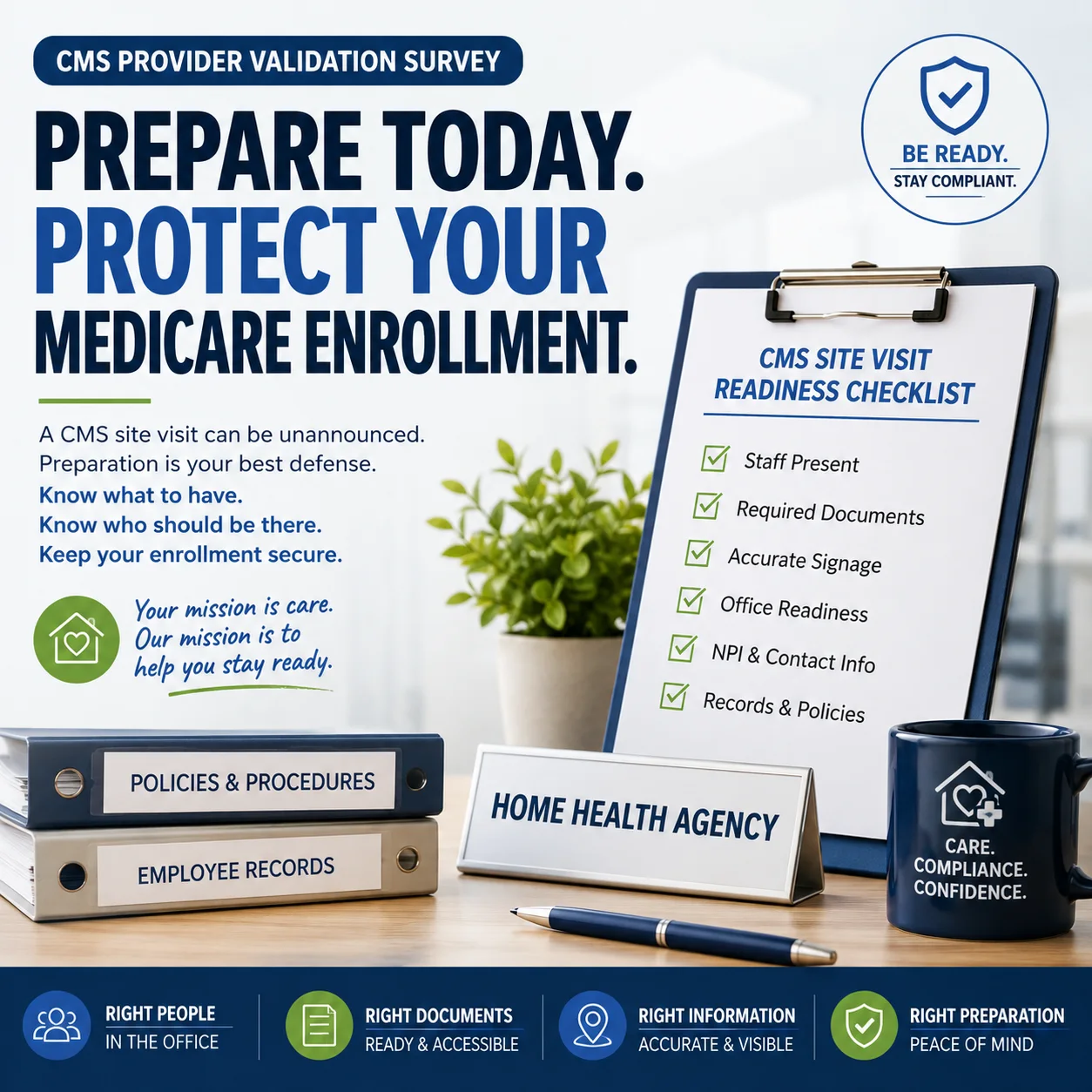
How Should Medicare Home Health Agencies Prepare for a CMS Provider Validation Survey?
A CMS provider enrollment site visit may be unannounced. Prepare your people, office, records, signage, and enrollment information before an inspector arrives.