
What Documentation Should Home Health Agencies Audit Before Billing?
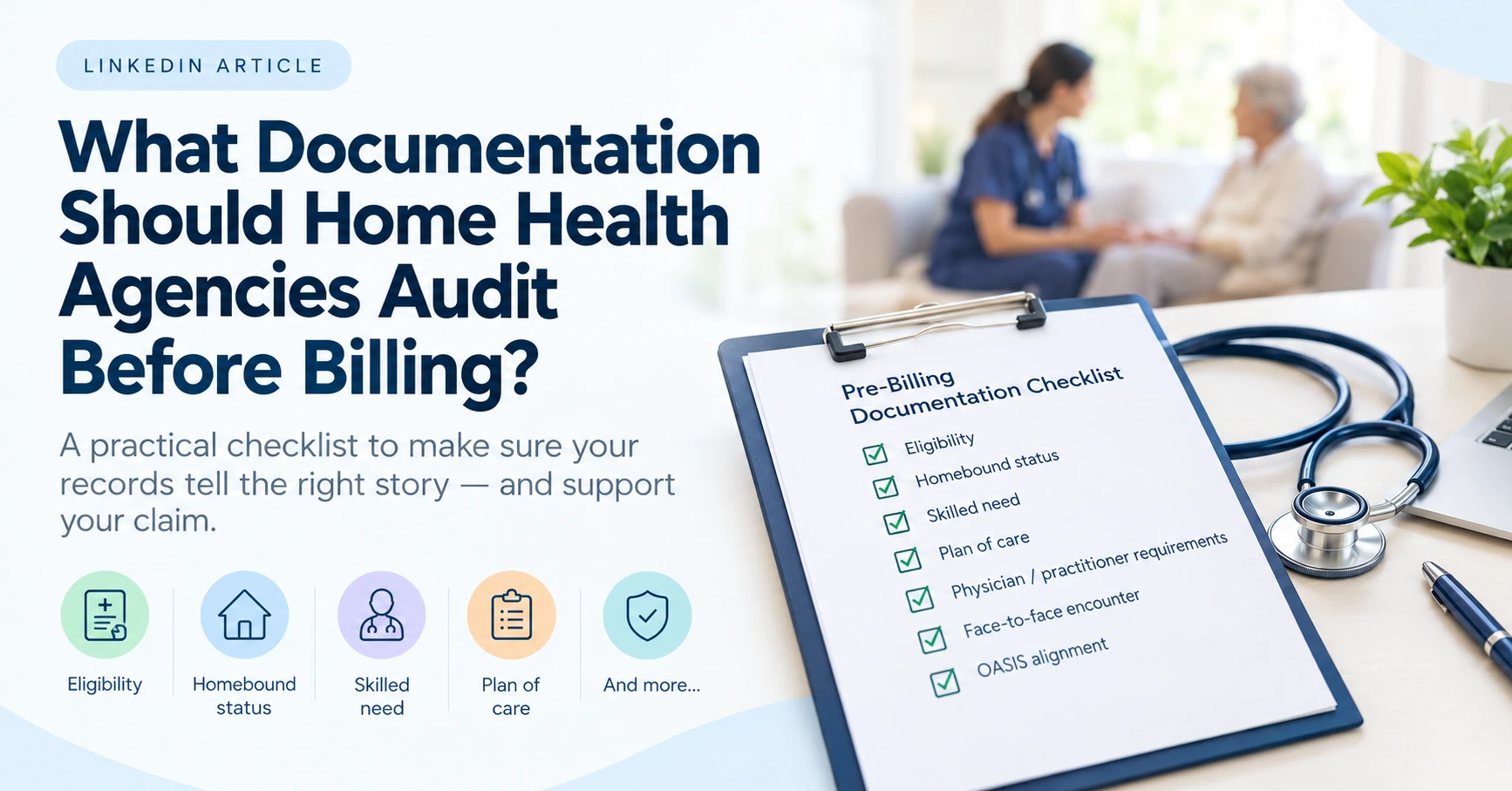
Before billing, confirm that eligibility, medical necessity, orders, OASIS-E2, coding, and visit documentation tell a consistent story and support the services on the claim.
Key Takeaways
- Review the plan of care, orders, face-to-face encounter, homebound status, and medical necessity before billing.
- Compare OASIS-E2 responses and diagnoses with the assessment, plan of care, and visit notes.
- Verify required signatures, dates, authentication, and patient-specific visit documentation.
- Reconcile documented visits with billed services and applicable visit-verification records.
- Use AI to flag potential gaps for human review, not as the final authority on claim compliance.
Why Should Home Health Agencies Audit Documentation Before Billing?
A home health claim is only as strong as the documentation supporting it.
Before billing, agencies need to make sure the patient's record tells a consistent story:
The patient qualified for home health → the care was ordered → the clinical need was established → the services were provided → the services were documented → the claim accurately reflects those services.
CMS's medical review guidance specifically identifies the medical record, OASIS, plan of care, progress notes, signatures, coding, and medical necessity as components that can be considered during home health claim review.
That makes a pre-billing documentation audit more than an administrative exercise.
It is a way to identify potential documentation gaps before they become billing, compliance, or medical-review problems.
What Should Home Health Agencies Include in a Pre-Billing Documentation Audit?
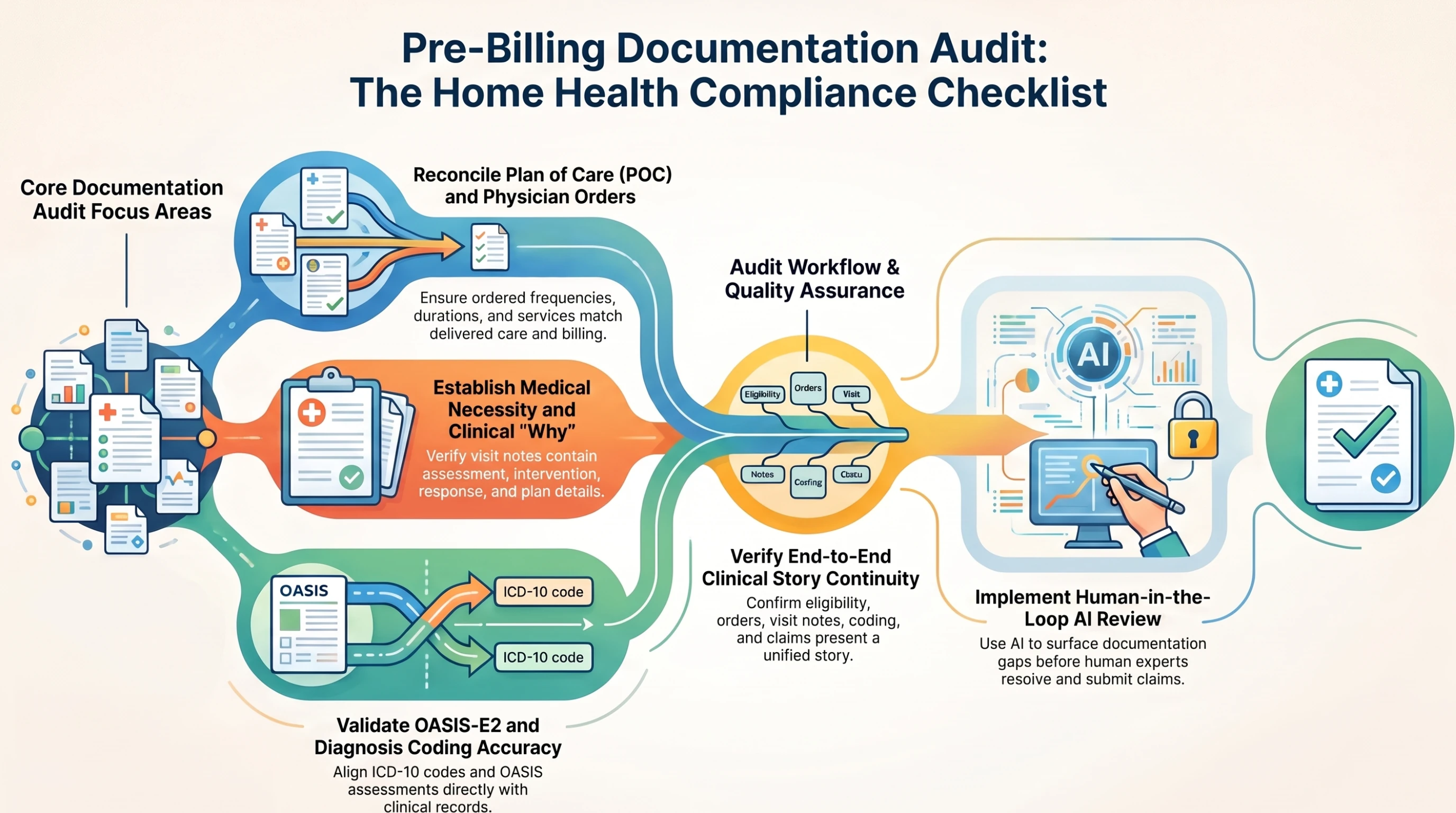
A practical pre-billing audit should cover five core areas:
- Plan of Care and Orders.
- Face-to-Face Encounter Documentation.
- Homebound Status and Medical Necessity.
- OASIS-E2 and Coding Accuracy.
- Signatures, Dates, and Visit Notes.
Agencies should also reconcile documented visits against billed services and applicable visit verification records, where required.
The objective is simple:
Does the clinical record support what the agency is about to bill?
What Should Agencies Audit in the Plan of Care and Physician Orders?
The Plan of Care (POC) and orders should be reviewed against the services actually delivered and billed.
The audit should verify:
- Ordered disciplines are consistent with services provided.
- Frequencies and durations match the applicable orders and POC.
- Ordered services and supplies are appropriately supported.
- Start-of-care information is complete.
- Required signatures and dates are present.
- Changes made during the episode or certification period are appropriately reconciled.
- The current POC reflects the patient's current needs and services.
This is particularly important because the POC is not a static document.
CMS states that the home health plan of care is reviewed every 60 days, or more frequently when the patient's condition warrants an update.
What should an agency ask?
Do the orders, POC, visit documentation, and claim all describe the same care?
If the POC says one thing and the visit record or claim says another, the discrepancy should be investigated before billing.
How Should Agencies Audit Face-to-Face Encounter Documentation?
The agency should confirm that required face-to-face encounter documentation is present and appropriately supports the home health episode.
The audit should verify:
- The encounter was performed by an appropriate practitioner.
- Required timing requirements are satisfied.
- The documentation is present in the record.
- The encounter supports the primary reason for home health.
- Required authentication is present.
- The clinical information is consistent with the patient's home health record.
The important point is that F2F documentation should not be treated as an isolated form.
It should fit into the broader clinical story supporting the patient's eligibility and need for home health.
How Should Agencies Audit Homebound Status and Medical Necessity?
Homebound status and medical necessity should be supported by the patient's clinical documentation.
The agency should look for documentation explaining the patient's relevant limitations and why the patient meets the applicable homebound criteria.
The audit should also ask:
- What skilled service was needed?
- Why was professional skill required?
- What clinical problem was addressed?
- What did the clinician assess?
- What intervention was provided?
- How did the intervention relate to the patient's goals or plan of care?
CMS guidance specifically addresses documentation supporting home health certification, coding, and medical necessity of services.
The key is to capture the clinical “why.”
A note that says a visit occurred is not necessarily enough to explain why the skilled service was necessary.
What Should Agencies Look for in Home Health Visit Notes?
Visit notes should allow a reviewer to understand what happened during the visit and why the service was clinically appropriate.
A practical audit can look for four elements:
Assessment: What did the clinician observe or assess?
Intervention: What skilled service was provided?
Response: How did the patient respond or what changed?
Plan: What happens next?
The agency should also look for documentation that is individualized to the patient rather than copied, cloned, vague, or ambiguous.
CMS's medical review guidance specifically addresses progress notes, templates, medical record review, and documentation used to support determinations.
How Should Agencies Audit OASIS-E2 Documentation?
For 2026, agencies should account for the current OASIS-E2 requirements, which became effective April 1, 2026.
The audit should compare OASIS information with the broader clinical record.
Look for consistency among:
- OASIS-E2 responses.
- Comprehensive assessment.
- Diagnoses.
- Functional status.
- Plan of care.
- Visit notes.
- Orders.
- Other supporting clinical documentation.
The question isn't whether every document uses exactly the same words.
The question is:
Does the OASIS assessment accurately reflect the patient's documented clinical condition and care needs?
How Should Agencies Audit OASIS Diagnosis and Coding Accuracy?
Diagnosis selection and coding should be reviewed carefully.
CMS OASIS guidance states that the primary diagnosis should reflect the chief reason the patient is receiving home care and be related to the current home health plan of care and skilled services. Secondary diagnoses should reflect conditions that are actively addressed or that can affect the patient's response to treatment or rehabilitative prognosis.
A pre-billing audit should therefore verify:
- Principal/primary diagnosis is appropriate.
- Secondary diagnoses are supported.
- Diagnoses are current and relevant.
- ICD-10-CM codes are accurate and sufficiently specific.
- Diagnosis sequencing follows applicable coding requirements.
- Diagnoses are supported by the medical record.
- OASIS diagnosis information aligns with the POC and clinical documentation.
This matters financially as well as clinically.
Under PDGM, the principal diagnosis is one of the variables used to place a 30-day period into a clinical group, while OASIS-derived information also contributes to case-mix adjustment.
So coding accuracy should not be treated as a separate billing-office task disconnected from the clinical assessment.
Should Agencies Audit M-Items and Other OASIS Data Before Billing?
Yes, agencies should review applicable OASIS data for accuracy and internal consistency.
The audit should focus on whether the assessment accurately reflects the patient's documented:
- Functional status.
- Clinical condition.
- Diagnoses.
- Care needs.
- Relevant assessment findings.
This is particularly important because OASIS data has multiple downstream uses in home health, including quality reporting and payment-related processes. CMS states that OASIS information is used for quality reporting, while OASIS-derived information is also incorporated into the home health payment system.
What Should Agencies Audit About Signatures, Dates, and Authentication?
Before billing, agencies should confirm that required documentation has been appropriately authenticated.
Review:
- Clinician identifiers.
- Signatures.
- Electronic signatures.
- Dates and timestamps.
- Practitioner authentication.
- Required attestations.
- Corrections.
- Amendments.
- Delayed entries.
The goal is not simply to confirm that a signature field contains something.
The agency should verify that the record provides appropriate evidence of who documented the service and when, consistent with applicable requirements.
CMS's medical review guidance specifically includes signature requirements and rules concerning amendments, corrections, and delayed entries.
How Should Agencies Reconcile Visit Notes With Billed Visits?
The agency should compare the clinical record against the services submitted for payment.
That means checking:
Visit documented → visit verified → service type confirmed → claim accurately reflects service
Where EVV or other visit-verification requirements apply, agencies should reconcile the applicable records rather than assuming the clinical note alone is sufficient.
The audit should look for:
- Visit date discrepancies.
- Missing visits.
- Duplicate visits.
- Incorrect visit types.
- Incorrect disciplines.
- Mismatched units or services.
- Documentation that does not support the billed service.
- Ambiguous or cloned documentation.
The goal is to make sure the visit that was billed is the visit that the record supports.
Should Agencies Audit for Cloned or Duplicate Documentation?
Yes.
A pre-billing review should look for documentation that appears copied forward without appropriate patient-specific updates.
Warning signs can include:
- Identical clinical findings across multiple visits.
- Identical patient responses.
- Identical goals or intervention descriptions despite changing circumstances.
- Notes that do not reflect documented changes in condition.
- Repeated language that conflicts with other parts of the record.
Templates can improve efficiency, but they should not replace individualized clinical documentation.
How Can Agencies Check Whether the Entire Record Tells a Consistent Story?
This is where the individual audit categories come together.
A reviewer should be able to follow the patient's story from:
Referral → Assessment → F2F → Homebound Status → OASIS-E2 → Diagnosis/Coding → POC → Orders → Visits → Documentation → Claim
Each component does not need to be identical.
But there should not be unexplained contradictions.
For example:
- Does the diagnosis support the skilled service?
- Does the skilled service match the POC?
- Does OASIS reflect the assessment?
- Does the visit note support the billed service?
- Do the orders support the care delivered?
- Does the claim accurately represent the documented care?
That is the real purpose of a pre-billing audit.
What Is the Core Pre-Billing Audit Checklist for Home Health Agencies?
| Audit Area | What to Verify |
|---|---|
| Plan of Care & Orders | Orders match billed frequencies, services, and applicable supplies; required dates/signatures are present; changes are appropriately reconciled |
| Face-to-Face Encounter | Required encounter documentation is present, appropriately timed, authenticated, and supports the home health need |
| Homebound Status | Documentation supports the applicable homebound criteria |
| Medical Necessity | Notes explain the clinical need and skilled “why” behind services |
| OASIS-E2 | Assessment accurately reflects the patient's documented condition and care needs |
| Coding | Primary and secondary diagnoses are supported, current, appropriately sequenced, and accurately coded |
| Case-Mix Data | Applicable OASIS and diagnosis information used in payment classification is accurate |
| Signatures & Authentication | Required signatures, identifiers, dates, timestamps, and attestations are complete |
| Visit Notes | Assessment, intervention, response, and plan are documented |
| Visit Verification | Applicable EVV/log information reconciles with documented and billed visits |
| Duplicate/Cloned Notes | Documentation is patient-specific and does not contain unexplained duplication |
| Claim Reconciliation | Billed services, dates, disciplines, diagnoses, and documentation agree |
Why Should Home Health Agencies Audit Documentation Before the Claim Is Submitted?
Because a pre-billing audit gives the agency something a post-payment review does not:
time to fix the problem.
Once a payer or contractor requests documentation, the agency is no longer identifying a potential gap internally. It is responding to an external review.
A structured pre-billing process can help identify exceptions involving:
- Missing documentation.
- Inconsistent information.
- Unsupported diagnoses.
- Missing orders.
- Authentication problems.
- OASIS discrepancies.
- Medical necessity concerns.
- Visit discrepancies.
- Claim-to-record mismatches.
The objective is not to create another layer of paperwork.
It is to catch documentation problems before they become claim problems.
Can AI Help Home Health Agencies With Pre-Billing Documentation Audits?
AI can potentially make this process more efficient by helping agencies identify records that deserve human review.
Depending on the system, AI could potentially:
- Extract information from clinical documentation.
- Compare information across multiple documents.
- Identify missing fields or information.
- Flag potential inconsistencies.
- Compare OASIS information with supporting documentation.
- Identify potential discrepancies between orders and visits.
- Surface unsigned or incomplete records.
- Help organize records for human review.
But AI should not be treated as the final authority on whether a claim is compliant.
A better model is:
AI identifies → Human reviews → Agency resolves → Claim is submitted
That keeps clinical judgment and accountability with the appropriate professionals.
What Is the Final Question Agencies Should Ask Before Billing?
The final audit question should be simple:
Does the documentation support what we are about to bill?
That means being able to connect:
Eligibility → Medical necessity → Orders → OASIS-E2 → Plan of Care → Visit → Documentation → Coding → Claim
If those pieces align, the agency has a much stronger foundation for billing.
If they don't, the best time to discover the problem is before the claim leaves the agency.
Good home health billing starts with good documentation.
And a strong pre-billing audit isn't about creating more work for clinicians.
It's about making sure the work they've already done is accurately documented, supported, and ready to stand up to review.
What Should I Document? 100 OASIS Situations Home Health Nurses Face Every Day
100 real OASIS scenarios, worked end to end — clinical situation, common mistake, better approach, and key takeaway. Built around OASIS-E2 (effective April 1, 2026) to turn what you assess into accurate, defensible documentation.
Bottom Line
Before billing, make sure the clinical record supports the claim: eligibility, medical necessity, orders, OASIS-E2, the plan of care, visit notes, and coding should agree.
Inside Home Health Podcast
The Hidden Spreadsheet Error That’s Causing the Nursing Shortage | Robert Wingo

Arvind Sarin is the founder of Copper Digital. He works inside home health agencies to build AI documentation workflows that help clinicians finish OASIS and visit notes sooner, with a nurse reviewing and approving every note. He writes about home health documentation, Medicare compliance, and applying AI responsibly in clinical workflows.
Join the conversation
Leave a comment
No comments yet. Be the first to share your thoughts.
Related reading
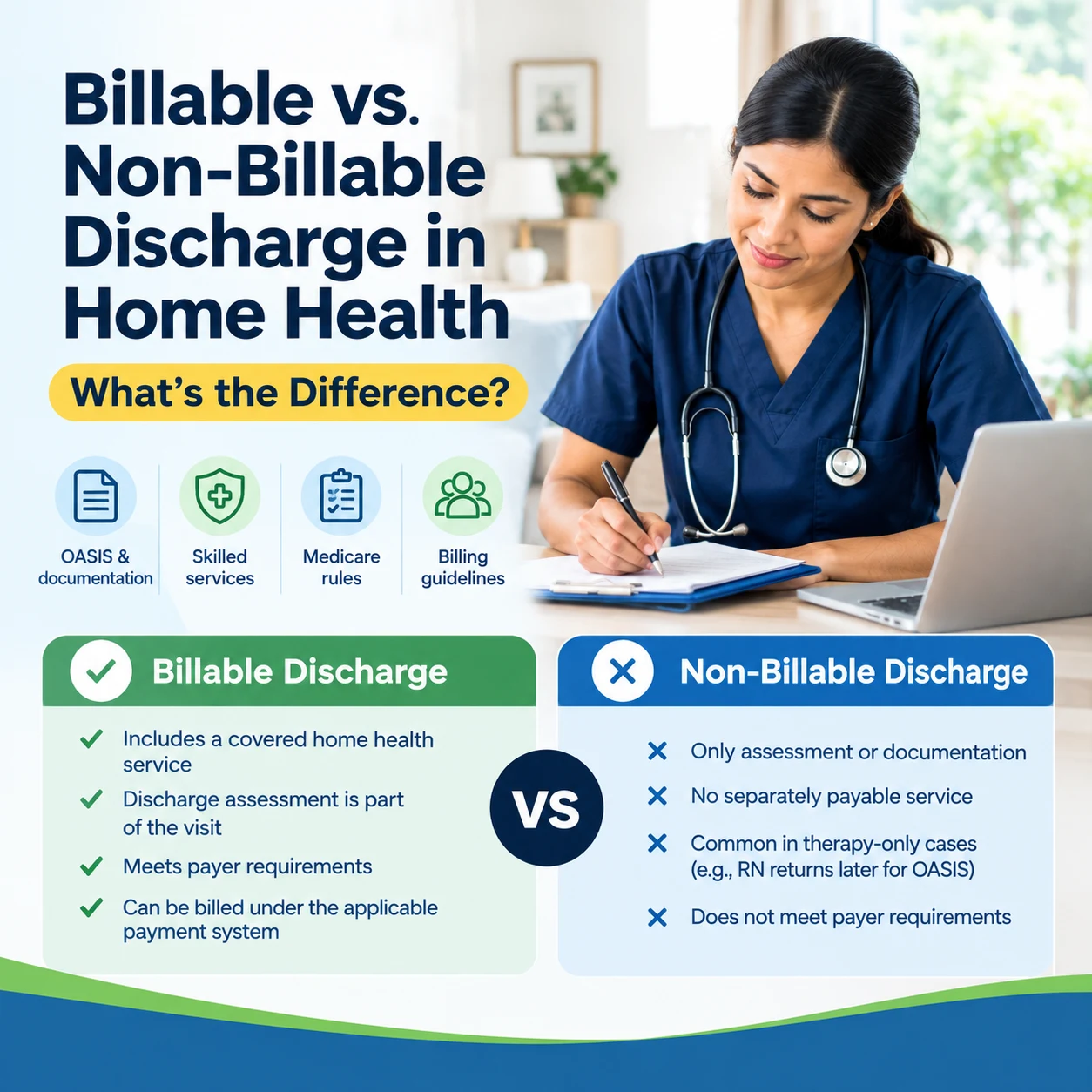
Billable vs. Non-Billable Discharge in Home Health: What's the Difference?
A discharge OASIS does not automatically make a home health visit billable. Learn how covered skilled services, payer rules, documentation, and the final clinician determine whether a discharge encounter may be payable.
What Is an ABN in Home Health & Hospice? Complete Guide With Billing Instructions
A patient wants to continue care, but Medicare may not pay for it. Who owes the bill? That's where the Advance Beneficiary Notice of Noncoverage (ABN), Form CMS-R-131, comes in. Here's when it's required in home health and hospice, what makes it valid, the beneficiary's three choices, and how to bill it correctly.
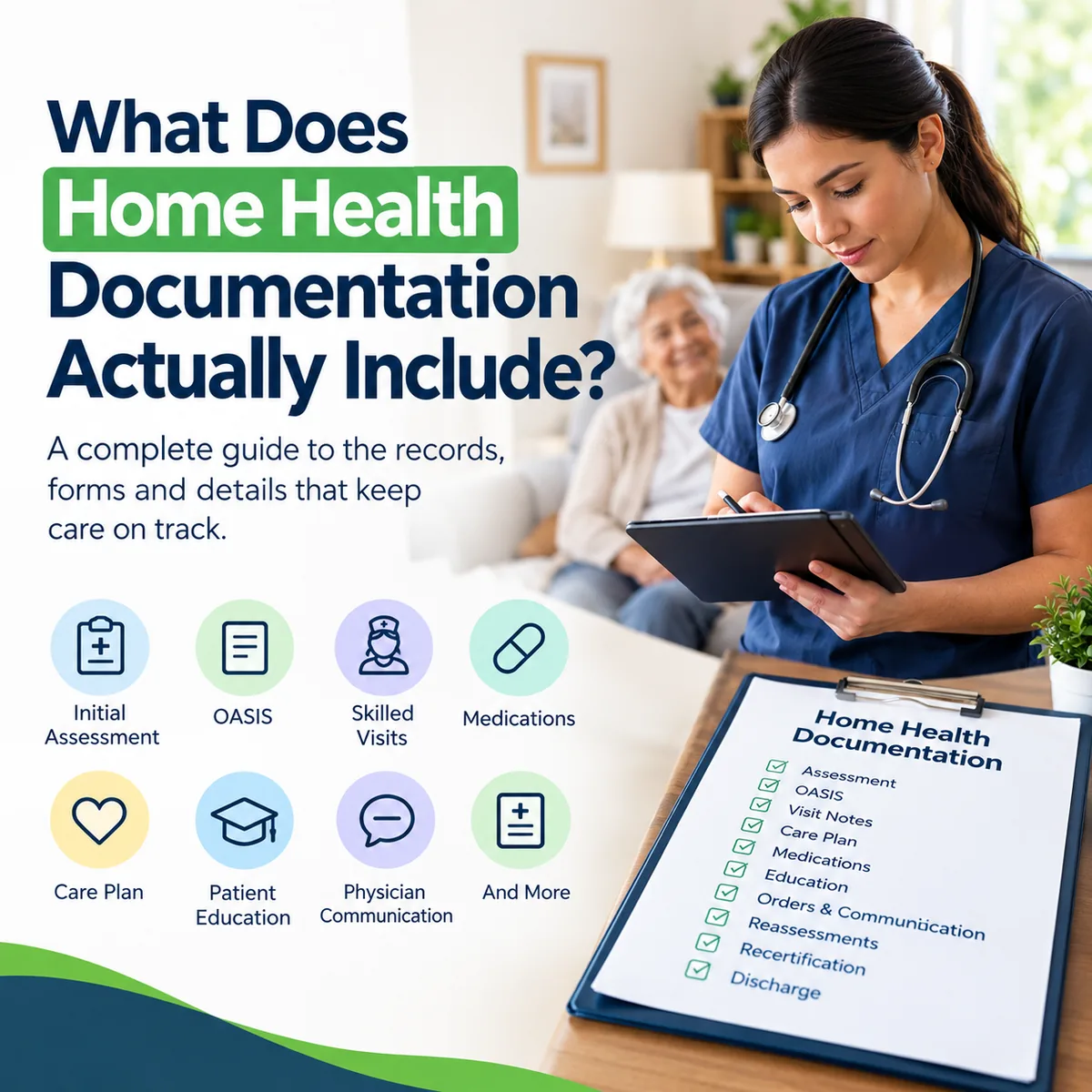
What Does Home Health Documentation Actually Include?
Home health documentation is much more than a visit note. Across an episode it spans the initial assessment, OASIS, skilled visits, medications, the care plan, education, physician communication, orders, reassessments, recertification, and discharge: each piece is part of the patient's larger story of care.