
What Does Home Health Documentation Actually Include?
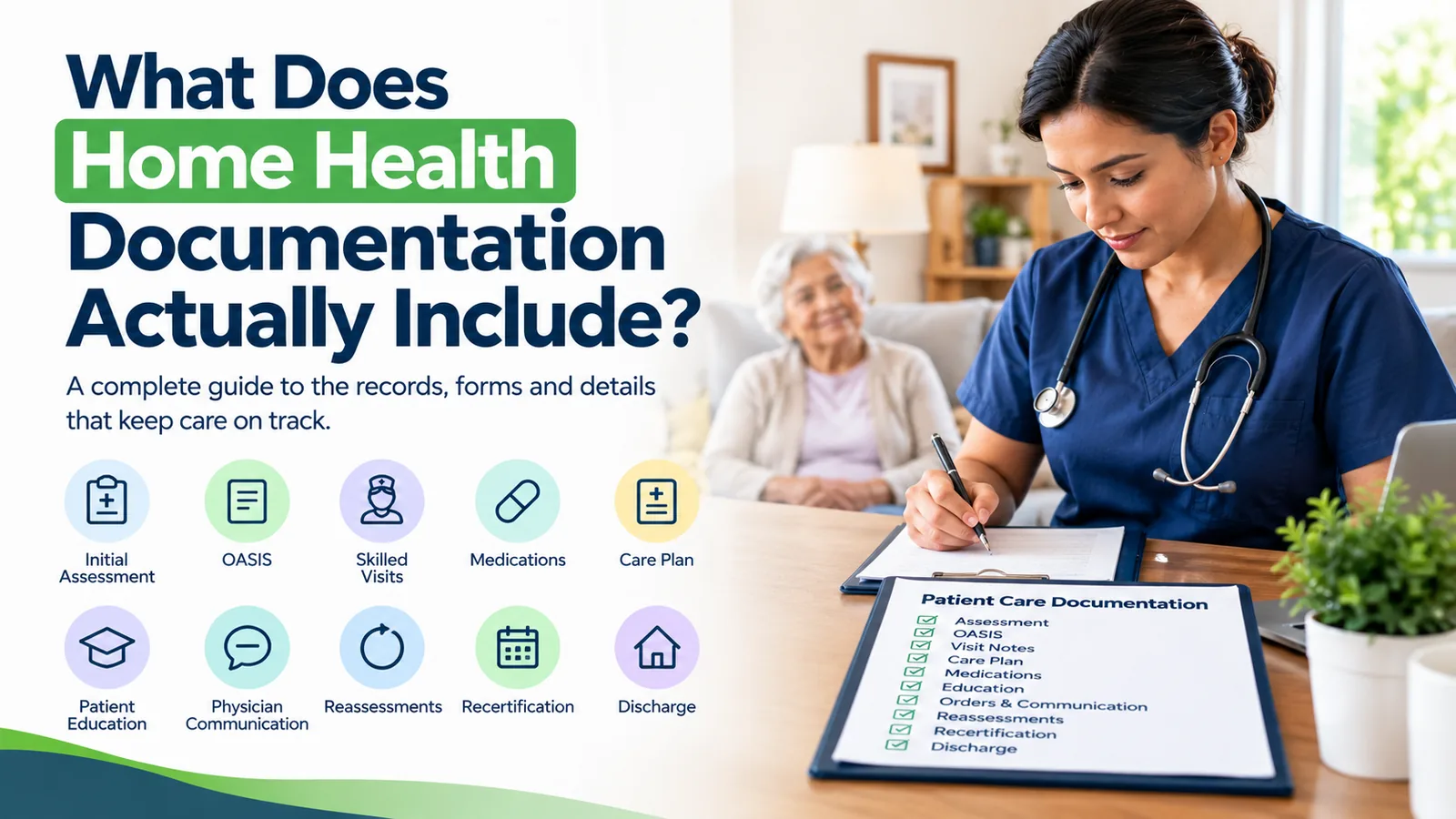
Home health documentation is much more than a visit note. Across an episode it spans the initial assessment, OASIS, skilled visits, medications, the care plan, education, physician communication, orders, reassessments, recertification, and discharge: each piece is part of the patient's larger story of care.
Key Takeaways
- Home health documentation is the full clinical and administrative record of a patient's episode, not a single visit note.
- It spans the comprehensive assessment, OASIS, visit notes, plan of care, medications, education, physician communication, reassessments, recertification, and discharge.
- For Medicare, documentation must support eligibility, skilled need, homebound status, and the link between the patient's condition and the services provided.
- OASIS-E2 is the current OASIS version as of April 1, 2026, and is a structured assessment dataset, not just another nursing note.
- The documentation burden is the accumulation of many small tasks and duplicate entry, not one giant note; the fix is removing steps, not typing faster.
- AI can reduce repetitive documentation work, extracting, drafting, organizing, flagging gaps, while the clinician reviews and keeps clinical judgment.
✓ Quick answer: Home health documentation is far more than a visit note. Across an episode it can span the initial assessment, OASIS, skilled visit notes, medications, the plan of care, patient education, physician communication, orders, reassessments, recertification, and discharge: each piece supporting the patient's care, eligibility, compliance, and continuity.
Home health documentation is much more than a visit note. For a home health agency, documentation can span the patient's initial assessment, OASIS, skilled visits, medications, care plan, patient education, physician communication, orders, reassessments, recertification, and discharge.
And because much of this information supports the patient's care, eligibility, compliance, and continuity, documentation needs to be accurate, timely, and connected to what is actually happening in the home. CMS requires Medicare-certified home health agencies (HHAs) to maintain clinical records, and Medicare home health documentation must support applicable eligibility and plan-of-care requirements.
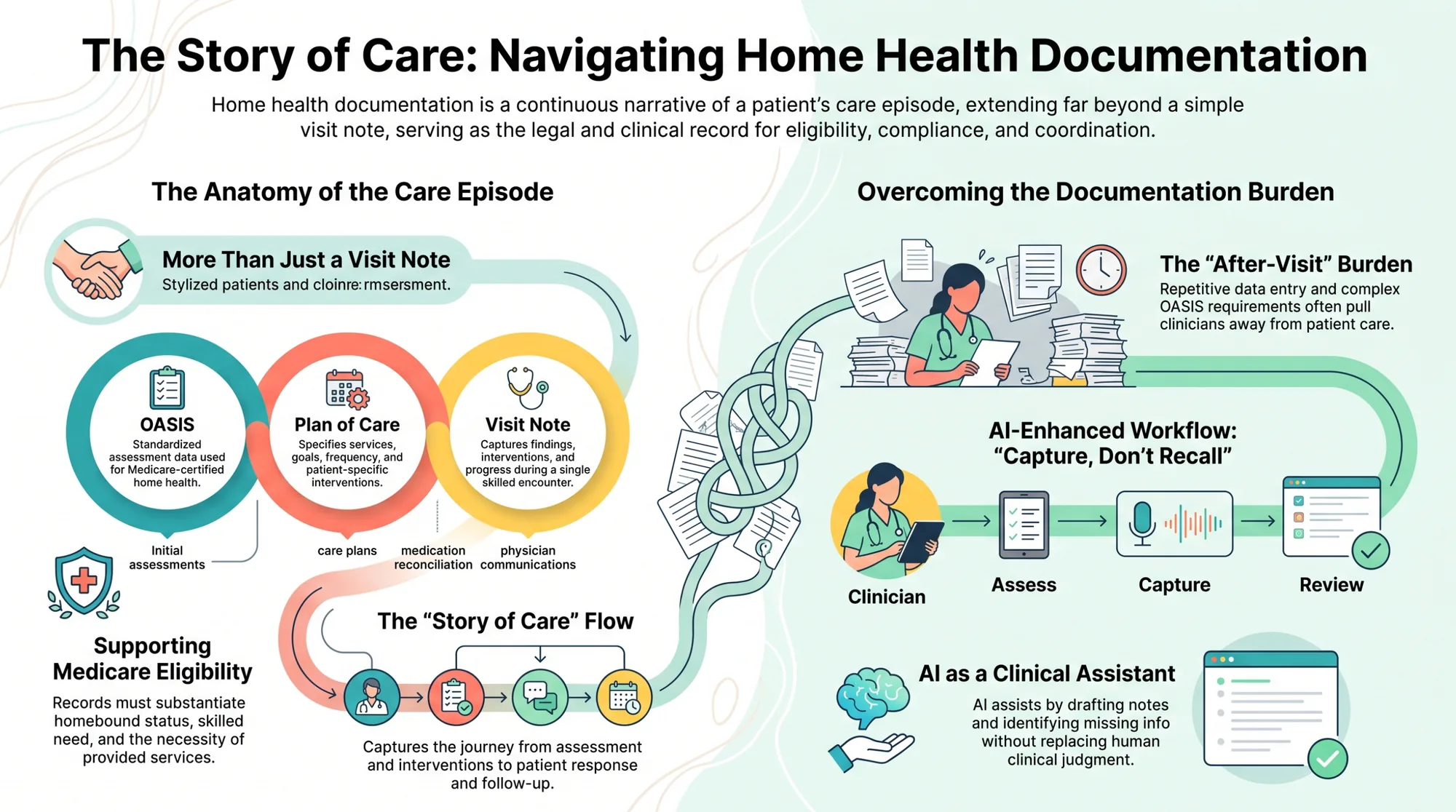
Home health documentation is a continuous narrative of the care episode: OASIS, plan of care, and visit notes form the anatomy, while an AI-enhanced "capture, don't recall" workflow helps overcome the after-visit burden.
What Is Home Health Documentation?
Home health documentation is the collection of clinical, administrative, and care-related information recorded throughout a patient's home health episode. It helps communicate:
- Why the patient needs home health services.
- What the clinician found during the visit.
- What care was provided.
- How the patient is progressing.
- What interventions were performed.
- What the patient and caregiver were taught.
- What changes occurred in the patient's condition.
- What follow-up is required.
- How the plan of care should change.
- Why services should continue, change, or end.
For Medicare home health, documentation also plays an important role in demonstrating applicable eligibility requirements, skilled need, homebound status, and the relationship between the patient's condition and the services provided.
What Are the Main Types of Home Health Documentation?
Home health documentation can include several different types of records rather than one single document.
| Documentation Type | What It Captures |
|---|---|
| Comprehensive Assessment | Patient condition, functional status, risks, needs, and care requirements |
| OASIS | Standardized assessment information collected at applicable time points |
| Visit Notes | What happened during an individual skilled visit |
| Plan of Care | Services, disciplines, frequency, duration, goals, and interventions |
| Medication Documentation | Medications, treatments, reconciliation, and related observations |
| Patient & Caregiver Education | Teaching provided and patient/caregiver response |
| Physician/Practitioner Communication | Changes, orders, questions, updates, and coordination |
| Reassessment Documentation | Changes in condition, progress, continued needs, and updated findings |
| Recertification Documentation | Information supporting continued home health services |
| Discharge Documentation | Patient status, reason for discharge, outcomes, and transition information |
The exact documentation required can vary based on the patient, payer, assessment time point, service provided, and applicable regulations.
What Does the Initial Home Health Assessment Include?
The initial assessment establishes a clinical picture of the patient and helps determine what care is needed. Depending on the patient and applicable requirements, documentation may include:
- Diagnoses and medical history.
- Current health status.
- Functional limitations.
- Mobility and ability to perform activities of daily living.
- Medication information.
- Safety risks.
- Pain.
- Cognitive and behavioral observations.
- Skin and wound status.
- Nutritional considerations.
- Cardiopulmonary status.
- Patient and caregiver needs.
- Home environment considerations.
- Skilled service needs.
- Goals and expected outcomes.
CMS guidance states that the comprehensive assessment and supporting clinical information are important in establishing the patient's overall health status and care needs.
What Is OASIS Documentation in Home Health?
OASIS stands for Outcome and Assessment Information Set. It is a standardized set of assessment items used in Medicare-certified home health and is collected at applicable time points for eligible patients.
As of April 1, 2026, OASIS-E2 is the current OASIS version. OASIS captures information related to areas such as:
- Patient demographics.
- Clinical conditions.
- Functional status.
- Medication-related information.
- Cognitive and psychosocial factors.
- Risk factors.
- Care needs.
- Outcomes and changes in condition.
OASIS is not simply another nursing note. It is a structured assessment dataset with specific instructions for collection and submission.
For a deeper explainer, see what OASIS-E is in home health.
What Does a Home Health Visit Note Include?
A home health visit note documents what occurred during a particular visit. Depending on the discipline and type of service, it may include:
- Reason for the visit.
- Patient's current condition.
- Assessment findings.
- Vital signs and relevant measurements.
- Symptoms and changes.
- Interventions performed.
- Medications or treatments addressed.
- Patient response.
- Education provided.
- Communication with caregivers or other providers.
- Progress toward goals.
- Changes requiring follow-up.
- Plan for the next visit.
The key is that the documentation should reflect the actual care provided and the patient's clinical status.
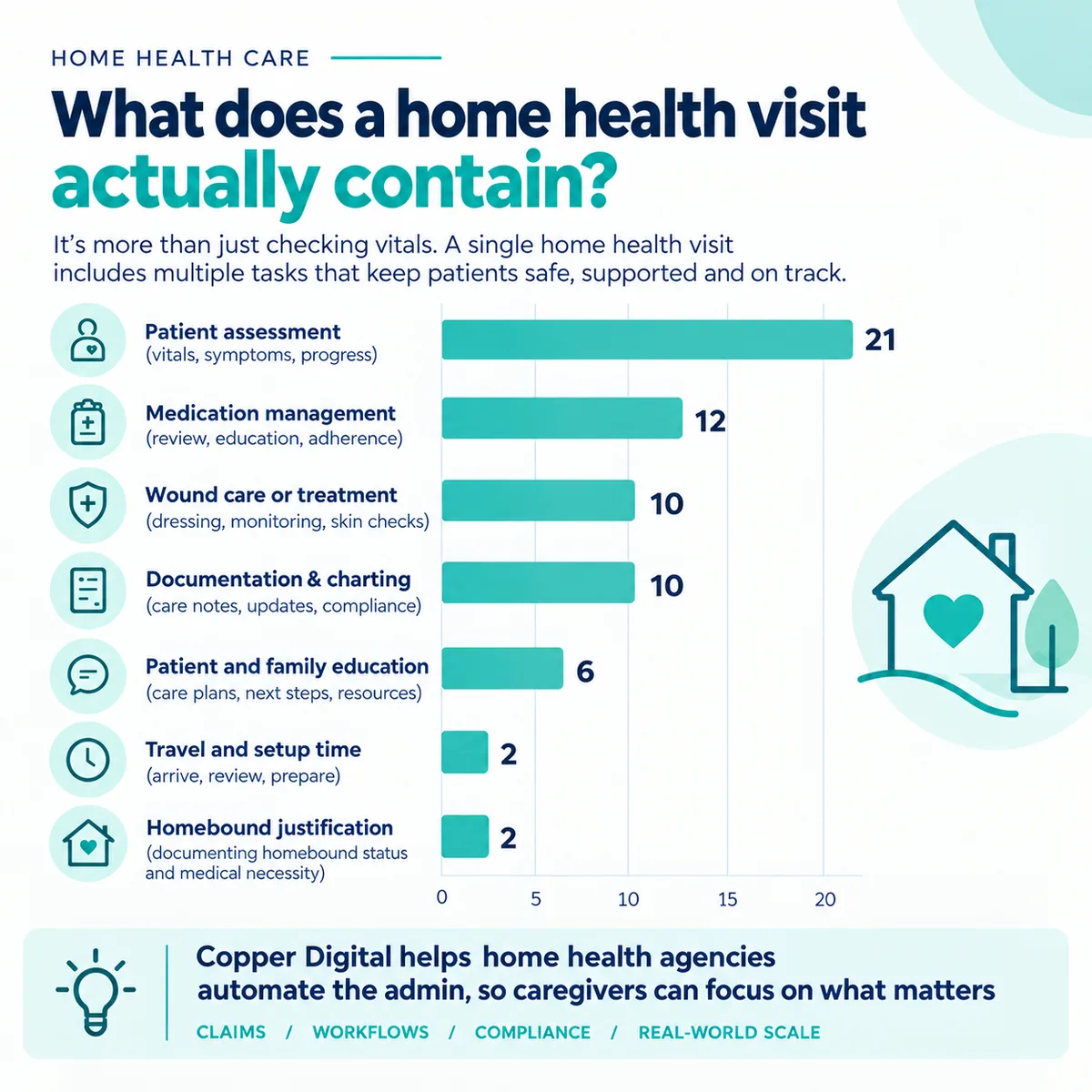
A single home health visit is more than checking vitals: patient assessment, medication management, wound care, documentation, education, travel, and homebound justification all add up.
What Does Medication Documentation Include?
Medication-related documentation can appear throughout the home health record. It may involve:
- Current medications.
- Medication reconciliation.
- Medication changes.
- Medication adherence.
- Side effects or adverse reactions.
- Patient/caregiver understanding.
- Medication-related education.
- Communication about discrepancies or concerns.
Medication information can also contribute to the clinician's understanding of the patient's overall condition and care needs. CMS's OASIS-E2 guidance specifically identifies the medication list as one source of information used when assessing and determining diagnoses.
What Does a Home Health Plan of Care Include?
The plan of care connects the patient's assessed needs with the services the agency will provide. CMS states that the individualized plan of care must specify the services needed to address the patient's specific needs identified through the comprehensive assessment.
It also includes responsible disciplines and the frequency and duration of visits. Depending on the patient and applicable requirements, the plan can address:
- Diagnoses.
- Services to be provided.
- Disciplines involved.
- Frequency and duration of services.
- Medications and treatments.
- Safety measures.
- Patient-specific interventions.
- Patient and caregiver education.
- Goals and measurable outcomes.
- Expected therapy duration.
- Discharge-related education and planning.
- Other applicable care requirements.
What Does Patient and Caregiver Education Documentation Include?
Education is another important part of home health documentation. A clinician may document what was taught, why it was taught, who received the education, patient or caregiver understanding, demonstration of the skill when applicable, questions or concerns, additional teaching required, and follow-up plans.
For example, documentation might capture education related to medication management, wound care, fall prevention, disease management, diet, equipment, or recognizing symptoms that require medical attention.
What Does Physician or Practitioner Communication Include?
Home health often requires communication between the agency and other members of the patient's care team. Documentation may include changes in patient condition, medication concerns, new symptoms, orders, clarifications, treatment changes, results or observations, follow-up recommendations, and care coordination.
These records help create a traceable connection between what the clinician observes in the home and what happens next.
What Is Included in Home Health Reassessment Documentation?
A reassessment documents how the patient's condition and care needs have changed over time. It can include:
- Changes in symptoms.
- Changes in functional ability.
- Progress toward goals.
- New risks.
- Changes in medications.
- Response to interventions.
- Continued skilled needs.
- Changes to the plan of care.
- New or discontinued interventions.
The purpose is not simply to repeat the previous assessment. It should reflect the patient's current situation.
What Documentation Is Needed for Home Health Recertification?
When continued Medicare home health services are needed, documentation must support the applicable requirements for continued eligibility and the ongoing plan of care. CMS states that at the end of the 60-day certification period, a decision is made about recertification, and the plan of care must be reviewed and signed at least every 60 days when continuous home health care is needed.
Documentation supporting continued care may include:
- Current clinical findings.
- Continued skilled need.
- Homebound status where applicable.
- Progress or changes in condition.
- Updated plan of care.
- Relevant assessment information.
- Supporting medical record documentation.
For how this differs from ending care, see home health recertification vs discharge.
What Does Home Health Discharge Documentation Include?
Discharge documentation closes the patient's home health episode. Depending on the circumstances, it may include:
- Patient's condition at discharge.
- Reason for discharge.
- Goals and outcomes.
- Services provided.
- Current functional status.
- Medication-related information.
- Patient/caregiver education.
- Follow-up recommendations.
- Coordination with other providers.
- Applicable discharge assessment information.
The exact requirements depend on the reason for discharge and applicable assessment and payer rules.
Why Is Home Health Documentation So Detailed?
Because home health care happens outside a traditional clinical facility. The record needs to connect what happened in the patient's home with the broader plan of care and care team.
Good documentation helps answer simple but important questions:
- What was happening with the patient?
- What did the clinician do?
- Why was it necessary?
- How did the patient respond?
- What changed?
- What happens next?
For Medicare, documentation also needs to support applicable eligibility and medical-necessity requirements. CMS notes that the certifying physician's or applicable facility's medical record must contain sufficient information to substantiate eligibility for the home health benefit.
Why Does Home Health Documentation Take So Long?
The burden isn't necessarily one giant documentation task. It can be the accumulation of many smaller tasks: assessing the patient, remembering required information, entering findings, completing structured assessments, updating medications, writing visit notes, updating the plan of care, documenting education, communicating with providers, checking for missing information, correcting inconsistencies, completing reassessments, preparing recertification documentation, and completing discharge documentation.
And sometimes the same information has to be entered or referenced in multiple parts of the workflow. That creates a bigger problem than typing speed.
The real issue is how much work is required to produce complete, accurate documentation. For the research on this, see how much of a nursing shift is spent on documentation.
How Can AI Help With Home Health Documentation?
AI can potentially reduce some of the repetitive work surrounding documentation. For example, AI can assist with:
- Extracting information from existing records.
- Drafting visit documentation.
- Organizing assessment information.
- Summarizing patient history.
- Identifying missing information.
- Detecting inconsistencies.
- Converting spoken information into structured documentation.
- Reducing repetitive data entry.
- Preparing information for clinician review.
But AI should not replace clinical judgment. A useful workflow is one where AI handles appropriate administrative or documentation tasks while the clinician reviews the output, corrects it when needed, and remains responsible for clinical decisions.
This is the essence of human-in-the-loop AI in healthcare.
The goal isn't simply “AI writes the note.” The bigger opportunity is: AI reduces the work required to create the right documentation.
What Should a Home Health Documentation Workflow Look Like?
A strong workflow should connect documentation to care rather than make documentation a separate administrative exercise. Ideally:
Assess → Capture → Document → Review → Complete
Instead of: Assess → Remember → Search → Re-enter → Check → Fix → Document → Recheck → Finish later. That distinction matters because reducing documentation burden isn't just about making clinicians type faster; it's about removing unnecessary steps.
When AI is involved, it should also be handled under HIPAA-compliant AI documentation practices.
What Are Common Home Health Documentation Challenges?
Some common challenges include:
- Repetitive data entry.
- Documentation after the visit.
- Missing information.
- Inconsistent information across records.
- Complex OASIS requirements.
- Medication reconciliation.
- Frequent plan-of-care updates.
- Multiple communication steps.
- Documentation that takes time away from patient care.
- Difficulty finding information in large records.
- Having to correct or clarify documentation later.
The challenge is especially important because home health clinicians are documenting while also managing travel, patient care, education, coordination, and changing clinical conditions.
What Is the Simplest Way to Understand Home Health Documentation?
Think of home health documentation as the story of the patient's care. It should show: where the patient started → what the clinician found → what care was provided → how the patient responded → what changed → what happens next.
OASIS, visit notes, care plans, medication documentation, communication, reassessments, recertification, and discharge documentation are different pieces of that larger record.
What Should I Document? 100 OASIS Situations Home Health Nurses Face Every Day
100 real OASIS scenarios, worked end to end — clinical situation, common mistake, better approach, and key takeaway. Built around OASIS-E2 (effective April 1, 2026) to turn what you assess into accurate, defensible documentation.
Bottom Line
Think of home health documentation as the story of the patient's care: where the patient started, what the clinician found, what care was provided, how the patient responded, what changed, and what happens next. OASIS, visit notes, care plans, medications, communication, reassessments, recertification, and discharge are all pieces of that one record, and the opportunity is to reduce the work required to produce it accurately, not to replace clinical judgment.
Inside Home Health Podcast
How AI Can Give Clinicians Their Time Back

Arvind Sarin is the founder of Copper Digital. For the past year he has spent three days a week inside a 500+ census Texas home health agency, building AI documentation that finishes OASIS and visit notes the same day, with a nurse reviewing and approving every note. He writes about home health documentation, OASIS, Medicare compliance, and applying AI responsibly in clinical workflows.
Frequently asked
Frequently asked questions
Home health documentation includes the clinical and administrative records created throughout a patient's home health episode. This can include comprehensive assessments, OASIS, visit notes, medication documentation, care plans, patient and caregiver education, physician or practitioner communication, reassessments, recertification documentation, and discharge documentation.
Join the conversation
Leave a comment
No comments yet. Be the first to share your thoughts.
Related reading
PDGM vs. PPS: What's Changed for Home Health?
PDGM did not replace Medicare's Home Health Prospective Payment System. It changed the case-mix methodology inside HH PPS, and reshaped payment periods, coding, OASIS, LUPA monitoring, billing, and cash flow.
What Is a Comprehensive Assessment in Home Health?
A complete guide to comprehensive assessments in home health: required content, current Medicare timing, OASIS-E2, clinician responsibility, care planning, documentation errors, and a practical checklist.
Home Health Documentation Templates With Examples
A complete guide to home health documentation templates, with practical examples for skilled nursing visits, OASIS, SOC, ROC, recertification, wounds, medications, care plans, and compliance.