
Home Health Recertification vs Discharge: What Are the Key Differences?
Recertification and discharge look similar—both involve assessment, documentation, and physician communication—but they answer two different questions: does the patient still need home health, or is it time for care to end? Here's how the timing, OASIS, and documentation differ.
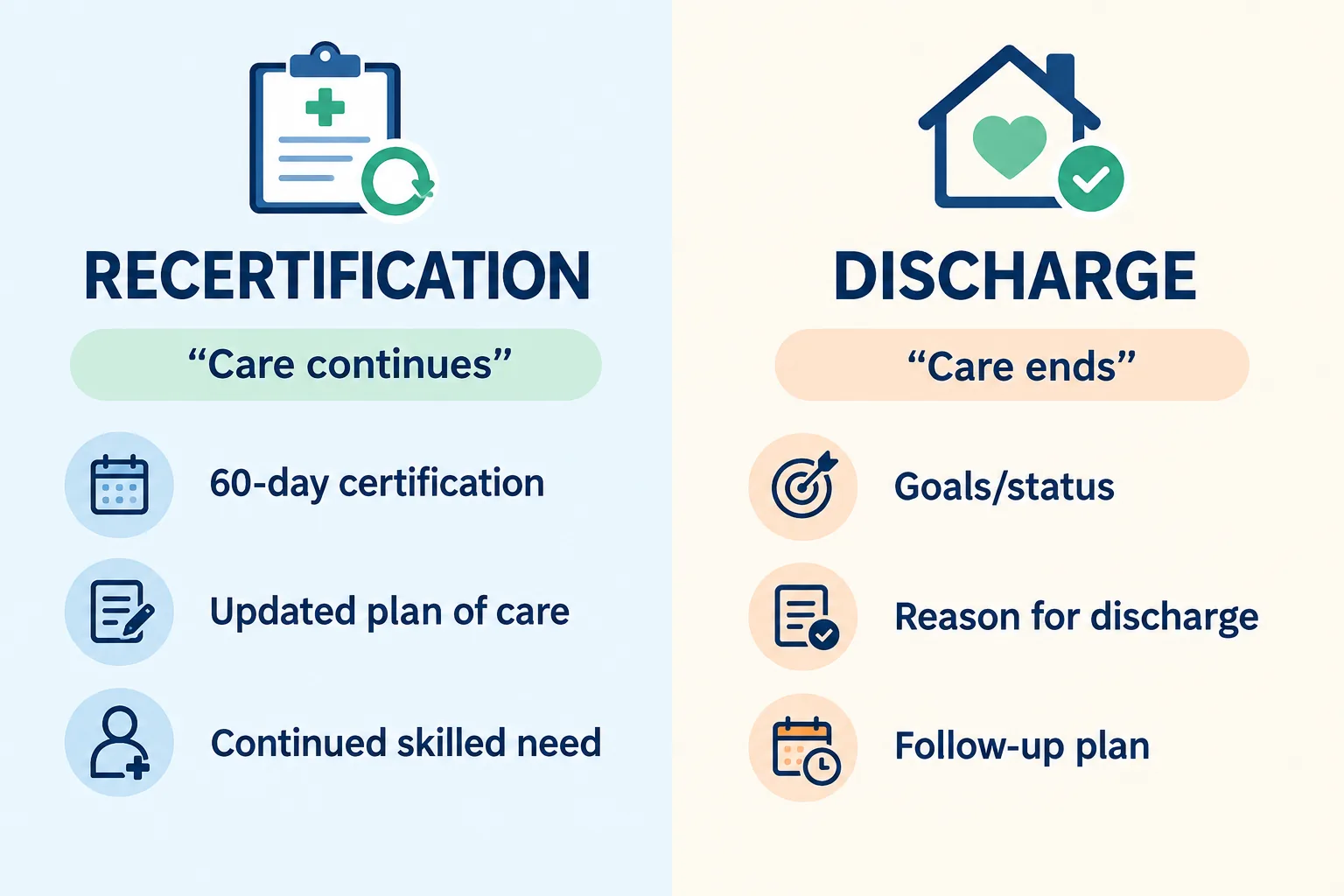
Key Takeaways
- Recertification asks “does this patient still qualify for and need home health?” Discharge asks “is it time for services to end?”
- Medicare home health allows unlimited continuous 60-day recertifications as long as eligibility continues; the recertification assessment is generally performed during the last five days (days 56–60) of the certification period.
- The 60-day certification period is separate from the 30-day payment periods under PDGM—payment is every 30 days, but eligibility and plan-of-care review remain every 60 days.
- Discharge can occur any time an applicable reason arises and does not have to wait for the 60-day mark.
- Both recertification and discharge are OASIS assessment time points for applicable patients; OASIS-E2 is the current version effective April 1, 2026.
- Documentation should tell a clinical story: for recertification, why care continues; for discharge, the patient's status and why care is ending—AI can help draft it, but clinical judgment stays with the clinician.
✓ Quick answer: Recertification and discharge both involve assessment and documentation, but they answer different questions. Recertification continues home health services into another 60-day certification period when the patient still meets Medicare's requirements. Discharge ends the episode when an applicable reason occurs. In short: recertification = care continues; discharge = care ends.
Home health recertification and discharge can look similar on the surface because both involve assessments, documentation, care-plan decisions, and communication with the patient's physician or allowed practitioner. But they answer two very different questions:
- Recertification asks: Does this patient still qualify for and need home health care?
- Discharge asks: Is it time for this patient's home health services to end?
For Medicare home health, continuous care can be recertified in successive 60-day periods when the beneficiary continues to meet the requirements for the home health benefit. CMS also requires a recertification assessment during the last five days of the current certification period in applicable circumstances.
Understanding the difference matters because the documentation needs to support the clinical decision being made.
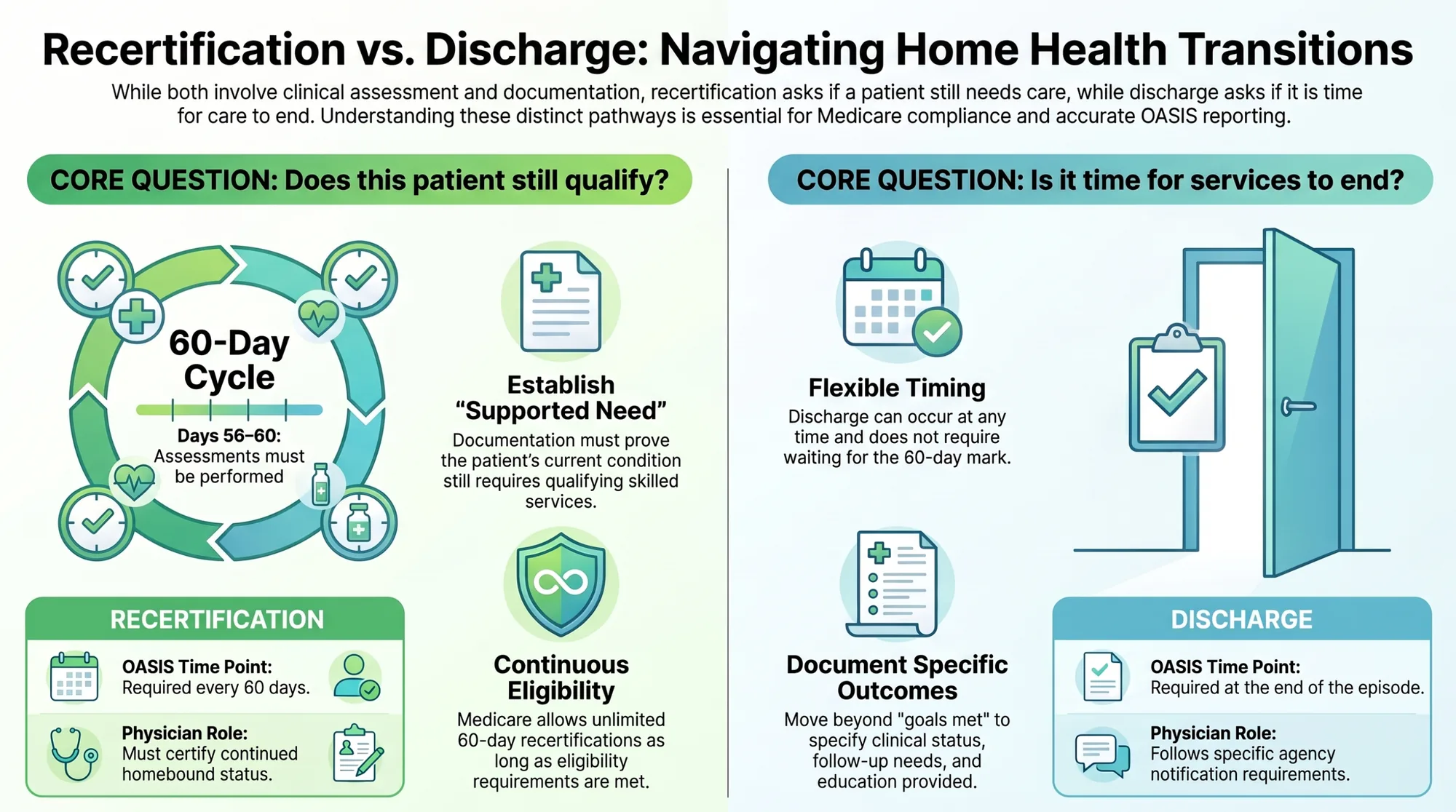
Recertification asks whether the patient still qualifies for home health on the 60-day cycle; discharge asks whether it is time for services to end. Both are OASIS time points, but the documentation supports different decisions.
What Is Home Health Recertification?
Home health recertification is the process of continuing a patient's home health services into another certification period when the patient continues to meet the applicable requirements for Medicare home health. CMS explains that home health permits continuous 60-day recertifications for patients who remain eligible for the benefit, and Medicare does not place a limit on the number of continuous 60-day recertifications when eligibility continues.
In practical terms, recertification means the care team needs to establish that the patient still has a supported need for home health services. The clinical record should therefore answer:
- What is the patient's current condition?
- What has changed since the previous certification period?
- What skilled needs remain?
- What care is being provided?
- How is the patient responding?
- What goals have been met?
- What goals or risks remain?
- Why is continued home health care appropriate?
Recertification is not simply an administrative extension of the previous episode. It should reflect the patient's current clinical situation and continued eligibility.
When Does Home Health Recertification Occur?
For Medicare home health, recertification is required at least every 60 days when continuous home health care is needed after the initial certification period. CMS states that the recertification assessment generally must be performed during the last five days of the previous certification period, meaning days 56–60 of the current 60-day period.
The 60-day certification period should not be confused with the 30-day payment periods used under the current Home Health Prospective Payment System. CMS confirms that although payment is based on 30-day periods, the timeframe for recertifying eligibility and reviewing the home health plan of care remains every 60 days.
For a deeper look at the payment side, see PDGM vs PPS in home health.
What Does a Patient Need for Home Health Recertification?
For Medicare home health, continued eligibility depends on the applicable requirements being met and supported by the clinical record. The certifying physician or allowed practitioner must certify the applicable requirements, including that the patient is confined to the home and needs qualifying skilled services.
The record should provide a clear clinical picture rather than simply repeating the original reason for admission.
Weak: Patient continues to need skilled nursing. Continue plan of care.
Stronger: Patient continues to require skilled nursing for management of wound care and assessment of worsening lower-extremity edema. Wound measurements have improved since the previous period, but drainage and surrounding skin changes remain present.
Skilled assessment and treatment remain necessary, with continued monitoring for signs of infection and response to the current treatment plan.
The stronger example explains what remains, what changed, what the clinician is doing, and why continued skilled care is relevant.
What Is Home Health Discharge?
Home health discharge is the process of ending a patient's home health services and closing the agency's episode of care under the applicable circumstances. Discharge can happen for different reasons.
A patient may have achieved the goals of care, no longer require skilled home health services, transfer to another agency, require a higher level of care, or experience another circumstance that ends the home health episode.
Importantly, discharge does not always mean the patient is completely recovered. A patient may be discharged because home health is no longer the appropriate level or type of care, even though the patient continues to have medical needs.
The documentation should make the reason for discharge clear.
When Should a Home Health Patient Be Discharged?
The timing and reason for discharge depend on the patient's circumstances. Examples can include:
- Goals have been achieved.
- The patient no longer requires skilled home health services.
- The patient no longer meets applicable eligibility requirements.
- The patient transfers to another home health agency (HHA).
- The patient requires a higher level of care.
- The patient moves outside the agency's service area.
- The patient refuses or withdraws from services.
- The patient is admitted to another care setting.
- The patient dies.
The agency should document the actual reason for discharge rather than relying on a generic statement such as “goals met” when the circumstances are more complicated.
What Is the Difference Between Home Health Recertification and Discharge?
The simplest way to understand the difference is: recertification = continue care; discharge = end care.
| Feature | Home Health Recertification | Home Health Discharge |
|---|---|---|
| Core definition | Continues home health services into another certification period when the patient continues to meet applicable requirements. | Ends home health services and closes the patient's home health episode under the applicable discharge circumstances. |
| Trigger criteria | Patient continues to meet applicable requirements, including homebound status and qualifying skilled need, with continued care supported by the clinical record. | Patient no longer needs or qualifies for home health, goals have been achieved, the patient transfers, requires a higher level of care, or another applicable discharge circumstance occurs. |
| Timing | Generally occurs at the end of the 60-day certification period when continued care is needed. The recertification assessment is generally performed during the last five days (days 56–60) of the current period. | Can occur when the applicable reason for discharge occurs; it does not necessarily have to wait until the end of the 60-day period. |
| Documentation needed | Recertification assessment and updated plan of care / recertification documentation as applicable. OASIS requirements apply based on the patient and applicable assessment requirements. | Discharge documentation, including the patient's status and reason for discharge, along with applicable OASIS / discharge assessment requirements. |
| Physician / practitioner role | The certifying physician or allowed practitioner must certify the applicable Medicare home health requirements and review/certify the plan of care as required. | The agency follows applicable discharge and notification requirements. Physician/practitioner involvement is described according to the discharge circumstances rather than a universal “sign-off.” |
CMS confirms that recertification occurs every 60 days for patients who continue to qualify, while OASIS includes both recertification and discharge as applicable assessment time points.
Does Recertification Mean a Patient Automatically Gets Another 60 Days?
No. Recertification is based on continued eligibility and need for home health services.
CMS requires the certifying physician or allowed practitioner to attest to applicable requirements for continued home health services, and the clinical record should support those requirements rather than simply carrying forward the previous certification. The next certification period begins when continued care is appropriate, but the documentation should reflect the patient's current status and needs.
Is OASIS Required for Home Health Recertification and Discharge?
OASIS applies to applicable home health patients and assessment time points, subject to CMS exemptions. CMS currently identifies recertification and discharge among the relevant OASIS time points.
For applicable patients beginning skilled home health services with an OASIS SOC date on or after July 1, 2025, CMS requires OASIS collection and submission for subsequent relevant assessment time points, subject to applicable exemptions.
As of April 1, 2026, OASIS-E2 is the current OASIS assessment version. CMS published the final OASIS-E2 instruments and guidance for implementation beginning on that date.
That makes it especially important for agencies to keep their documentation workflows aligned with the current assessment requirements. For a version-by-version breakdown, see OASIS-E1 vs OASIS-E2.
What Should Nurses Document During Recertification?
A strong recertification assessment should tell the story of why continued care is appropriate. Nurses should focus on:
- Current patient status — What is the patient's condition now?
- Changes since the previous period — What has improved, worsened, or remained unresolved?
- Skilled need — What requires the expertise of a skilled clinician?
- Interventions — What was assessed, treated, taught, monitored, or evaluated?
- Patient response — How did the patient respond to the intervention?
- Progress toward goals — Which goals have been achieved, partially achieved, or remain unresolved?
- Continued need — Why does the patient still require home health services?
- Plan moving forward — What will the clinician continue to monitor or address?
The documentation should connect these elements instead of presenting them as disconnected pieces of information.
What Should Nurses Document at Discharge?
Discharge documentation should provide a clear picture of the patient's status when home health services end. Depending on the circumstances, this can include:
- Current clinical status.
- Progress toward goals.
- Goals achieved or remaining limitations.
- Reason for discharge.
- Patient and caregiver education.
- Follow-up needs.
- Medication-related information when relevant.
- Provider communication when applicable.
- Ongoing care recommendations.
- Discharge date.
- Applicable discharge assessment information.
The goal is to make it clear what happened, why services ended, and what happens next.
Can a Patient Be Discharged Before the End of the 60-Day Period?
Yes. A 60-day certification period does not mean that every patient must remain on home health services for the full 60 days.
If the applicable circumstances for discharge occur earlier, the agency can discharge the patient according to the applicable requirements. The important distinction is that recertification is tied to continued care across certification periods, while discharge can occur when the patient's home health episode ends.
What Happens If a Patient Is Discharged and Later Returns to Home Health?
A discharge followed by a later return to home health should not automatically be treated as a continuation of the previous certification. CMS distinguishes discharge and return to home health from ordinary continuous recertification; its Medicare guidance identifies discharge and return to home health during the 60-day episode as an exception to the ordinary plan-of-care recertification process.
When a patient returns after discharge, the agency needs to evaluate the circumstances and applicable certification requirements for the new episode of care.
What Happens If a Patient Transfers to Another Home Health Agency?
A transfer to another HHA is different from simply recertifying the patient for another certification period. CMS specifically identifies beneficiary transfer to another HHA as an exception to the normal 60-day plan-of-care recertification process.
The transferring agency should ensure that the patient's clinical information and applicable documentation accurately communicate the patient's current status and care needs.
How Should Recertification Documentation Show Continued Skilled Need?
One of the biggest documentation mistakes is confusing doing a skilled task with documenting the skilled need for that task.
Task-focused: Changed wound dressing and educated patient.
More clinically meaningful: Wound assessed for drainage, odor, tissue appearance, and periwound changes. Dressing changed according to the established treatment plan.
Patient and caregiver instructed on signs of infection and when to notify the agency. Continued skilled assessment is needed due to persistent drainage and risk of deterioration.
The second version provides more context around the assessment, intervention, patient/caregiver education, and ongoing clinical need. For more on this, see our WellSky documentation tips for home health nurses.
How Can Nurses Avoid Copying Previous Documentation Into a Recertification?
Copying forward can save time, but inaccurate carry-forward information can weaken the clinical record. Before completing a recertification assessment, nurses should ask:
- Is the diagnosis or condition still accurate?
- Are the wound measurements current?
- Has the patient's mobility changed?
- Has medication changed?
- Are the patient's symptoms different?
- Have goals been achieved?
- Is the patient still homebound?
- Does the skilled need remain?
- Is the frequency still appropriate?
- Does the plan of care reflect the patient's current situation?
The goal isn't to make the recertification note longer. It's to make it current.
How Can Nurses Make Discharge Documentation More Useful?
A discharge note should help another clinician understand where the patient is at the end of the home health episode. Instead of “Patient discharged.
Goals met,” consider documenting the specific outcome:
Patient has met the established mobility and medication-management goals. Patient is independently managing the medication schedule with caregiver support and is able to safely ambulate within the home using the prescribed assistive device. Education completed regarding follow-up with the primary care provider and signs/symptoms requiring medical attention.
The exact documentation will depend on the patient's situation, but the principle remains the same: be specific about the outcome, not just the event.
Why Does Documentation Quality Matter for Both Recertification and Discharge?
Recertification and discharge represent two different clinical decisions, but both depend on accurate documentation. For recertification, documentation needs to support continued care.
For discharge, documentation needs to explain the patient's status and why care is ending.
CMS requires the clinical record to support the applicable requirements for the Medicare home health benefit. That means documentation should not simply describe what happened during a visit—it should create a coherent clinical story.
Can AI Help With Home Health Recertification and Discharge Documentation?
AI can potentially help reduce the administrative work associated with clinical documentation. For example, an AI documentation workflow can help organize information from a visit into a structured draft, identify missing information, and reduce repetitive documentation work.
But AI should not make the clinical decision about whether a patient should be recertified or discharged. The nurse or other qualified clinician still needs to review the documentation and determine whether it accurately represents the patient's condition, interventions, response, progress, and ongoing needs.
For an AI documentation tool, the better question isn't “Can it write a note?” It's “Can it help clinicians create accurate, patient-specific documentation while keeping clinical judgment with the clinician?”
That distinction is particularly important for recertification and discharge, where documentation supports significant decisions about the patient's care. See how much time is at stake in how much of a nursing shift is spent on documentation.
What Are the Most Common Recertification Documentation Mistakes?
- Treating recertification as an automatic renewal — Continued care needs to be supported by the applicable eligibility and clinical documentation.
- Copying the previous assessment — The patient's current status should be accurately reflected.
- Using vague descriptions — Statements such as “patient doing well” don't provide enough clinical context by themselves.
- Documenting tasks without clinical reasoning — The record should connect the intervention to the patient's condition and need.
- Failing to document changes — Changes in condition, function, symptoms, wounds, medications, or goals can be important to the continued-care story.
What Are the Most Common Home Health Discharge Documentation Mistakes?
- Writing only “goals met” — Explain what goals were met and what the patient's functional or clinical status is at discharge.
- Not clearly documenting the reason for discharge — The record should make the discharge circumstance understandable.
- Ignoring remaining needs — Discharge does not necessarily mean the patient has no medical needs.
- Leaving follow-up unclear — When applicable, document education, follow-up recommendations, and communication.
- Treating discharge as purely administrative — The discharge record is part of the patient's clinical story and should accurately represent the end of the home health episode.
What Is the Easiest Way to Remember Recertification vs Discharge?
Think of the two questions every time you document:
- Recertification: “Why does this patient still need home health?”.
- Discharge: “Why is home health ending, and what is the patient's status now?”.
If the documentation clearly answers those questions, it is much easier for another clinician, reviewer, or auditor to understand the patient's episode of care.
What Should I Document? 100 OASIS Situations Home Health Nurses Face Every Day
100 real OASIS scenarios, worked end to end — clinical situation, common mistake, better approach, and key takeaway. Built around OASIS-E2 (effective April 1, 2026) to turn what you assess into accurate, defensible documentation.
Bottom Line
Recertification continues home health when the patient still meets Medicare's requirements; discharge ends the episode when an applicable reason occurs. The documentation for each must support the specific clinical decision being made—continued skilled need for recertification, and status plus reason for ending care at discharge.
Inside Home Health Podcast
Why OASIS Is Every Nurse's Biggest Nightmare

Arvind Sarin is the founder of Copper Digital. For the past year he has spent three days a week inside a 500+ census Texas home health agency, building AI documentation that finishes OASIS and visit notes the same day, with a nurse reviewing and approving every note. He writes about home health documentation, OASIS, Medicare compliance, and applying AI responsibly in clinical workflows.
Frequently asked
Frequently asked questions
Recertification continues home health services into another certification period when the patient continues to meet applicable requirements. Discharge ends the patient's home health episode under the applicable discharge circumstances.
Join the conversation
Leave a comment
No comments yet. Be the first to share your thoughts.
Related reading
PDGM vs. PPS: What's Changed for Home Health?
PDGM did not replace Medicare's Home Health Prospective Payment System. It changed the case-mix methodology inside HH PPS—and reshaped payment periods, coding, OASIS, LUPA monitoring, billing, and cash flow.
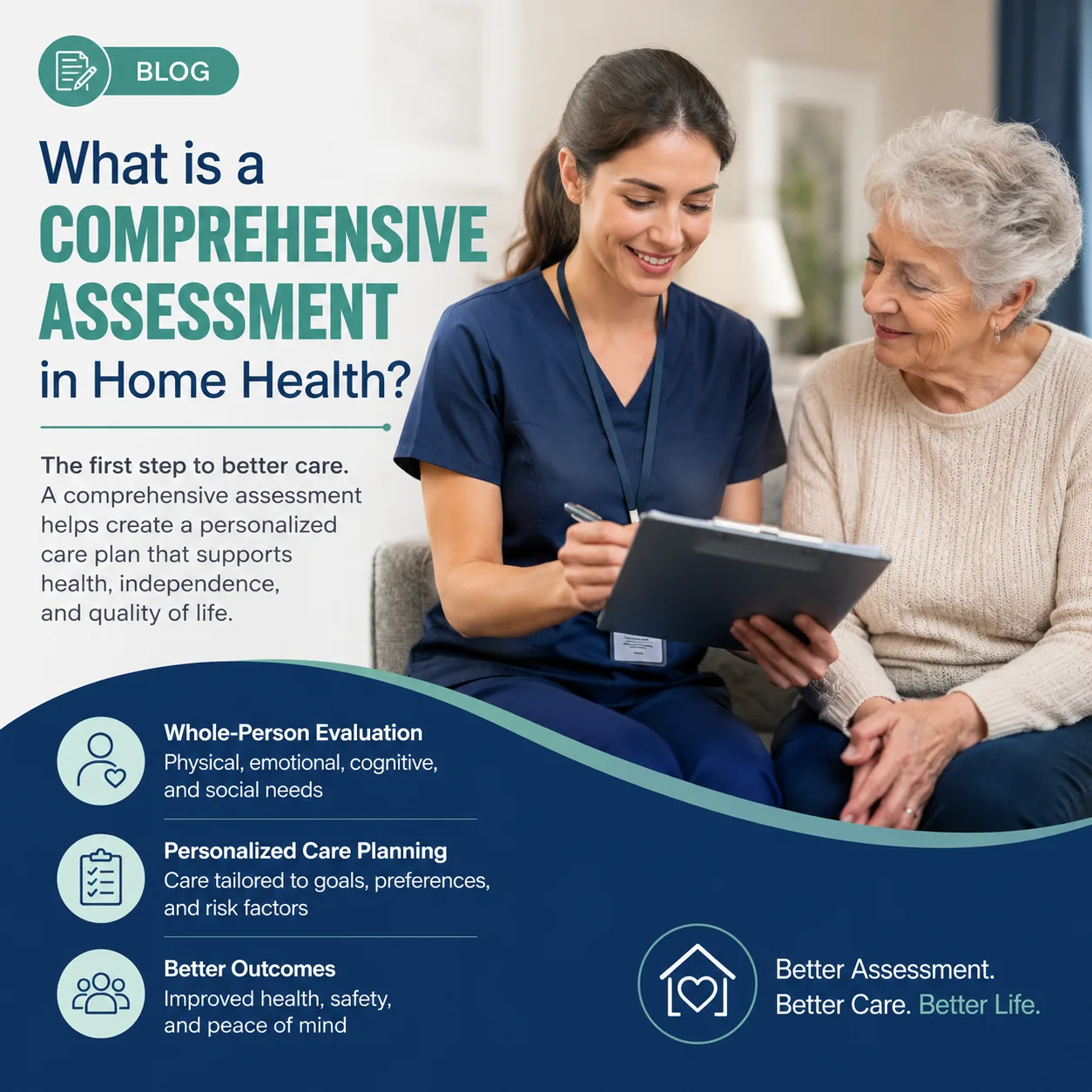
What Is a Comprehensive Assessment in Home Health?
A complete guide to comprehensive assessments in home health: required content, current Medicare timing, OASIS-E2, clinician responsibility, care planning, documentation errors, and a practical checklist.
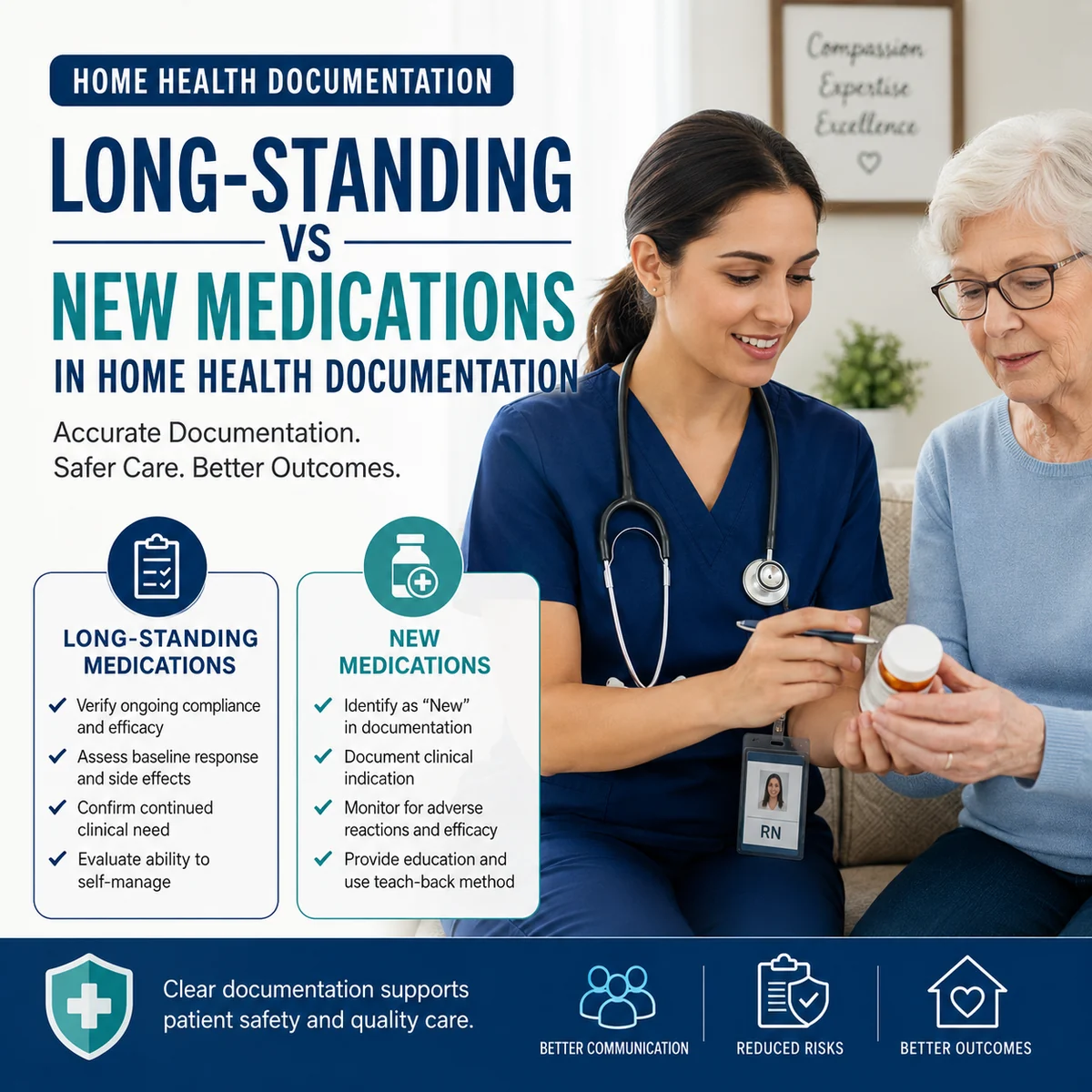
Long-Standing vs. New Medications in Home Health Documentation: What Nurses Need to Know
A patient's medication list often mixes drugs they've taken for years with brand-new prescriptions from a recent hospital stay — and the two need very different documentation. This guide breaks down what to document for long-standing vs. new medications, how to reconcile the regimen, and how to use teach-back to confirm understanding.