
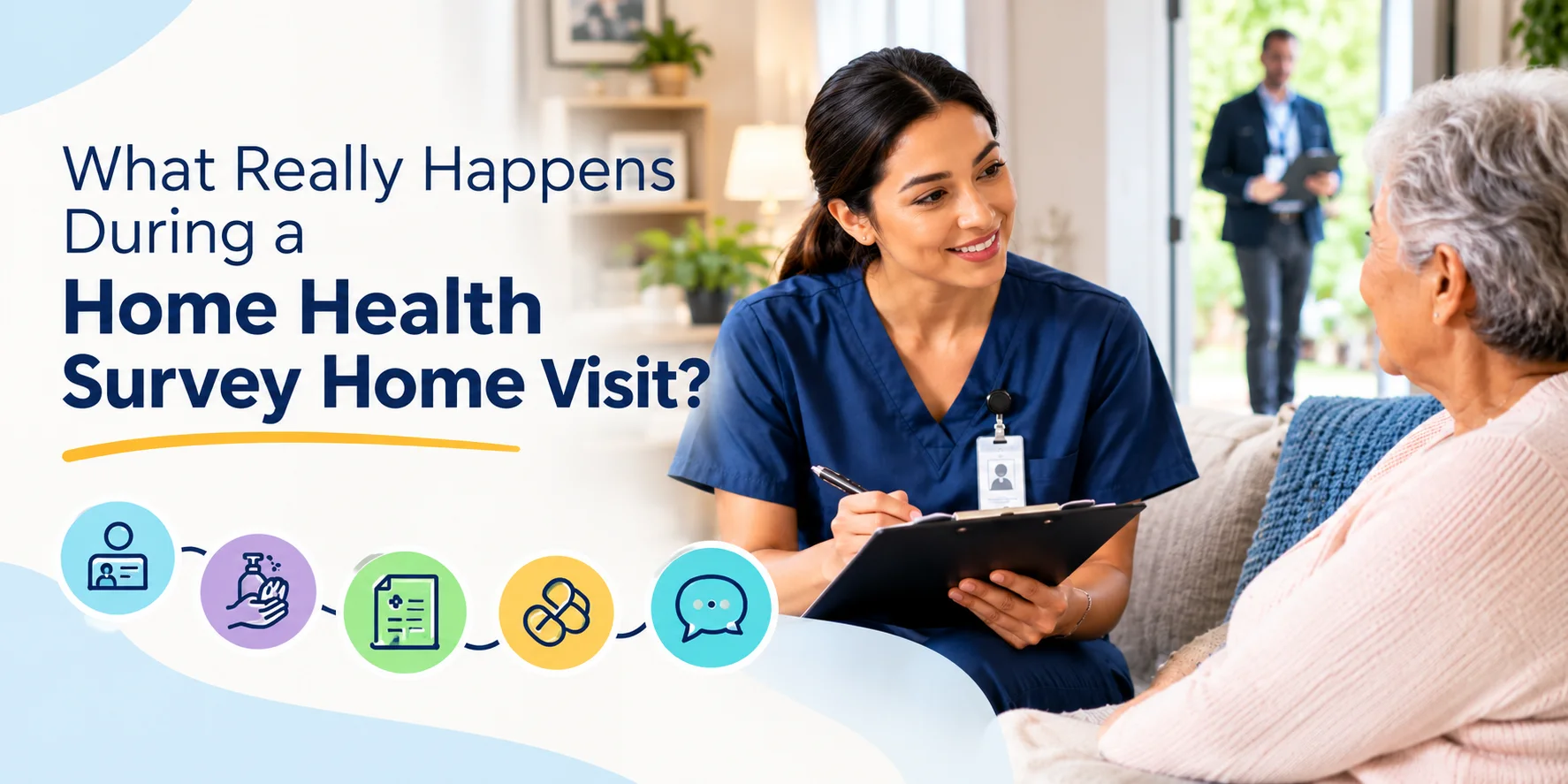
What Really Happens During a Survey Home Visit for Home Health?
A home health survey visit lets a surveyor observe care in the patient's home and compare real-world practice with the plan of care, clinical record, agency policies, and Medicare requirements.
Key Takeaways
- CMS describes the home visit as the surveyor's only opportunity to observe direct care and the most important information-gathering method during an HHA survey.
- The patient or caregiver must consent to the survey home visit; participation is voluntary, and refusal does not affect home health benefits.
- The surveyor observes care without interfering and may interview the patient, caregiver, clinician, and other agency staff.
- Surveyors review relevant clinical information before the visit and may review the record in greater detail afterward when concerns arise.
- Care in the home should align with the comprehensive assessment, current plan of care, orders, medication information, and visit documentation.
- Patient identification, hand hygiene, infection-control technique, medication management, education, and response to changes in condition are highly visible in the field.
- An observation can lead to broader record review or staff interviews when it suggests potential noncompliance or a systemic pattern.
- The strongest preparation is continuous survey readiness: routine field observation, documentation audits, competency validation, and corrective-action follow-up.
✓ Quick answer: During a home health survey visit, a surveyor observes care in the patient's home, may interview the patient and clinician, and compares what happens in the home with the current plan of care, medication information, clinical record, agency practices, and Medicare Conditions of Participation. The visit is voluntary for the patient, and the surveyor should observe without interfering with care.
When a home health agency hears that a surveyor will be visiting one of its patients, the first question is often: What exactly is the surveyor going to look at?
The answer goes beyond whether one nurse performs one procedure correctly. A home health survey home visit lets the surveyor see how the agency's systems work where care actually happens: the patient's home.
CMS's current home health survey guidance identifies home-visit observations, patient interviews, clinical-record reviews, staff interviews, and other document review as information-gathering methods during a home health agency survey. This article reflects the Appendix B version issued August 5, 2026.
ℹ️ Scope: This article explains a Medicare home health health-and-safety survey visit. A CMS provider-enrollment site visit is a separate process. See how to prepare for a CMS provider enrollment site visit for that workflow.
Why Is the Home Visit So Important During a Home Health Survey?
A policy manual and electronic record can describe what should happen. A home visit shows what actually happens.
CMS calls it the only opportunity for the surveyor to observe direct care by HHA personnel and the most important means of gathering information during the survey.
The surveyor uses observation and interviews to evaluate whether care meets Medicare health-and-safety standards and follows the patient's plan of care. What is seen in the home can then be validated against the clinical record and other agency evidence.
The home visit is where written policy, clinical documentation, and real-world care meet.
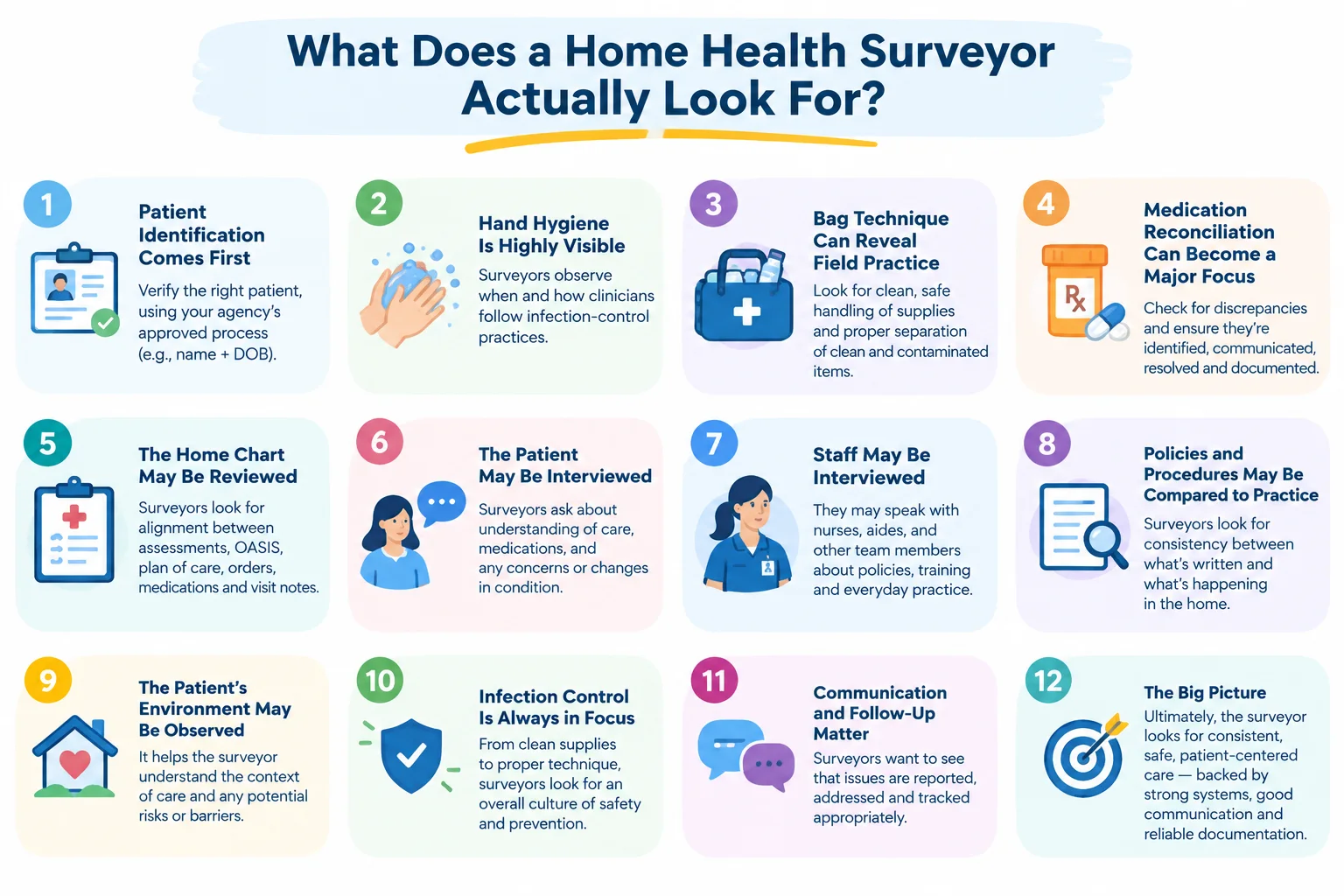
A surveyor may follow multiple threads: from direct observation and patient interviews to the plan of care, medication list, and clinical documentation.
What Happens Before the Surveyor Enters the Patient's Home?
After the survey team selects a patient, CMS guidance says the HHA should contact the patient, family, or caregiver to request permission and arrange the home visit. If the patient refuses, the surveyor selects another patient.
The home visit and interview are voluntary. Refusal does not affect the patient's home health benefits.
Before the visit proceeds, the patient or caregiver is asked to sign the Consent for Home Visit, Form CMS-36, in a language and manner they understand.
CMS also instructs surveyors to respect the patient's home, clinical status, privacy, and willingness to participate. A surveyor should end the interview or visit if the patient asks to stop or indicates a desire to conclude it.
What Does a Home Health Surveyor Look for During the Visit?
Every visit is different. The surveyor's focus depends on the patient's condition, the discipline providing care, the services scheduled, the plan of care, and any concerns identified elsewhere in the survey.
The following areas commonly deserve attention.
1. Patient identification
The clinician should follow the agency's approved patient-identification process before providing care. Consistency matters: field practice should match the agency's policy and any applicable accreditor requirements.
⚠️ Do not confuse standards: Two patient identifiers should not be presented as a universal CMS home-visit survey rule. For organizations subject to Joint Commission home-care standards, Joint Commission guidance addresses two identifiers and home identification. Agencies should follow the regulatory, state, accreditation, and policy requirements that apply to them.
2. Hand hygiene and infection prevention
Hand hygiene is visible evidence of whether infection-control policy is being followed in practice. It may be relevant before and after patient contact, during care when indicated, after contact with potentially contaminated material, and at other points required by the agency's procedure.
Medicare's infection prevention and control Condition of Participation requires an HHA-wide program for surveillance, identification, prevention, control, and investigation of infectious and communicable diseases.
3. Bag technique and supply handling
For clinicians who carry bags, reusable equipment, and supplies, the surveyor can see whether the agency's infection-control procedures are applied in the patient's environment. Depending on policy and the service provided, that may include bag placement, barriers, clean-and-contaminated separation, equipment cleaning, waste disposal, and safe supply handling.
The key question is not whether the clinician can recite a bag-technique policy. It is whether the clinician consistently applies the agency's approved process in the home.
4. Medication reconciliation and follow-up
The medications found in the home may differ from the agency's list, the plan of care, recent discharge information, practitioner orders, or what the patient reports taking. The clinician should follow the agency's medication-review process, identify potential discrepancies, communicate them, complete appropriate follow-up, and document the response.
Medications in the home → medication list → orders → clinical note → patient understanding → documented follow-up
CMS continues to include Drug Regimen Review Conducted with Follow-Up for Identified Issues among its home health process measures. Learn the clinical workflow in the medication reconciliation glossary.
5. Clinical-record alignment
CMS instructs surveyors to review enough of the record before the home visit to prepare for the observation, for example, the current plan of care, medication list, and aide instructions. The record may be reviewed in more detail afterward to investigate concerns and evaluate compliance.
The review may test alignment among the comprehensive assessment, OASIS, plan of care, orders, medication information, visit notes, patient education, changes in condition, communication, and follow-up.
Under the clinical-record Condition of Participation, the record must contain information including the plan of care, clinical and progress notes, assessments, and other required material.
6. Care compared with the plan of care
The surveyor can compare the patient's needs, assessment findings, ordered services, visit frequency and duration, care delivered, and visit note. The care-planning Condition of Participation requires an individualized plan of care with patient-specific services, interventions, education, measurable outcomes, and goals.
Patient need → comprehensive assessment → plan of care and orders → today's service → visit documentation → patient response
7. Patient education and understanding
A record may document education about medications, symptoms, fall prevention, wound care, diet, infection warning signs, escalation, or emergency response. The surveyor may ask the patient what they were taught and what they would do if a problem occurred.
Patients do not need to repeat education word for word. The question is whether education was meaningful, individualized, understood to the extent possible, and documented accurately, including the patient's or caregiver's response.
8. Recognition of changes in condition
A surveyor may explore whether clinicians recognize and respond to increased shortness of breath, new pain, wound deterioration, medication concerns, confusion, falls, reduced function, or other changes.
The follow-up matters as much as the observation: further assessment, patient education, practitioner notification, care-plan review, coordination, emergency escalation when appropriate, and documentation of what happened next.
9. Communication and coordination
The surveyor may look for evidence that the agency coordinates disciplines, communicates relevant patient changes, integrates orders, involves the patient and caregiver, and closes the loop on concerns. A call that occurred but was never documented may be difficult to validate later.
10. The patient's environment
The home provides context that the office record may not show: medication storage, fall hazards, equipment use, caregiver support, access barriers, sanitation concerns, oxygen risks, and other factors that may affect safe care. The clinician's assessment and interventions should address relevant risks within the plan of care and professional scope.
11. The clinician's knowledge of the patient
The clinician does not need to memorize the entire chart, but should understand the patient's primary clinical needs, current risks, plan of care, goals, services scheduled for the visit, recent changes, notifications, and follow-up.
12. Documentation that reflects what actually occurred
One of the biggest survey risks is a disconnect between observation, patient report, and documentation. If the surveyor sees major mobility difficulty but the record describes independence, or the patient cannot explain education that the record says was mastered; the surveyor may investigate further.
Defensible documentation is accurate, specific, timely, internally consistent, clinically meaningful, and supported by what occurred. The goal is not to write more; it is to make the clinical record reliably reflect the patient's care.
Does the Surveyor Watch the Entire Home Health Visit?
Not necessarily. There is no single requirement that every surveyor remain for every minute of every visit.
The observation's length and focus depend on what the surveyor needs to evaluate, what care is being provided, and whether questions or concerns arise.
A significant procedure, such as wound care, an IV-related service, medication management, or complex teaching, may require a longer observation. CMS instructs surveyors to observe without interfering and permits questions during care only when they do not disrupt the service or the clinician-patient rapport.
✓ Practical standard: Follow normal clinical, safety, and infection-control procedures throughout the entire time the surveyor is present. Do not assume the important part of the observation has ended.
What Questions May a Surveyor Ask the Patient?
Patient interviews help surveyors validate observations and understand the patient's experience. Depending on the visit, questions may include:
- Why are you receiving home health services?
- Which clinicians visit, and what do they do?
- Do visits occur as expected?
- What has the agency taught you about your condition or medications?
- Do you understand your plan of care and goals?
- Do you know whom to call with a problem?
- What should you do if your condition changes?
- Are your questions and concerns addressed?
The patient is not expected to give a rehearsed or perfect answer. Staff should never coach the patient.
The surveyor is gathering the patient's own perspective and may remain after agency staff leave so the patient or family can speak confidentially.
What Questions May a Surveyor Ask the Clinician?
The surveyor may ask the clinician to explain the clinical reasoning behind the visit. Common topics include:
- The patient's primary clinical need and risks.
- What the clinician is assessing or providing today, and why.
- How the visit relates to the plan of care and patient goals.
- Changes observed since the last visit.
- Who was notified about a change and what follow-up occurred.
- How the patient's understanding and response were evaluated.
- How medication discrepancies or safety concerns are handled.
If the clinician does not know an answer, the safest response is to say so and use the agency's normal process to obtain accurate information. Guessing can create a new inconsistency.
What Happens If a Surveyor Finds a Problem During the Visit?
A concern during one home visit does not automatically mean the agency failed its entire survey. It can, however, lead to additional investigation.
CMS says surveyors may conduct further record review and staff interviews when a home-visit observation suggests potential noncompliance.
| Observation | Possible follow-up |
|---|---|
| Hand-hygiene or supply-handling concern | Review infection-control policies, competency, and practice across staff |
| Medication discrepancy | Compare medication records, orders, practitioner communication, and follow-up |
| Documentation inconsistency | Review additional records and interview relevant staff |
| Care does not match the plan | Review the assessment, orders, visit pattern, coordination, and plan revisions |
| Patient reports an unresolved complaint | Review the complaint log and the agency's response |
The surveyor is often trying to determine whether a concern is isolated or represents the agency's normal practice. A repeated gap across clinicians or records carries a different implication from a single corrected error.
If your agency has received a finding, see what happens after a home health or hospice survey failure.
What Should Clinicians Do When a Surveyor Is Present?
- Follow the agency's patient-identification process.
- Perform hand hygiene and use infection-control technique as required.
- Assess the patient's current condition and relevant risks.
- Follow the current plan of care, orders, and professional scope.
- Provide the appropriate skilled service without turning the visit into a performance.
- Complete medication-related activities and address discrepancies when applicable.
- Educate the patient or caregiver and assess understanding.
- Recognize and respond to changes in condition.
- Communicate concerns through the agency's normal escalation pathway.
- Document what actually happened, including the patient's response and follow-up.
What Should Clinicians Avoid During a Survey Visit?
- Do not coach the patient. Let the patient answer honestly.
- Do not guess. Verify information through the approved workflow.
- Do not become defensive. Questions are part of information gathering.
- Do not hide a clinical problem. Follow the normal assessment and escalation process.
- Do not document care that did not occur. The note must reflect the actual visit.
- Do not invent a special survey version of care. Consistent everyday practice is the safest preparation.
How Can an Agency Prepare for Survey Home Visits?
Standardize patient identification
Confirm that clinicians understand the agency's procedure and any applicable state or accreditation standards. Audit whether the process used in the field matches the written policy.
Observe infection-control practice in the field
Directly observe hand hygiene, bag and supply handling, equipment cleaning, waste disposal, and PPE use when applicable. A chart audit cannot show whether field technique is consistent.
Test medication-review follow-through
Audit whether medication differences are identified, communicated, acted on, and closed with documentation. Do not stop at whether a medication list exists.
Compare the full clinical story
Review whether the assessment, OASIS, plan of care, orders, medication list, visit notes, education, changes in condition, and follow-up agree. For a deeper framework, read what a comprehensive assessment includes in home health.
Use findings in QAPI
Trend field-observation and documentation findings through the agency's QAPI process. Assign corrective actions, confirm completion, and re-audit to determine whether improvement is sustained.
Home Health Survey Visit Readiness Checklist
Patient rights and identification
- The patient understands that the survey home visit is voluntary.
- The agency has a process for requesting and documenting permission.
- Clinicians follow the approved identification process.
- Accreditation-specific identification rules are understood where applicable.
Infection prevention
- Hand hygiene is performed at appropriate points.
- Bag and supply technique follows agency policy.
- Clean and contaminated items are separated.
- Reusable equipment is handled and cleaned appropriately.
- PPE and waste-disposal procedures are followed when applicable.
Medication management
- The medication list is current and compared with what the patient is taking.
- Potential discrepancies are identified and communicated.
- Appropriate follow-up and recommended actions are documented.
- Patient or caregiver education is individualized and evaluated.
Clinical care and documentation
- The clinician understands the patient's current status, skilled need, risks, and goals.
- Care follows the current plan of care and orders.
- Changes in condition trigger appropriate assessment, notification, and follow-up.
- Visit notes reflect the service, patient response, education, and next steps.
- OASIS, the assessment, plan of care, medication information, and notes tell a consistent story.
Survey Preparation vs. Continuous Survey Readiness
| Survey preparation | Continuous survey readiness |
|---|---|
| Begins when a survey is expected | Built into normal operations every day |
| Focuses on quickly finding missing items | Prevents gaps through reliable workflows |
| May rely heavily on chart cleanup | Combines chart audits with direct field observation |
| Corrects the visible example | Investigates root causes and patterns |
| Ends when the survey ends | Uses monitoring and QAPI to sustain correction |
The stronger approach is to operate as though a surveyor could observe care tomorrow: policies are practiced, clinicians are supported and observed, documentation is audited, medication processes are monitored, and problems are corrected before they become patterns.
The Real Test of a Home Health Survey Home Visit
A surveyor is not only checking whether a policy exists. The surveyor is gathering evidence about whether the agency's care systems work for actual patients.
Patient → clinician → care → plan of care → documentation → patient response → agency follow-up
When those elements tell the same accurate story, the agency can demonstrate a stronger culture of safe, patient-centered, compliant care. That is the goal whether a surveyor is standing in the room or not.
Editorial Review and Official Sources
This article was reviewed against sources available September 9, 2026. Survey procedures, interpretive guidance, accreditor standards, and state requirements can change; verify the requirements that apply to the agency and survey pathway.
- CMS: Home Health Agencies—laws, regulations, Appendix B, and interpretive guidelines.
- 42 CFR § 484.55—Comprehensive assessment of patients.
- 42 CFR § 484.60—Care planning, coordination of services, and quality of care.
- 42 CFR § 484.70—Infection prevention and control.
- 42 CFR § 484.110—Clinical records.
- CMS: Home Health Quality Measures.
- Joint Commission: Two Patient Identifiers—Home Identification.
📝 Editorial and regulatory disclaimer: This article is for general educational purposes. It is not legal, accreditation, compliance, clinical, or survey-response advice. Follow the current CMS manual, applicable federal and state requirements, accreditor standards, agency policies, and instructions from the survey team. Seek qualified counsel when needed.
Home Health Documentation Playbook
The complete guide to OASIS-E, Medicare compliance, PDGM, and AI-assisted documentation. Learn how top agencies reduce documentation time without sacrificing compliance.
Bottom Line
A home health survey home visit tests whether the agency's policies, plan of care, clinical practice, documentation, and patient experience tell one accurate and consistent story.
Inside Home Health Podcast
5-Star Agency or Compliance Disaster? Understanding Home Health Ratings

Arvind Sarin is the founder of Copper Digital. For the past year he has spent three days a week inside a 500+ census Texas home health agency, building AI documentation that finishes OASIS and visit notes the same day, with a nurse reviewing and approving every note. He writes about home health documentation, OASIS, Medicare compliance, and applying AI responsibly in clinical workflows.
Frequently asked
Frequently asked questions
A surveyor may observe care in the patient's home, interview the patient or caregiver and clinician, and compare what is observed with the plan of care, medication information, clinical record, agency practices, and Medicare requirements. The home visit is one part of the broader HHA survey process.
Join the conversation
Leave a comment
No comments yet. Be the first to share your thoughts.
Related reading
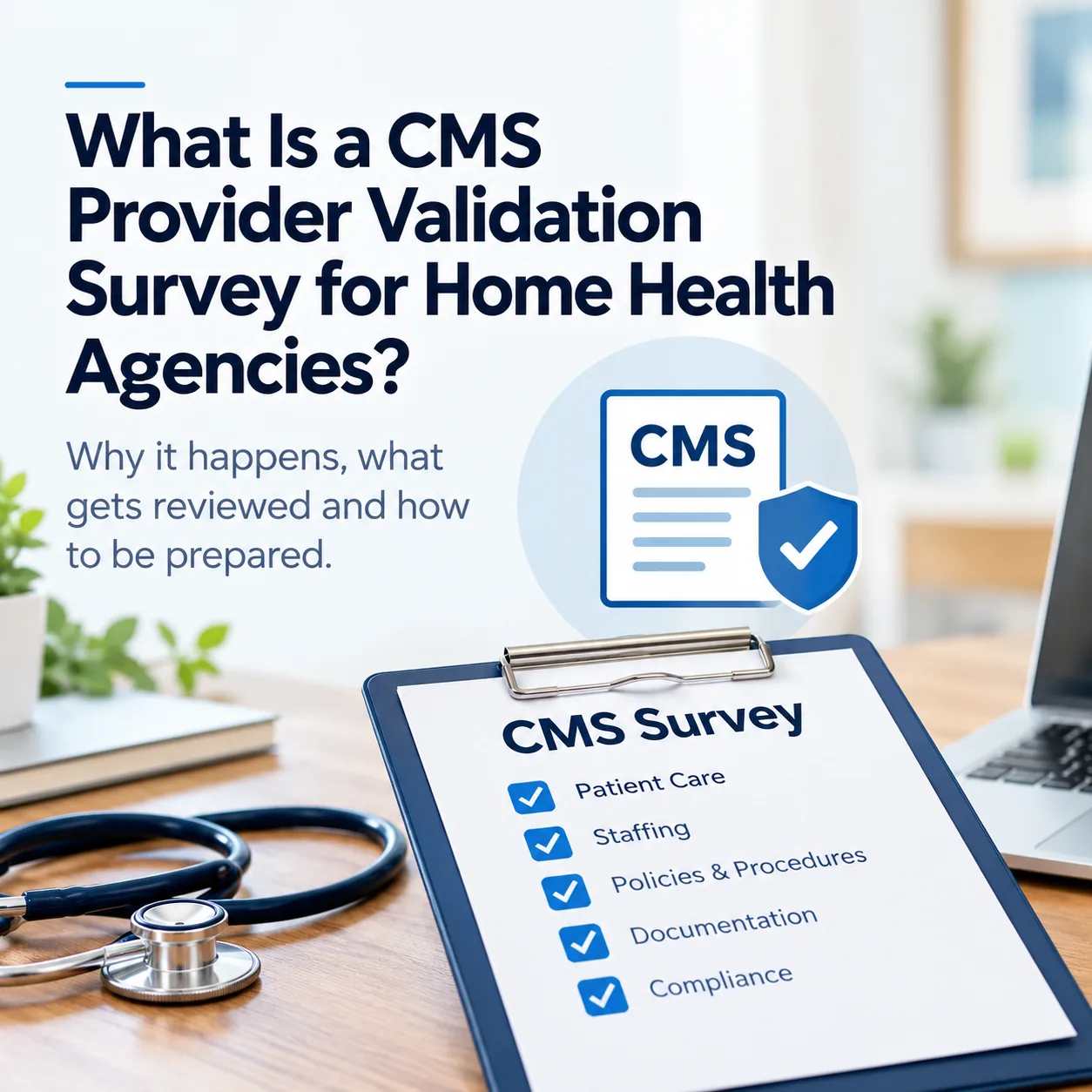
What Is a CMS Provider Validation Survey for Home Health Agencies?
A CMS provider validation survey checks whether a deemed-status home health agency actually meets Medicare health and safety requirements. Here is what CMS reviews and how an HHA can stay ready.
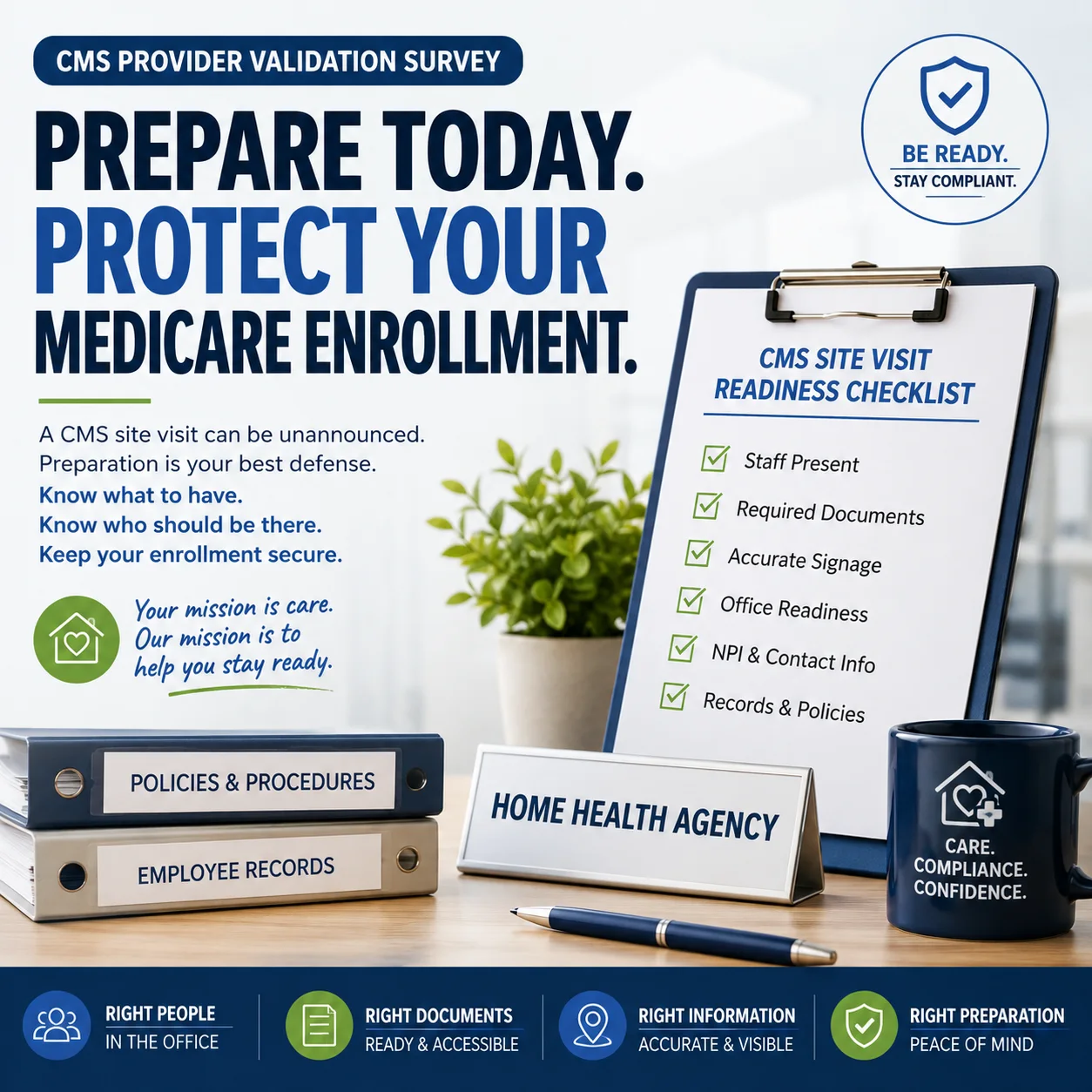
How Should Medicare Home Health Agencies Prepare for a CMS Provider Validation Survey?
A CMS provider enrollment site visit may be unannounced. Prepare your people, office, records, signage, and enrollment information before an inspector arrives.
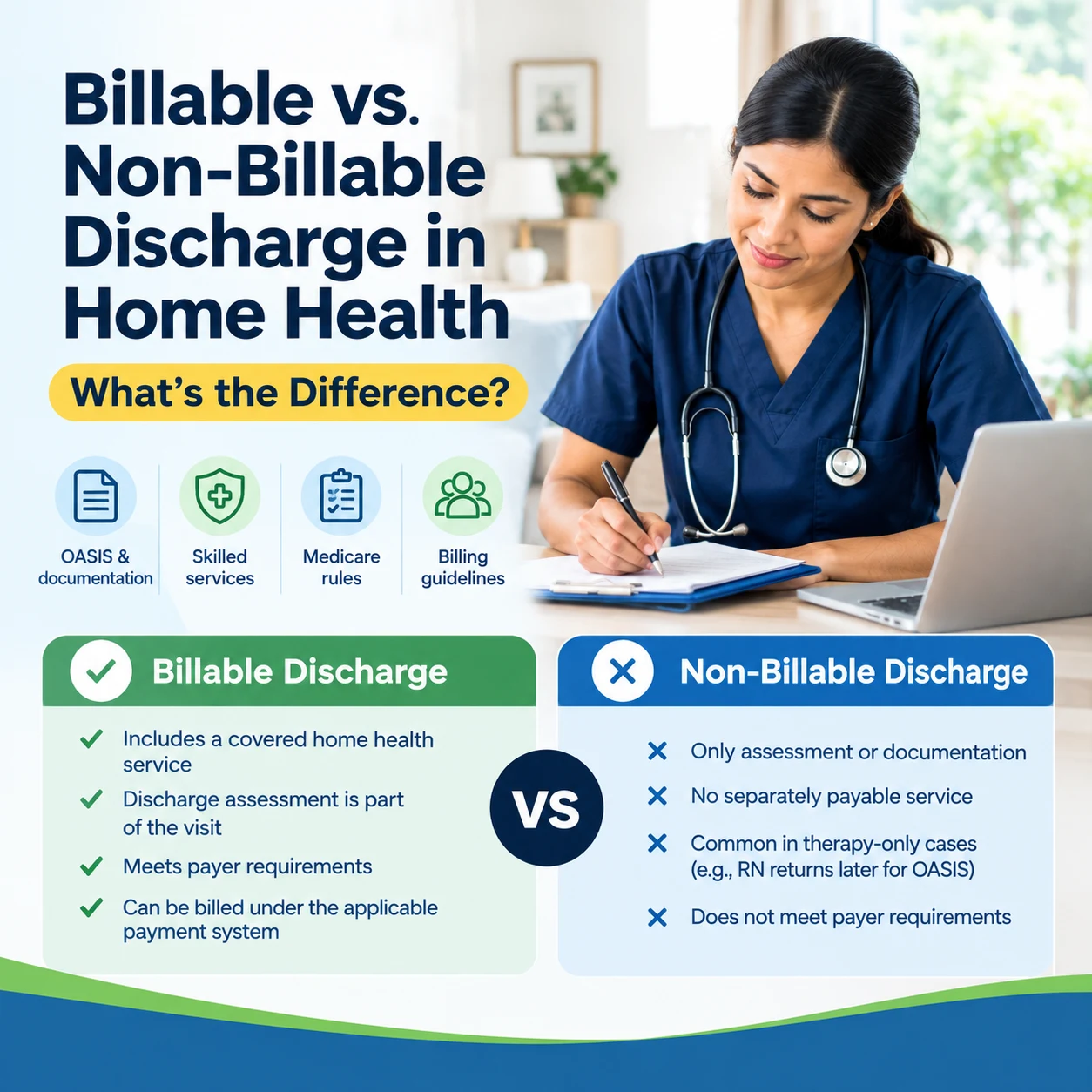
Billable vs. Non-Billable Discharge in Home Health: What's the Difference?
A discharge OASIS does not automatically make a home health visit billable. Learn how covered skilled services, payer rules, documentation, and the final clinician determine whether a discharge encounter may be payable.