
Why Most Healthcare AI Fails: It's Rarely a Technology Problem
Healthcare AI projects usually fail because organizations implement AI before clearly defining the problem they're trying to solve. Success depends on understanding clinical workflows, involving frontline users, aligning business incentives, establishing governance, and designing around patients, not simply deploying more advanced technology.

Key Takeaways
- Healthcare AI usually fails because of workflow and governance, not the algorithm.
- The best products start problem-first and fit existing clinical workflows.
- Every solution must satisfy clinicians, patients, and the organization at once.
- Governance and human-in-the-loop review determine whether pilots ever scale.
💡 Healthcare AI projects usually fail because organizations implement AI before clearly defining the problem they're trying to solve. Success depends on understanding clinical workflows, involving frontline users, aligning business incentives, establishing governance, and designing around patients, not simply deploying more advanced technology.
Healthcare organizations have invested billions into artificial intelligence. Yet despite unprecedented excitement around generative AI, ambient documentation, automation, and predictive analytics, many healthcare AI initiatives never move beyond pilot programs.
Surprisingly, the technology itself is rarely the reason. The real obstacles are hidden beneath the surface, in clinical workflows, organizational incentives, governance, and the complexity of healthcare delivery itself.
In a recent episode of the Inside Home Health podcast, Dr. Sarah Matt, former Vice President of Product Strategy at Oracle Health and Chief Strategy Officer, shared insights from hundreds of healthcare AI deployments.
Her conclusion was simple:
Most healthcare AI projects fail long before the algorithm does.
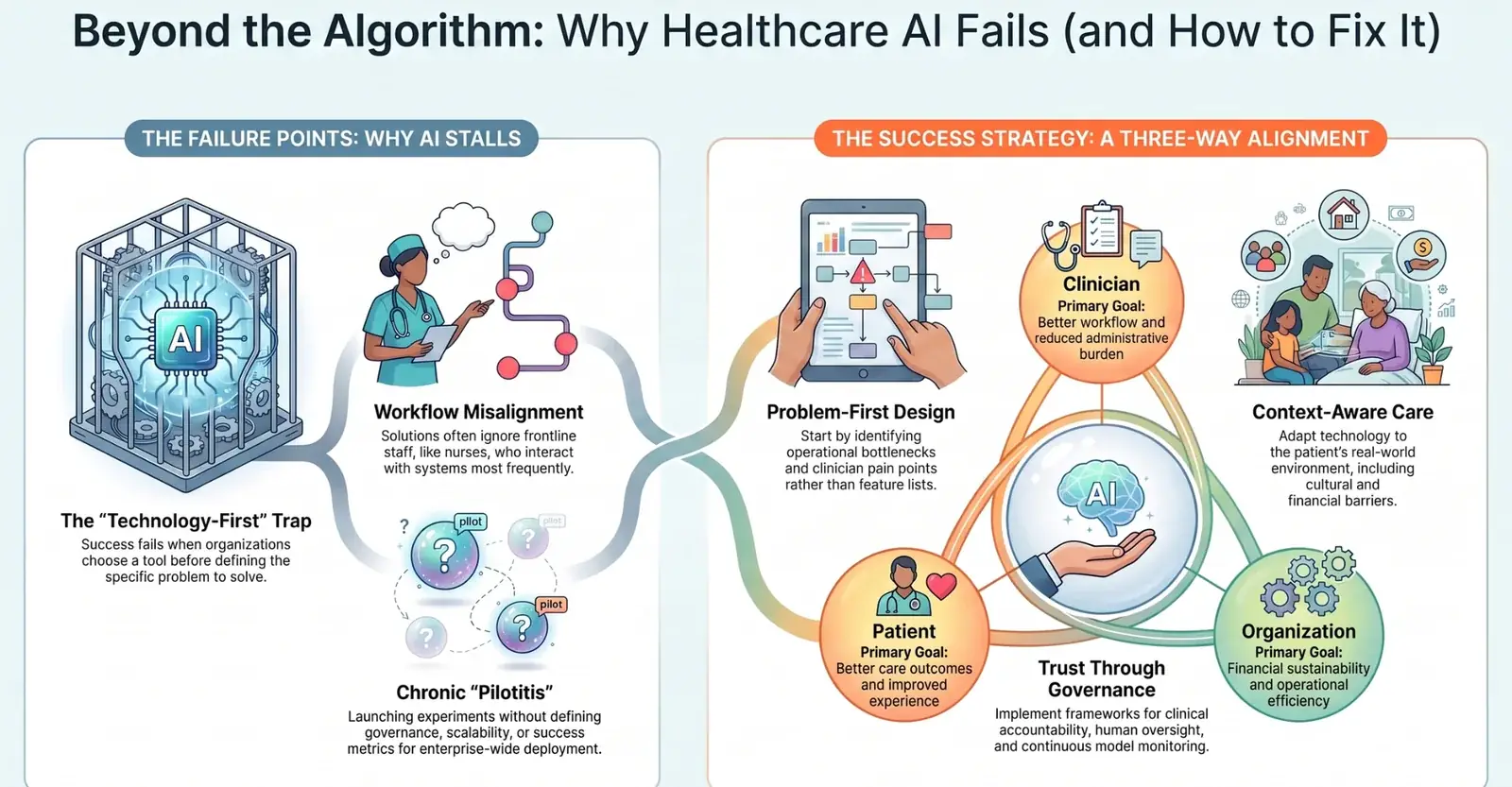
The failure points that stall AI, and the three-way alignment that lets it scale.
Healthcare AI Doesn't Have a Technology Problem; It Has a Strategy Problem
Many health systems begin their AI journey with the wrong question: how can we use AI? Instead, successful organizations ask a different one: what problem are we trying to solve?
This distinction seems small, but it changes everything. Organizations often feel pressure from boards, competitors, investors, or market trends to have an AI strategy.
As a result, they choose the technology first and search for a problem afterward. That approach almost always leads to disappointing outcomes.
Successful AI adoption starts by:
- Clearly identifying operational bottlenecks.
- Understanding clinician pain points.
- Measuring business impact.
- Determining whether AI is actually the right solution.
Being AI-first isn't inherently wrong. Being problem-first is simply far more effective.
The Biggest Mistake Health Systems Make During AI Adoption
Healthcare technology companies frequently assume they already understand clinical workflows. In reality, they often design products around imagined workflows instead of real ones.
This creates friction from day one.
The most successful healthcare products aren't built inside conference rooms. They're built through continuous conversations with:
- Nurses.
- Physicians.
- Medical assistants.
- Care coordinators.
- Front desk staff.
- Patients.
Every iteration begins with one simple question: what problem are you trying to solve today? Without that feedback loop, even sophisticated AI becomes another layer of administrative burden.
Clinical Workflow Assumptions That Break Digital Health Products
One of the biggest themes from the discussion was that healthcare software frequently makes incorrect assumptions about how clinicians actually work. Here are three of the most common.
1. Designing Only for Physicians
Many healthcare AI products prioritize physicians because they're viewed as primary decision-makers. But healthcare operates differently.
Nurses, medical assistants, therapists, and administrative staff often spend far more time interacting with documentation systems than physicians. If AI reduces physician workload while increasing nursing complexity, overall efficiency actually declines.
Organizations that solve problems for frontline clinical teams often see much higher adoption.
2. Assuming More Features Create More Value
Healthcare startups frequently over-engineer products. Every customer request becomes another feature.
Eventually, the software attempts to solve every problem, and ends up solving none particularly well. Instead of feature expansion, successful AI companies focus on:
- Reliability.
- Simplicity.
- Workflow integration.
- Speed.
- User trust.
Users rarely ask for more features. They ask for existing functionality to work flawlessly.
3. Ignoring Executive Incentives
Healthcare purchasing decisions involve multiple stakeholders. Clinicians may love a product.
Patients may benefit from it. But executives evaluate something different.
They ask questions like:
- Does this reduce costs?
- Does it improve reimbursement?
- Does it reduce compliance risk?
- Can it scale across the enterprise?
Ignoring executive priorities often prevents successful pilots from becoming enterprise deployments.
Healthcare's Three-Body Problem
Unlike many industries, healthcare products rarely serve a single customer. Instead, every solution must satisfy three different groups simultaneously.
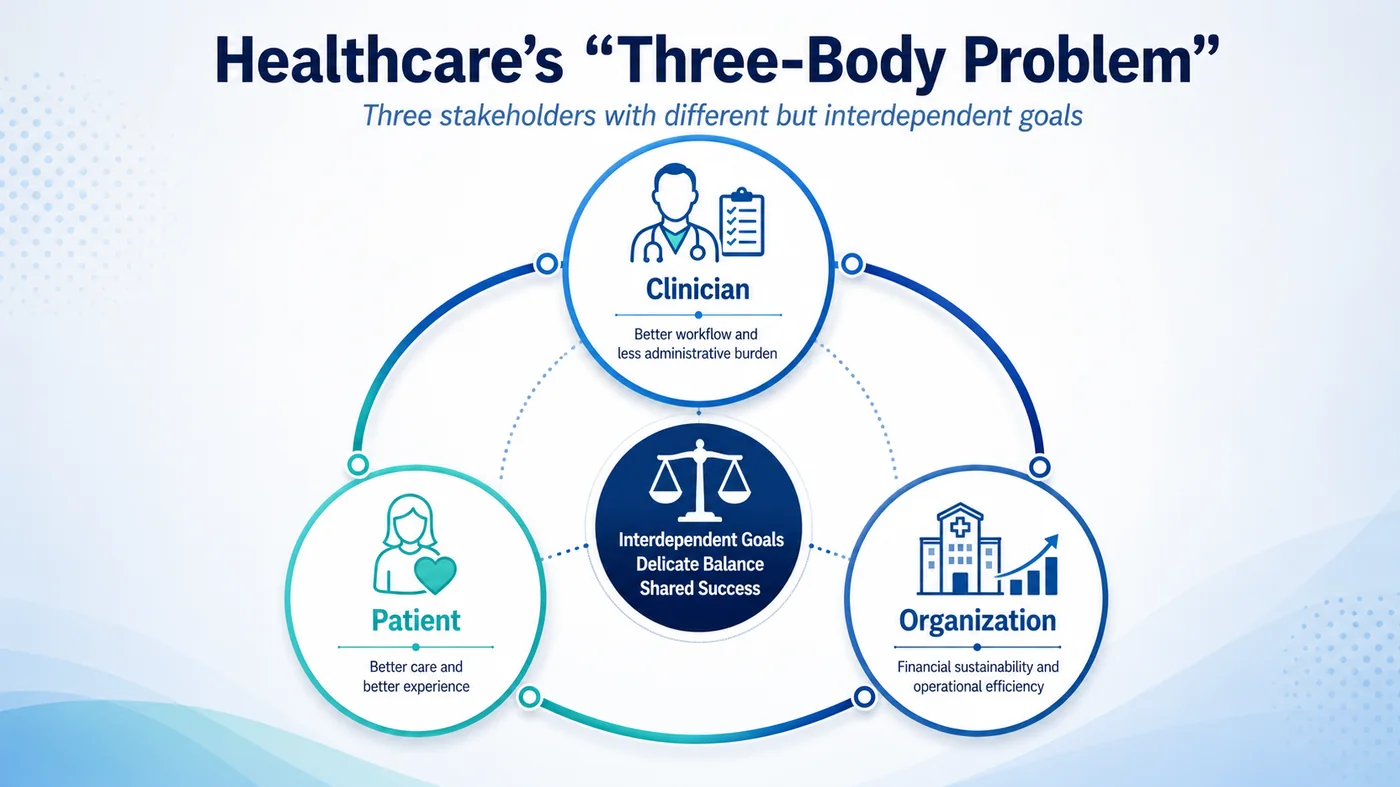
Every healthcare AI solution has to satisfy three stakeholders at once.
| Stakeholder | Primary Goal |
|---|---|
| Clinician | Better workflow and less administrative burden |
| Patient | Better care and better experience |
| Organization | Financial sustainability and operational efficiency |
An AI solution that delights nurses but hurts reimbursement won't survive. Likewise, a product that saves money but frustrates clinicians won't achieve long-term adoption.
The most successful healthcare AI platforms align incentives across all three groups.
Why So Many Healthcare AI Pilots Never Scale
Healthcare has developed what many leaders jokingly call pilotitis. Organizations launch pilot after pilot, and few ever become enterprise deployments.
Why? Because many pilots were never designed to scale in the first place.
Successful AI implementations begin with clear expectations beyond proof of concept. Instead of asking whether the software worked, health systems should ask:
- Can it work across multiple departments?
- Can workflows be standardized?
- Does governance exist?
- Can operational teams support enterprise deployment?
- Are success metrics defined before implementation begins?
Pilots should represent Phase One, not temporary experiments.
AI Governance Matters More Than Most Organizations Realize
As healthcare AI becomes increasingly autonomous, governance becomes equally important. Organizations need frameworks that define:
- Clinical accountability.
- Human oversight.
- Model monitoring.
- Regulatory compliance.
- Data quality.
- Risk management.
Without governance, even technically successful AI projects struggle to gain organizational trust. Healthcare leaders increasingly recognize that governance is becoming just as important as model performance.
This is why compliance and human-in-the-loop review sit at the center of responsible healthcare AI.
Consumer-Centered Care Is More Than Better Apps
Healthcare organizations frequently describe themselves as consumer-centered. But many initiatives focus only on improving digital interfaces.
True consumer-centered care requires structural redesign. That means understanding:
- Language differences.
- Cultural preferences.
- Transportation barriers.
- Financial limitations.
- Technology access.
- Trust in the healthcare system.
Healthcare cannot assume every patient shares the same background, digital literacy, or healthcare experience. Designing around the average patient often excludes the people who need care the most.
Why Understanding Patient Context Changes Everything
Home healthcare offers a unique perspective because clinicians see patients where they actually live. That environment reveals challenges impossible to identify inside hospitals.
Home visits expose:
- Medication adherence issues.
- Family support systems.
- Housing conditions.
- Nutrition challenges.
- Mobility limitations.
- Technology access.
This broader context should influence how healthcare AI is designed. Technology should adapt to patients, not expect patients to adapt to technology.
Digital Transformation Shouldn't Replace Trusted Workflows
Healthcare technology companies often view legacy systems as problems waiting to be eliminated. Fax machines are a perfect example.
From a technology perspective, they seem outdated. From a clinical perspective, many organizations trust them because they consistently work.
Replacing legacy technology simply because it's old rarely creates value. Instead, healthcare organizations should ask: what workflow problem are we actually solving?
Sometimes the bottleneck isn't the technology. It's everything surrounding it.
Lessons for Healthcare AI Companies
For startups building healthcare AI solutions, several lessons stand out.
Start with one problem
Don't build ten features before validating one.
Talk to users constantly
Clinical assumptions are rarely accurate without direct feedback.
Design for every stakeholder
Patients, clinicians, executives, and payers all influence adoption.
Think beyond pilots
Success metrics should include enterprise scalability from day one.
Build trust before adding complexity
Reliable products outperform feature-heavy products.
The Future of Healthcare AI Isn't Bigger Models
Healthcare doesn't necessarily need more sophisticated algorithms. It needs better implementation.
Organizations that succeed with AI will likely focus less on technology itself and more on:
- Clinical workflow integration.
- Human-centered design.
- Governance.
- Organizational alignment.
- Consumer-centered care.
- Continuous user feedback.
Technology remains an important enabler. But healthcare transformation has always been, and will continue to be, fundamentally about people.
Final Thoughts
The future of healthcare AI won't be determined by who builds the smartest model. It will be determined by who understands healthcare the best.
Organizations that prioritize frontline clinicians, define clear business problems, establish strong governance, and design around real patient experiences will move beyond endless pilots toward meaningful transformation.
Healthcare AI succeeds not when technology leads, but when clinical reality does.
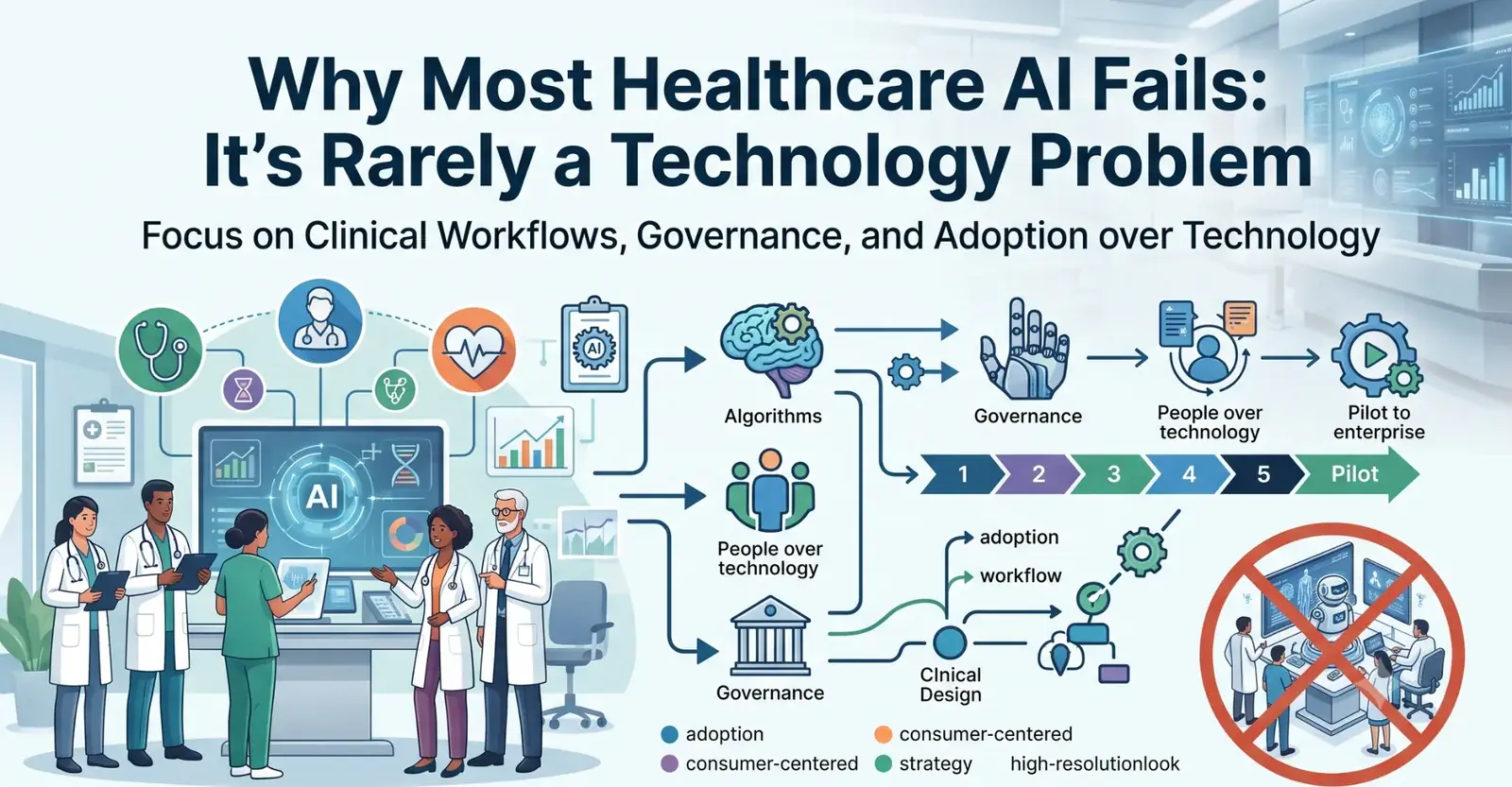
The takeaway: healthcare AI succeeds when clinical workflows, governance, and adoption come before the technology.
🚀 Ready to move beyond AI pilots? Discover how Copper Digital helps healthcare organizations design AI solutions around real clinical workflows, measurable outcomes, and scalable enterprise adoption. Talk to our healthcare AI experts, or explore AI tools for home health nurses and pricing.

Home Health Documentation Playbook
The complete guide to OASIS-E, Medicare compliance, PDGM, and AI-assisted documentation. Learn how top agencies reduce documentation time without sacrificing compliance.
Bottom Line
Most healthcare AI fails for strategy and workflow reasons, not technology: it's deployed before the problem is defined and it ignores clinical workflows and stakeholder alignment.

Watch the Full Conversation
Most Healthcare AI Startups Are Building the Wrong Product
Arvind Sarin and Dr. Sarah Matt on why most healthcare AI misses the mark, and what it takes to build products clinicians actually adopt.

Dr. Sarah Matt is a Chief Strategy Officer and former Vice President of Product Strategy at Oracle Health, with experience across hundreds of healthcare AI deployments. A board trustee, keynote speaker, and USA TODAY bestselling author, she focuses on clinical AI governance, product strategy, and building healthcare technology that fits real clinical workflows.
Frequently asked
Frequently asked questions
Most healthcare AI projects fail because organizations focus on technology before defining the problem. Poor workflow integration, weak governance, and lack of stakeholder alignment are more common causes than technical limitations.
Join the conversation
Leave a comment
No comments yet. Be the first to share your thoughts.
Related reading
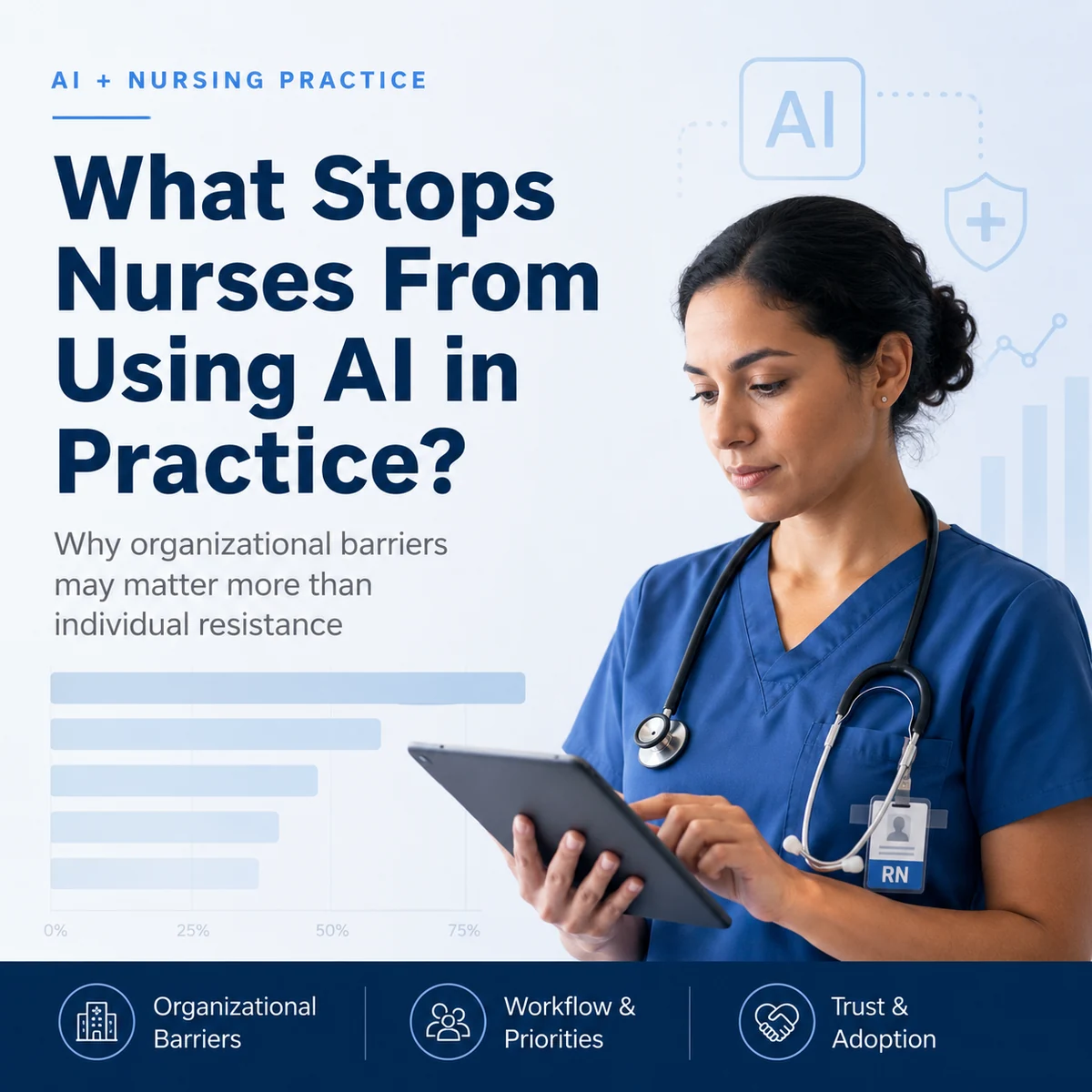
What Stops Nurses From Using AI in Practice?
AI adoption is usually framed as a clinician problem, but a 42-nurse course evaluation found the top barrier was organizational policy and IT restrictions (21 of 42), not distrust or fear. This guide breaks down 12 real barriers (governance, patient trust, competing priorities, time, workflow friction, privacy, burnout, and more) and the seven conditions that make nurses actually adopt AI.
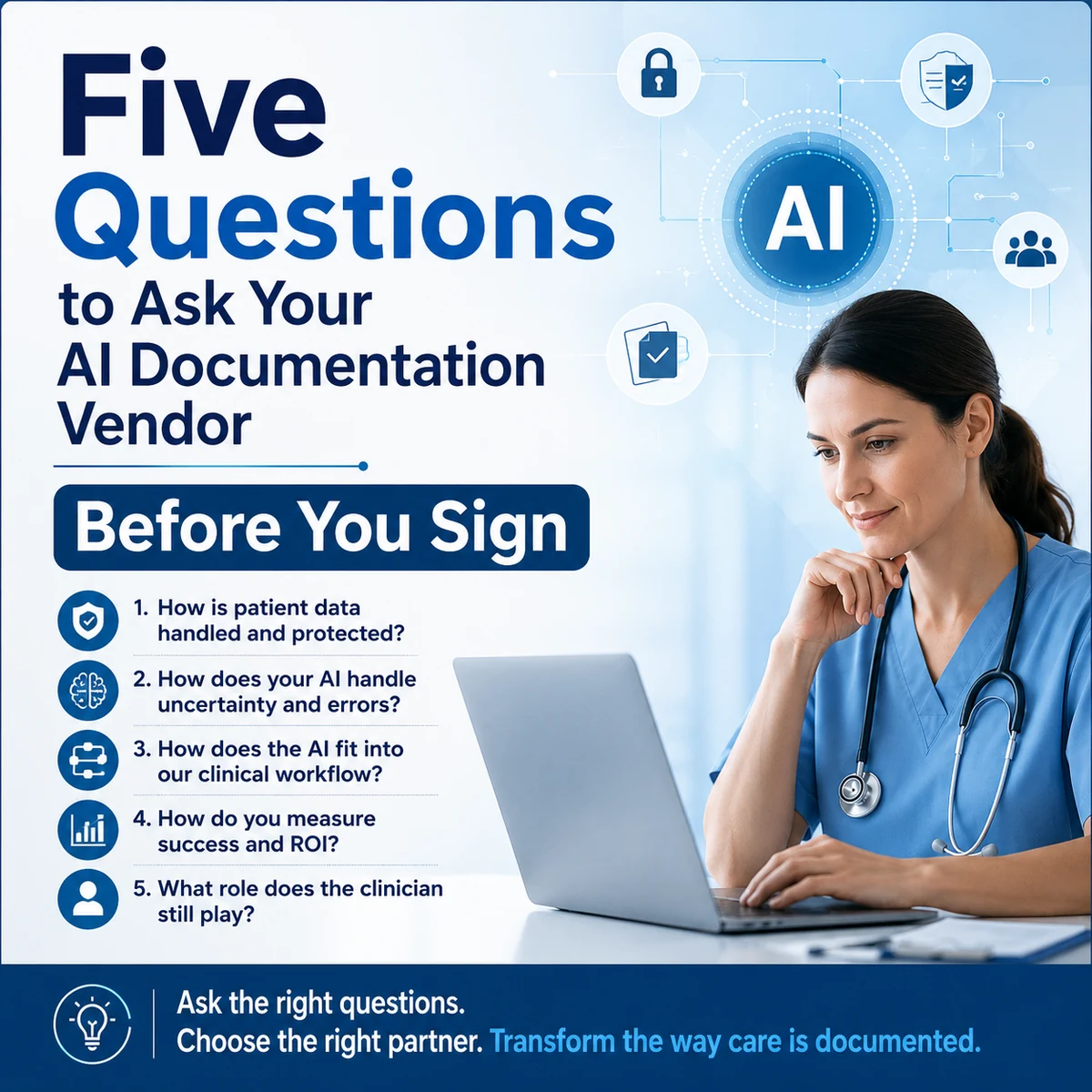
Five Questions to Ask Your AI Documentation Vendor Before You Sign
Almost every AI documentation vendor can show an impressive demo, but a demo doesn't tell you how the technology behaves inside your real clinical workflow. This guide gives five questions to ask before you sign, covering data handling, hallucinations, workflow fit, measurable ROI, and clinician control, plus demo red flags and a six-area vendor evaluation framework.

AI Scribe vs AI Documentation Agent: Which One Does Home Health Really Need?
An AI scribe transcribes conversations into notes. An AI Documentation Agent goes further: it understands clinical workflows, processes referral PDFs, drafts OASIS-E assessments, assists with medication reconciliation, surfaces missing documentation, and helps nurses complete compliant charts. For home health's OASIS complexity and referral processing, an AI Documentation Agent does more than a transcription-only scribe.