
Ambient AI vs. AI Voice Agents for Home Health Documentation
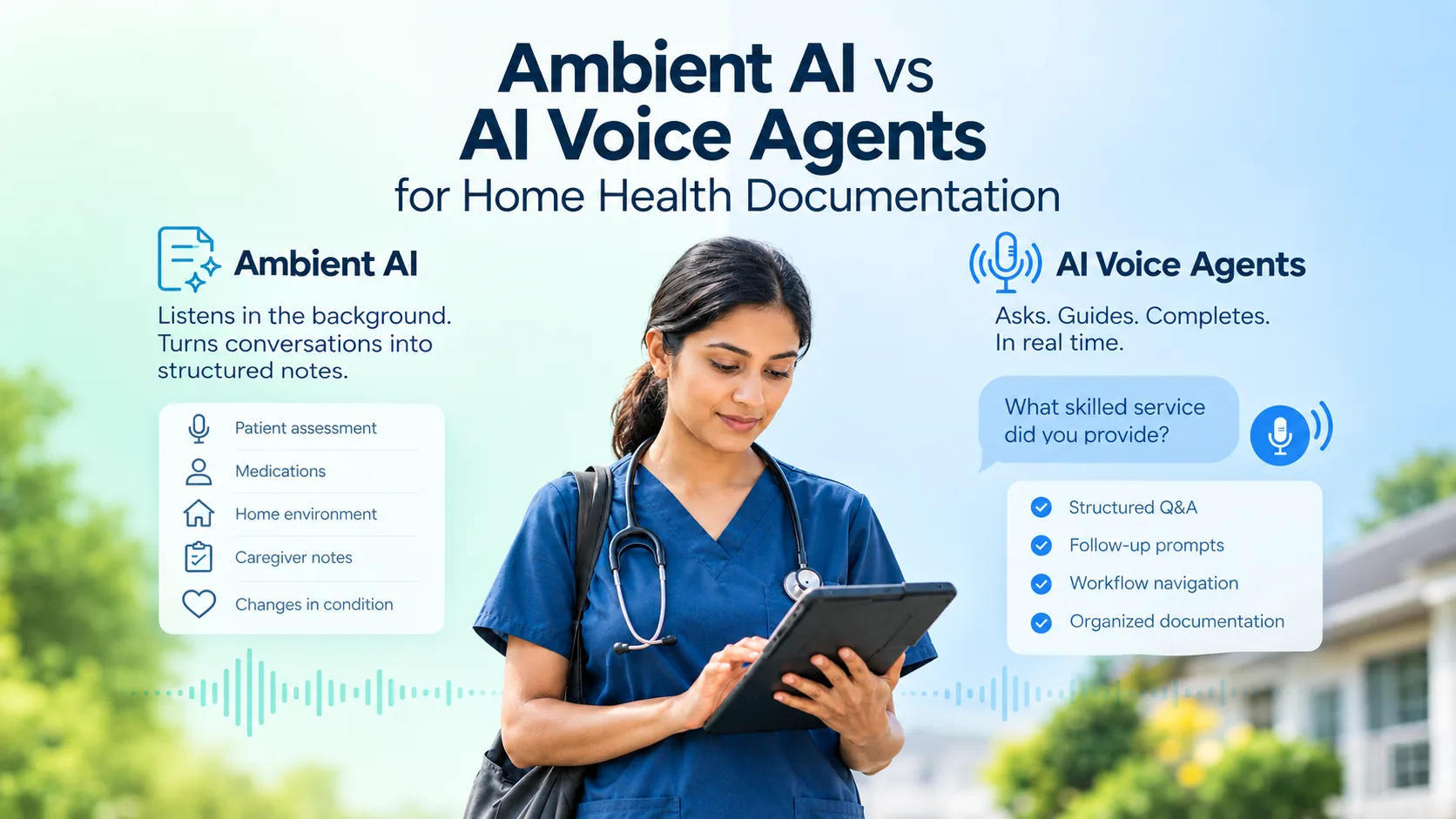
Ambient AI listens and structures natural visit conversations, while AI voice agents actively ask, guide, and complete targeted workflows. The strongest home health documentation design may combine both, with the clinician reviewing every final record.
Key Takeaways
- Ambient AI primarily captures natural, nonlinear clinical conversations in the background and turns them into a draft.
- AI voice agents actively interact with clinicians or patients through questions, prompts, navigation, and approved workflow actions.
- Audio-based systems cannot independently document silent clinical observations, so clinicians must verbalize or separately enter what they see.
- Ambient capture and voice follow-up can work together: capture the visit, identify gaps, ask targeted questions, then route the draft for human review.
- Neither approach should autonomously decide OASIS responses, invent unsupported details, or replace clinical judgment.
- Agencies should evaluate workflow fit, accuracy, privacy, speaker handling, auditability, EMR integration, and the actual work removed from clinicians.
✓ Quick answer: Ambient AI generally listens in the background and turns a natural clinical conversation into a draft. An AI voice agent actively interacts with a clinician or patient by asking questions, giving prompts, navigating a workflow, or collecting structured information. For home health, ambient capture may preserve the broad visit story, while a voice agent may be better for targeted follow-up. The most complete workflow can combine both and require clinician approval before finalization.
Ambient AI and AI voice agents can both reduce documentation burden, but they participate in the workflow differently. That difference matters in home health, where a clinician may assess the patient, talk with family, observe mobility, review medications, perform skilled interventions, evaluate the home, coordinate with caregivers, and complete structured assessment requirements during one visit.
The useful question is not simply which tool can transcribe speech. It is where AI should participate in the journey from a completed visit to an accurate, structured, clinician-approved record.
This article focuses on active voice agents. For a broader comparison of ambient capture and full documentation platforms, see AI vs. an ambient scribe for home health nurses.
What Is the Difference Between Ambient AI and AI Voice Agents?
| Dimension | Ambient AI | AI voice agents |
|---|---|---|
| Primary mode | Passive or background capture | Active voice interaction |
| Workflow state | Captures natural, nonlinear conversation | Responds to prompts, questions, or defined tasks |
| Conversation | May capture multiple speakers, depending on the system | Usually focuses on the person actively interacting with it |
| Clinical context | Organizes information from a broader interaction | Can request a specific missing detail |
| Typical output | A visit summary or documentation draft | Structured answers, task completion, or additions to a draft |
| Gap handling | May flag gaps after processing | Can actively ask follow-up questions |
| Human review | Required before finalization | Required before finalization |
The distinction is best understood as passive capture versus active workflow participation. It is not simply ambient versus voice because both systems use audio, and modern voice agents can hold natural conversations rather than depend on rigid commands.
How Does Ambient AI Work for Home Health Documentation?
Ambient AI generally operates while the clinical interaction is taking place. It captures relevant spoken information and uses AI to organize that information into a documentation draft.
A basic workflow is: natural conversation, capture, clinical organization, draft generation, clinician review, and clinician approval.
This can help when information appears in a clinically natural order rather than in the order required by the final note. A nurse may discuss pain, medications, mobility, caregiver concerns, and recent changes during one conversation.
The system can potentially place those details into the appropriate documentation sections afterward.
ℹ️ Ambient capture does not guarantee complete documentation. The result still depends on what was said, what the system captured and understood, how clinical terminology and multiple speakers were handled, whether silent observations were added, and how carefully the clinician reviewed the draft.
How Do AI Voice Agents Work for Home Health Documentation?
AI voice agents take an interactive approach. A voice agent can ask questions, respond to spoken answers, provide prompts, navigate a workflow, or initiate approved actions.
It may be used during a structured debrief after a visit or after a draft has been checked for potentially missing information.
- What skilled service did you provide?
- What changed from the previous visit?
- What patient or caregiver education was provided?
- Were there medication concerns or changes?
- Did the patient report new symptoms?
- Is follow-up or care coordination required?
- Is any information still missing from the documentation?
A well-designed voice agent can reduce cognitive load by asking a relevant question at the right moment. A poorly designed one can simply move the burden from typing to verbal commands.
Agencies should evaluate the full workflow rather than assuming a voice interface automatically saves time. For a deeper workflow view, read how voice AI changes clinical documentation.
Why Is Home Health Different From Documentation in a Clinic?
A patient's home is not a controlled clinical environment. Televisions, barking dogs, room acoustics, interruptions, multiple speakers, hearing differences, and equipment can all affect audio quality.
The patient, spouse, paid caregiver, and clinician may each contribute a different part of the story.
Agencies should test speaker identification, background-noise performance, clinical vocabulary, and the system's ability to keep historical information separate from the current condition. They should not assume that every ambient product handles multi-party conversation or every voice agent understands home health context equally well.
Why Do Silent Clinical Observations Matter?
A significant part of a home health assessment is observed rather than spoken. A clinician may notice gait changes, unsafe medication organization, mobility barriers, equipment problems, caregiver limitations, skin changes, or a change in the patient's appearance or behavior.
An audio-only system cannot independently see a patient stumble or identify a cluttered hallway. If the clinician verbalizes an observation, ambient AI may capture the statement.
If the observation remains silent, it must be entered through another supported input. The AI is capturing the clinician's observation, not replacing the clinician's assessment.
How Does OASIS Change the Requirements for Documentation AI?
OASIS is not simply a narrative note. CMS defines OASIS as standardized data elements integrated into a home health agency's comprehensive assessment for quality-data collection and reporting.
The current CMS OASIS data sets and OASIS-E2 Guidance Manual govern the applicable items and instructions.
That creates a harder technical problem: turning natural, nonlinear information into structured assessment support without inventing an answer. A capable system may capture, extract, organize, map, and flag information for review.
Agencies still need to verify exactly which OASIS workflows a product supports and whether its behavior aligns with current CMS guidance.
- Ambient approach: natural conversation, extraction, structured draft, gap detection, human review.
- Voice-agent approach: targeted prompt, clinician response, structured input, documentation update, human review.
- Hybrid approach: ambient draft, gap check, voice follow-up, clinician correction and approval.
! AI may surface relevant evidence or ask for missing information, but it should not autonomously choose an OASIS response or create clinical facts. The assessing clinician remains responsible for applying current CMS guidance and approving the record.
Can Ambient AI and AI Voice Agents Work Together?
Yes. Ambient AI and voice agents can be complementary rather than competing technologies.
One can capture the broad interaction, while the other asks focused questions after the system identifies possible gaps.
- The clinician provides care and talks naturally with the patient and caregiver.
- Ambient AI captures relevant spoken information during the visit.
- The system organizes the captured information into a documentation draft.
- A completeness check identifies information that may still be missing or unclear.
- A voice agent asks the clinician targeted follow-up questions.
- The clinician reviews source information, corrects the draft, and approves the final record.
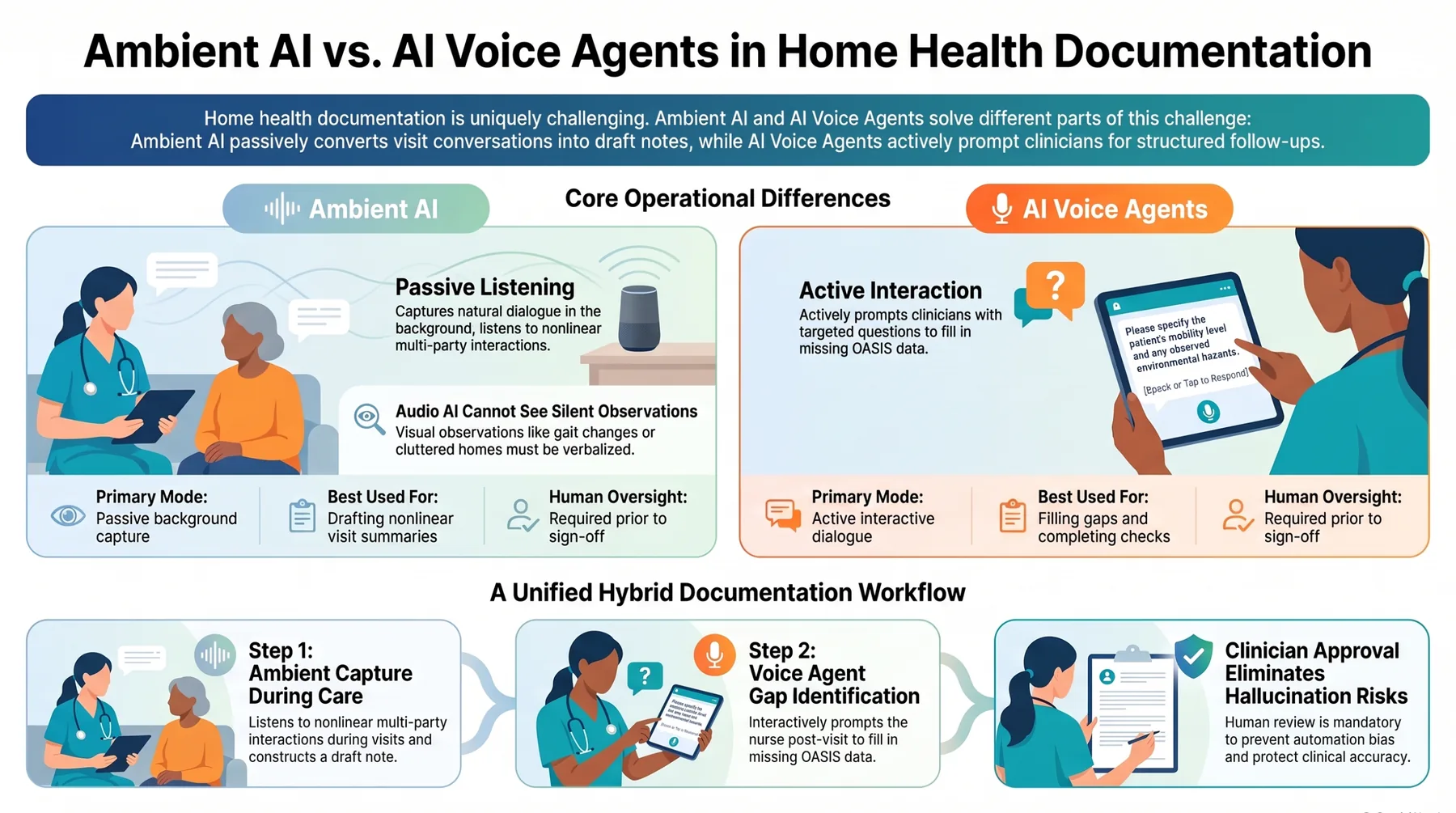
Ambient capture and active voice follow-up can support different stages of one clinician-controlled documentation workflow.
Where Are AI Voice Agents Most Useful?
- Targeted follow-up questions after a visit.
- Structured documentation checks.
- Collecting details that were not captured in the original interaction.
- Hands-free workflow navigation.
- Reminder and status workflows.
- Clinician check-ins.
- Defined patient check-ins with escalation rules.
- Approved workflow actions connected to agency systems.
The scope matters. A voice agent that asks an approved question and routes the answer to a clinician is different from a system that independently interprets symptoms or makes a clinical decision.
Agencies should define what the agent can ask, record, escalate, and never do.
Can AI Voice Agents Support Patient Check-Ins Between Visits?
Potentially. A patient-facing agent may collect predefined information such as symptoms, weight, blood glucose, or medication-related updates when that workflow is clinically approved.
It needs clear escalation rules, identity and consent controls, accessibility planning, and a safe response when the patient reports an emergency.
Patient check-ins should not be presented as autonomous diagnosis, emergency triage, or a replacement for a clinician. The agency needs to define who receives alerts, how quickly they are reviewed, what happens after hours, and what the agent tells a patient who may need urgent help.
What Are the Main Risks of AI-Generated Clinical Documentation?
Automation Bias
Automation bias occurs when a person places too much trust in an automated output. A polished note can still omit an important detail, misinterpret a statement, confuse history with current status, misrecognize a medication, or place correct information in the wrong context.
Unsupported or Incorrect Content
Generative systems can produce fluent information that is not supported by the visit. Agencies should evaluate how the product handles uncertainty, whether it preserves links to source information, how corrections are tracked, and whether finalization always requires an accountable human reviewer.
Privacy and Security
Audio, transcripts, prompts, and generated notes may contain protected health information. HHS explains that a cloud provider that creates, receives, maintains, or transmits electronic PHI on behalf of a regulated entity is generally a business associate, even when the data is encrypted and the provider cannot view it.
Agencies should perform their own risk analysis, establish appropriate agreements, and apply administrative, physical, and technical safeguards. See the official HHS guidance on HIPAA and cloud computing.
Unclear Human Responsibility
The NIST AI Risk Management Framework emphasizes defined roles, oversight, measurement, and risk management across the AI lifecycle. For clinical documentation, agencies should clearly assign who reviews AI output, who can correct or finalize it, how incidents are reported, and how performance is monitored after deployment.
Which Is Better for Home Health: Ambient AI or AI Voice Agents?
| If the primary problem is | Potential fit |
|---|---|
| Capturing natural, nonlinear conversations | Ambient AI |
| Creating an initial visit documentation draft | Ambient AI |
| Capturing information from multiple participants | Ambient AI, when speaker handling is validated |
| Asking targeted follow-up questions | AI voice agent |
| Completing structured checks | AI voice agent |
| Finding and resolving missing information | Either or both, depending on workflow |
| Hands-free navigation or post-visit prompts | AI voice agent |
| Supporting the full capture-to-approval workflow | A hybrid approach |
No label guarantees the right fit. An agency should start with the workflow problem, identify the people and systems involved, then test whether the technology actually removes work without weakening accuracy, privacy, or clinical control.
What Should Agencies Ask an AI Documentation Vendor?
- Can the system capture natural clinical conversation, and how does it handle multiple speakers and background noise?
- What inputs can it use besides audio for silent clinical observations?
- How does it distinguish historical information from current status?
- Which home health and OASIS workflows does it support today?
- Can it flag missing information and ask targeted follow-up questions?
- Can clinicians inspect source information and correct the output easily?
- Does every final note require clinician review and approval?
- How are edits, approvals, and workflow actions recorded in an audit trail?
- How is PHI protected, where is it processed, and which parties require business associate agreements?
- How does the product integrate with the agency's EMR and existing workflows?
- How is performance monitored after deployment, including failure cases?
- How much net work does the system remove after capture, review, corrections, and data transfer are counted?
What Does the Future of Home Health Documentation AI Look Like?
The future is unlikely to be one interface used for every task. A more complete system can listen, understand, extract, structure, identify gaps, ask, coordinate, document, flag, and route the result for review.
Each capability should have a defined scope and an accountable human checkpoint.
The design principle is simple: AI should adapt to the clinician's real workflow. Home health technology must work in patients' homes, around caregivers and interruptions, across nonlinear conversations, inside structured assessment requirements, and with clinical judgment firmly in human hands.
Official Resources
- CMS OASIS Data Sets.
- CMS OASIS User Manuals.
- HHS Guidance on HIPAA and Cloud Computing.
- NIST AI Risk Management Framework.
This article provides general educational information and is not legal, compliance, cybersecurity, or clinical advice. Agencies should evaluate their own workflows, applicable requirements, contracts, risk analysis, and clinical oversight before deploying AI.
Home Health Documentation Playbook
The complete guide to OASIS-E, Medicare compliance, PDGM, and AI-assisted documentation. Learn how top agencies reduce documentation time without sacrificing compliance.
Bottom Line
Ambient AI is strongest at capturing and organizing natural interactions, while AI voice agents are strongest at actively collecting missing information and guiding tasks; a hybrid workflow can use both, but the clinician must verify, correct, and approve the final clinical record.
Inside Home Health Podcast
Watch: How AI Can Give Clinicians Their Time Back

Arvind Sarin is the founder of Copper Digital. He works inside home health agencies to build AI documentation workflows that help clinicians finish OASIS and visit notes sooner, with a nurse reviewing and approving every note. He writes about home health documentation, Medicare compliance, and applying AI responsibly in clinical workflows.
Frequently asked
Frequently asked questions
Ambient AI generally captures and organizes a natural conversation in the background. An AI voice agent actively interacts with a clinician or patient through questions, prompts, navigation, or approved workflow actions.
Join the conversation
Leave a comment
No comments yet. Be the first to share your thoughts.
Related reading
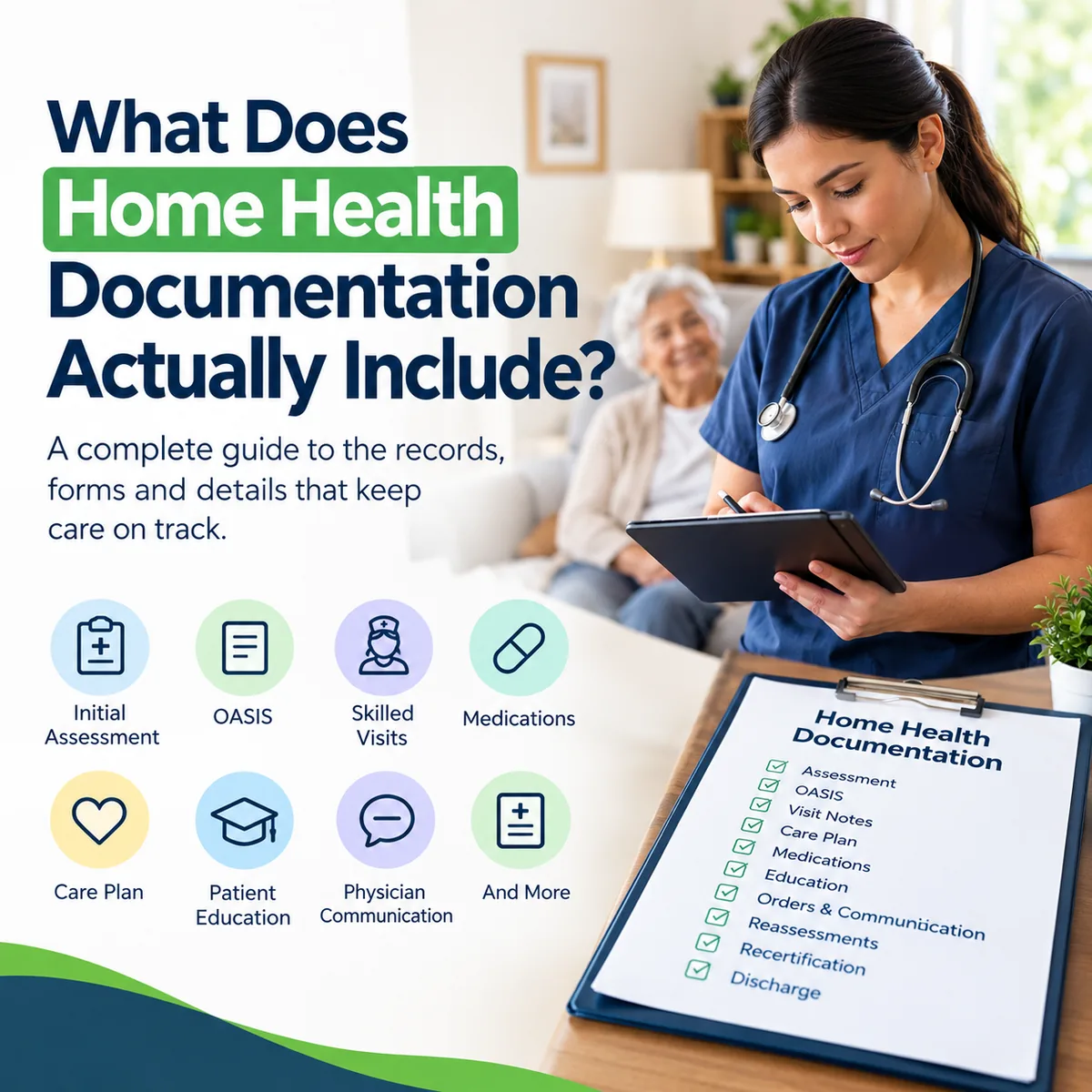
What Does Home Health Documentation Actually Include?
Home health documentation is much more than a visit note. Across an episode it spans the initial assessment, OASIS, skilled visits, medications, the care plan, education, physician communication, orders, reassessments, recertification, and discharge: each piece is part of the patient's larger story of care.
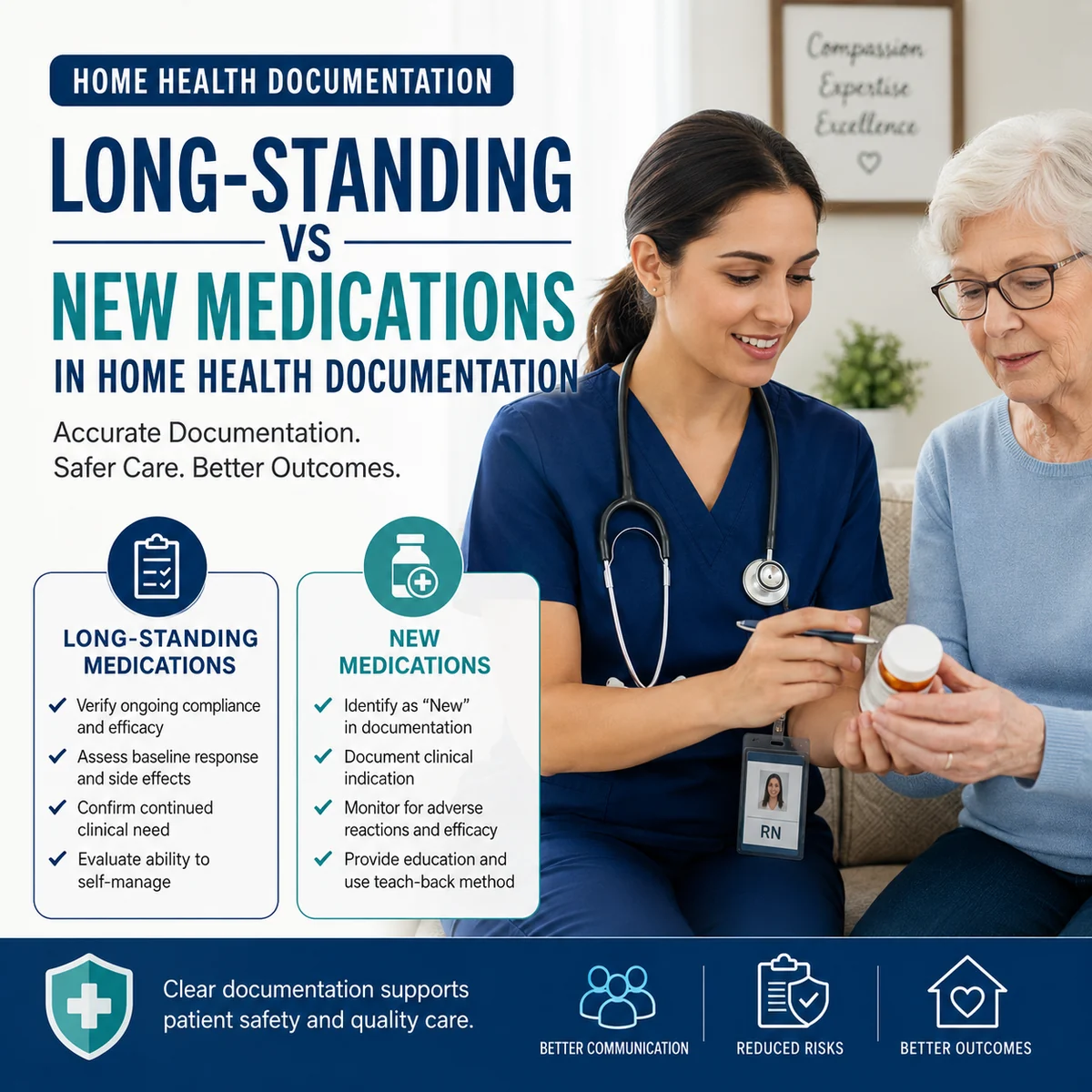
Long-Standing vs. New Medications in Home Health Documentation: What Nurses Need to Know
A patient's medication list often mixes drugs they've taken for years with brand-new prescriptions from a recent hospital stay, and the two need very different documentation. This guide breaks down what to document for long-standing vs. new medications, how to reconcile the regimen, and how to use teach-back to confirm understanding.

Why OASIS Documentation Is Burning Out Your Nurses
OASIS documentation is the CMS-required Outcome and Assessment Information Set that home health nurses complete for Medicare patients. With more than 100 data elements and a Start of Care assessment that takes 60 to 90 minutes, it often follows nurses home as after-hours 'pajama time,' making it a leading cause of home health nurse burnout. AI-powered documentation with human-in-the-loop review can cut charting time and give nurses their evenings back.