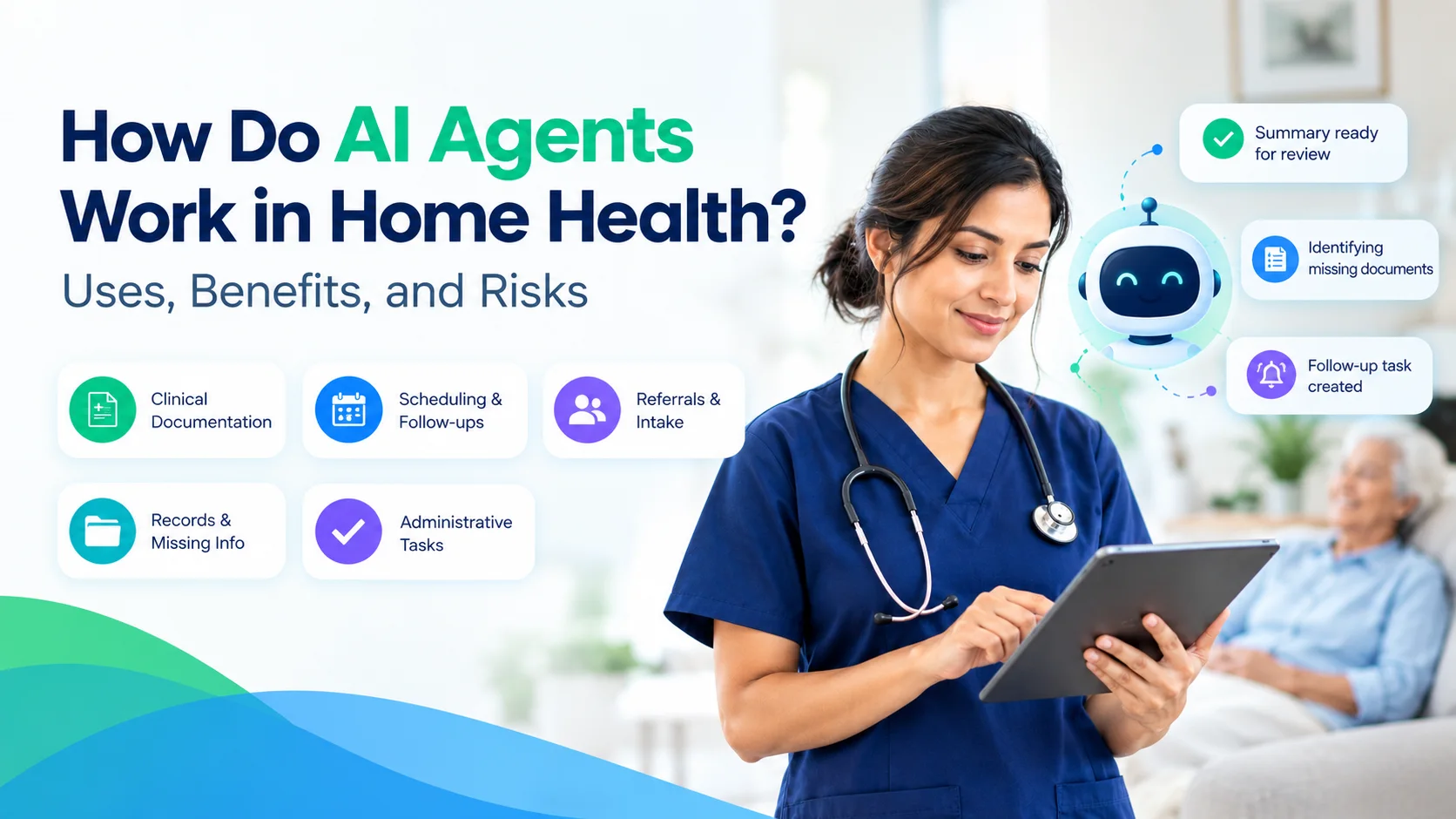
Home health agencies manage a lot more than patient visits. Teams coordinate referrals, verify information, prepare documentation, track unfinished tasks, follow up on missing records, and keep clinical and administrative workflows moving.
Much of this work happens across multiple systems and involves repeated steps. When those steps are handled manually, even small delays can create additional work for nurses and administrators.
This is where AI agents can help.
Unlike a basic chatbot that responds to a question, an AI agent can work toward a defined goal, gather permitted information, complete a sequence of tasks, and interact with connected systems within established boundaries.
In home health, that could mean helping organize referral information, preparing a clinical summary, identifying missing documentation, or following up on an unfinished administrative task.
The important distinction is that AI agents can help move work forward, but their level of authority must be clearly defined. Some agents prepare information for a person to review. Others can perform approved routine actions. Clinical decisions and final documentation approval require appropriate safeguards.
What Are AI Agents in Home Health?
AI agents in home health are software systems designed to carry out specific tasks or coordinate multiple steps within an agency's workflow.
They combine AI capabilities with access to approved information sources, tools, and workflow rules. Depending on their design, they can interpret information, determine the next step, retrieve additional data, prepare an output, or initiate an authorized action.
For example, an agency receives a referral with patient information, clinical records, and supporting documents.
An AI agent might extract the relevant details, organize the information, identify missing items, and prepare a checklist for staff to review. If the workflow permits, it could also create a follow-up task for the missing information.
The agent is not simply answering a question. It is helping progress a defined workflow.
The exact capabilities depend on the system. Not every product marketed as an AI agent can independently access records, take actions, or coordinate multiple tasks.
How Do AI Agents Work in Home Health?
Although implementations differ, a typical AI agent workflow involves several steps.
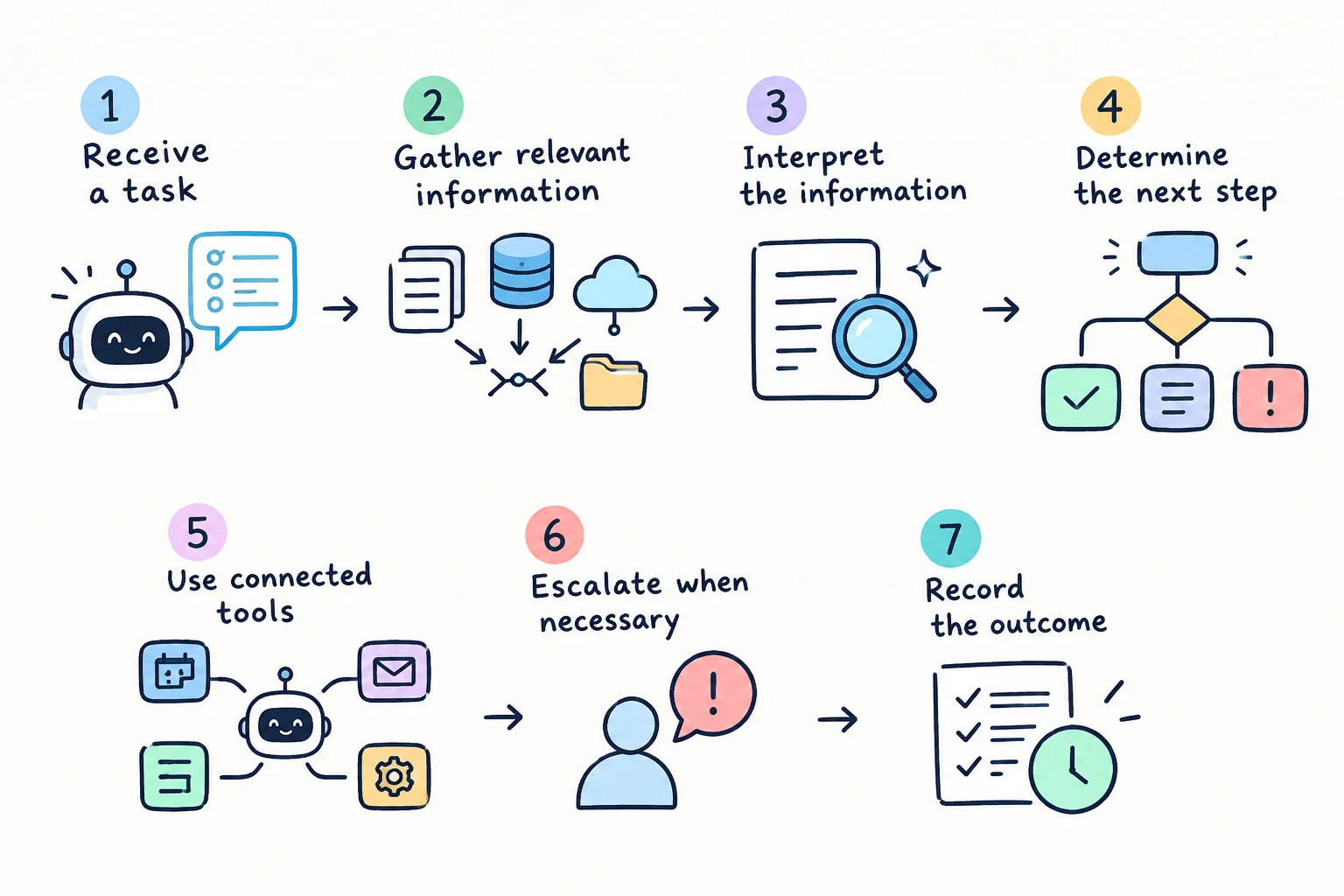
1. Receive a task.
The agent is given a goal, such as preparing a referral summary or identifying incomplete documentation.
2. Gather relevant information.
It retrieves information from approved sources, such as documents, databases, or connected applications, according to its permissions.
3. Interpret the information.
AI models help extract details, understand natural language, summarize records, or identify information that may be missing or inconsistent.
4. Determine the next step.
The agent follows its instructions and workflow rules to decide what action is appropriate. It may need to retrieve more information, prepare a draft, flag an exception, or ask a person for clarification.
5. Use connected tools.
Depending on its permissions, the agent may create a task, prepare a message, update an authorized field, or present a draft for review.
6. Escalate when necessary.
If information is incomplete, conflicting, or outside the agent's authority, the workflow should route the issue to an appropriate person rather than forcing a conclusion.
7. Record the outcome.
Where supported, system logs and audit trails help establish what the agent accessed or did, when it happened, and whether a person reviewed or approved the result.
This process can reduce repeated manual steps. However, its reliability depends on the quality of the available information, the design of the workflow, the permissions granted, and the controls around each action.
How Are AI Agents Different From Chatbots and Traditional Automation?
These technologies can overlap, but they do not work in exactly the same way.
A chatbot primarily responds to user prompts. Traditional automation follows predefined rules and triggers. An AI agent can combine AI interpretation with multi-step task execution and tool use.
For example, a rule-based system might flag a referral when a required field is blank. An AI agent could help interpret the accompanying documents, identify which information appears to be missing, and prepare a request for clarification.
The rule-based system is useful when the conditions are predictable. The AI agent may be more useful when the task involves varied documents or unstructured information.
Neither approach is automatically better. Many home health workflows benefit from a combination of rules, conventional automation, AI capabilities, and human review.
What Tasks Can AI Agents Handle in Home Health?
AI agents can support several operational and administrative workflows, depending on their capabilities and the agency's implementation.
How Can AI Agents Help With Referral Intake?
Referral intake often involves reviewing documents, extracting patient details, checking required information, and routing the referral to the appropriate team.
An AI agent can help organize information from incoming documents and compare it against an agency's defined intake checklist.
It may identify missing records, prepare a referral summary, or create a follow-up task for staff.
For example, if a referral packet appears to be missing a required document, the agent can flag the gap instead of allowing the packet to move forward without review.
The agent should not assume that a missing document means a patient is ineligible. Eligibility and acceptance decisions should follow the agency's established procedures and applicable requirements.
How Can AI Agents Reduce Clinical Documentation Work?
Clinical documentation is a potential use case because it often involves converting observations and other source information into structured, readable notes.
An AI agent may help organize a nurse's dictated observations, prepare a visit summary, or identify areas that need clarification.
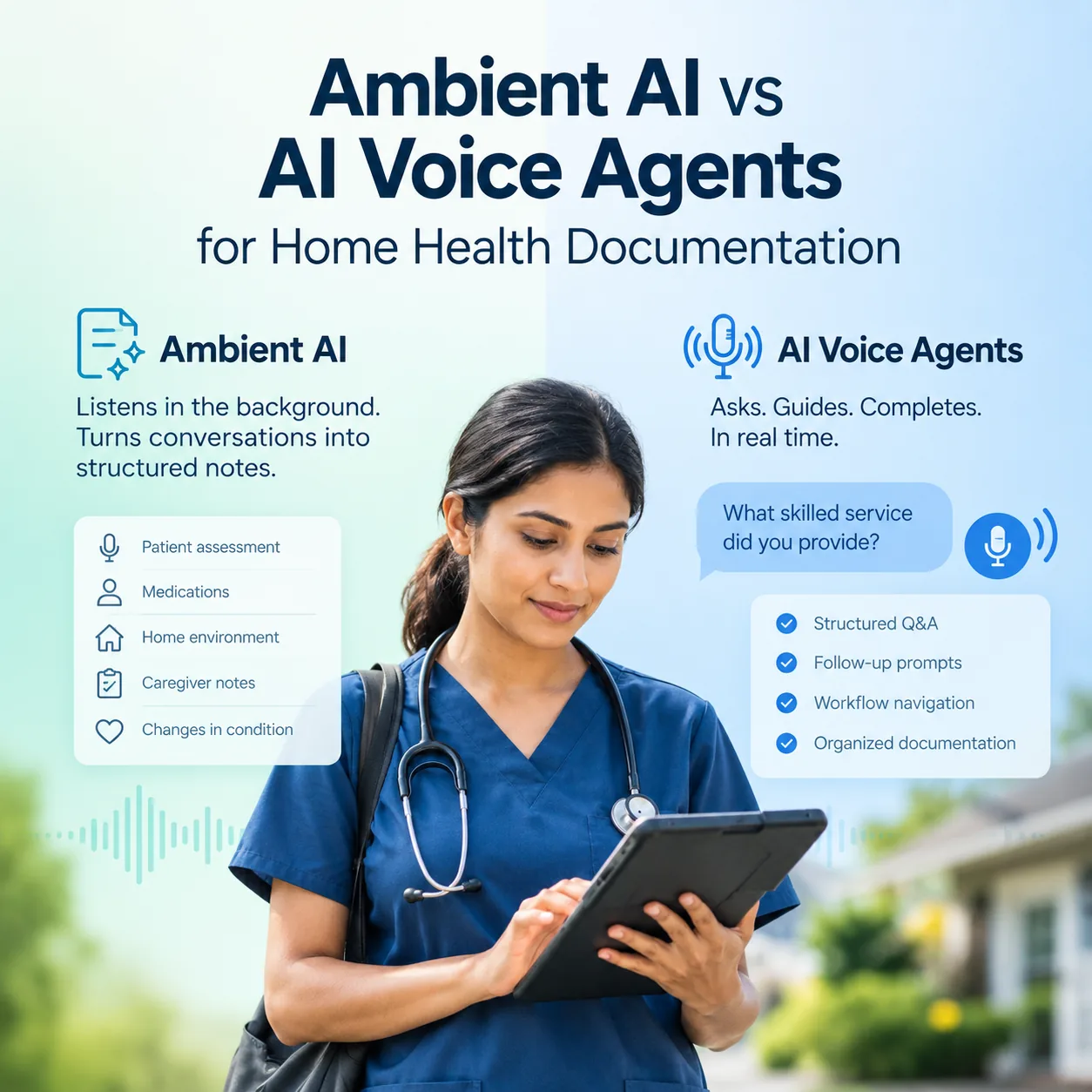
For instance, a nurse could provide visit information through voice input. The system could prepare a draft summary for the nurse to review and correct.
The distinction matters: the agent should not invent findings, fill gaps with unsupported assumptions, or treat an earlier assessment as a substitute for current observations.
For OASIS-related documentation, the agent may help organize information relevant to assessment items. The clinician must still verify the content and determine the appropriate responses based on the assessment and applicable guidance.
CMS identifies OASIS as a key instrument in the Home Health Quality Reporting Program. OASIS-E2 became effective on April 1, 2026, making it important for agencies to ensure that their workflows reflect the applicable assessment requirements.
Can AI Agents Help With Scheduling and Visit Coordination?
AI agents may support scheduling by organizing visit requests, identifying conflicts, and preparing suggested changes based on agency-defined rules.
For example, an agent could flag a scheduling conflict or alert an administrator that a visit remains unassigned.
More advanced integrations may allow an agent to propose or make authorized scheduling changes.
However, scheduling decisions can involve clinician availability, patient needs, geographic constraints, and agency policies. These factors should be considered before changes are finalized.
How Can AI Agents Help Track Late Notes and Missing Documentation?
An agent can monitor authorized workflow information for tasks that remain incomplete and trigger appropriate reminders or escalation steps.
For example, if a visit note remains unfinished beyond an agency-defined threshold, an agent could notify the responsible person or prepare a follow-up task.
It could also help route unresolved documentation exceptions to the appropriate team.
This is different from simply sending the same reminder to everyone. A well-designed workflow can account for task status, previous follow-ups, and escalation rules.
The agent should not mark a note complete unless the required action has actually occurred and the system has reliable evidence of that status.
Can AI Agents Help With Billing and Compliance Workflows?
AI agents can assist with administrative checks by comparing available information against defined requirements.
Potential tasks include identifying missing documents, flagging inconsistent information, organizing supporting records, and preparing exception lists for billing or compliance staff.
For example, an agent might identify a discrepancy between two records and route it for review before the claim proceeds.
It should not assume that every discrepancy makes a claim invalid or that a document is sufficient simply because it is present.
Billing decisions, coding judgments, and compliance determinations require the appropriate review based on the applicable rules and the agency's processes.
How Do Multiple AI Agents Work Together in a Home Health Agency?
Some systems use several specialized agents rather than asking one agent to handle every task.
One agent might organize incoming referral information. Another might check whether required documents are present. A third might prepare a follow-up task when something is missing.
A coordinating workflow can then route the results to the appropriate person or system.
For example:
- A referral agent extracts information from the incoming packet.
- A document-checking agent compares the packet with the agency's checklist.
- A follow-up agent prepares a request for missing information.
- An authorized staff member reviews exceptions and makes the relevant decisions.
This approach can separate responsibilities and make workflows easier to monitor.
However, multiple agents also introduce additional complexity. Organizations need to understand which agent performed each step, how information moves between them, and what happens when two agents produce conflicting results.
Using more agents does not automatically make a workflow more effective. The design should be driven by the task and its risks.
Do AI Agents Need Access to the Agency's EHR?
Not always. The access required depends on what the agent is expected to do.
A tool that prepares a draft from information provided by a user may need only limited access. An agent that checks task status or updates an approved field may require a connection to the agency's existing software.
Where integrations are used, organizations should define what information the agent can access, what actions it can take, and how those actions are recorded.
Useful safeguards include:
- Access limited to the information needed for the task.
- Permissions aligned with the agent's specific role.
- Secure data transfer and appropriate storage controls.
- Clear separation between draft content and finalized records.
- Logging of relevant actions and changes.
- Testing of integrations and error-handling procedures.
Agencies should also establish how updates to the EHR or connected systems affect the agent's behavior.
An AI agent should not receive unrestricted access simply because broader access makes implementation easier.
Can AI Agents Work With Existing Home Health Software?
They can, provided the relevant systems support a suitable and secure integration.
Depending on the software, integration may use APIs, approved connectors, structured data exchange, or other supported methods.
An agency should evaluate whether the proposed integration can retrieve the correct information, preserve its meaning, handle errors, and make authorized updates reliably.
It should also understand whether the agent can operate without replacing the existing EHR.
Keeping the current EHR may reduce the disruption associated with a full platform replacement, but it does not eliminate implementation work. Integration testing, permissions, staff training, and workflow changes may still be necessary.
Before deployment, agencies should ask vendors to demonstrate the actual workflow using realistic scenarios rather than relying only on feature lists.
Can AI Agents Make Clinical Decisions Without a Nurse?
AI agents should not be assumed to have authority to make clinical decisions simply because they can complete multiple tasks independently.
Their appropriate level of autonomy depends on their intended use, validation, applicable requirements, and the consequences of an error.
An agent may be designed to organize information, prepare a draft, or flag a discrepancy. Those functions differ from independently determining a patient's clinical status or making a treatment decision.
For clinical documentation, a safe workflow should make it clear what the AI generated and provide an appropriate opportunity for the clinician to review and correct the content.
Where approval is required, the agent should not bypass it or represent an unapproved draft as finalized documentation.
The objective is to reduce repetitive work while preserving the clinician's role in interpreting the patient's condition and exercising professional judgment.
What Are the Risks of Using AI Agents in Home Health?
AI agents introduce risks that agencies should assess before implementation and monitor after deployment.
Inaccurate outputs: The agent may misinterpret a document, omit relevant information, or generate an unsupported statement.
Incomplete information: The agent may work with an incomplete record or fail to recognize that a required source is missing.
Integration errors: Information may be retrieved from the wrong record, mapped incorrectly, or not synchronized as expected.
Excessive permissions: An agent may be able to access or change more information than its task requires.
Unclear accountability: Staff may not know who is responsible for reviewing an output, correcting an error, or investigating an incident.
Privacy and security risks: Patient information may be exposed if data handling, access controls, or vendor arrangements are inadequate.
Workflow disruption: Poorly designed agents may generate duplicate tasks, send unnecessary reminders, or route exceptions to the wrong team.
These risks can be reduced through appropriate testing, access controls, human oversight, monitoring, and incident response procedures.
The NIST AI Risk Management Framework offers a voluntary structure for identifying and managing AI-related risks across design, deployment, and use.
How Should Home Health Agencies Evaluate an AI Agent Before Deployment?
A useful evaluation starts with a specific workflow problem rather than a general goal to adopt AI.
Agencies can ask:
- What task will the agent perform? Define the workflow and the expected outcome.
- What information will it use? Identify the source records and the permissions required.
- What actions can it take? Distinguish between drafting, recommending, creating tasks, and making changes to systems.
- When is human approval required? Specify which actions must wait for review.
- How will errors be detected? Test incomplete, conflicting, outdated, and incorrect information.
- Can the workflow be audited? Establish what the system records and how an incident can be investigated.
- How will performance be measured? Track accuracy, time saved, exception rates, and the amount of correction required.
- What happens when the agent fails? Define escalation, recovery, and fallback procedures.
A pilot should use representative cases and include the staff who will use the system. It should measure not just how quickly the agent completes a task, but also whether the result is accurate, usable, and safe.
How Can Agencies Measure the Value of AI Agents?
The value of an AI agent should be measured against the specific problem it was introduced to solve.
Useful measures may include:
- Time spent on the target task before and after implementation.
- Percentage of outputs requiring correction.
- Number of incomplete tasks identified and resolved.
- Frequency of duplicate or unnecessary alerts.
- Time taken to resolve documentation exceptions.
- Staff experience and adoption.
- Errors, escalations, and incidents.
- Reliability of integration with existing systems.
Agencies should establish a baseline before deployment and evaluate results over a representative period.
A reduction in time spent on one task does not necessarily mean the overall workflow has improved. If the agent creates additional review work or increases error rates, the net benefit may be smaller than expected.
The strongest evaluation considers both efficiency and quality.
How Is Copper AI Relevant to AI Agents in Home Health?
Copper AI focuses on AI agents for home health documentation and administrative workflows.
For example, in a documentation workflow, an agent can help prepare a clinical summary from information provided by a nurse. The clinician remains responsible for reviewing the summary, making necessary corrections, and approving the final documentation.
The broader objective is to reduce repetitive administrative work without requiring agencies to assume that AI can replace clinical judgment or that every agency needs to replace its existing EHR.
As with any AI solution, agencies should evaluate the specific capabilities, integration requirements, privacy and security arrangements, and approval controls against their own needs.
The important question is not simply whether a product uses AI agents. It is whether those agents solve a meaningful workflow problem, produce reliable results, and operate within clearly defined boundaries.
What Is the Future of AI Agents in Home Health?
AI agents may increasingly coordinate work across documentation, referral intake, scheduling, follow-ups, and administrative exception handling.
Instead of helping with one isolated task, they may support connected workflows that move information from one stage to the next.
That potential also makes governance more important. When agents interact with multiple systems, agencies need clear permissions, reliable records of activity, defined escalation paths, and appropriate human oversight.
The goal should not be to automate every task. It should be to identify where AI can reduce repetitive work, where conventional automation is sufficient, and where human judgment remains essential.
For home health agencies, successful adoption will depend on how well the technology fits the realities of care delivered in the home.