An OASIS discharge assessment is generally required when a patient’s skilled home health episode ends, and the circumstances meet the requirements for an agency discharge.
For applicable home health patients, the agency must complete the required comprehensive assessment at discharge. The assessment should reflect the patient's condition, functional status, progress toward goals, and circumstances surrounding the end of care.
However, not every patient leaving an agency requires the same OASIS assessment. The correct assessment reason depends on whether the patient is being discharged from the agency, transferred to an inpatient facility, or has died.
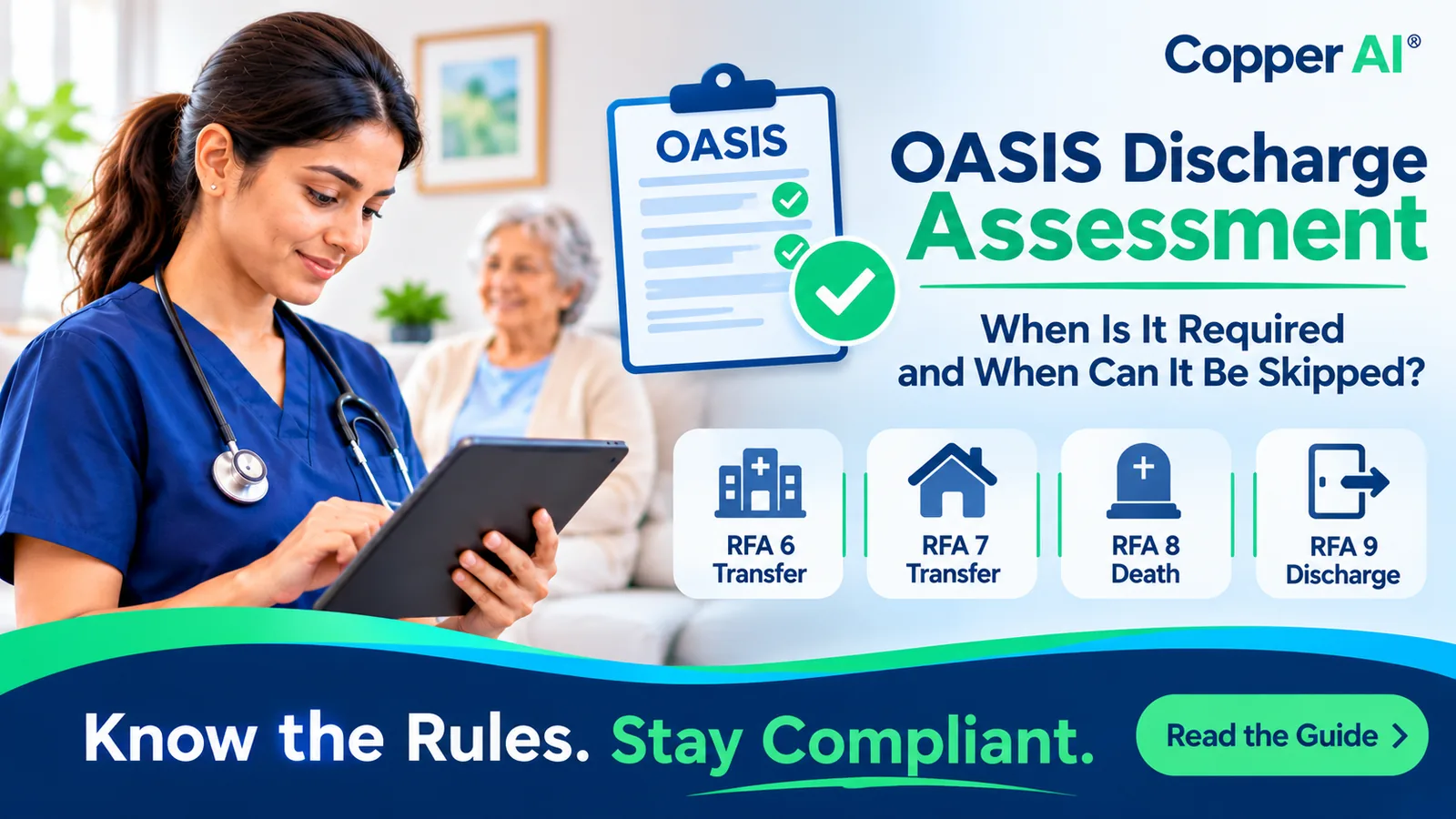
Under the OASIS-E2 Guidance Manual, effective April 1, 2026, the relevant assessment reasons include:
- RFA 6: Transfer to an inpatient facility – patient not discharged from the agency.
- RFA 7: Transfer to an inpatient facility – patient discharged from the agency.
- RFA 8: Death at home.
- RFA 9: Discharge from the agency for reasons other than transfer to an inpatient facility or death at home.
RFA 9 is the assessment reason generally used when a patient’s skilled home health services end without a qualifying inpatient facility transfer or death-at-home event.
Understanding these distinctions helps agencies avoid unnecessary assessments, incorrect OASIS submissions, and preventable QA delays.
When Should an Agency Use RFA 9 for an OASIS Discharge?
RFA 9 is used when a patient is discharged from the home health agency for a reason other than transfer to an inpatient facility or death at home.
Common situations include:
- The patient has met the goals of the home health plan of care.
- The patient no longer requires skilled home health services.
- The patient is no longer eligible for the home health benefit.
- The patient or representative requests discontinuation of services.
- The patient moves outside the agency's service area.
- The patient transfers to another home health agency.
- The patient transitions from Medicare home health to an in-home hospice provider.
The assessment should explain why services are ending and accurately reflect the patient's condition at discharge.
What if skilled services end but non-skilled services continue?
The end of the skilled home health episode may require an OASIS discharge even if the organization continues providing non-skilled services. The agency should determine whether the skilled home health episode is ending and whether the remaining services fall outside the OASIS-required skilled home health episode.
The discharge documentation should make this transition clear.
Does a Change in Payer Require an OASIS Discharge Assessment?
A change in payer does not automatically require a discharge assessment and a new Start of Care (SOC).
The agency should first determine whether the new payer requires a new SOC assessment.
If a new SOC is required, CMS recommends discharging the patient under the previous pay source and completing a new SOC under the new pay source.
However, certain payer changes do not require a new SOC. For example, when a patient moves from Original Medicare to Medicare Advantage and continues receiving skilled services, a new SOC is not required solely because of the payer change. The agency can record the payer change at the next applicable assessment time point.
The important distinction is whether the new payer requires a new SOC, not simply whether the patient's insurance has changed.
What Is the Difference Between an OASIS Discharge Assessment and a Transfer Assessment?
A discharge assessment and a transfer assessment are not interchangeable.
A discharge assessment generally applies when the agency ends its responsibility for the patient's home health services. A transfer assessment applies when the patient is admitted to a qualifying inpatient facility.
The distinction depends on the patient's inpatient status and whether the agency expects the patient to return to home health care.
For example:
- A patient completes the home health episode after meeting treatment goals: generally RFA 9.
- A patient is admitted to a hospital, and the agency expects to resume services after the stay: RFA 6.
- A patient is admitted to a hospital, and the agency does not anticipate returning to provide care: RFA 7.
A hospital emergency department visit or observation stay does not automatically qualify as an inpatient transfer, regardless of how long the patient remains at the hospital.
When Should an Agency Use RFA 6 Instead of RFA 9?
RFA 6 is used when a patient is admitted to a qualifying inpatient facility for 24 hours or longer for a reason other than diagnostic testing, and the agency expects the patient to return to home health services.
For example, a patient receiving skilled nursing and physical therapy is admitted to a hospital following a fall. The agency expects the patient to return home and continue receiving services.
In this situation, the agency completes a transfer assessment using RFA 6 rather than an agency discharge assessment.
What happens if the patient never returns after RFA 6?
CMS provides a specific exception.
If the agency completes and transmits RFA 6 and the patient does not return to the agency during the current 60-day certification period, no further OASIS assessment is required. The agency should complete its internal discharge paperwork.
It does not need to cancel RFA 6 and submit RFA 7 simply because the patient did not return.
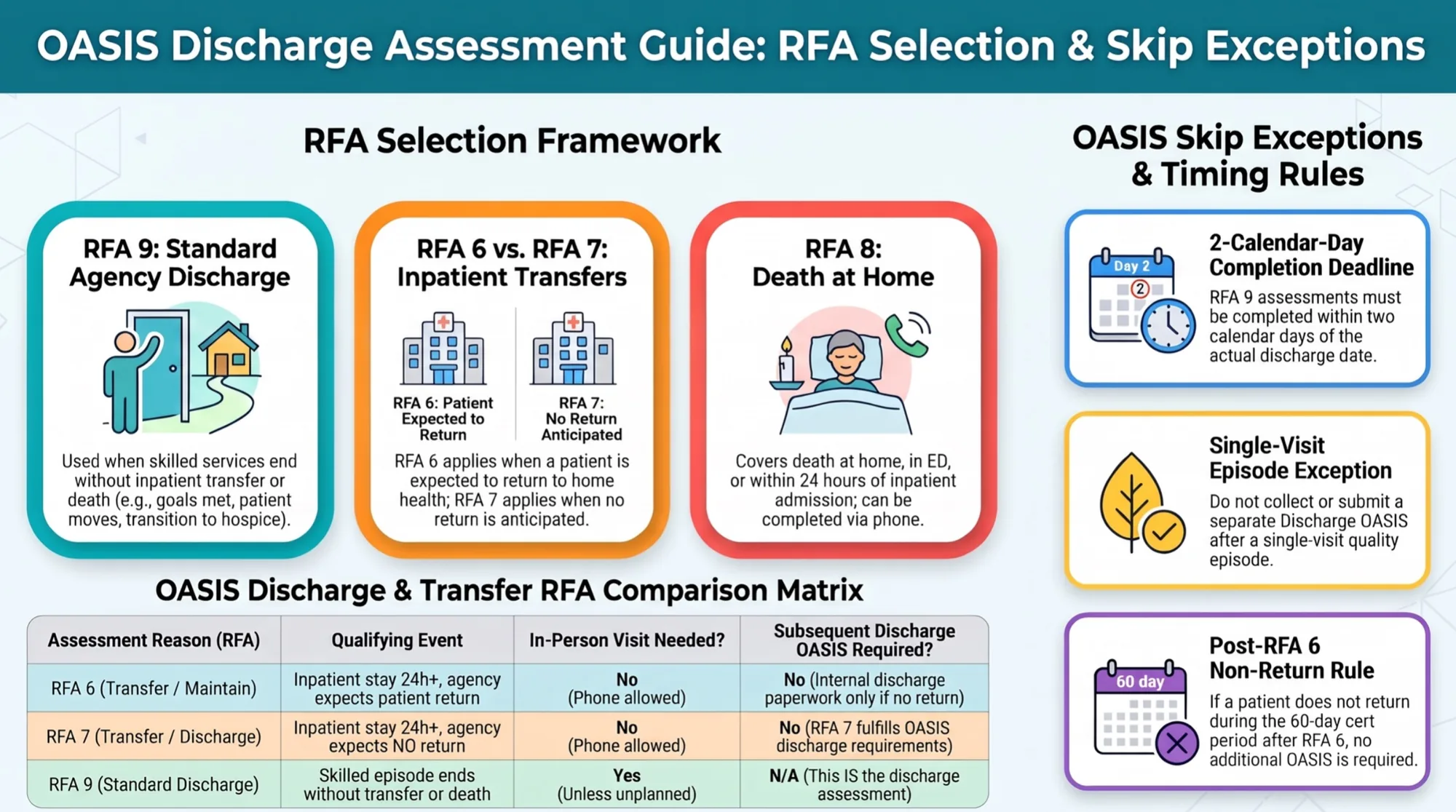
Choosing the correct RFA, and knowing when CMS does not require a separate discharge OASIS, prevents unnecessary assessments and QA rework.
When Should an Agency Use RFA 7 for an Inpatient Transfer?
RFA 7 applies when a patient is admitted to a qualifying inpatient facility for 24 hours or longer for a reason other than diagnostic testing, and the agency does not anticipate that the patient will return to its care.
Examples include situations where the patient requires a higher level of care or the agency has determined that home health services will not resume.
Does RFA 7 require a separate OASIS discharge assessment?
No. RFA 7 is the applicable transfer assessment when the agency is discharging the patient from its care.
CMS states that no additional OASIS discharge data are required for RFA 7.
The agency must still complete its internal discharge documentation and maintain an accurate clinical record.
When Should an Agency Use RFA 8 for a Patient's Death?
RFA 8 is used when a patient dies under circumstances that meet the OASIS definition of death at home.
This includes situations where the patient:
- Dies at home while receiving home health services.
- Dies before being treated in an emergency department or admitted to an inpatient facility.
- Dies in the emergency department.
- Dies less than 24 hours after admission to an inpatient facility.
- Dies during outpatient surgery or in the recovery room following outpatient surgery.
RFA 8 should not be used when the patient dies after a qualifying inpatient facility admission.
The agency should document the date of death and collect the required information. CMS allows a telephone call to provide the information needed for the limited OASIS data collected at this time point.
When Can an OASIS Discharge Assessment Be Skipped?
There are specific situations in which a separate OASIS discharge assessment is not required.
Understanding these exceptions helps agencies avoid unnecessary assessments and incorrect submissions.
Can an OASIS discharge assessment be skipped after only one visit?
Yes. CMS identifies a single-visit quality episode as an exception.
When a patient is discharged after only one visit in the quality episode, a separate Discharge OASIS should not be collected or submitted.
However, there is an important Medicare payment distinction.
For a Medicare PPS (PDGM) single-visit quality episode, OASIS data must still be collected and submitted to support billing. If OASIS is collected for this purpose, the appropriate assessment reason is RFA 1 (Start of Care), not a separate Discharge OASIS.
Other payer requirements may differ, so agencies should verify the applicable payer rules.
Can an agency skip another OASIS assessment after completing RFA 6?
Yes, under the specific CMS scenario.
If RFA 6 has been completed and transmitted and the patient does not return to the agency during the current 60-day certification period, no additional OASIS assessment is required.
The agency should complete its internal discharge paperwork. It does not need to cancel the submitted RFA 6 and replace it with RFA 7.
Can an agency skip a separate discharge OASIS after completing RFA 7?
Yes. RFA 7 is the applicable transfer assessment when the agency does not expect the patient to return to its care.
CMS specifically states that no additional OASIS discharge data are required for RFA 7.
Can an agency skip OASIS when a patient changes from skilled care to personal care?
CMS encourages agencies transitioning a patient from a situation requiring OASIS to one that does not require OASIS, such as moving from skilled Medicare services to personal care only, to complete a discharge OASIS at the last visit under the skilled pay source.
However, CMS describes this as encouraged rather than required. Agencies should also review applicable payer and state requirements.
Do non-OASIS patients require a discharge assessment?
No. OASIS exemptions apply to certain patient populations and service arrangements.
Examples include:
- Patients under 18 years of age.
- Patients receiving maternity services.
- Patients receiving only personal care, housekeeping, or chore services.
- Services provided by HHA staff under a loaned-employee agreement.
- Certain outpatient therapy services billed under Medicare Part B without a home health plan of care.
OASIS is an all-payer requirement for applicable skilled home health patients, subject to CMS exemptions. Agencies should not assume that OASIS applies only to Medicare fee-for-service patients.
What Is the Timeframe for Completing an OASIS Discharge Assessment?
For an RFA 9 discharge, the comprehensive assessment must be completed within two calendar days of the discharge date.
For an unplanned discharge, the applicable timeframe is measured from when the agency learns of the need to discharge.
The transfer and death-at-home assessment time points also have specific two-calendar-day requirements. Agencies should follow the exact instructions for the applicable RFA rather than applying the RFA 9 rule to every situation.
What is the difference between M0090 and M0906?
These two OASIS items record different dates:
- M0090 – Date Assessment Completed: Records the date the assessment was completed.
- M0906 – Discharge/Transfer/Death Date: Records the actual date of the discharge, transfer, or death, as applicable.
The two dates may be different. Agencies should not use the date the clinician completes the assessment as a substitute for the actual event date.
Accurate date documentation is important for assessment timing, submission, and record consistency.
Does Every OASIS Discharge Assessment Require an In-Person Visit?
For a standard RFA 9 discharge, the comprehensive assessment must meet the applicable in-person assessment requirements.
The assessment must be completed by a qualified clinician in accordance with the Medicare Conditions of Participation and CMS OASIS guidance. The clinician's discipline and responsibility must be appropriate to the assessment and applicable regulations.
However, not every OASIS time point requires the same type of patient encounter.
For RFA 6 and RFA 7 transfers and RFA 8 death-at-home assessments, CMS allows the limited required OASIS information to be obtained by telephone.
This distinction matters when the patient is no longer at home or cannot participate in a traditional home visit.
How Should an Agency Complete an OASIS Assessment After an Unplanned Discharge?
An unplanned discharge occurs when home health services end and an in-home discharge visit cannot be made.
CMS allows the last qualified clinician who saw the patient to complete the discharge comprehensive assessment using information from that clinician's last visit.
The clinician may supplement the assessment with documentation from other agency staff who visited the patient during the last five days the agency provided visits. This includes the date of the last visit and the four preceding calendar days.
There are important limitations:
- The assessment must be completed by an appropriately qualified clinician.
- The clinician should use the permitted recent documentation to support the assessment.
- The agency should not assume that a supervisor who never assessed or visited the patient can complete the comprehensive assessment solely by reviewing other staff members' notes.
- A dash may be used only for items where it is an allowed response and information is unavailable.
- Patient interview items, such as BIMS and PHQ-2 to 9, must follow the specific CMS instructions when an interview cannot be completed.
The agency should document why an in-person discharge assessment could not be completed and retain the supporting clinical information.
What Happens If an Agency Misses the OASIS Discharge Assessment Deadline?
CMS requires the applicable discharge assessment to be completed within the specified timeframe.
For RFA 9, this is within two calendar days of the discharge date. For an unplanned discharge, the timeframe is measured from when the agency learns of the need to discharge.
If the deadline is missed, the agency should not simply create a retrospective assessment using old visit notes and treat it as though it were completed on time.
Instead, it should:
- Establish the actual discharge date and when the agency learned of the discharge.
- Determine why the assessment was not completed within the required timeframe.
- Review available clinical documentation and whether the unplanned discharge guidance applies.
- Follow the applicable CMS instructions and agency correction and escalation procedures.
- Document the circumstances accurately.
The agency should not change event dates or assessment completion dates simply to make the record appear timely.
What Are the Most Common OASIS Discharge Assessment Errors?
Even when an agency selects the correct assessment type, incomplete or inconsistent documentation can create QA delays and additional work.
Common issues include:
- Selecting the wrong RFA: Using RFA 9 for a qualifying inpatient transfer instead of determining whether RFA 6 or RFA 7 applies.
- Treating every hospital admission as an inpatient transfer: Emergency department visits and observation stays do not automatically meet the OASIS definition of an inpatient transfer.
- Submitting an unnecessary discharge assessment: Completing a separate Discharge OASIS after a single-visit quality episode or after an RFA 7.
- Submitting another OASIS after RFA 6 unnecessarily: Failing to recognize the CMS exception when the patient does not return during the current certification period.
- Misunderstanding payer changes: Assuming every change in insurance requires a discharge and a new SOC.
- Using an incorrect discharge date: Recording the date the assessment was completed instead of the actual event date.
- Missing the assessment timeframe: Failing to complete the assessment within the applicable two-calendar-day window.
- Incomplete unplanned discharge documentation: Not using the permitted five-day lookback or failing to document why an in-person visit could not be completed.
- Leaving the discharge reason unclear: Failing to explain why services ended.
- Documenting goals without supporting evidence: Marking goals as met or unmet without explaining the patient's progress.
- Inconsistent clinical records: Recording different patient conditions or discharge details in the OASIS and visit notes.
- Missing signatures or authentication: Leaving required clinical documentation incomplete.
- Ignoring payer-specific requirements: Assuming that all payers follow identical OASIS collection and submission expectations.
A consistent QA process can catch these issues before the record moves forward.
How Can Home Health Agencies Prevent OASIS Discharge Documentation Errors?
Agencies can reduce discharge-related rework by making the assessment decision part of their standard discharge workflow.
A practical process should include:
- Confirm the event: Determine whether the patient is being discharged from the agency, transferred to an inpatient facility, or has died.
- Determine whether care is expected to resume: For a qualifying inpatient admission, establish whether RFA 6 or RFA 7 applies.
- Check for exceptions: Confirm whether the case is a single-visit quality episode or falls under another CMS exception.
- Review payer requirements: Determine whether a payer change requires a new SOC.
- Verify the assessment timeframe: Track the applicable deadline for discharge, transfer, or death-at-home time points.
- Review clinical documentation: Check the discharge reason, patient status, goals, medications, instructions, and continuity-of-care arrangements.
- Validate the OASIS responses: Confirm that the selected RFA and completed items match the actual circumstances.
- Complete internal discharge requirements: Ensure the agency's discharge paperwork and required notifications are finalized.
A standardized checklist helps clinicians and QA reviewers follow the same process across the agency.
How Can AI Help Home Health Agencies Review OASIS Discharge Documentation?
OASIS discharge documentation involves more than completing assessment fields. Agencies must make sure the assessment, clinical notes, discharge summary, and supporting records tell a consistent story.
AI can help reduce the manual effort involved in reviewing these records.
For example, AI-supported workflows can help agencies:
- Identify missing documentation and incomplete fields.
- Flag inconsistencies between clinical notes and assessment responses.
- Highlight potential mismatches between the documented discharge circumstances and selected assessment reason for human verification.
- Identify missing information that may require clinician or QA follow-up.
- Organize documentation for a more consistent review process.
Copper AI supports home health documentation and QA workflows through AI-assisted chart review, OASIS review, visit note review, ICD-10-CM coding review, and plan-of-care review. It can help identify documentation gaps and present recommendations for review by the appropriate clinical or agency team.
The goal is not to replace clinical judgment. Clinicians and authorized agency staff remain responsible for reviewing the information, making corrections, and approving the final documentation.
For home health agencies, this can mean less time spent searching through records and more time focused on accurate, complete documentation.
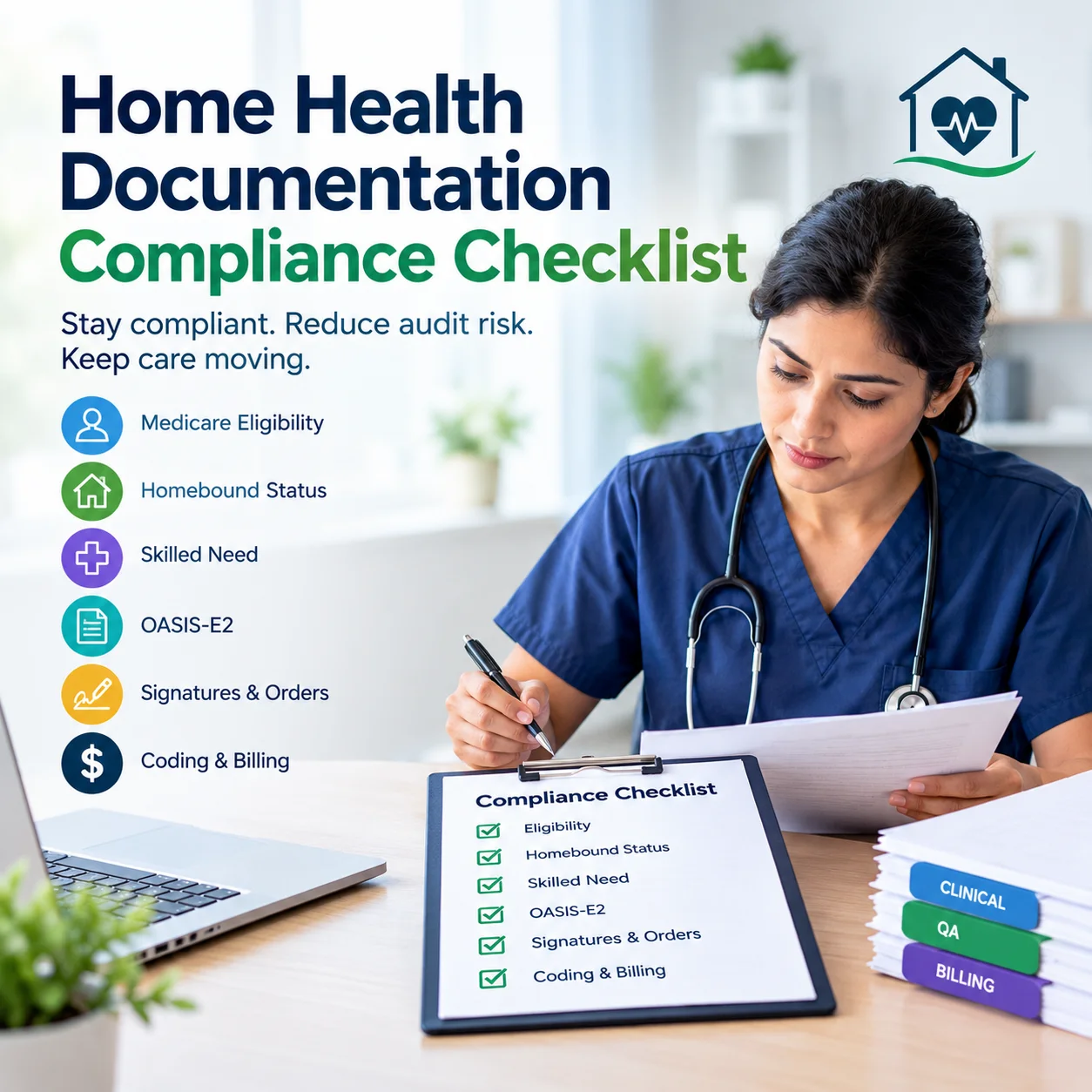
What Should Agencies Check Before Finalizing an OASIS Discharge?
Use this checklist to confirm that the discharge record is complete before closing the patient episode.
- Is the reason for discharge or transfer clearly documented?
- Has the agency selected the correct RFA?
- Has the agency determined whether the patient is expected to return after an inpatient stay?
- Has the single-visit quality episode exception been considered, where applicable?
- Has the agency reviewed payer requirements if the patient's insurance changed?
- Has the applicable assessment timeframe been followed?
- Is the actual discharge, transfer, or death date recorded accurately?
- Does the clinical documentation reflect the patient's condition?
- Are goal outcomes supported by documentation?
- Have medication reconciliation and patient instructions been addressed, as applicable?
- Are required orders, signatures, and notifications complete?
- Has the unplanned discharge guidance been followed, if applicable?
- Has the agency completed its internal discharge procedures?
- Has the OASIS record been reviewed for accuracy before submission?
A final review can help prevent avoidable corrections, delayed chart closure, and inconsistent records.
Final Takeaway
The key to accurate OASIS discharge documentation is knowing when to use RFA 6, 7, 8, or 9—and recognizing when CMS does not require a separate discharge OASIS.
A clear decision process, accurate clinical records, and a consistent QA review can help agencies avoid unnecessary assessments, reduce documentation errors, and close patient episodes with greater confidence.