
What Is OASIS-E2? A Complete Guide for Home Health Agencies
A practical guide to OASIS-E2: assessment changes, time points, quality and payment uses, EHR and iQIES readiness, and AI support that keeps clinicians in control.
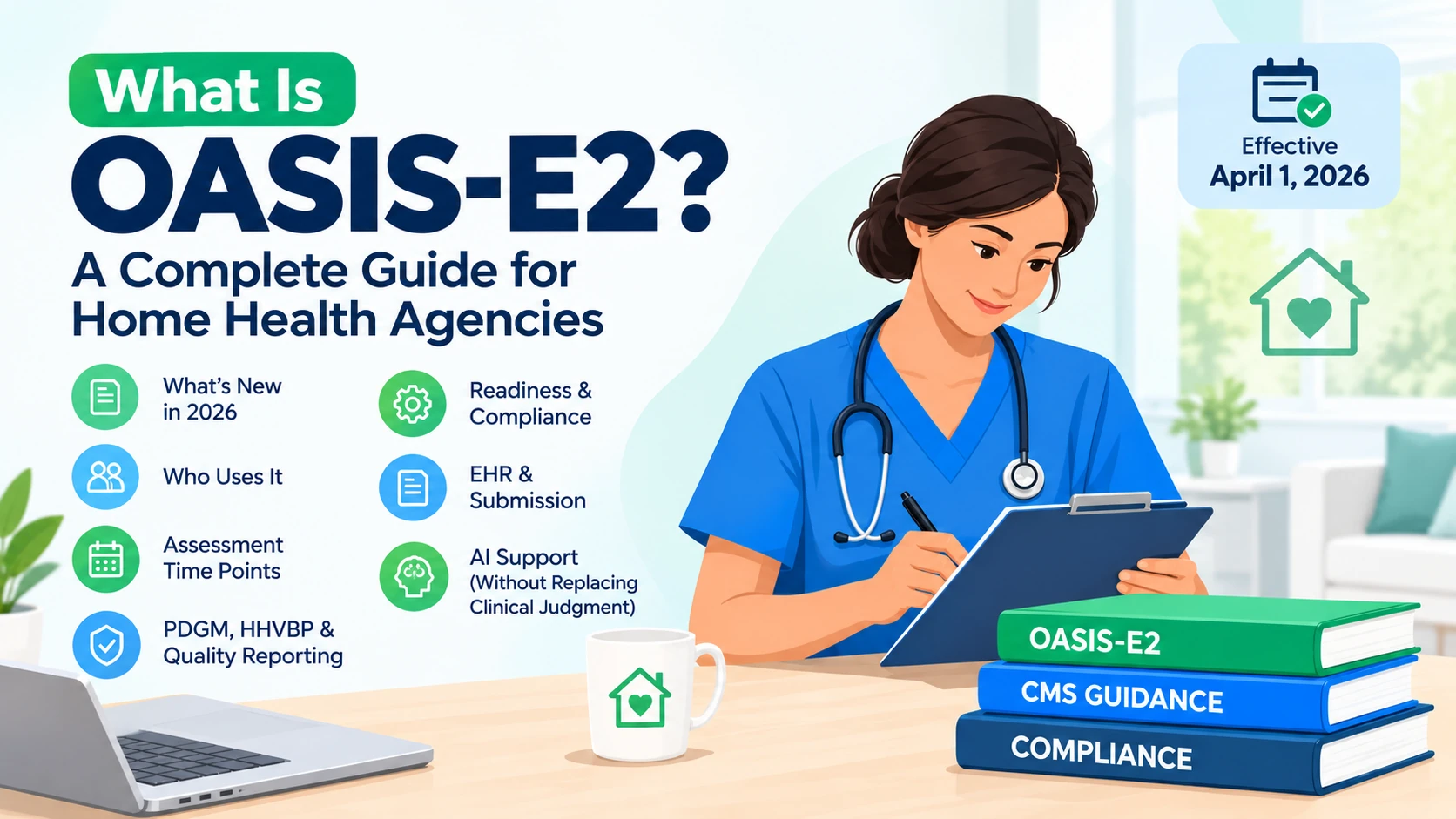
Key Takeaways
- OASIS-E2 became effective April 1, 2026, for applicable home health assessments.
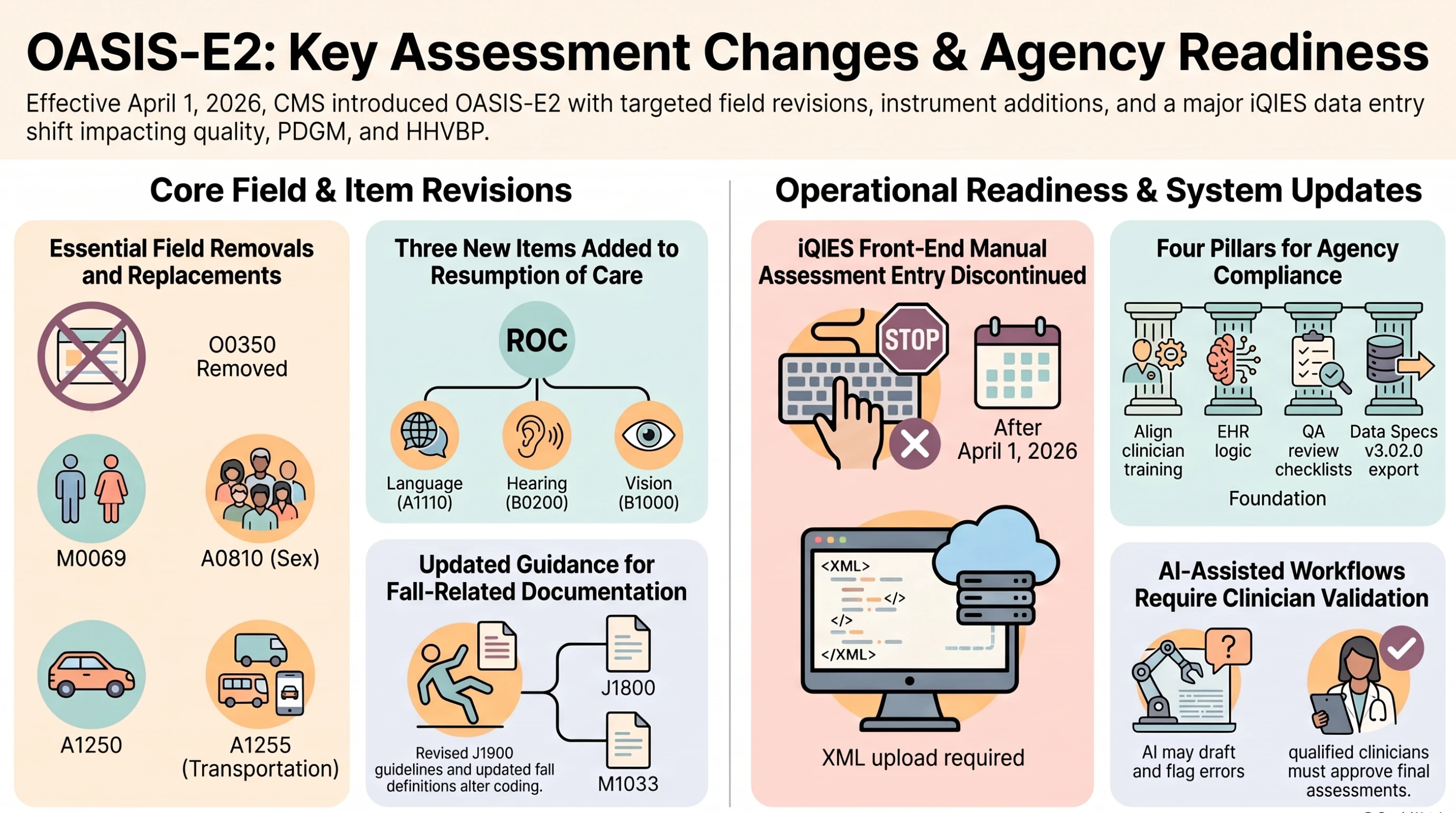
- The update removes O0350, replaces M0069 and A1250, and adds language, hearing, and vision items at Resumption of Care.
- Agencies should align clinician training, EHR configuration, QA, and submission workflows with current CMS guidance.
- OASIS data supports quality reporting and selected payment-related processes; not every item serves the same purpose.
- AI may help organize documentation and flag inconsistencies, but clinicians remain responsible for assessment and final validation.
What Is OASIS-E2?
OASIS-E2 is the current version of the Outcome and Assessment Information Set (OASIS) used by home health agencies to collect standardized patient assessment data and report quality information to the Centers for Medicare & Medicaid Services (CMS).
Importantly, OASIS is not a completely separate assessment from the comprehensive assessment. CMS describes OASIS as a group of standardized data elements that home health agencies integrate into their comprehensive assessment.
The OASIS-E2 Guidance Manual provides instructions for collecting accurate data, including general conventions, item-specific guidance, data accuracy, correction implications, and applicable time points.
OASIS-E2 became effective April 1, 2026, replacing OASIS-E1 for applicable assessments with dates on or after that date. CMS published the final OASIS-E2 instruments, guidance manual, questions and answers, and data submission specifications ahead of implementation.
OASIS data has several important uses, including:
- Home health quality reporting.
- Selected payment-related processes.
- Quality measurement and public reporting.
- Applicable Home Health Value-Based Purchasing measures.
That makes OASIS-E2 more than a documentation form. The accuracy of the information collected can affect how an agency's care and performance are represented in CMS programs.
When Did OASIS-E2 Take Effect?
OASIS-E2 took effect on April 1, 2026.
CMS made the final OASIS-E2 instruments effective April 1, 2026, including both the all-items instrument and time-point versions.
CMS also published the final OASIS-E2 Data Submission Specifications Version 3.02.0, which apply to the new item set.
For agencies, the important operational point is that the OASIS version must correspond to the applicable assessment date and CMS requirements.
Why Was OASIS-E2 Introduced?
OASIS-E2 is a targeted revision of the OASIS data set, rather than a complete redesign of the home health assessment process.
CMS updates OASIS periodically to improve data collection, align items and guidance with current requirements, and support accurate quality measurement and reporting.
The OASIS-E2 Guidance Manual specifically emphasizes high-quality and accurate OASIS data, including item-specific guidance and information about auditing and correcting data.
For agencies, that means OASIS-E2 is not simply about learning a few new fields. It also requires agencies to understand how revised items affect assessment workflows, documentation, QA, and data submission.
Who Needs to Use OASIS-E2?
OASIS requirements apply to applicable adult patients receiving home health services from Medicare-certified home health agencies, subject to CMS applicability rules and exceptions.
Depending on the patient's situation and assessment, OASIS assessments may be completed by qualified clinicians such as:
- Registered nurses.
- Physical therapists.
- Occupational therapists.
- Speech-language pathologists.
The exact requirements depend on the assessment circumstances and applicable CMS guidance, so agencies should use the current OASIS-E2 Guidance Manual and CMS Questions and Answers rather than relying on a generic checklist. CMS maintains dedicated OASIS-E2 Q&As covering applicability, comprehensive assessments, follow-up assessments, and individual OASIS items.
What Are the OASIS-E2 Assessment Time Points?
OASIS is used at applicable assessment time points throughout the home health episode, including:
- Start of Care (SOC).
- Resumption of Care (ROC).
- Recertification.
- Transfer.
- Discharge.
The specific OASIS items collected can vary by time point. That distinction becomes particularly important with OASIS-E2 because some items were added or changed for specific assessment types.
For example, several items were added to the Resumption of Care version of the OASIS-E2 instrument.
What Changed From OASIS-E1 to OASIS-E2?
OASIS-E2 is best understood as a focused update rather than a wholesale replacement of OASIS-E1.
Among the notable changes are:
- Removal of the O0350 COVID-19 vaccination item.
- Replacement of M0069 with A0810 for sex.
- Replacement of the A1250 transportation items with A1255.
- Addition of A1110 Language, B0200 Hearing, and B1000 Vision to the Resumption of Care instrument.
- Revisions to J1900, relating to fall-related injury documentation.
- Changes to certain data specifications and validation/edit rules.
CMS's final OASIS-E2 data specifications specifically confirm that A0810 replaces M0069, A1255 replaces the A1250 items, several items were added to RFA 03, and the dash is now an allowed value for the D0150 frequency items.
What OASIS-E2 Items Were Removed?
One of the most visible changes is the removal of O0350, Patient's COVID-19 Vaccination Is Up to Date.
The removal also aligns with CMS's 2026 public-reporting changes, which included removal of the corresponding COVID-19 vaccination quality measure from home health public reporting.
Agencies should therefore make sure older OASIS-E1 workflows or templates are not inadvertently carrying removed items into OASIS-E2 workflows.
What OASIS-E2 Items Were Replaced?
Two important replacements are:
M0069 → A0810
The former M0069 patient gender item was replaced by A0810, Sex.
A1250 → A1255
The previous A1250 transportation items were replaced by A1255, addressing transportation barriers.
CMS confirms these changes in the final OASIS-E2 data specifications.
Agencies should verify that their EHR templates, validation rules, reports, and QA workflows reflect the current item names and response options.
What OASIS-E2 Items Were Added at Resumption of Care?
OASIS-E2 adds several items to the Resumption of Care (ROC) instrument:
- A1110 — Language.
- B0200 — Hearing.
- B1000 — Vision.
These additions are important because clinicians and QA teams need to recognize that the items collected can differ by OASIS time point.
Agencies should therefore avoid treating the “all items” OASIS-E2 instrument as though every item is required at every assessment.
How Did OASIS-E2 Change Fall-Related Documentation?
OASIS-E2 includes revisions related to fall documentation, including changes to J1900.
The updated guidance also includes a revised fall definition that affects how clinicians approach related items, including J1800 and M1033.
This is an area where training matters because a change in the definition or coding guidance can affect how clinicians interpret the patient's history and select responses.
CMS's OASIS-E2 materials and related training resources should be used for the authoritative definitions and item-level instructions.
What Happened to the OASIS Social Determinants of Health Items?
The OASIS-E2 discussion can sometimes create confusion around social determinants of health items involving:
- Living situation.
- Food.
- Utilities.
These items should not be described as new OASIS-E2 collection requirements.
Certain SDOH items had been finalized in earlier rulemaking but were removed before their planned collection under the OASIS-E2 implementation.
For agencies, the practical takeaway is simple: use the final OASIS-E2 instrument and current CMS guidance rather than relying on earlier draft item sets or proposed requirements.
Does OASIS-E2 Change the M-Items or Section GG?
OASIS-E2 does not represent a wholesale replacement of the existing M-item and Section GG framework.
However, agencies should be careful about how different OASIS items are used for different purposes.
In particular, Section GG should not be described as the source of the PDGM functional impairment score.
Selected OASIS items, including M1800–M1860 and M1033, are relevant to the functional impairment component of the PDGM case-mix methodology.
This distinction matters because clinicians may encounter both M-items and Section GG items during the assessment but those items do not necessarily serve the same payment or quality-measurement purpose.
How Does OASIS-E2 Affect PDGM Payment?
OASIS data has a role in Medicare's Patient-Driven Groupings Model (PDGM) and selected OASIS items are used in payment-related processes.
Under PDGM, the 30-day payment period is classified using several components, including:
- A clinical grouping.
- A functional impairment level.
- A comorbidity adjustment.
For the functional impairment component, applicable OASIS information includes items such as M1800–M1860 and M1033.
The clinical grouping and comorbidity adjustment involve diagnosis information from the claim and other payment-system inputs.
CMS's OASIS manual notes that selected OASIS items were identified for use in payment determination under the prospective payment system.
This is why inaccurate assessment information can have consequences beyond documentation quality.
Does OASIS-E2 Determine LUPA?
No. OASIS-E2 should not be described as directly determining a LUPA.
A Low-Utilization Payment Adjustment (LUPA) is associated with the number of visits furnished during a payment period relative to the applicable threshold.
OASIS information can contribute to the broader payment and case-mix process, but it is not accurate to say that an OASIS response itself “sets” the LUPA threshold.
CMS establishes LUPA thresholds as part of the home health prospective payment system.
This distinction is important for agencies discussing OASIS and revenue-cycle management.
How Does OASIS-E2 Affect Home Health Quality Reporting?
OASIS is central to the Home Health Quality Reporting Program (HH QRP).
CMS uses OASIS data to calculate applicable quality measures, and home health quality information is used in public reporting.
CMS's 2026 updates continue to incorporate OASIS-E2 into the home health quality-reporting environment. The agency also publishes provider preview reports so HHAs can review performance information before applicable public reporting updates.
This makes accurate OASIS collection important not only at the individual patient level, but also at the agency level.
How Does OASIS-E2 Relate to Home Health Value-Based Purchasing?
OASIS data also contributes to applicable measures in the expanded Home Health Value-Based Purchasing (HHVBP) Model.
For the CY 2026 performance year, CMS lists six OASIS-based measures in the applicable measure set, including measures related to dyspnea, management of oral medications, discharge function, bathing, upper-body dressing, and lower-body dressing.
For example, CMS identifies:
- Improvement in Bathing — based on OASIS M1830.
- Improvement in Upper Body Dressing — based on M1810.
- Improvement in Lower Body Dressing — based on M1820.
The broader lesson is that OASIS accuracy can influence how an agency's performance is represented across applicable CMS quality programs.
How Does OASIS-E2 Affect Home Health Star Ratings?
OASIS data also supports home health quality measurement used in public reporting and Star Rating calculations.
That does not mean every OASIS response directly changes an agency's Star Rating.
Instead, applicable OASIS information feeds quality measures that CMS uses in its home health quality-reporting framework.
Agencies should therefore think about OASIS as part of a larger chain:
Patient assessment → OASIS data → Quality measures → CMS reporting
The quality of the information collected at the point of care can ultimately affect the quality information reported about the agency.
Why Is OASIS-E2 Data Accuracy So Important?
OASIS accuracy matters because the data can serve multiple purposes simultaneously.
An OASIS assessment can contribute to:
- Quality reporting.
- Public quality measurement.
- Selected payment-related processes.
- Applicable value-based purchasing measures.
- Clinical communication and care planning.
- Agency QA and performance improvement.
CMS's OASIS-E2 manual specifically includes a chapter on data accuracy and auditing OASIS data to minimize errors.
An incorrect response can therefore become more than a documentation error. It can affect downstream calculations, reporting, QA, and compliance.
What Should Home Health Agencies Update for OASIS-E2?
Agencies should review more than the OASIS form itself.
A practical OASIS-E2 readiness review should include:
Clinician training
Train clinicians on:
- New and revised items.
- ROC changes.
- Fall-related guidance.
- Updated definitions.
- Item-specific coding instructions.
- Applicable time-point requirements.
EHR configuration
Confirm that the EHR reflects:
- OASIS-E2 items.
- Correct skip logic.
- Required fields.
- Validation rules.
- Current assessment versions.
- CMS submission specifications.
QA processes
Update QA checklists to identify:
- Incorrect item selection.
- Missing responses.
- Inconsistent documentation.
- Unsupported assessment responses.
- Time-point errors.
- Data-entry or transmission issues.
Submission workflow
Confirm that the agency's process can generate and submit OASIS-E2 data using the current CMS specifications.
CMS's final OASIS-E2 submission specifications are Version 3.02.0.
Do Home Health EHRs Need OASIS-E2 Updates?
Yes. Agencies should verify that their EHR or OASIS software has been updated for the OASIS-E2 item set and current CMS submission requirements.
This includes more than changing the labels on individual fields.
Agencies should verify:
- Item availability.
- Skip logic.
- Time-point logic.
- Validation rules.
- Data export.
- Submission formatting.
- QA reports.
- User permissions.
- Assessment version tracking.
CMS provides technical OASIS information for software vendors, including OASIS-E2 Q&As and error-message resources.
The agency remains responsible for ensuring that its workflow and systems are producing accurate assessments.
What Changed With OASIS Submission in iQIES in 2026?
One important operational change occurred on April 1, 2026.
CMS discontinued the legacy iQIES front-end software used to manually create OASIS assessments for assessments with target dates on or after April 1, 2026.
CMS states that HHAs cannot use that legacy interface to directly enter assessment data for OASIS assessments with target dates on or after April 1, 2026. Future data must instead be uploaded in the correct format.
CMS also states that prior assessments dated January 1, 2025 through March 31, 2026 will be accepted through December 31, 2026.
For agencies, this makes system readiness particularly important.
How Should Agencies Train Clinicians on OASIS-E2?
OASIS-E2 training should focus on how clinicians apply the updated guidance, not simply on memorizing new item numbers.
Training should cover:
- What changed from OASIS-E1.
- Which items were removed.
- Which items were replaced.
- Which items were added at ROC.
- Updated fall-related guidance.
- Time-point-specific requirements.
- Documentation that supports assessment responses.
- Common QA errors.
- How the assessment connects to quality and payment processes.
CMS's final OASIS-E2 Guidance Manual and Q&As should remain the primary references for training.
How Should Agencies Audit OASIS-E2 Assessments?
An effective OASIS QA process should ask whether the assessment is:
Accurate → Supported → Consistent → Complete → Submitted correctly
Agencies can review:
- Whether responses are supported by the clinical record.
- Whether assessment findings are consistent with visit documentation.
- Whether time-point requirements were followed.
- Whether the correct OASIS version was used.
- Whether changed items were coded correctly.
- Whether fall-related responses align with current guidance.
- Whether relevant functional responses are internally consistent.
- Whether required fields and responses are complete.
- Whether corrections are handled according to CMS requirements.
The CMS OASIS-E2 manual specifically addresses data accuracy, auditing, and correction implications.
Can AI Help With OASIS-E2 Documentation?
Yes, AI can support parts of the OASIS-E2 workflow, but it should not replace clinical judgment.
Potential uses include:
- Organizing information gathered during the visit.
- Drafting documentation for clinician review.
- Identifying potentially missing information.
- Flagging inconsistencies across documentation.
- Helping clinicians locate relevant information in the record.
- Supporting QA review.
- Reducing repetitive administrative work.
For example, an AI system could help surface a potential inconsistency between a visit narrative and an assessment response. The clinician can then review the underlying information and determine the appropriate response.
The important principle is:
AI can assist with documentation. The clinician remains responsible for the clinical assessment and final validation.
Can AI Automatically Complete OASIS-E2?
AI should not be positioned as an autonomous replacement for the clinician's OASIS assessment.
OASIS responses depend on clinical observations, patient interactions, assessment findings, context, and CMS-specific guidance.
A safer workflow is:
Clinical visit → AI-assisted organization/drafting → clinician review → correction/approval → submission
This keeps clinical judgment and accountability with the appropriate healthcare professional while using technology to reduce repetitive documentation work.
For agencies evaluating AI, the more important question is not simply “Can AI fill out OASIS?”
It is:
“Can AI reduce documentation work while preserving assessment accuracy, clinician oversight, auditability, and compliance?”
How Does OASIS-E2 Fit Into the Broader Home Health Workflow?
OASIS-E2 is one component of a much larger home health workflow.
A simplified process looks like:
Referral → Intake → Start of Care → Comprehensive Assessment + OASIS → Plan of Care → Visits → Documentation → QA → OASIS/claims submission → Quality reporting
This is why OASIS problems are rarely isolated.
An incomplete referral can affect the initial assessment.
An incomplete assessment can affect documentation.
Documentation inconsistencies can create QA problems.
And inaccurate data can ultimately affect quality reporting or payment-related processes.
The goal should therefore be to improve the entire workflow around OASIS, not simply teach clinicians how to complete another form.
Where Can Home Health Agencies Find the Official OASIS-E2 Guidance?
Agencies should use CMS as the primary source for OASIS-E2 requirements.
The key resources include:
- OASIS-E2 Guidance Manual.
- OASIS-E2 Questions and Answers.
- Final OASIS-E2 Instruments.
- OASIS-E2 Change Table.
- OASIS-E2 Data Submission Specifications.
- CMS OASIS training and Q&A resources.
CMS's OASIS User Manuals page provides the final OASIS-E2 Guidance Manual and Q&As.
The CMS OASIS Data Sets page provides the final OASIS-E2 instruments and change table.
The CMS Data Specifications page provides the final OASIS-E2 Data Submission Specifications Version 3.02.0.
What Is the Biggest Takeaway About OASIS-E2?
OASIS-E2 is not simply a new version of a form.
It is part of the infrastructure that connects clinical assessment, documentation, quality measurement, payment-related processes, and CMS reporting in home health.
For agencies, the transition to OASIS-E2 means more than updating an EHR template.
It means making sure:
- Clinicians understand the changes.
- EHR workflows use the correct item set.
- QA teams understand the revised guidance.
- OASIS responses are supported by the clinical record.
- Submission workflows use the current CMS specifications.
- Agencies understand how OASIS data is used in quality and payment-related programs.
- Technology supports clinicians without replacing clinical judgment.
OASIS-E2 is the current OASIS standard for applicable assessments beginning April 1, 2026. The agencies that handle it well will treat it as both a clinical documentation process and a data-quality process.
Official CMS resources
Home Health Documentation Playbook
The complete guide to OASIS-E, Medicare compliance, PDGM, and AI-assisted documentation. Learn how top agencies reduce documentation time without sacrificing compliance.
Bottom Line
OASIS-E2 is both a clinical assessment and a data-quality process. Accurate, supported assessment responses, current systems, and clinician oversight create a stronger foundation for care, reporting, and compliance.
Inside Home Health Podcast
Building Healthcare AI Without Trust is a Mistake | Jeanette Yates

Arvind Sarin is the founder of Copper Digital. He works inside home health agencies to build AI documentation workflows that help clinicians finish OASIS and visit notes sooner, with a nurse reviewing and approving every note. He writes about home health documentation, Medicare compliance, and applying AI responsibly in clinical workflows.
Frequently asked
Frequently asked questions
OASIS-E2 is the current version of the Outcome and Assessment Information Set (OASIS) used in applicable home health assessments.
OASIS is a standardized group of data elements that is integrated into the home health comprehensive assessment. CMS uses OASIS data for multiple purposes, including quality reporting and applicable payment and quality-measurement processes.
OASIS-E2 became effective April 1, 2026, replacing OASIS-E1 for applicable assessments. CMS describes the E2 update as a new version of the OASIS data set with revised items, updated guidance, and updated data-submission specifications.
For home health agencies, OASIS-E2 is therefore more than a new form. It is part of the data infrastructure connecting clinical assessment, documentation, quality reporting, and payment-related processes.
Join the conversation
Leave a comment
No comments yet. Be the first to share your thoughts.
Related reading
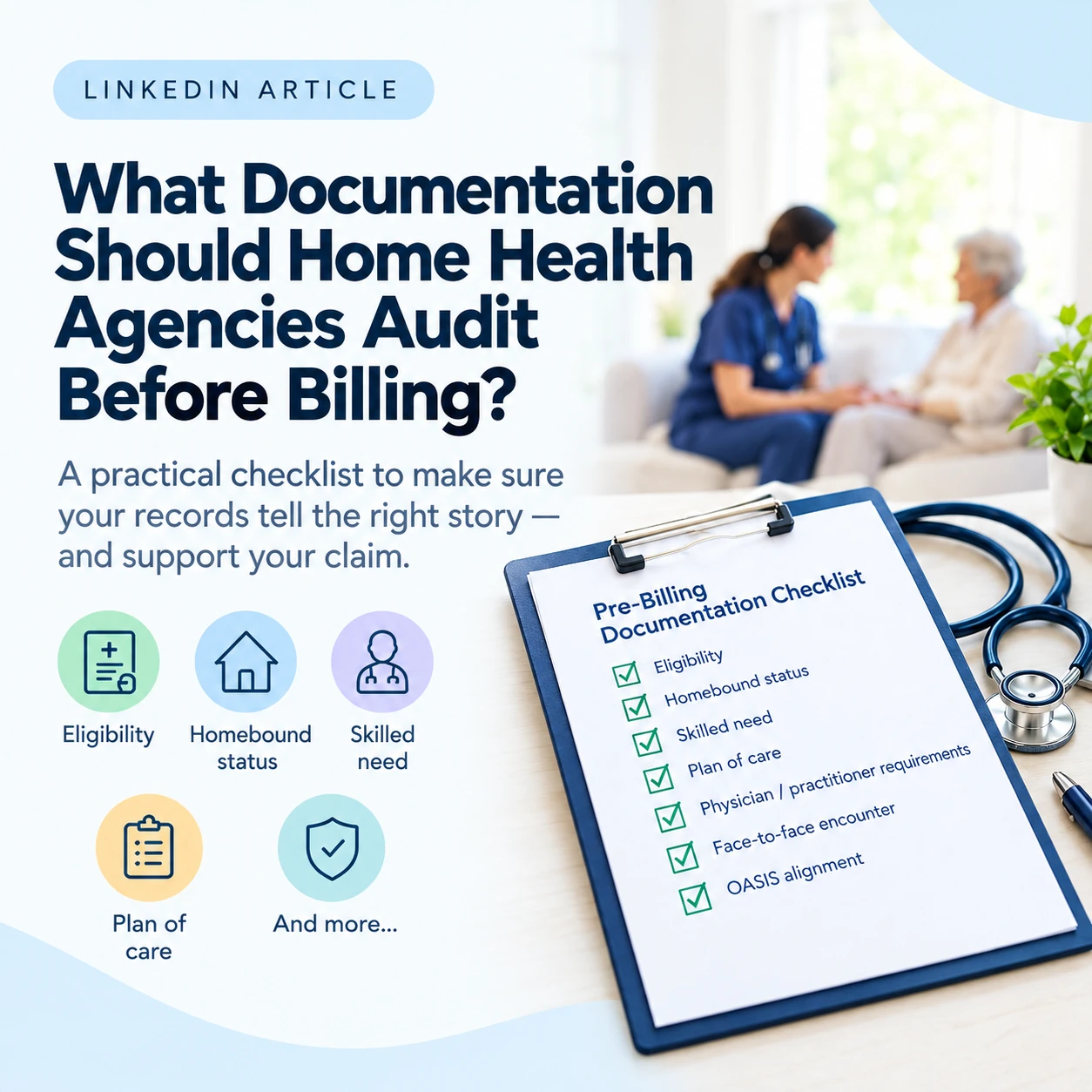
What Documentation Should Home Health Agencies Audit Before Billing?
Before billing, confirm that eligibility, medical necessity, orders, OASIS-E2, coding, and visit documentation tell a consistent story and support the services on the claim.
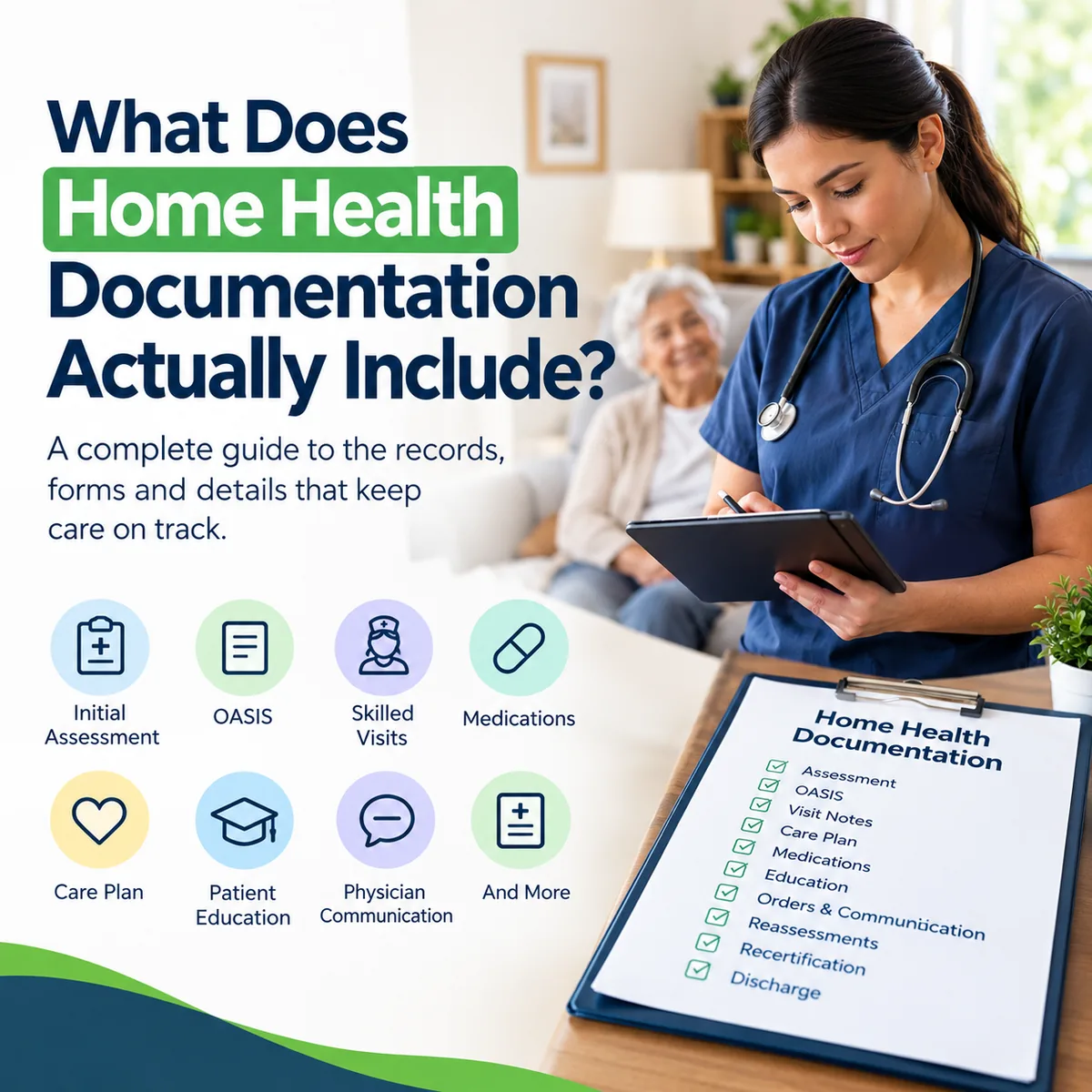
What Does Home Health Documentation Actually Include?
Home health documentation is much more than a visit note. Across an episode it spans the initial assessment, OASIS, skilled visits, medications, the care plan, education, physician communication, orders, reassessments, recertification, and discharge: each piece is part of the patient's larger story of care.
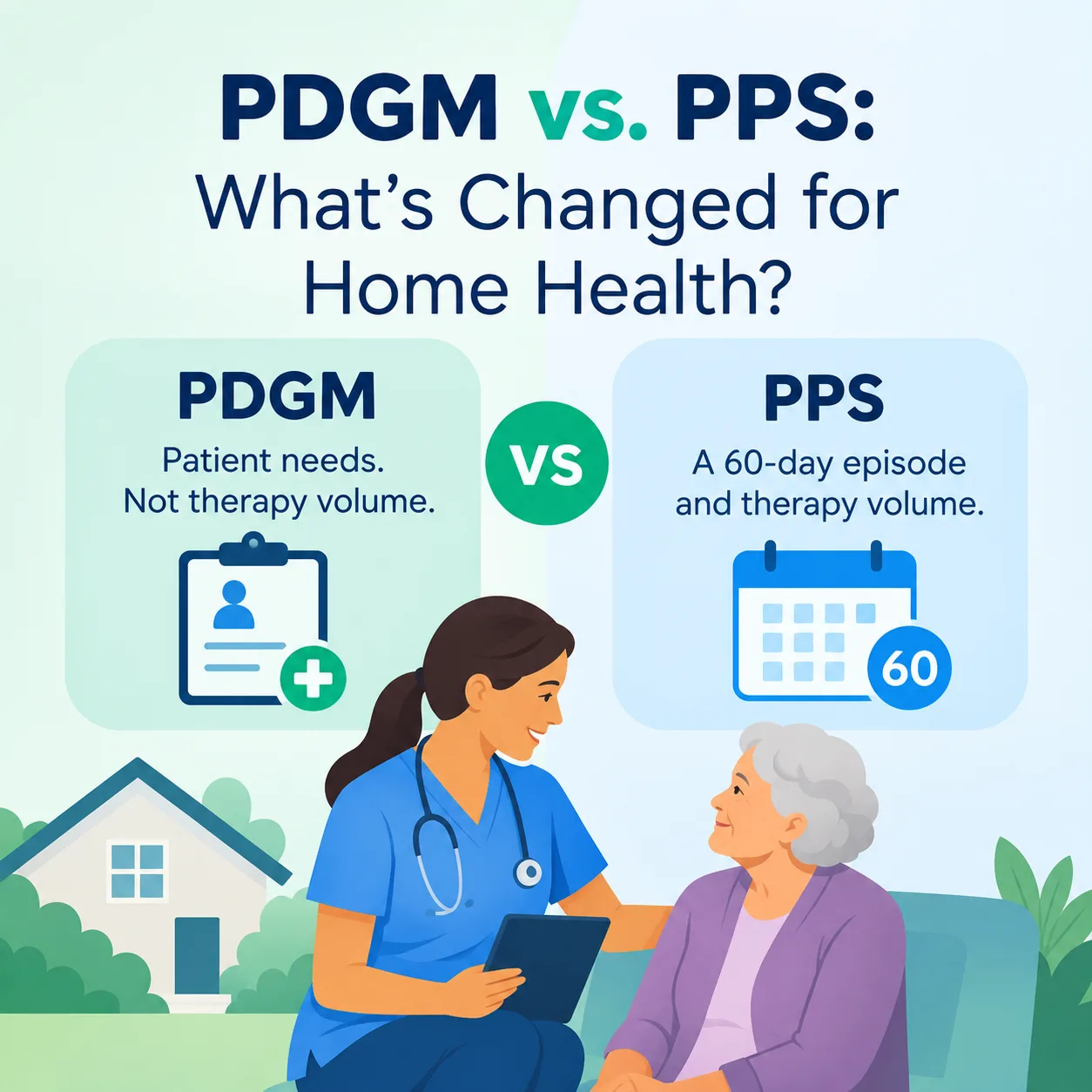
PDGM vs. PPS: What's Changed for Home Health?
PDGM did not replace Medicare's Home Health Prospective Payment System. It changed the case-mix methodology inside HH PPS, and reshaped payment periods, coding, OASIS, LUPA monitoring, billing, and cash flow.