Discharging a patient from home health care involves more than completing a final visit and closing the patient's chart.
Nurses must assess the patient's current condition, document progress toward care plan goals, review medications, evaluate functional abilities, communicate continuing care needs, and complete the applicable OASIS discharge requirements.
Missing information or selecting the wrong assessment reason can lead to incomplete records, inaccurate OASIS submissions, and additional work for clinical and QA teams.
The OASIS-E2 assessment set, effective April 1, 2026, provides the current framework for applicable home health assessments. Its discharge time point includes specific clinical, functional, and administrative items. Nurses must follow the item-specific instructions and skip patterns rather than assume every OASIS item is required at discharge.
This guide provides a practical OASIS discharge checklist for home health nurses, covering what to review before the final visit, what to assess, which OASIS items to verify, and what to check before closing the record.
What Is an OASIS Discharge Assessment in Home Health?
An OASIS discharge assessment is the comprehensive assessment completed when a patient is discharged from a home health agency and OASIS collection is required.
It captures the patient's condition at the end of the agency's care, including relevant clinical, functional, cognitive, mood, and other assessment information required by the applicable OASIS instrument.
The assessment helps document:
- The patient's health status at discharge.
- Changes in functional abilities.
- Progress toward care plan goals.
- The patient's continuing care needs, if any.
- Medication information and communication.
- The reason for discharge.
- The patient's discharge destination or disposition.
The information collected also contributes to Medicare's Home Health Quality Reporting Program and applicable quality measures.
A complete discharge assessment should reflect the patient's actual status rather than simply repeat information from the Start of Care or most recent follow-up assessment.
When Should a Home Health Nurse Complete an OASIS Discharge Assessment?
Under OASIS-E2 guidance, the discharge assessment is completed within 2 calendar days of the discharge date.
The discharge date is the reference date, or Day 0, for calculating this timeframe. The assessment completion date is recorded separately in M0090.
Nurses should coordinate the assessment with the actual discharge event and agency procedures. Documentation should accurately reflect the patient's status at or close to the time of discharge.
It is also important to distinguish the OASIS assessment timeframe from the deadline for completing the discharge summary.
Under 42 CFR §484.110(a)(6), the discharge summary must generally be sent within 5 business days of discharge. These are separate documentation requirements.
What Should Nurses Review Before the Final Home Health Discharge Visit?
A pre-visit review helps nurses identify outstanding clinical, functional, and administrative requirements before completing the discharge assessment.
How Should Nurses Verify the Certification Period and Episode Dates?
- Confirm the original Start of Care date.
- Verify the current 60-day certification period.
- Review the certification and recertification dates.
- Check whether the patient is being discharged before the end of the current certification period.
- Confirm the effective discharge date according to agency policy and applicable practitioner orders.
- Review any recent changes to the patient's service status.
Remember that Medicare's home health certification period is generally 60 days, while the payment system operates in 30-day payment periods. These should not be treated as interchangeable.
A discharge can occur before the end of a certification period.
How Should Nurses Review the Patient's Care Plan Goals?
Review all initial and updated plan-of-care goals before the final visit.
- Identify goals that have been achieved.
- Identify goals that have been partially achieved.
- Identify goals that remain unresolved.
- Review changes in the patient's condition that affected progress.
- Document any continuing care needs.
- Identify goals that require follow-up by another provider.
If a goal was not achieved, document the reason when known. Do not mark every goal as achieved simply because the patient is leaving the agency.
Should Nurses Review Hospitalizations and Emergency Department Visits During the Episode?
Yes. Review the patient's record for emergency department visits, observation stays, and inpatient hospitalizations.
- Identify any emergency department visits.
- Review inpatient admissions and discharge dates.
- Determine whether any hospitalization resulted in a qualifying inpatient transfer.
- Review any Resumption of Care assessments completed during the episode.
- Check for changes in diagnoses, medications, or treatment plans following hospitalization.
- Include relevant events in the discharge summary.
An emergency department visit or short observation stay does not automatically meet the OASIS definition of a transfer to an inpatient facility.
How Should Nurses Review Ordered Visits and Services?
Review the ordered services across all disciplines.
- Skilled nursing visits.
- Physical therapy visits.
- Occupational therapy visits.
- Speech-language pathology visits.
- Home health aide services.
- Other ordered services, where applicable.
Identify visits that were completed, missed, refused, discontinued, or otherwise not provided as planned.
Document relevant changes and follow-up actions. Visit utilization is an important agency QA review, but it should not be confused with a separate OASIS discharge scoring requirement.
Which Clinician Should Complete and Authenticate the Discharge Assessment?
The agency should follow applicable CMS assessment-completion requirements and its policies for assigning responsibility for the comprehensive assessment.
Before the discharge visit:
- Confirm which qualified clinician is responsible for completing the assessment.
- Review whether another discipline completed the last in-home visit.
- Follow agency policy for therapy-only cases and discharge assessment coordination.
- Ensure the responsible clinician has access to the necessary clinical information.
- Confirm that the assessment is authenticated according to agency policy and applicable requirements.
An agency may use an RN to complete the comprehensive assessment in certain therapy-only cases, according to its policy. This should not be presented as a universal requirement for every discharge.
Which Clinical and Physical Areas Should Nurses Reassess at Discharge?
The discharge assessment should reflect the patient's current condition and relevant changes since the previous assessment.
What Clinical Information Should Be Documented?
- Current health status.
- Relevant vital signs.
- Current symptoms and complaints.
- Changes in medical condition.
- Relevant physical assessment findings.
- Pain status, when applicable.
- Respiratory and cardiovascular status, as relevant.
- Skin integrity and wound status.
- Nutritional and hydration concerns, when relevant.
- New or unresolved clinical concerns.
Documentation should describe actual findings. Avoid vague statements such as "patient stable" without supporting clinical information.
How Should Nurses Reassess Wounds and Skin Conditions?
Review all wounds and relevant skin conditions documented during the episode.
- Reassess each active wound.
- Record the wound location and type.
- Document relevant wound measurements.
- Review wound characteristics and drainage.
- Document signs of infection or other complications, when present.
- Review current wound care interventions.
- Compare findings with previous documentation.
- Ensure OASIS responses and narrative notes are consistent.
For applicable wound items, review M1306 and M1311 according to the OASIS-E2 instructions.
Do not copy previous wound measurements into the discharge assessment without reassessing the patient's current condition.
How Should Nurses Assess Dyspnea and Respiratory Status?
Review the patient's respiratory condition and any changes during the episode.
For M1400, assess the patient's shortness of breath according to the item instructions and applicable assessment timeframe.
- Review whether the patient experiences shortness of breath.
- Assess the level of activity associated with dyspnea.
- Document relevant respiratory findings.
- Review oxygen use and related treatment information, where applicable.
- Identify any changes requiring follow-up.
The response should reflect the patient's actual condition, not assumptions based on the diagnosis or previous assessment.
How Should Nurses Review Falls During the Episode?
Review falls and related injuries during the applicable look-back period.
- Determine whether the patient experienced any falls.
- Review the number and circumstances of falls.
- Identify any fall-related injuries.
- Review emergency care or practitioner notification, when applicable.
- Document relevant safety interventions.
- Ensure applicable J1800 and J1900 responses are accurate.
Falls information should be consistent with the incident reports and clinical notes in the patient's record.
How Should Nurses Complete Section GG at Discharge?
Section GG assesses the patient's self-care and mobility abilities.
At discharge, the nurse should assess the patient's usual performance during the applicable look-back period and use the OASIS-E2 coding instructions.
The two main areas are:
- GG0130 – Self-Care.
- GG0170 – Mobility.
What Should Nurses Review Under GG0130?
Review the patient's ability to perform applicable self-care activities, including:
- Eating.
- Oral hygiene.
- Toileting hygiene.
- Showering or bathing.
- Upper-body dressing.
- Lower-body dressing.
- Footwear management.
The nurse should assess the patient's usual performance based on the applicable look-back period.
What Should Nurses Review Under GG0170?
Review the patient's mobility and transfer abilities, including applicable activities such as:
- Roll left and right.
- Sit to lying.
- Lying to sitting.
- Sit to stand.
- Chair or bed-to-chair transfer.
- Toilet transfer.
- Car transfer.
- Walking.
- Walking different distances.
- Managing steps or stairs.
- Using a wheelchair, when applicable.
How Should Nurses Select Section GG Performance Codes?
For discharge, Section GG responses should reflect the patient's usual ability to perform each activity during the applicable look-back period.
When performance varies, the usual performance is generally the level demonstrated more than 50% of the time.
Use the six-point assistance scale or the permitted activity-not-attempted codes:
| Code | Meaning |
|---|---|
| 06 | Independent |
| 05 | Setup or clean-up assistance |
| 04 | Supervision or touching assistance |
| 03 | Partial/moderate assistance |
| 02 | Substantial/maximal assistance |
| 01 | Dependent |
| 07 | Patient refused |
| 09 | Not applicable |
| 10 | Not attempted due to environmental limitations |
| 88 | Not attempted due to medical condition or safety concerns |
A dash should only be used where the applicable OASIS-E2 item instructions permit it. Nurses should not use a dash simply because an activity was not assessed.
What Is the Discharge Function Score?
The Discharge Function Score is a calculated quality measure based on applicable Section GG self-care and mobility responses.
The score is not something the nurse should estimate or manually assign based on an overall impression of the patient's independence.
The nurse's responsibility is to complete the required functional items accurately. The applicable calculation and measure specifications determine the resulting score.
Accurate Section GG documentation matters because the patient's functional status at discharge contributes to how functional outcomes are evaluated.
What Medication Information Should Nurses Review at Discharge?
Medication reconciliation is an important part of a safe home health discharge.
The nurse should review the patient's current medication information and identify relevant changes made during the episode.
What Should Be Included in the Medication Review?
- Current prescription medications.
- Over-the-counter medications.
- Medication dosage and frequency.
- Route of administration.
- Recent medication changes.
- Discontinued medications.
- Known medication allergies.
- Potential medication-related concerns.
- Patient or caregiver understanding of the medication regimen.
- Unresolved medication discrepancies.
The medication list should reflect the patient's current reconciled medication information at discharge.
Which OASIS-E2 Items Address Medication List Provision?
The OASIS-E2 instrument includes specific items related to providing a current reconciled medication list.
| OASIS item | What it addresses |
|---|---|
| A2121 | Provision of a current reconciled medication list to a subsequent provider at discharge |
| A2122 | Route of transmission to the subsequent provider |
| A2123 | Provision of a current reconciled medication list to the patient, family, or caregiver at discharge |
| A2124 | Route of transmission to the patient, family, or caregiver |
The applicable pathway depends on the patient's discharge situation and the item's skip instructions.
For example, when the patient is discharged to another provider, the nurse should review the applicable subsequent-provider pathway. When the patient is discharged to the community, the patient/family/caregiver pathway may apply.
The nurse should accurately document whether the list was actually provided. Preparing a medication list is not the same as providing it to the intended recipient.
Should Nurses Review the Patient's Ability to Manage Medications Independently?
Yes. Medication self-management should be part of the broader clinical discharge review.
Consider:
- Can the patient identify their medications?
- Does the patient understand dosage and timing?
- Can the patient safely take oral medications?
- Can the patient or caregiver administer injectable medications, when relevant?
- Is assistance required for medication organization or administration?
- Are there unresolved medication safety concerns?
M2020 addresses oral medication management, and M2030 addresses injectable medication management at the applicable OASIS time points. These should not be represented as automatically scored discharge items when they are not collected at that time point.
The nurse can still review medication-management ability as part of the clinical discharge process and document relevant findings in the appropriate clinical record.
What Caregiver and Home Safety Checks Should Nurses Complete Before Discharge?
Discharge planning should consider whether the patient can safely manage at home and whether the necessary support is available.
How Should Nurses Check Caregiver Readiness?
- Identify the primary caregiver, if applicable.
- Confirm the caregiver understands ongoing care tasks.
- Review medication instructions.
- Review wound care or other treatment instructions, when applicable.
- Explain relevant warning signs and symptoms.
- Review when and how to contact the practitioner.
- Explain emergency procedures and contact information.
- Identify any gaps in caregiver availability or ability.
Document the education provided and the patient's or caregiver's response.
What Home Safety and Equipment Needs Should Be Reviewed?
- Check relevant environmental hazards.
- Review accessibility and mobility concerns.
- Identify fall risks.
- Review the need for durable medical equipment.
- Confirm relevant equipment arrangements.
- Identify supplies required for continuing care.
- Communicate unresolved equipment or supply needs.
Examples of equipment may include oxygen, hospital beds, walkers, wheelchairs, and wound therapy equipment.
The nurse should document relevant equipment arrangements without assuming that ownership or rental responsibility automatically transfers to another provider.
What Follow-Up and Community Resources Should Be Confirmed?
- Identify the patient's primary care practitioner.
- Review scheduled outpatient appointments.
- Identify specialist follow-ups.
- Review pending referrals.
- Identify community-based support services, when relevant.
- Communicate ongoing care needs to the patient and caregiver.
- Document any unresolved follow-up arrangements.
The objective is to ensure the patient understands the next steps after home health services end.
Which OASIS-E2 Items Should Nurses Verify Before Submitting a Discharge Assessment?
The discharge time point includes specific items from several OASIS sections. The exact responses must follow the current instrument and applicable skip patterns.
Important items and sections include:
| Item or section | What nurses should verify |
|---|---|
| M0100 | Correct reason for assessment |
| M0090 | Actual date assessment was completed |
| M0906 | Actual discharge, transfer, or death date |
| M1306 and M1311 | Applicable wound and skin assessment information |
| M1400 | Dyspnea assessment |
| J1800 and J1900 | Falls and related injury information |
| GG0130 | Self-care performance |
| GG0170 | Mobility performance |
| A2121–A2124 | Medication list provision and transmission |
| M2420 | Discharge disposition |
| B1300 | Health literacy, when applicable |
| C items | Cognitive patterns, according to applicable instructions |
| D items | Mood and social isolation items, according to applicable instructions |
This table is a practical review guide, not a replacement for the complete OASIS-E2 instrument. Nurses should use the current CMS manual to confirm item-level requirements and skip patterns.
Which OASIS Reason for Assessment Should a Nurse Select at Discharge?
The correct Reason for Assessment (RFA) depends on why the patient is leaving the agency.
For a routine discharge, the applicable code is generally RFA 9 – Discharge from agency.
| Discharge or transfer situation | OASIS reason for assessment |
|---|---|
| Patient discharged after completing home health services | RFA 9 |
| Patient transfers and is discharged to another home health agency | RFA 9 |
| Patient transfers to an inpatient facility but is not discharged from the agency | RFA 6 |
| Patient transfers to an inpatient facility and is discharged from the agency | RFA 7 |
| Patient dies at home, including qualifying circumstances specified in CMS guidance | RFA 8 |
RFA 9 includes discharge to another home health agency or an in-home hospice.
A transfer to a non-institutional hospice is not coded as RFA 3. RFA 3 is Resumption of Care following a qualifying inpatient stay.
The nurse must also distinguish the assessment reason from the discharge disposition recorded in M2420. They serve different purposes.
How Should Nurses Document the Patient's Discharge Disposition?
M2420 identifies the patient's discharge disposition.
The nurse should verify the patient's actual destination and select the appropriate response based on the OASIS-E2 definitions.
The patient's situation may involve:
- Remaining in the community without skilled services from a Medicare-certified home health agency or non-institutional hospice.
- Remaining in the community with skilled services from another Medicare-certified home health agency.
- Transferring to a non-institutional hospice.
- Moving to another applicable care setting or disposition.
For a patient who remains in the community and continues receiving skilled services from another Medicare-certified home health agency, the applicable M2420 response is generally Response 2.
For a patient transferring to a non-institutional hospice, review the applicable response, generally Response 3.
The nurse should not select a response based only on a planned destination if the actual discharge circumstances are different.
What Should Nurses Document When a Patient Transfers to Another Home Health Agency?
A transfer to another home health agency is generally coded as RFA 9 when the patient is discharged from the current agency.
The nurse should document the patient's transfer circumstances and the information needed to support continuity of care.
Include:
- Patient's reason for changing agencies, when known.
- Effective discharge date.
- Receiving agency name and contact details, when available.
- Patient's current clinical condition.
- Current medication information.
- Active treatments and care needs.
- Wound care instructions, when applicable.
- Relevant functional status.
- Outstanding practitioner orders.
- Pending tests and follow-up needs.
- Relevant equipment and supply arrangements.
- Clinical records shared with the receiving agency.
- Communication with the receiving agency, when available.
The receiving agency is responsible for its own admission assessment and plan of care. The transferring agency's documentation should provide the information needed to support that transition.
What Should the Home Health Discharge Summary Include?
The OASIS discharge assessment and discharge summary serve related but different purposes.
The OASIS assessment captures the required standardized assessment information. The discharge summary provides a clinical account of the patient's episode and relevant information for the next provider, patient, or caregiver.
A complete discharge summary should generally address:
- Admission and discharge dates.
- Reason for admission.
- Reason for discharge.
- Primary and relevant secondary diagnoses.
- Services provided during the episode.
- Patient's clinical condition at discharge.
- Relevant functional status.
- Progress toward goals.
- Current medication information.
- Treatments and wound care information, when applicable.
- Patient and caregiver education.
- Continuing care needs.
- Follow-up appointments and recommendations.
- Pending clinical items.
- Receiving provider information, when applicable.
Under 42 CFR §484.110(a)(6), the discharge summary must generally be sent within 5 business days of discharge.
Agencies should also follow applicable requirements for sharing necessary medical information with subsequent providers.
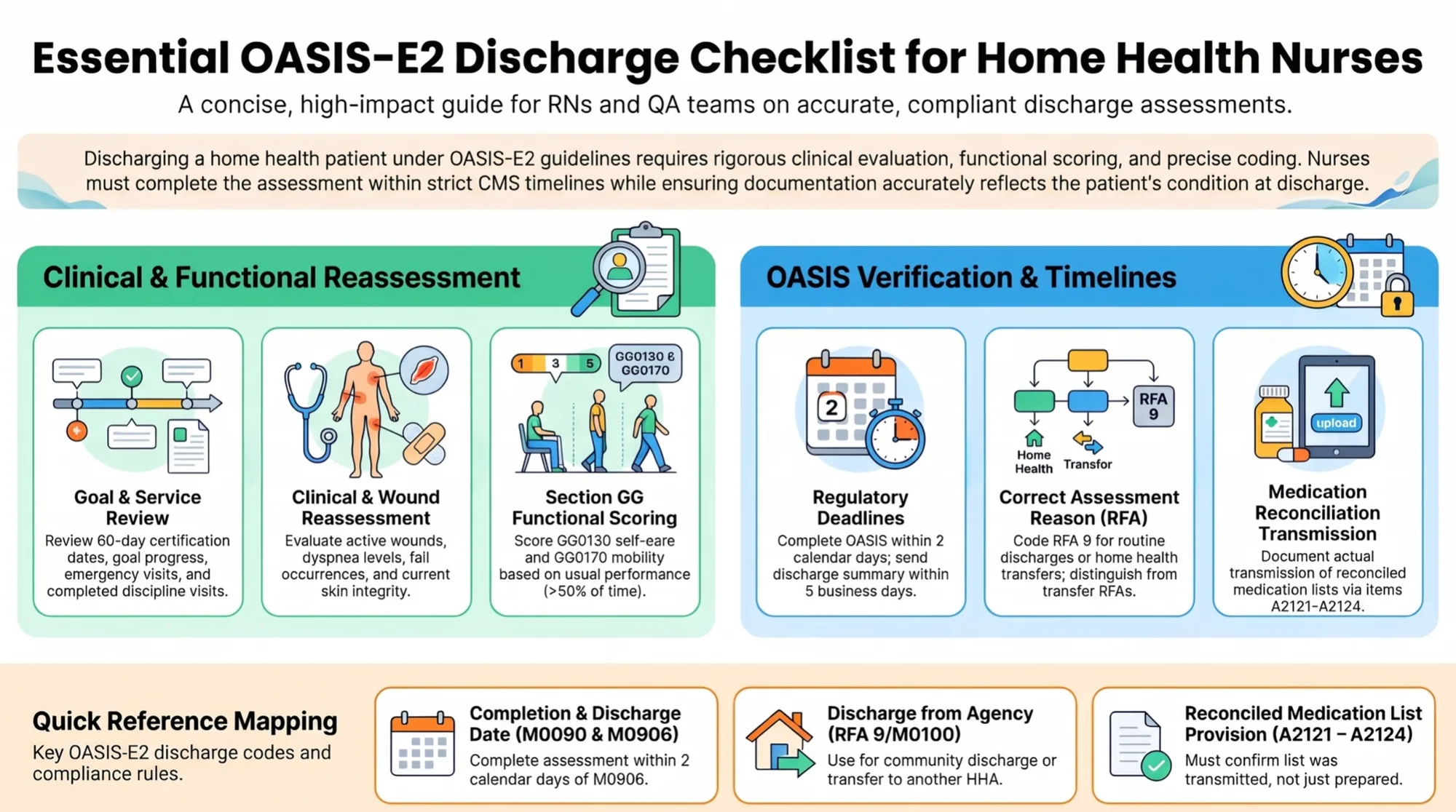
Use the current OASIS-E2 instrument and item-specific instructions to confirm every response before locking the discharge assessment.
What Should QA Teams Verify Before Locking and Submitting the OASIS Discharge Assessment?
A final QA review helps identify missing information, inconsistent responses, and incomplete documentation before the record is closed.
What Should the Final OASIS Discharge Checklist Include?
Episode and administrative review
- Correct patient information.
- Certification period and relevant dates reviewed.
- Reason for discharge documented.
- Hospitalizations and emergency department visits reviewed.
- Ordered visits and services reviewed.
- Responsible clinician identified according to agency policy.
Clinical assessment
- Current clinical status documented.
- Relevant vital signs recorded.
- Wounds and skin conditions reassessed.
- Applicable M1306 and M1311 responses reviewed.
- Dyspnea assessment reviewed.
- Applicable M1400 response verified.
- Falls and injury information reviewed.
- Applicable J1800 and J1900 responses verified.
Functional assessment
- GG0130 self-care items completed.
- GG0170 mobility items completed.
- Usual performance during the applicable look-back period considered.
- Permitted activity-not-attempted codes used correctly.
- Functional documentation consistent with clinical notes.
Medication and safety review
- Current reconciled medication list reviewed.
- Medication changes and discrepancies addressed.
- Applicable A2121–A2124 items completed.
- Medication self-management concerns documented.
- Caregiver readiness reviewed.
- Home safety and DME needs addressed.
- Follow-up and community support needs documented.
OASIS and final documentation
- Correct M0100 RFA selected.
- M0090 assessment completion date accurate.
- M0906 discharge date accurate.
- M2420 discharge disposition selected correctly.
- Applicable OASIS items and skip patterns followed.
- Clinical narrative consistent with OASIS responses.
- Practitioner communication and required orders documented.
- Discharge summary completed.
- Required records shared with appropriate recipients.
- Documentation authenticated.
- Final QA review completed.
- OASIS edits reviewed and corrected before transmission.
- Assessment submitted according to applicable requirements.
The chart should only be locked and submitted after the required review, corrections, and authentication are complete under agency procedures.
What Are the Most Common OASIS Discharge Documentation Mistakes?
Even when nurses complete the final assessment, small documentation gaps can create problems during QA review and OASIS submission.
Common mistakes include:
- Selecting the wrong RFA: Using an inpatient transfer reason when the patient is actually being discharged to another home health agency.
- Using an incorrect discharge date: M0906 should reflect the actual discharge date as determined under agency policy or applicable practitioner orders.
- Copying previous assessment findings: The discharge assessment must reflect the patient's current condition.
- Incomplete wound documentation: Wound measurements and descriptions should be consistent with the assessment and narrative notes.
- Incorrect Section GG scoring: Discharge performance should reflect the patient's usual performance during the applicable look-back period.
- Leaving medication reconciliation incomplete: The medication information should be reviewed and communicated as required.
- Incorrectly documenting medication list provision: Nurses should distinguish between preparing a list and actually providing it to the appropriate recipient.
- Missing progress toward goals: The discharge record should explain which goals were achieved, partially achieved, or not achieved.
- Using vague clinical statements: Entries such as "patient doing well" should be supported by specific findings.
- Selecting the wrong discharge disposition: M2420 should reflect the patient's actual discharge situation.
- Missing caregiver and safety information: Relevant support needs, equipment arrangements, and follow-up instructions should be documented.
- Failing to complete the required discharge summary: The discharge summary and OASIS assessment are separate documentation responsibilities.
How Can AI Help Nurses Complete OASIS Discharge Documentation More Efficiently?
OASIS discharge documentation requires nurses to bring together information from multiple parts of the patient's record.
Clinical findings, medication information, treatment notes, functional status, and progress toward goals may be documented in different places. Reviewing and organizing these details can add time to an already demanding discharge process.
AI-supported documentation tools can help by:
- Organizing relevant information from existing clinical notes.
- Preparing structured discharge summaries for clinician review.
- Identifying missing documentation.
- Flagging inconsistencies between notes and assessment responses.
- Helping organize medication information.
- Reducing repetitive data entry.
- Supporting QA teams with more consistent chart reviews.
AI should support the nurse's documentation process, not replace the nurse's clinical judgment.
The nurse remains responsible for assessing the patient, verifying the information, correcting inaccuracies, and approving the final documentation.
At Copper Digital, we believe technology should work around the way clinicians already work. The goal is to reduce repetitive documentation tasks so nurses can spend more time focused on patients and less time completing paperwork.
How Can a Consistent OASIS Discharge Checklist Improve Home Health Documentation?
A complete discharge assessment helps ensure that the patient's final clinical status, functional abilities, medication information, and ongoing care needs are accurately documented.
For home health nurses, a structured checklist reduces the chances of overlooking important assessment items. For QA teams, it creates a consistent review process and helps identify incomplete or inconsistent records before submission.
The most important steps are to use the current OASIS-E2 guidance, select the correct assessment reason, document the patient's actual condition, and verify the final record before submission.
A well-documented discharge is not just about closing an episode. It is about making sure the next step in the patient's care starts with the right information.
Sources and Further Reading
Related Reading
- OASIS Discharge Assessment: When Is It Required and When Can It Be Skipped?.
- How to Document a Patient Transfer to Another Home Health Agency: A Step-by-Step Guide.
- OASIS-E vs OASIS-D: What's Changed?.
- What Is OASIS-E2? A Complete Guide for Home Health Agencies.
- Home Health Documentation Compliance Checklist.
This article is an educational checklist, not a substitute for the CMS OASIS instrument, item-specific guidance, or agency policy.