What Is RFA 9 in OASIS?
RFA 9, or Reason for Assessment 9, is the OASIS assessment reason used when a patient is discharged from a home health agency for a reason other than transfer to an inpatient facility or death at home.
It applies to routine and unplanned agency discharges, including situations where a patient:
- Completes the home health plan of care.
- Meets established treatment goals.
- Chooses to discontinue home health services.
- Transfers to another home health agency.
- Moves to non-institutional hospice care.
- Is discharged because the agency can no longer provide services in the patient's location.
- Is discharged for another reason that does not meet the criteria for a different OASIS discharge reason.
RFA 9 closes the agency's OASIS quality episode and captures the patient's clinical and functional status at discharge, along with information about medication management, discharge disposition, and care coordination.
The correct assessment reason matters. Selecting the wrong RFA can affect OASIS reporting, quality measures, and the accuracy of the patient's clinical record.
When Should an Agency Use RFA 9 Instead of Another OASIS Reason?
RFA 9 is not appropriate for every patient who stops receiving home health services. Agencies must distinguish routine discharge from inpatient transfer and death at home.
| Patient situation | Correct OASIS reason |
|---|---|
| Routine discharge from the agency | RFA 9 |
| Transfer to another home health agency | RFA 9 |
| Discharge to non-institutional hospice | RFA 9 |
| Transfer to an inpatient facility, but the agency retains the patient | RFA 6 |
| Transfer to an inpatient facility, and the agency discharges the patient | RFA 7 |
| Death at home | RFA 8 |
| Return home following an inpatient stay, when a Resumption of Care assessment is required | RFA 3 |
A hospital emergency department visit does not automatically mean the patient should receive RFA 6 or RFA 7. The agency must determine whether the patient was actually admitted to a qualifying inpatient facility and apply the relevant CMS instructions.
Similarly, RFA 3 is a Resumption of Care assessment, not a hospice discharge reason.
When Is an RFA 9 Discharge Assessment Required?
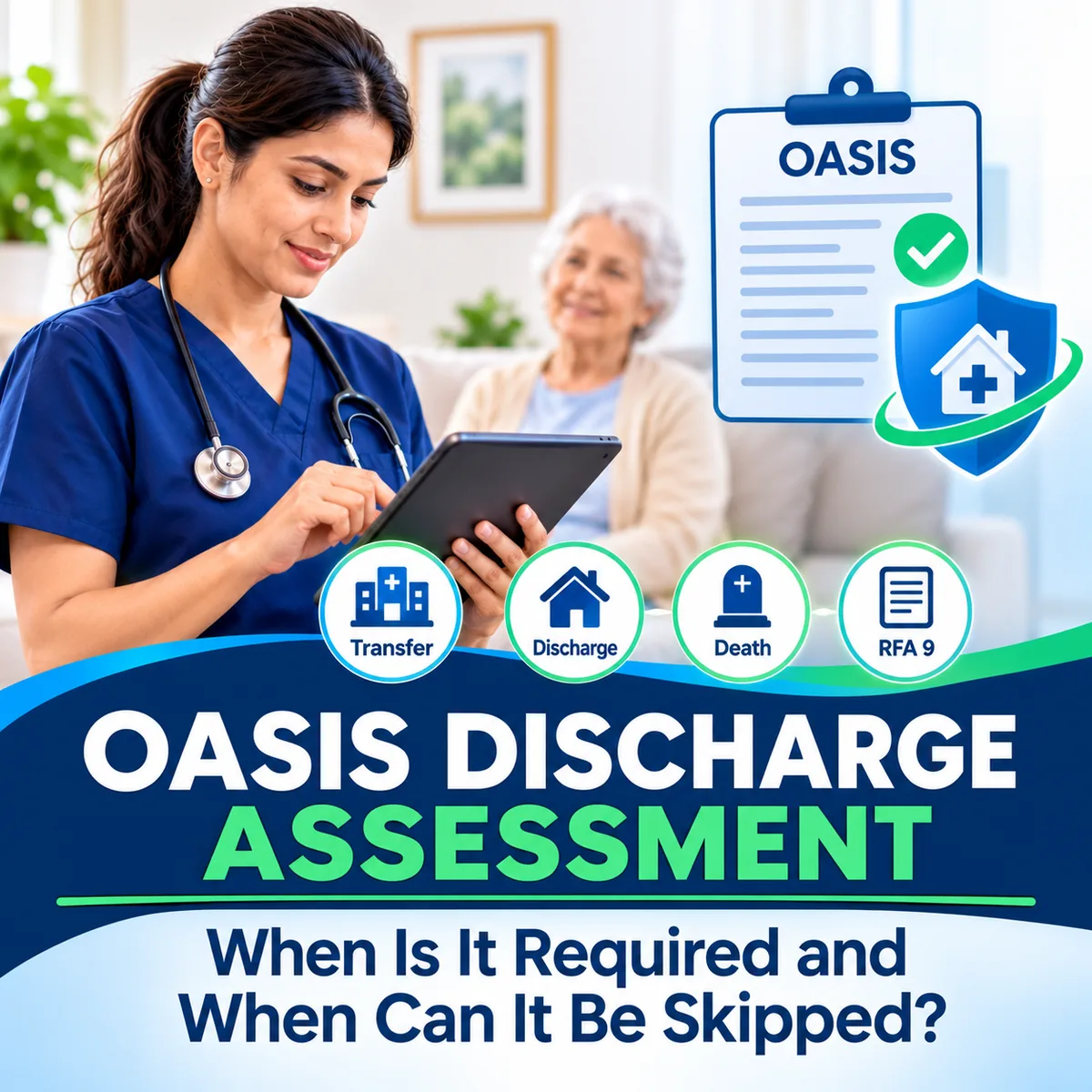
A discharge comprehensive assessment is generally required when a patient is discharged from the home health agency for a reason covered by RFA 9.
However, CMS provides an exception for a patient discharged after receiving only one visit from the agency. In this single-visit situation, a discharge OASIS assessment should not be collected or submitted.
Agencies should also distinguish between an agency discharge and a temporary interruption in care. A patient who returns home after a qualifying inpatient stay may require a Resumption of Care assessment rather than an RFA 9 discharge assessment, depending on the circumstances.
Before selecting RFA 9, verify:
- Whether the patient is actually being discharged from the agency.
- Whether the patient was admitted to an inpatient facility.
- Whether the patient died at home.
- Whether the agency has completed only one visit.
- Whether another OASIS assessment reason applies.
When Must the RFA 9 Assessment Be Completed?
Under OASIS-E2, the discharge comprehensive assessment must generally be completed within two calendar days of the actual discharge date.
The discharge date recorded in M0906 is Day 0. The following two calendar days make up the assessment completion window.
For example, if the discharge date is Monday, the assessment must be completed by Wednesday.
For an unexpected or unplanned discharge, the assessment timeframe is calculated from when the agency learns of the need to discharge, in accordance with CMS guidance.
Agencies should not confuse the discharge date with the date the assessment is completed. These are separate data elements:
- M0906: The actual discharge, transfer, or death date.
- M0090: The date the assessment was completed.
M0090 represents the date the last information needed to complete the assessment was gathered and documented. It is not necessarily the date of the last home visit.
What Is the OASIS Submission Deadline for RFA 9?
Completing the assessment within the required timeframe is only one part of compliance. Agencies must also transmit the completed OASIS record to CMS within the applicable submission window.
Under 42 CFR §484.45(a), completed OASIS data must generally be transmitted within 30 calendar days of the assessment completion date recorded in M0090.
This creates two separate deadlines:
| Requirement | Deadline |
|---|---|
| Complete the RFA 9 assessment | Within two calendar days of the discharge date, or the applicable date the agency learns of an unplanned discharge |
| Transmit the completed OASIS record | Within 30 calendar days of M0090 |
Agencies should monitor both deadlines through their clinical documentation and OASIS submission workflows. A completed assessment that is not transmitted on time can still create a compliance and reporting issue.
Who Can Complete the RFA 9 Discharge Assessment?
The comprehensive assessment must be completed by a qualified assessing clinician in accordance with CMS requirements.
Depending on the patient's services and applicable assessment rules, this may include:
- Registered Nurse (RN).
- Physical Therapist (PT).
- Speech-Language Pathologist (SLP).
- Occupational Therapist (OT), when permitted under the applicable conditions.
When both an RN and a qualified therapist are scheduled to conduct discharge visits on the same day, CMS guidance assigns responsibility for completing the discharge comprehensive assessment to the last qualified clinician who sees the patient.
This should not be interpreted as a universal rule that the last skilled discipline always completes every discharge assessment.
Agencies should establish clear scheduling and communication procedures so the responsible clinician knows that the discharge assessment must be completed and has access to the relevant clinical information.
Which OASIS Items Must Be Reviewed at Discharge?
An RFA 9 assessment includes several clinical, functional, medication, and discharge-planning elements. Each response should reflect the patient's actual status and the specific instructions for that item.
Which clinical status items should be reviewed?
The clinician should evaluate the patient's condition at discharge and ensure that the OASIS responses agree with the clinical record.
Relevant areas may include:
- Wound status and healing progress.
- Respiratory condition and dyspnea.
- Pain and symptom management.
- Falls and other safety concerns.
- Changes in medical condition.
- Progress toward established care goals.
- Ongoing needs requiring follow-up after discharge.
For example, if the patient has an active wound at discharge, the documentation should describe its current condition, treatment provided, and follow-up instructions. The clinician should not simply copy the previous assessment's wound status.
How should Section GG functional items be scored?
Section GG captures the patient's usual performance in self-care and mobility activities.
The relevant discharge items include:
- GG0130: Self-care.
- GG0170: Mobility.
Scoring should reflect the patient's usual performance during the applicable discharge assessment period, not an isolated moment or an assumption based only on the patient's diagnosis.
Direct observation is useful, but it is not the only permitted source of information. The clinician may also use patient or caregiver interviews and relevant clinical documentation, following the item-specific CMS instructions.
When performance varies, the clinician should determine the usual level of performance using the applicable coding guidance. Activity-not-attempted codes should be used when appropriate. A dash should only be used where CMS permits it.
Avoid copying Start of Care scores forward without reassessing the patient's current functional status.
Which medication items apply at discharge?
Medication-related OASIS items help establish the patient's medication management status and whether medication information was appropriately communicated at discharge.
Important items include:
M2005 – Medication Intervention
This item reviews whether clinically significant medication issues identified since the most recent SOC or ROC were communicated to the physician or allowed practitioner and whether recommended actions were completed by midnight of the next calendar day, to the extent possible.
M2020 – Management of Oral Medications
This item assesses the patient's current ability to prepare and take oral medications reliably and safely.
A2121 and A2122 – Medication List to Subsequent Provider
These items apply when the patient's M2420 response indicates that the patient remains in the community with skilled services from another Medicare-certified home health agency or has transferred to non-institutional hospice.
A2123 and A2124 – Medication List to Patient
These items apply when the patient's M2420 response indicates that the patient remains in the community without skilled services from another Medicare-certified home health agency or non-institutional hospice, or when the applicable disposition is unknown.
A2120 is associated with the transfer pathway and should not be confused with the RFA 9 discharge items.
The agency should follow the applicable skip logic and document whether the reconciled medication list was provided and, when required, how it was transmitted.
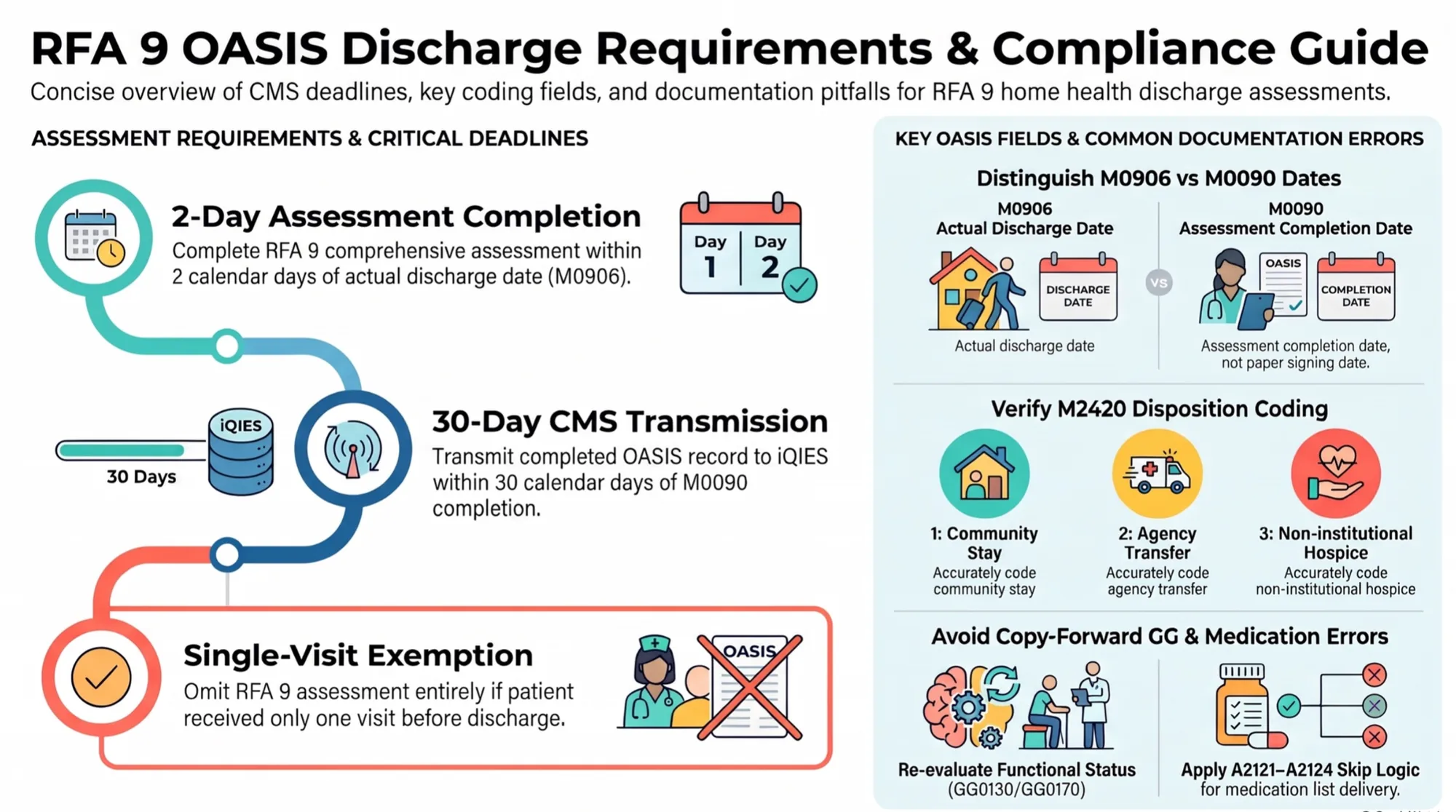
RFA 9 has three separate clocks: the 2-day assessment window, the 30-day OASIS transmission deadline, and the 5-business-day discharge summary.
How Should an Agency Complete M0906 and M2420?
Two fields are particularly important when documenting an RFA 9 discharge: M0906 and M2420.
What should be entered in M0906?
M0906 records the actual date of discharge, transfer, or death.
It should not automatically be treated as the date the discharge paperwork was signed or the date the OASIS assessment was completed.
The discharge date should be established according to agency policy or the applicable practitioner order and cannot precede the last visit. For an unexpected discharge, agencies should follow CMS guidance for determining the date and assessment timeframe.
For example, if a patient unexpectedly moves out of the service area and the agency learns of the move after the last visit, the agency must document when it learned of the discharge and apply the relevant CMS instructions.
What does M2420 tell the agency?
M2420 captures the patient's discharge disposition and whether the patient will continue receiving certain services after leaving the agency.
The response options are:
| M2420 response | Meaning |
|---|---|
| 1 | Patient remains in the community without skilled services from another Medicare-certified HHA or non-institutional hospice |
| 2 | Patient remains in the community with skilled services from another Medicare-certified HHA |
| 3 | Patient transferred to non-institutional hospice |
| 4 | Unknown because the patient moved to a geographic location not served by the agency |
| UK | Other unknown |
A dash is not a valid substitute for an M2420 response.
The clinician should use available information from the patient, family, caregiver, physician, and community resources to determine the correct disposition.
What should be documented when a patient transfers to another HHA?
When a patient transfers to another home health agency, the record should explain the reason for the transfer and identify the receiving provider when known.
The documentation should support continuity of care and include relevant information such as:
- Current clinical condition.
- Ongoing skilled care needs.
- Medication reconciliation.
- Wound and treatment information.
- Pending tests, referrals, or follow-up needs.
- Relevant physician instructions.
- Care coordination with the receiving agency.
For this situation, M2420 response 2 generally applies when the patient remains in the community and receives skilled services from another Medicare-certified HHA.
What should be documented when a patient moves to home hospice?
When the patient transfers to non-institutional hospice, RFA 9 applies rather than treating the situation as an inpatient transfer.
M2420 response 3 identifies the transfer to non-institutional hospice.
The agency should document the hospice transition, relevant coordination, medication information, and the patient's clinical status at discharge.
How Should Medication Reconciliation Be Documented at RFA 9?
Medication reconciliation is an important part of a safe home health discharge.
The agency should review the current medication regimen, identify discrepancies, and ensure that the appropriate medication information is communicated to the patient, family, caregiver, or subsequent provider.
The documentation should make clear:
- Which medications the patient is currently taking.
- Whether medication changes occurred during the episode.
- Whether clinically significant medication issues were addressed.
- Whether the reconciled medication list was provided.
- Who received the medication list.
- How the list was transmitted, when the applicable OASIS items require this information.
The medication list should reflect the patient's actual medication status at discharge. It does not have to be identical to the initial medication list if changes occurred during the episode.
If the patient has no current medications, that information should be clearly documented and communicated according to the applicable CMS instructions.
What Should the Discharge Summary Include?
The OASIS discharge assessment and the agency's discharge summary serve related but distinct purposes.
The OASIS assessment captures standardized clinical and functional information. The discharge summary provides a clinical account of the patient's care and transition out of the agency.
The discharge summary should be consistent with the OASIS record and include relevant information such as:
- Reason for discharge.
- Patient's condition at discharge.
- Progress toward goals.
- Skilled services provided during the episode.
- Current wound and symptom status, when applicable.
- Medication reconciliation and communication.
- Patient and caregiver education.
- Outstanding care needs.
- Follow-up appointments and physician instructions.
- Referral or transfer information, when applicable.
Under 42 CFR §484.110(a)(6), the discharge summary must be sent to the appropriate practitioner or healthcare provider within five business days of the patient's discharge.
This is a separate requirement from the OASIS two-calendar-day assessment timeframe and the 30-calendar-day OASIS transmission deadline.
How Should an Agency Handle an Unexpected or Non-Visit Discharge?
Not every discharge happens as planned. A patient may move out of the service area, refuse further visits, become unavailable, or otherwise leave the agency without a final in-person discharge visit.
In these situations, the agency should follow CMS guidance for unplanned discharges and document the information available to the assessing clinician.
The record should explain:
- Why the planned discharge visit could not take place.
- When the agency learned of the need to discharge.
- The patient's last known clinical condition.
- Information obtained from the patient, family, caregiver, or other providers.
- Relevant care coordination and follow-up efforts.
- The basis for the discharge date and assessment responses.
For functional and clinical items, follow the individual CMS coding instructions. Do not automatically copy forward previous scores or use a dash simply because a discharge visit did not occur. Permitted activity-not-attempted codes and dash responses are item-specific.
The agency should also distinguish an unexpected discharge from a qualifying inpatient transfer or death at home, which require different assessment reasons.
What Are the Most Common RFA 9 Documentation Errors?
Even when agencies understand the purpose of RFA 9, mistakes can occur during discharge documentation, assessment completion, and submission.
| Common error | Why it happens | How to prevent it |
|---|---|---|
| Selecting RFA 9 after an inpatient transfer | The agency does not verify the patient's admission status | Confirm whether the patient was admitted to a qualifying inpatient facility and apply RFA 6 or RFA 7 when appropriate |
| Using the paperwork date for M0906 | Confusing the assessment completion date with the discharge date | Verify the actual discharge date using agency policy and the applicable CMS guidance |
| Missing the two-day assessment window | Discharge notifications are delayed or not communicated | Track planned and unexpected discharges and document when the agency learns of an unplanned discharge |
| Missing the 30-day submission deadline | Assessment completion is tracked, but transmission is not | Monitor M0090 and the OASIS submission status in iQIES |
| Copying forward Section GG scores | Previous scores are reused without reassessment | Evaluate usual performance at discharge and follow item-specific coding instructions |
| Using a dash incorrectly | The clinician assumes missing observation always permits a dash | Check the CMS instructions for each item and use only permitted codes |
| Incorrect M2420 disposition | The receiving provider or post-discharge service arrangement is not verified | Confirm the patient's discharge destination and available follow-up information |
| Missing medication-list communication | The team completes medication reconciliation but does not document provision of the list | Apply the A2121–A2124 skip logic and record the appropriate recipient and transmission method |
| Inconsistent clinical documentation | Nursing, therapy, and discharge records contain conflicting information | Coordinate across disciplines and reconcile discrepancies before finalizing the record |
| Incorrect correction of a submitted assessment | Staff attempt to overwrite an accepted record without following CMS procedures | Follow the applicable OASIS correction, modification, or inactivation process |
How Can Agencies Correct an RFA 9 Assessment After Submission?
If an agency identifies an error in a submitted OASIS assessment, it should follow the CMS OASIS correction policy and applicable data specifications.
The first step is to identify the type of error. It may involve an incorrect clinical response, a data-entry problem, or a key field such as the assessment reason or assessment dates.
Agencies should:
- Review the original assessment and supporting clinical documentation.
- Determine the correct response using the applicable OASIS-E2 instructions.
- Identify whether the error requires a correction, modification, or inactivation.
- Follow the appropriate CMS and iQIES procedure.
- Retain supporting documentation and the correction history.
- Verify that the corrected record has been accepted.
Key-field errors may require a different correction process from ordinary item errors. Agencies should not simply overwrite a submitted record without following the applicable CMS procedure.
How Can Technology Help Reduce RFA 9 Documentation Errors?
Discharge documentation often involves information collected by multiple clinicians, across several visits and systems. When this information is scattered or entered repeatedly, it becomes easier to miss details or create inconsistencies.
Technology can help agencies organize the information needed for discharge and reduce repetitive documentation work.
For example, AI-assisted documentation can help:
- Organize relevant clinical information from existing records.
- Prepare structured clinical summaries for clinician review.
- Support voice-assisted visit documentation.
- Make relevant medication and functional information easier to review.
- Help identify possible missing information or inconsistencies for staff to verify.
Copper AI is designed to support home health documentation workflows without requiring agencies to replace their existing EMR. Its voice agent, Joy, can turn a clinician's spoken visit narrative into a structured documentation draft.
The clinician remains responsible for reviewing, correcting, and approving the documentation. Copper AI does not replace clinical judgment or the required clinician sign-off.
The goal is to reduce repetitive administrative work while keeping the clinical team in control of the record.
What Should Agencies Include in an RFA 9 Discharge Checklist?
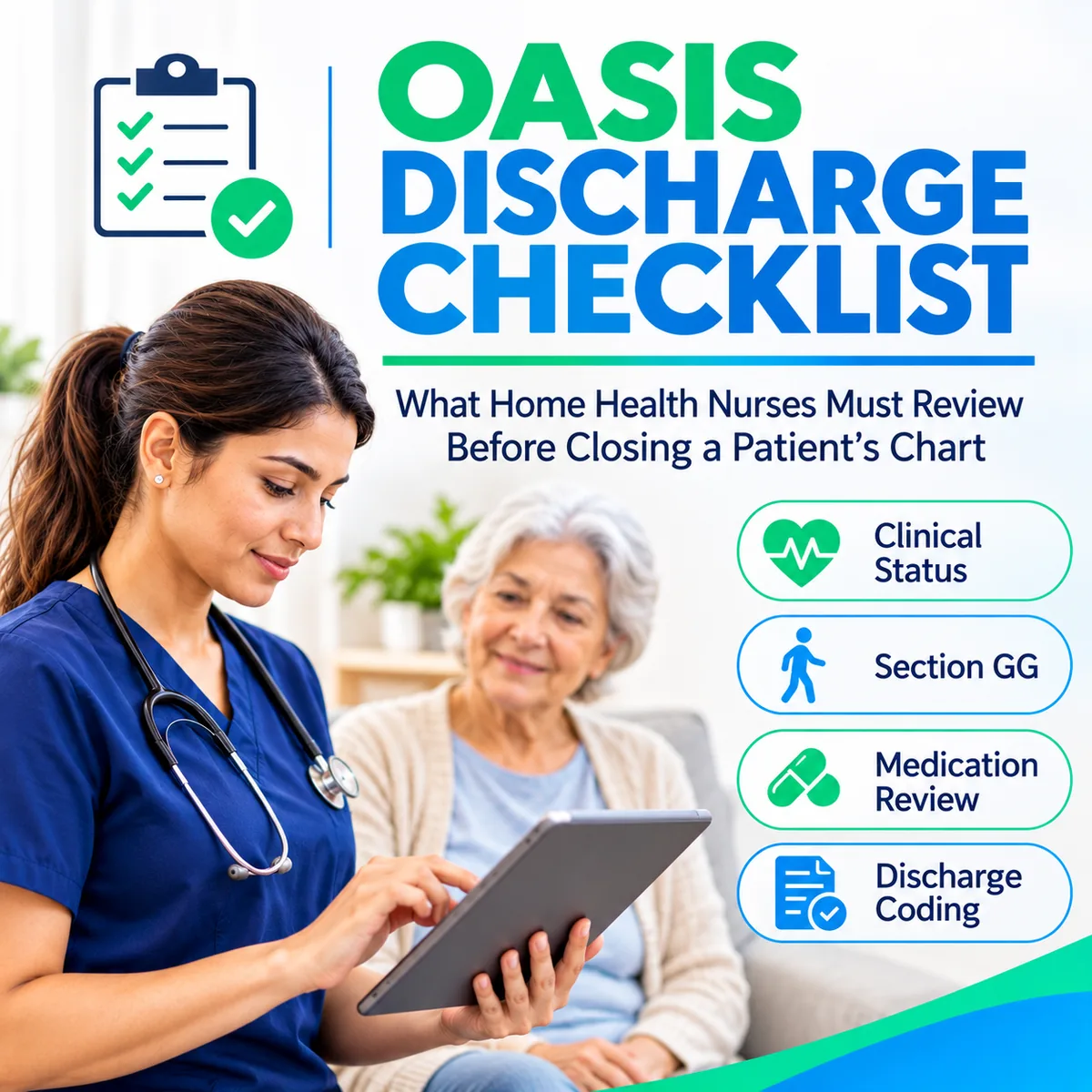
Before finalizing an RFA 9 assessment, agencies can use this checklist to review the most important requirements.
- Confirm that RFA 9 is the correct assessment reason.
- Verify that the patient is not being discharged under a qualifying inpatient transfer or death-at-home category.
- Check whether the single-visit discharge exception applies.
- Establish the correct discharge date for M0906.
- Complete the assessment within the applicable two-calendar-day timeframe.
- Record the correct M0090 assessment completion date.
- Review the patient's clinical status and progress toward goals.
- Complete GG0130 and GG0170 using the applicable usual-performance rules.
- Review medication items, including M2005 and M2020.
- Apply the correct A2121–A2124 medication-list pathway.
- Verify M2420 discharge disposition.
- Document patient and caregiver education.
- Record relevant follow-up instructions and care coordination.
- Ensure the discharge summary is sent within the required five-business-day timeframe.
- Transmit the OASIS record within 30 calendar days of M0090.
- Verify successful acceptance in iQIES.
What Is the Difference Between the RFA 9 Assessment Deadline and the Discharge Summary Deadline?
These deadlines are often confused, but they apply to different documentation requirements.
| Requirement | Timeframe | What it covers |
|---|---|---|
| RFA 9 comprehensive assessment | Within two calendar days of discharge, or the applicable date the agency learns of an unplanned discharge | Completion of the OASIS discharge assessment |
| OASIS transmission | Within 30 calendar days of M0090 | Submission of the completed OASIS record to CMS |
| Discharge summary | Within five business days after discharge | Sending the discharge summary to the appropriate practitioner or healthcare provider |
Tracking these deadlines separately helps agencies avoid incomplete records and late submissions.
How Can Agencies Keep RFA 9 Discharges Accurate and Compliant?
RFA 9 is more than a final OASIS form. It documents the patient's status when home health services end and helps establish whether the transition from agency care has been appropriately managed.
A reliable discharge process requires accurate assessment selection, correct dates, appropriate clinical and functional scoring, medication reconciliation, and clear discharge documentation.
Agencies should also ensure that their clinical, QA, and administrative teams understand the difference between the assessment completion deadline, the OASIS submission deadline, and the discharge summary requirement.
A consistent workflow, supported by clear clinical review and appropriate technology, can reduce avoidable errors and help teams close home health episodes with complete, accurate records.
Care should remain the priority. The discharge documentation process should support that care, not create another administrative burden for clinicians.
Official CMS References
- CMS OASIS User Manuals.
- CMS OASIS Data Sets.
- CMS OASIS-E2 Guidance Manual, effective April 1, 2026.
- 42 CFR §484.45 – Reporting OASIS information.
- 42 CFR §484.110 – Clinical records.
Related Reading
- OASIS Discharge Checklist for Home Health Nurses: A Step-by-Step OASIS-E2 Guide.
- OASIS Discharge Assessment: When Is It Required and When Can It Be Skipped?.
- How to Document a Patient Transfer to Another Home Health Agency: A Step-by-Step Guide.
- OASIS-E vs OASIS-D: What's Changed?.
- How to Prepare a Home Health Chart for a Medicare Audit: A Complete Checklist.