
The Conversation Medicare Pays For That Almost Nobody Is Having
Seventy percent of Americans say they want to die at home. About 30 percent do. Critical care nurse Luke Adams on advance care planning, the Medicare code that pays for it, the nurse-led model that generates $100K to $150K net per nurse, and why nurses are revenue engines, not cost centers.
Key Takeaways
- Medicare reimburses advance care planning, but most families never have the conversation.
- A nurse-led, two-visit ACP model honors patient wishes and reduces crisis-driven care.
- Advance care planning can add significant net revenue per nurse.
- Home health nurses are ideally positioned to lead these conversations.
Let me ask you a question that matters more than anything else in this post. How did your mother or father or spouse make decisions about end of life?
Was it a planned conversation in a quiet room with someone trained to walk through it? Or was it a panic decision in an ICU hallway at three in the morning, made by a family member who had never been asked the question and was now responsible for the answer?
For most American families, it is the hallway. I know because I have been in those hallways for 15 years across medical, cardiovascular, and neuro ICUs.
One path leads to a person surrounded by family in a place they chose with their values honored. The other leads to a cascade of interventions that nobody wanted, delivered to a patient who cannot speak, authorized by a family member who is absorbing maybe 20 percent of what the medical team is explaining because they are in crisis.
That second path is how most Americans die. And there is a Medicare code that pays to prevent it, sitting on the books since 2016, waiting for someone to build the model around it.
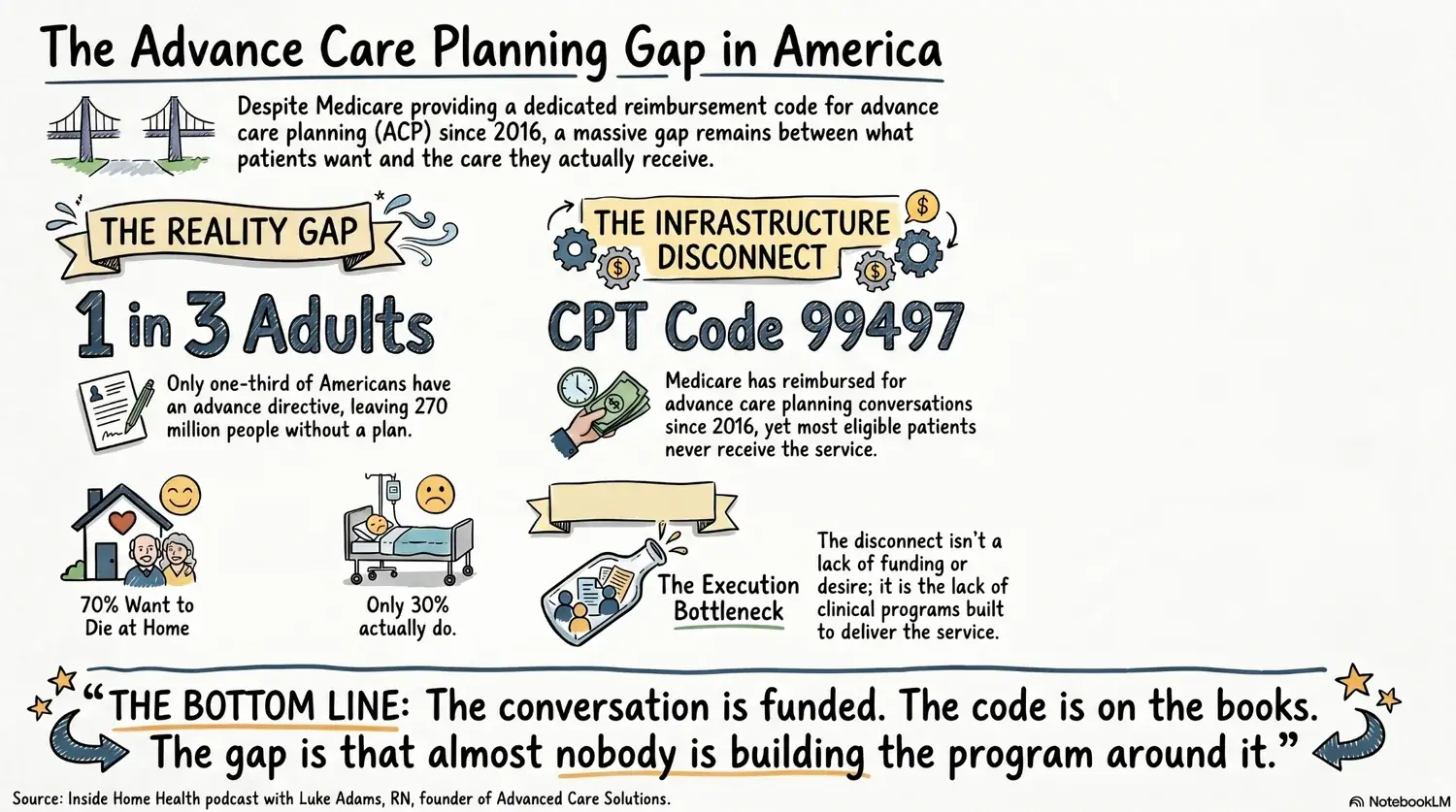
The conversation is funded and the code is on the books since 2016. The gap is that almost nobody is building the program around it.
The Biggest Lie in Healthcare: We Are Doing Everything We Can
When I started at Geisinger Medical Center as an oncology nurse, my patients came back every four to six weeks for chemotherapy, and I got to know their families. As my career moved into critical care, I saw the same pattern repeated across every unit: patients with chronic illness follow a predictable decline, and yet when they arrive in the ICU, nobody has talked to them or their families about the realities and limitations of intensive care medicine.
I would hear providers get frustrated with families who wanted everything done, and I kept asking the same question: has anybody actually had the conversation with them? After 15 years, the answer was consistently no.
The problem is not that families make bad decisions. It is that they are making decisions in the worst possible conditions.
They are emotional, absorbing less than 20 percent of highly technical medical information, and their default when they do not understand is to want everything done, often just to buy time to process. That causes resource strain, clinician burnout from the futility of care nobody wanted, and ultimately a death that does not reflect what the patient would have chosen.
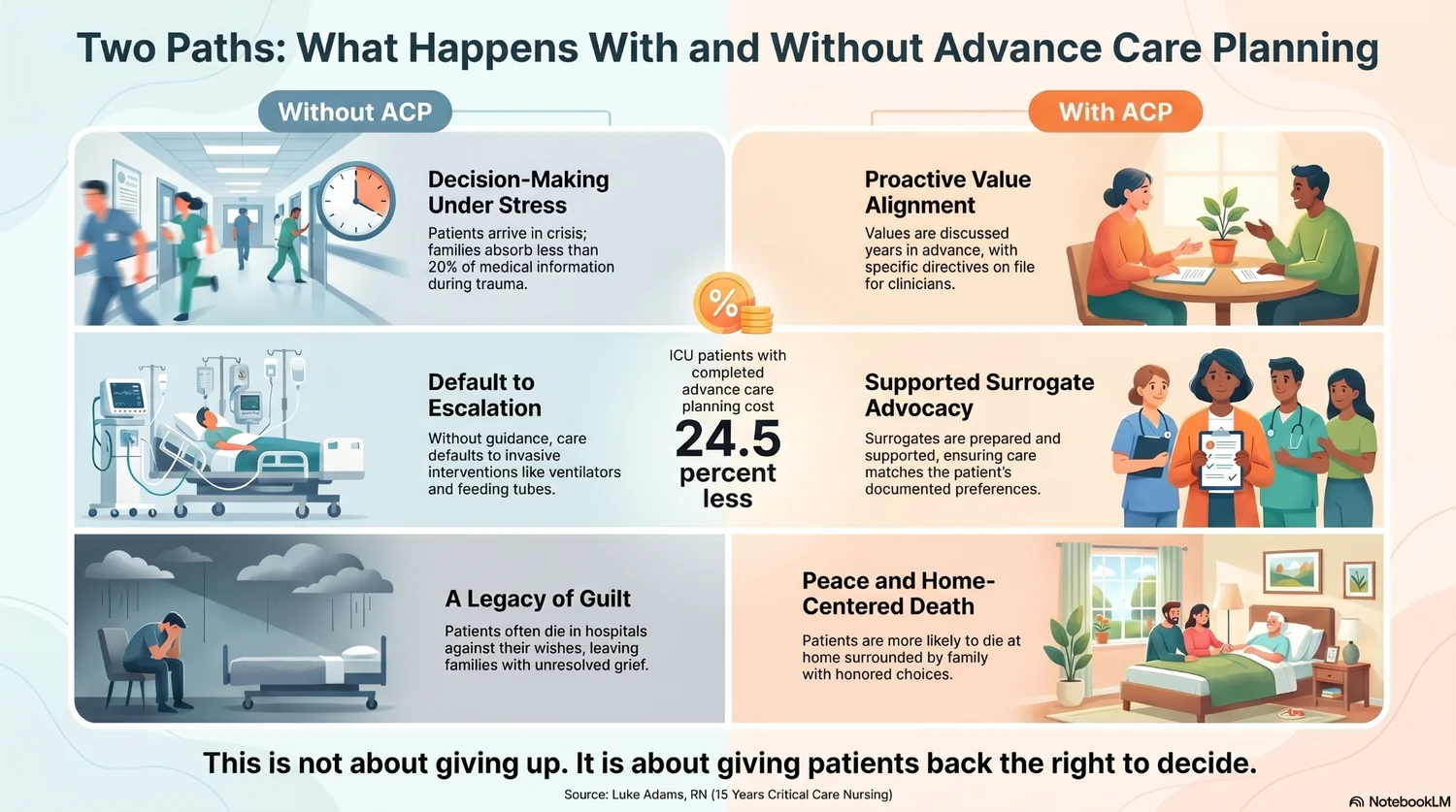
The two paths of care. This is not about giving up. It is about giving patients back the right to decide.
🏠 70 percent of Americans say they want to die at home. About 30 percent actually do. That gap exists because nobody had the conversation while there was still time to have it. ICU patients with completed advance care planning cost 24.5 percent less.
What Advance Care Planning Actually Is, and Why It Is Not Just a Form
Most advance directives that exist today were written by attorneys. A generic legal document is not particularly useful to clinicians on the inpatient side when they need to make real-time decisions about a specific patient in a specific situation.
Advance care planning is not a form. It is a conversation, and it needs to be led by someone who can speak intelligently about the patient's actual medical condition, the road ahead for their specific disease process, and the options available at each stage.
The way I build these programs, we use a two-visit structure. In the first visit, the nurse meets with the patient and potentially their surrogate to cover what advance care planning is, why it matters, and what quality of life means to this specific person, and to send home thought-provoking resources.
Three months later, they come back for the second visit. We discuss their answers, elect their healthcare power of attorney (which may not be the spouse of 55 years, because that person may have difficulty honoring wishes in a crisis), and create an advance directive specific to them as a person, not a checkbox form.
These are not static conversations; a person at 60 may feel very differently than at 85. That is why this belongs in healthcare, not a lawyer's office: healthcare sees these patients regularly and can revisit the conversation as their health status changes.
The Financial Model: $100K to $150K Net Revenue Per Nurse
Medicare covers advance care planning under CPT code 99497 for the first 16 to 30 minutes, and CPT 99498 for each additional 30 minutes. It does not matter how long the conversation takes because you continue to be reimbursed for the time.
When ACP is performed as part of an Annual Wellness Visit, Medicare waives the coinsurance and Part B deductible entirely. The conversation must be voluntary, the patient must have capacity, and the ordering physician must be available for clinical questions that exceed the nurse's scope.
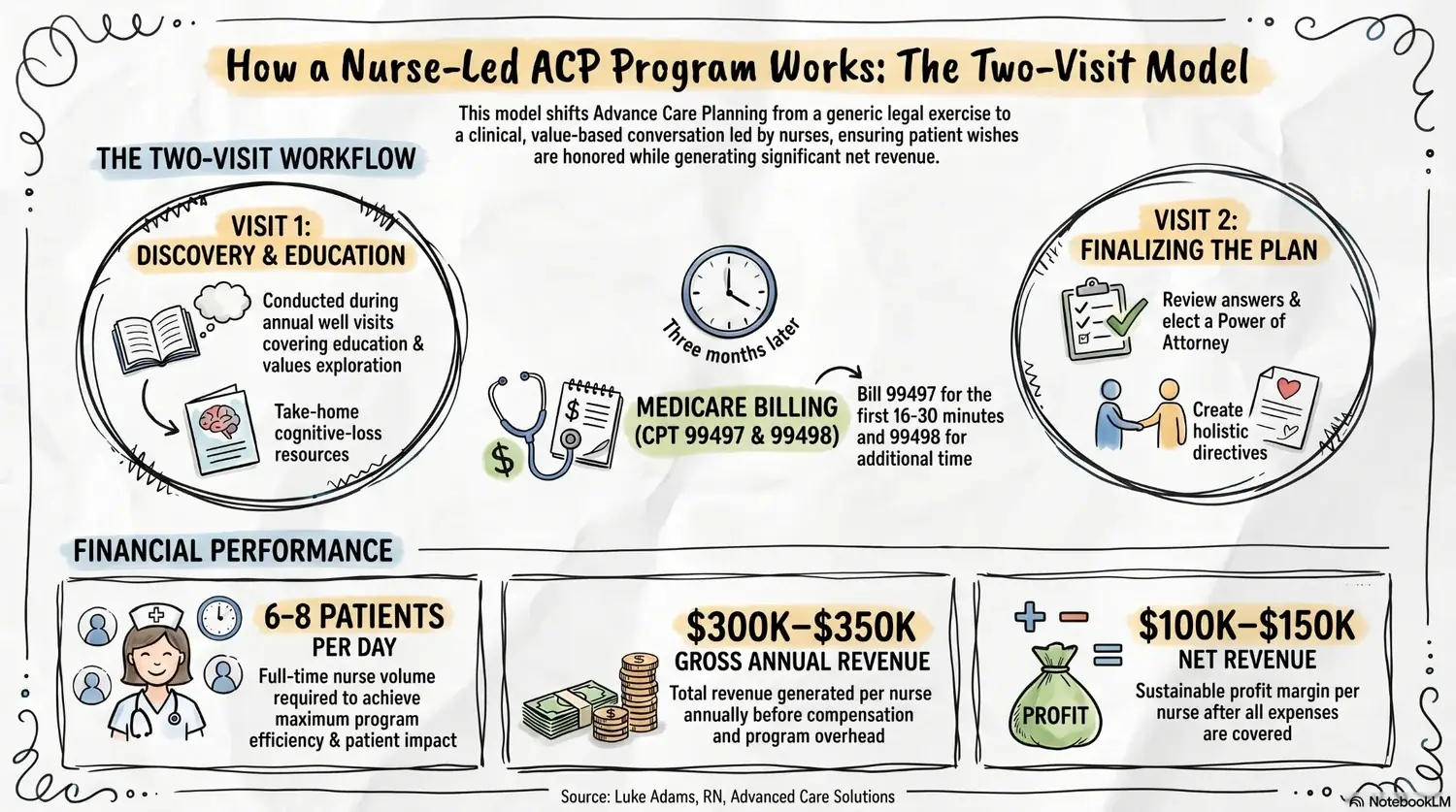
The nurse-led two-visit model: value-based conversations that honor patient wishes and generate real net revenue.
RNs can bill Medicare incident-to the ordering physician, who does not have to be in the room for the entire conversation but must be available and must have meaningfully contributed. In the programs I build, we embed the ACP nurse in a primary care office; scheduling identifies high-risk patients coming in for their annual well visit, the physician introduces the concept and refers the patient down the hall, and that nurse sees six to eight patients per day, Monday through Friday.
At that volume, each full-time ACP nurse generates roughly $300,000 to $350,000 in gross revenue annually, with $100,000 to $150,000 net after the nurse's compensation and program overhead. This is not a charity program.
It is a revenue-generating clinical service that also happens to be the most important conversation in medicine.
What This Means for Home Health
When Arvind showed me the data from Copper Digital's AI documentation system, one pattern jumped out: the advance directive field on the OASIS assessment repeatedly shows no advance directive for patients in their 80s and 90s. That is the gap in visual form.
These are exactly the patients who need this conversation, and nobody is having it.
The billing pathway for ACP in home health is still evolving, and I will not give guidance on the telehealth-modifier specifics that I could not stand behind on the record. But home health nurses are in a unique position to identify patients who need this conversation and initiate the referral.
The nurse is in the patient's home, seeing the functional decline firsthand, and building the kind of trust that makes this conversation possible. Even if the billing happens at the PCP's office on the next scheduled visit, the home health nurse can open the door.
And there is the documentation connection. When AI takes the documentation burden off the clinician's plate, the question becomes what you do with the recovered time.
One answer is more patient visits. Another, and I would argue the more important one, is this conversation.
A home health nurse who is not racing to finish her charting has the space to notice that the patient does not have an advance directive, to ask the question gently, and to start a process that could change how that patient dies.
Why This Is Personal
My mother found out she had stage four cancer one day, out of nowhere. She was seemingly healthy, cooked Easter dinner, and then we went to the hospital and got the results of her scans, and it was everywhere, in every organ system.
She got about five and a half weeks between diagnosis and passing. She was a textbook case for quality over quantity.
She was a proud woman, a little Italian spark plug who never wanted anybody to have to do anything for her. For four and a half weeks she was still herself, 80 percent of herself, able to move and take care of herself.
It was only the last few days that she was on a bed in our living room, surrounded by the sound of my son's concrete feet and all the familiar sounds and smells of home.
That is what I want for people: to be surrounded by their family in a place they are comfortable, where they can still feel like themselves. If 70 percent of people want to die at home and only 30 percent do, we have a lot of work ahead. But the conversation is where it starts, and Medicare is already willing to pay for it.
🎧 Luke appeared on the Inside Home Health podcast with Arvind Sarin. To see how Copper Digital reduces documentation burden so nurses have room for the conversations that matter most, explore AI tools for nurses, pricing, or more resources.
Home Health Documentation Playbook
The complete guide to OASIS-E, Medicare compliance, PDGM, and AI-assisted documentation. Learn how top agencies reduce documentation time without sacrificing compliance.
Bottom Line
Advance care planning is reimbursed by Medicare yet rarely done; a nurse-led, two-visit model improves outcomes and can generate meaningful net revenue per nurse.

Watch the Full Conversation
The Biggest Mistake Healthcare Makes About Nurses
Arvind Sarin and Luke Adams on advance care planning, and turning nurses into revenue-generating clinicians.

Luke Adams, RN, is the founder of Advanced Care Solutions and a critical care nurse with 15 years of bedside experience across medical, cardiovascular, and neuro ICUs. He began his career at Geisinger Medical Center and deployed to New York City during the COVID-19 crisis. He builds nurse-led advance care planning programs for health systems that generate revenue while improving patient and family outcomes.
Frequently asked
Frequently asked questions
Advance care planning is a process where patients discuss and document their values, goals, and preferences for future medical care while they still have the capacity to make those decisions. It matters because only about one in three American adults has an advance directive, and when patients arrive in a crisis without documented wishes, families default to wanting everything done, often leading to aggressive interventions the patient would not have chosen. Patients with completed ACP have lower ICU costs, higher rates of dying at home, and families that experience less decisional conflict.
Join the conversation
Leave a comment
No comments yet. Be the first to share your thoughts.
Related reading
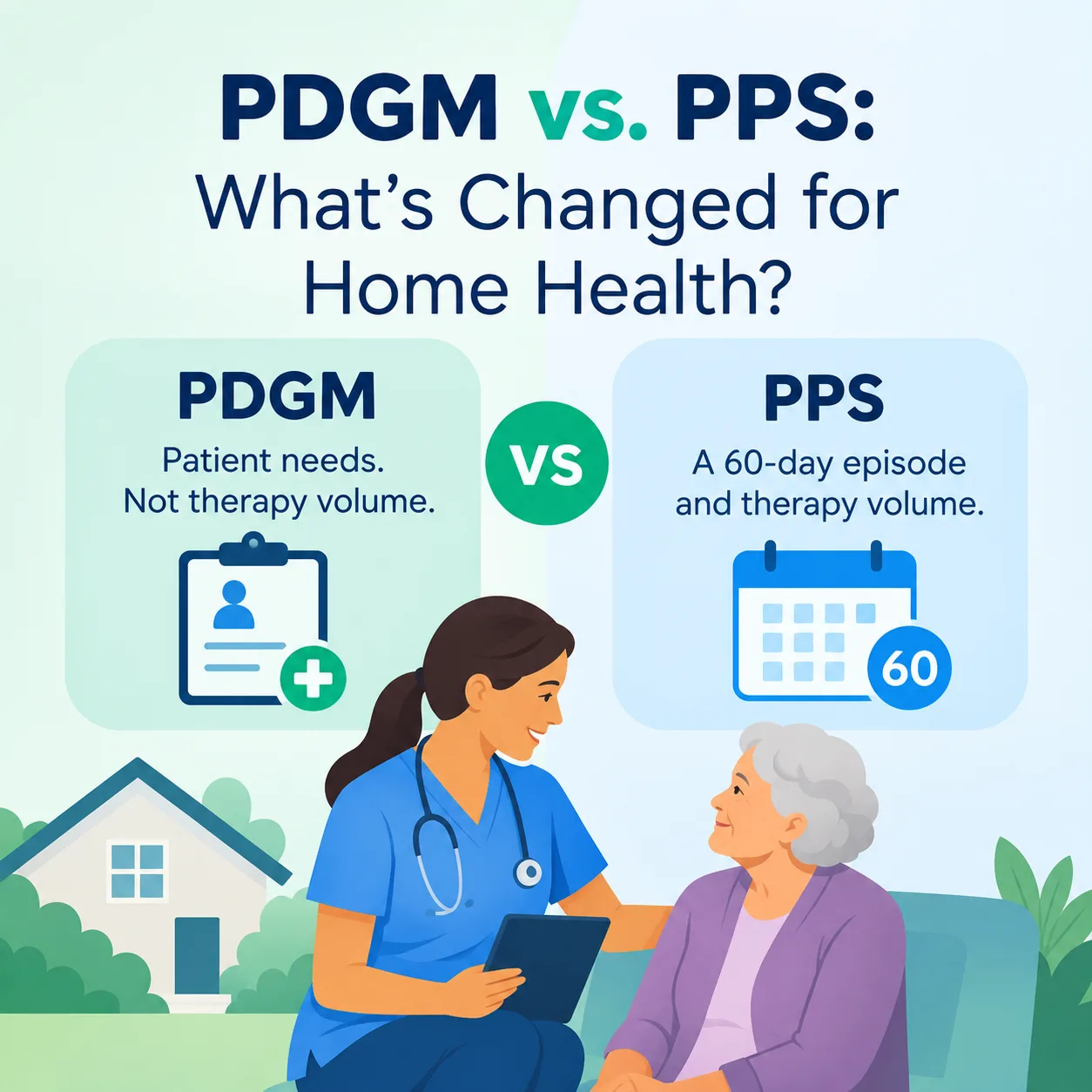
PDGM vs. PPS: What's Changed for Home Health?
PDGM did not replace Medicare's Home Health Prospective Payment System. It changed the case-mix methodology inside HH PPS—and reshaped payment periods, coding, OASIS, LUPA monitoring, billing, and cash flow.

Common OASIS Documentation Mistakes That Lead to Payment Delays
Common OASIS documentation mistakes, such as incomplete assessments, incorrect diagnosis coding, inaccurate Section GG scoring, medication and homebound-status errors, weak skilled-need documentation, and missing physician signatures, are among the biggest causes of home health payment delays. Because OASIS data drives PDGM reimbursement, most of these errors are preventable with point-of-care charting, strong QA, and AI-powered documentation validation.
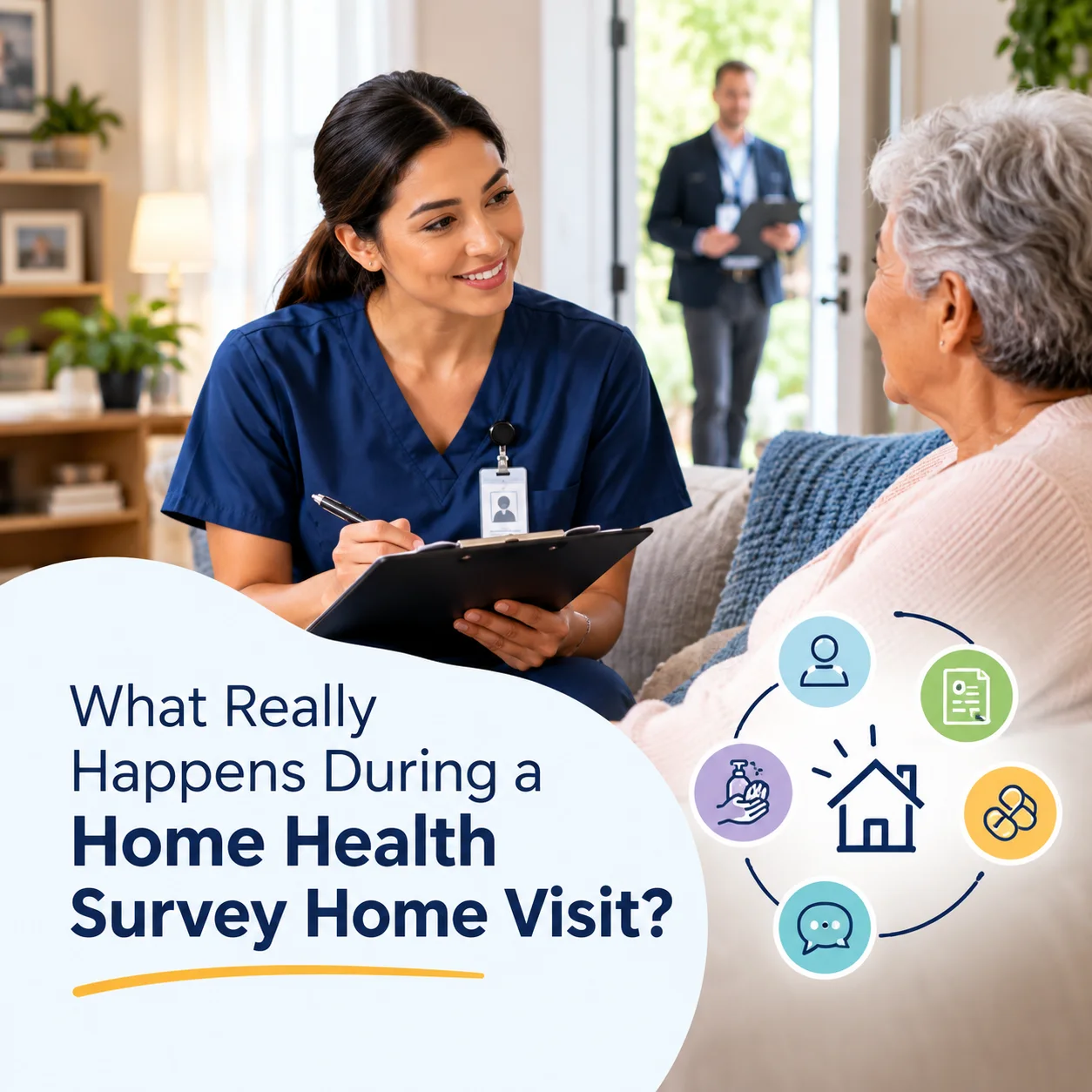
What Really Happens During a Survey Home Visit for Home Health?
A home health survey visit lets a surveyor observe care in the patient's home and compare real-world practice with the plan of care, clinical record, agency policies, and Medicare requirements.