
AI Is the Biggest Opportunity in Nursing Right Now
The biggest career opportunity in nursing right now is not a better unit or an NP degree. It is AI, and the conversation has been happening without nurses in the room. Nurse Nina Stevenson on what nurses can build today, the Five Rights of AI in healthcare, and training 100,000 nurses by 2030.

Key Takeaways
- A large share of a nurse's shift goes to documentation that AI can help reduce.
- The Five Rights of AI in healthcare keep adoption safe and effective.
- Nurses can start using AI now to reduce administrative burden.
- Empowering nurses with AI is a path to retention, not replacement.
I want to start with something that might sound controversial coming from a nurse who still picks up hospital shifts. The biggest career opportunity in nursing right now is not a better unit, a better hospital, a travel contract, or even a nurse practitioner degree. It is AI. And the reason most nurses do not see that yet is because the entire conversation about AI in healthcare has been happening without them.
I have been going to AI conferences and healthcare technology events for about four years. Every one of them is full of doctors, engineers, investors, and product managers. I look around and think, where are my nurses? We are the ones at the bedside, collecting the data, doing the documentation, managing the workflows these tools are supposedly being built to improve. But we are not in the room when the decisions get made, which means the tools are built on what engineers think nursing looks like, not what nursing actually is.
That is the gap I am trying to close. Not by asking the system to invite nurses in, but by training nurses to walk in on their own.
How I Got Here: Shelters, Bedside, and a Podcast That Changed Everything
I grew up in shelters in Chicago, taking care of people before I even knew what nursing was. I got my CNA through MATC while still in high school and started the long road into nursing. It was not a straight path: hardship with prerequisites, a lottery system for program admission, and the feeling that I did not fit the traditional applicant profile. That experience is why I created Nina Nurses, to build alternative pathways for non-traditional applicants who come from different backgrounds but still belong in nursing.
I moved to Sacramento 26 years ago and worked across nearly every specialty: clinical trials, corrections, neuroscience, rehabilitation, pediatrics, cardiology, urgent care, and home health. I loved neuroscience. Then my sister passed away at the same hospital where I worked, and after that every code blue reminded me of her. I took leave, and on that leave I heard AI explained on a podcast in a way that finally connected to what I already knew how to do. That was the moment I got it. I could see myself building something. That is how the Certified AI Nurse Consultant program was born, giving nurses both clinical AI training and business development, with certification through the International Association of AI Consultants.
What Nurses Can Actually Do with AI Right Now
When a nurse comes into my program, the first thing I do is meet one-on-one to understand their background and where they want to go, then build a personalized plan. Some nurses want to build a consulting practice, packaging the clinical experience they already have into advising healthcare companies, hospitals, or startups on how to build AI tools that actually work for clinicians. Some want to build apps: conversational agents for home health agencies, documentation tools that capture information as the nurse walks through the door, patient education platforms that deliver discharge instructions in the patient's language at their literacy level. Some just want to get hired into AI roles, and I have more organizations reaching out for nurses with these skills than I have graduates to fill the demand.
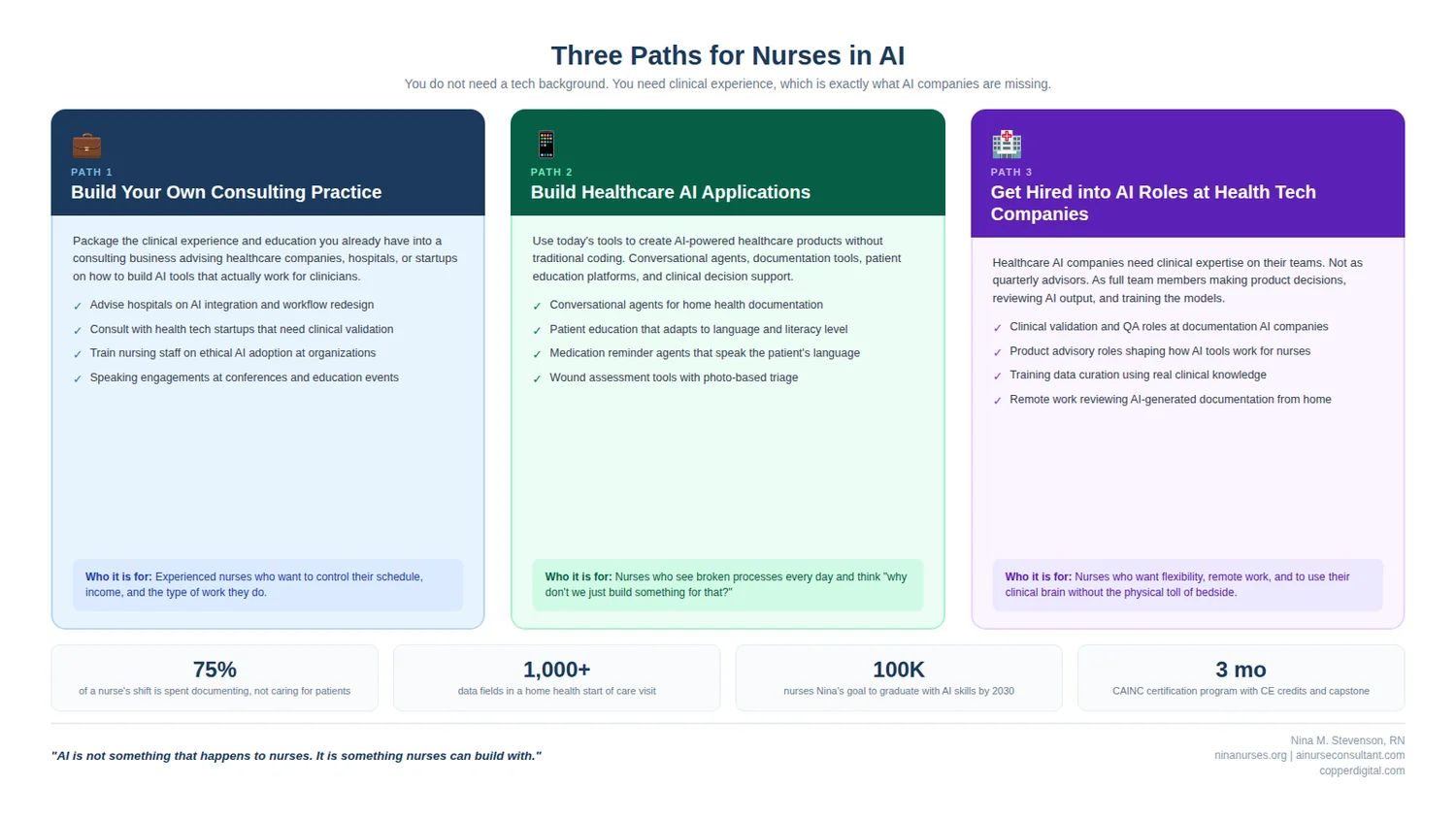
Three paths nurses are taking right now: consulting, building applications, and AI roles at health-tech companies.
The certification is the Certified AI Nurse Consultant, or CAINC: a three-month hybrid program with AI tools training, business development, a capstone project, a speaker track, and continuing education credits. The most valuable part is the lifelong learning community, because the technology keeps evolving and the opportunities keep expanding. The nurses who moved early are already landing contracts with hospitals, schools, and healthcare companies scrambling to integrate AI responsibly.
75 Percent of a Nurse's Shift Is Documentation. That Has to Change.
📋 About 75 percent of a hospital shift, clock-in to clock-out, is documentation. A 30-second action can take two minutes to chart. That ratio is unsustainable, and it is why nurses are burning out and leaving.
I worked in home health too, and the documentation burden there is even more intense. The start of care visit requires a full OASIS assessment with over a thousand data fields once you count the non-OASIS items like vitals, vaccine status, and the rest. You are pulling in the entire medication list, the hospital course, the functional assessment, and building a care plan from all of it. It is hours of documentation for a single visit, and because home health nurses work alone in the patient's home, there is no one to hand it off to.
When Arvind showed me what Copper Digital is building, the idea that AI agents can extract referral data, pre-populate the EMR, and have the chart prepared before the nurse even walks into the house, I immediately thought about how much time that would have saved me. If the documentation foundation is already there when the nurse arrives, she can spend her time on the actual clinical assessment, on the conversation with the patient, on the real human connection that is the reason most of us became nurses.
The Five Rights of AI in Healthcare
When I started getting contracts with healthcare organizations, I noticed nobody had a framework for using AI ethically in clinical settings. Just like we follow the five rights of medication administration, I believe we need the five rights of AI in healthcare.
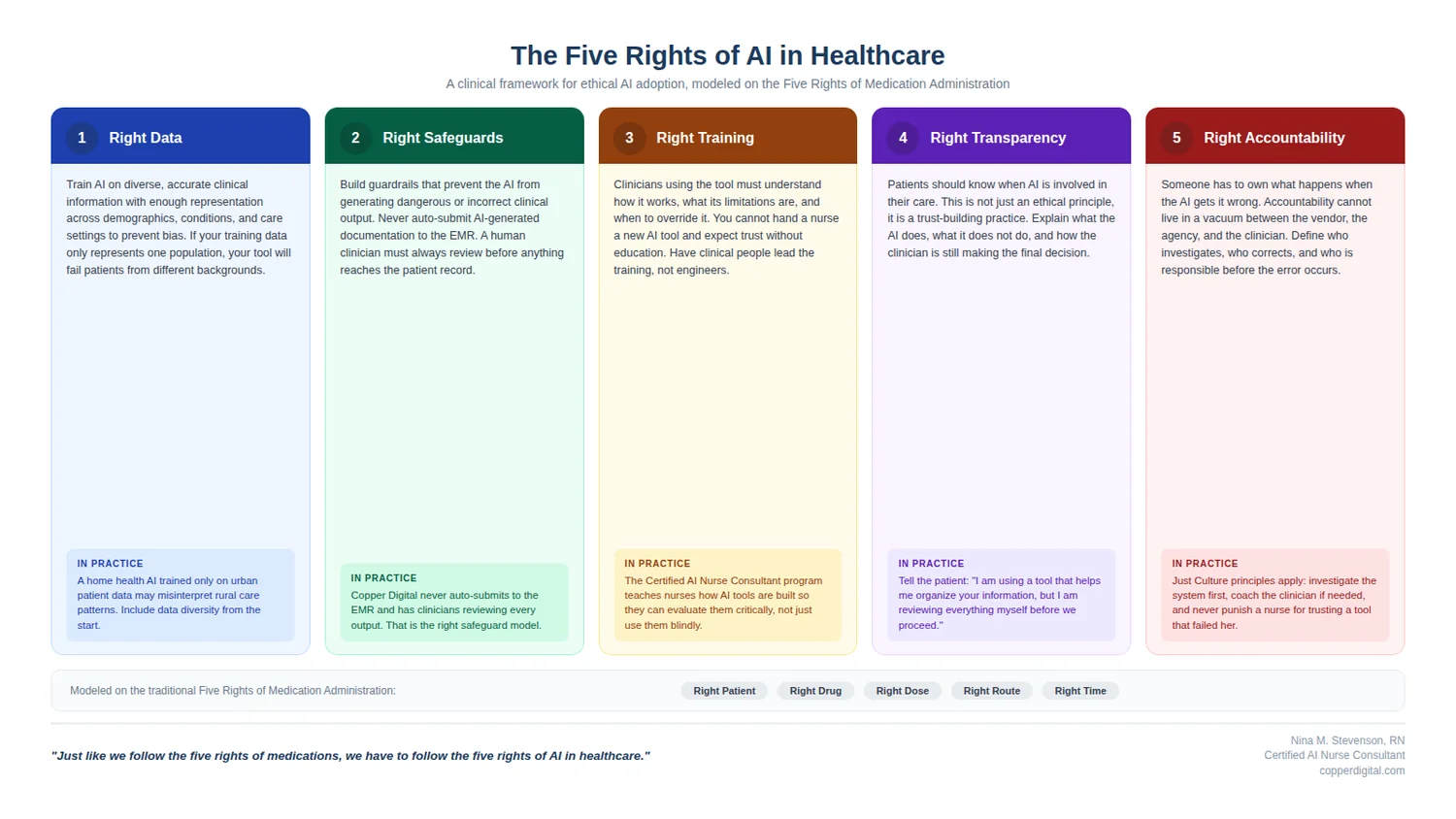
The Five Rights of AI in Healthcare, modeled on the five rights of medication administration.
- Right data. Every AI tool starts from a prompt and must be trained on the right clinical information, with enough diversity to prevent bias. If your training data represents only one demographic, your tool will fail patients from others.
- Right safeguards. You need guardrails that prevent dangerous or incorrect clinical output. This is why I respect Copper Digital never auto-submitting to the EMR and having clinicians review every output. Human-in-the-loop is not optional right now.
- Right training. You cannot hand a nurse a new AI tool and expect her to trust it without understanding how it works and what its limitations are.
- Right transparency. Patients should know when AI is involved in their care.
- Right accountability. Someone has to own what happens when the AI gets it wrong.
I wrote about this framework in my book, Smart Nursing: How AI Is Shaping the Future of Healthcare, and it is the foundation of everything I teach in the CAINC program. These are not theoretical principles. They are practical guardrails every nurse should understand before using any AI tool in clinical practice.
100,000 Nurses by 2030
🎯 The goal: graduate 100,000 licensed nurses through the CAINC program by 2030, through partnerships with nursing schools, universities, CNA programs, and healthcare organizations.
You do not need a BSN to start understanding how these tools work. If we can train 100,000 nurses who understand both the clinical reality and the technology, we can genuinely transform healthcare. Fresh nurses coming out of school with AI skills will look at broken processes and say, why don't we just build something for that, and they will actually have the tools to do it: care plans that generate faster, patient education that adapts to language and literacy, agents that call patients with medication reminders in their own language, and wound assessment tools where a patient takes a photo and learns whether they need to come in.
This is not about replacing what you do. It is about amplifying it. Your clinical experience is the data that makes these tools work. The nurses who move now will be the ones writing the rules for the next three decades of healthcare AI. Do not wait for permission. Walk in and start building.
🎧 Listen to the full conversation between Nina Stevenson and Arvind Sarin on the Inside Home Health podcast. To see how Copper Digital gives nurses their time back with AI documentation, explore AI tools for nurses, pricing, or more resources.
Bottom Line
AI is nursing's biggest opportunity: with so much of a shift spent on documentation, AI can give nurses time back when it follows the Five Rights of AI in healthcare.

Watch the Full Conversation
The Nursing Crisis Nobody's Talking About (It's AI)
Arvind Sarin and Nina Stevenson on why AI is the biggest opportunity in nursing, and why nurses need to be in the room.
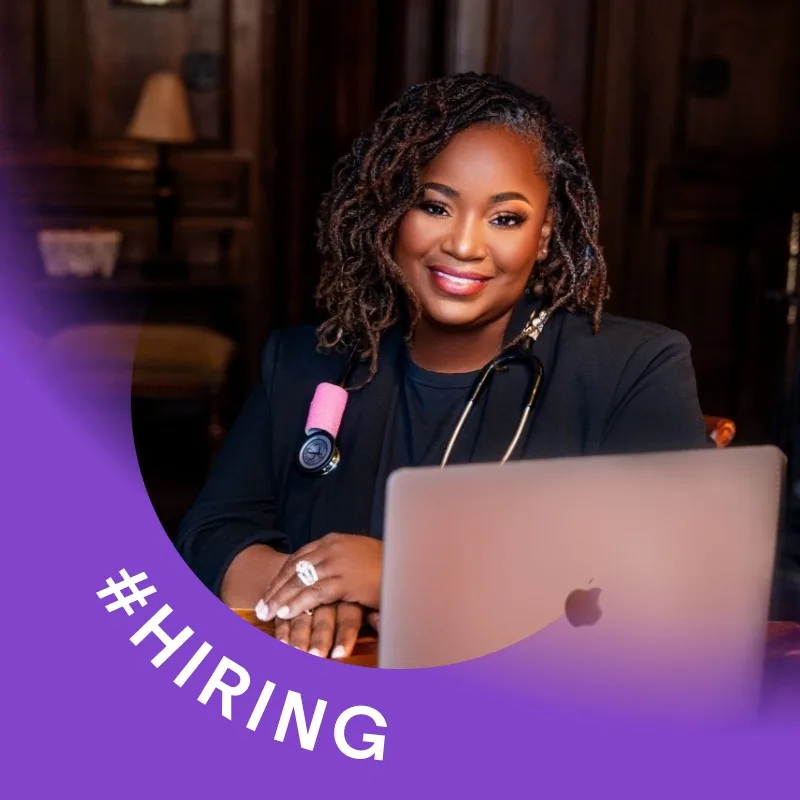
Nina M. Stevenson, RN, is the founder and CEO of Nina Nurses Continuing Education and AI Nurse Academy and one of the first certified AI nurse consultants in the United States. She has 26 years of bedside experience across clinical trials, corrections, neuroscience, pediatrics, cardiology, urgent care, home health, and rehabilitation, and is the author of Smart Nursing: How AI Is Shaping the Future of Healthcare.
Frequently asked
Frequently asked questions
A Certified AI Nurse Consultant (CAINC) is a nurse trained in AI tools, ethical AI frameworks, and business development to advise healthcare organizations on AI integration or build their own AI-powered products and consulting practices. The credential was created by Nina M. Stevenson, RN, in partnership with the International Association of AI Consultants. The three-month hybrid program includes AI tools training, business development, a capstone, speaker training, and continuing education credits approved by CDPH, BVNPT, and the California Board of Registered Nursing.
Join the conversation
Leave a comment
Related reading

Why Home Health Documentation Is Driving Your Best Nurses Out the Door
Home health was designed as a short-term bridge from the hospital to independence at home. Veteran nurse Kathy Duckett explains how we buried that purpose under 150+ OASIS questions, and why fixing documentation, not blaming nurses, is how agencies keep their best clinicians.
Nursing Intuition vs Clinical Judgment: What's the Difference?
Every experienced nurse has felt it: the vital signs look normal, the labs haven't changed, but something feels wrong. Is that intuition or clinical judgment? They're two distinct but complementary skills. This guide explains how each works, how intuition develops, why clinical judgment turns a gut feeling into safe action, and what AI can and can't do about it.
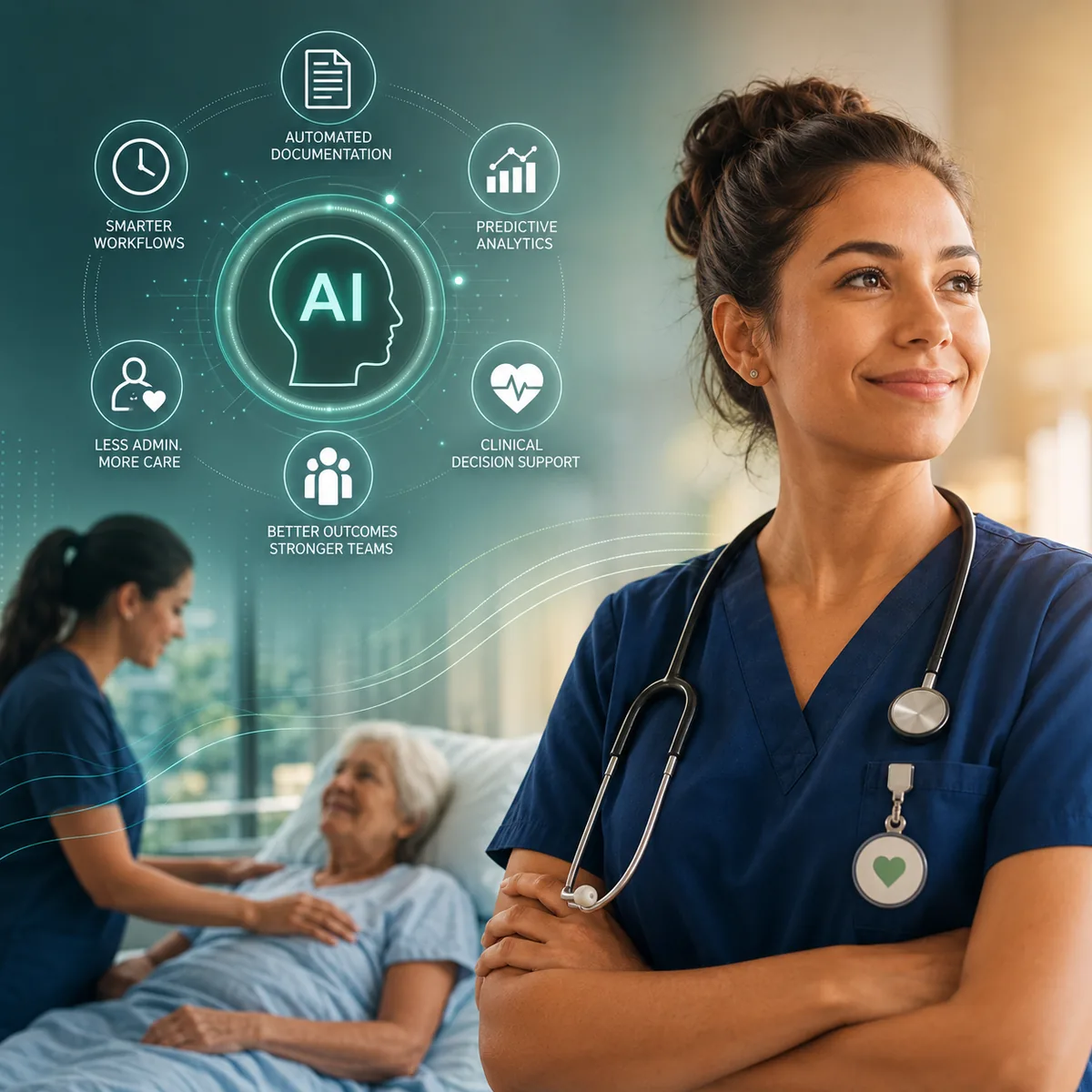
Can AI Help Reduce Nurse Burnout?
Nurses now spend nearly as much time documenting care as delivering it, and the result is unprecedented burnout. AI can help, but only when it is designed to support nurses rather than replace them. This guide breaks down how AI reduces cognitive load, ambient documentation, predictive deterioration detection, human-in-the-loop safety, and what it means for retention and home health.