Blog
Jan 13, 2026
An Autopsy of a Start of Care: The 2-Hour Visit That Takes 6 Hours

Arvind Sarin

Check your agency schedule. It likely says that a Start of Care visit takes two hours.
Now ask a field nurse how long it really takes.
If they are honest, they will tell you the Start of Care does not end when they leave the patient's driveway. It follows them home. It eats dinner with them. And it keeps them awake until midnight.
We have accepted a broken workflow where highly skilled clinicians spend more time acting as data entry clerks than as healthcare providers.
Let us perform an autopsy on a single admission visit to see exactly where the time goes.
The Invisible Hours
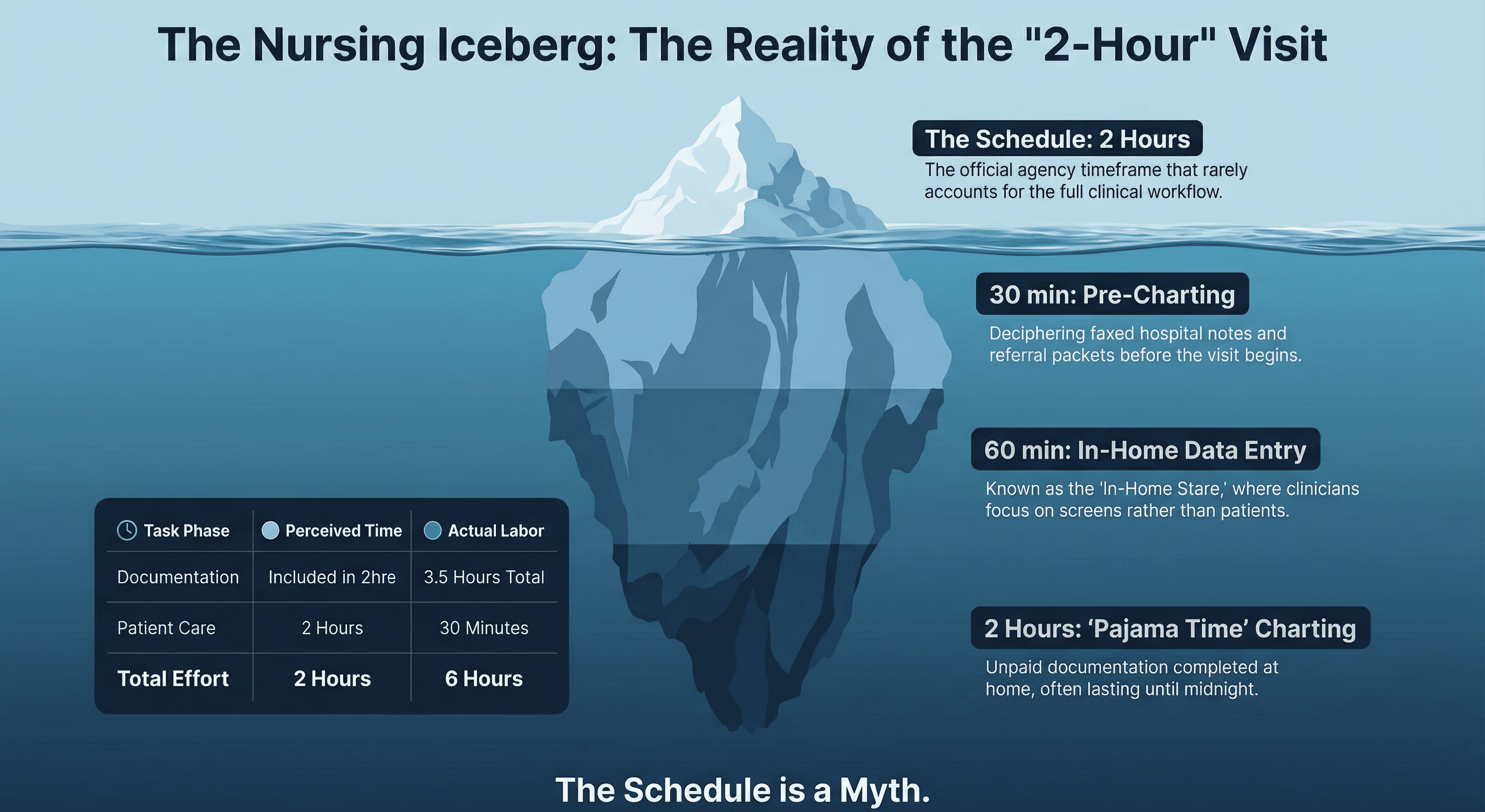
The scheduled "2-hour visit" is a myth. Here is the real timeline of an admission.
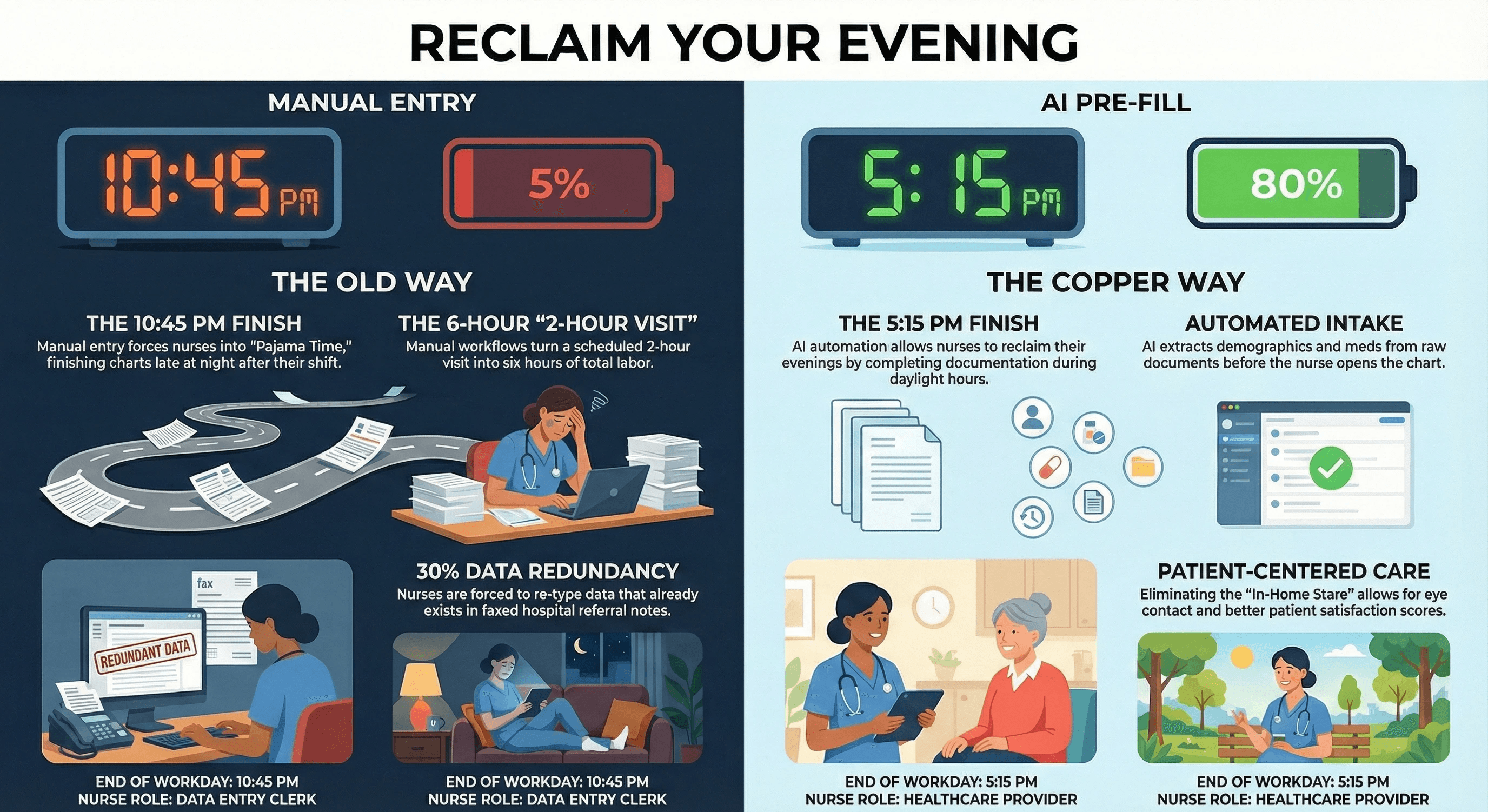
The Pre-Game (30 Minutes): Before the nurse even starts the car, she is digging through the referral packet. She is trying to decipher faxed hospital notes. She is calling the patient to confirm the address. She is mapping the route.
The Drive (20 Minutes): Traffic is unpaid downtime.
The In-Home "Care" (30 Minutes): This is the work she signed up for. Listening to heart sounds. Assessing the wound. Teaching the patient how to use their new oxygen concentrator. This is the only part of the visit that generates value for the patient.
The In-Home "Stare" (60 Minutes): This is the awkward part. The nurse sits at the dining table. The patient sits on the couch waiting. For the next hour, the nurse stares at her tablet. She is clicking checkboxes. She is hunting for diagnosis codes. She is typing narrative notes with one finger.
The patient wonders why they are paying for a nurse to play on an iPad.
The Pajama Time (2 Hours): The nurse leaves the home, but the chart is only 60% complete. After dinner, she opens her laptop. She wrestles with the OASIS functional items. She cross-references the medication profile. She types the outcome goals.
The Total
That "2-hour visit" actually consumed nearly six hours of labor.
The Cost of Data Redundancy
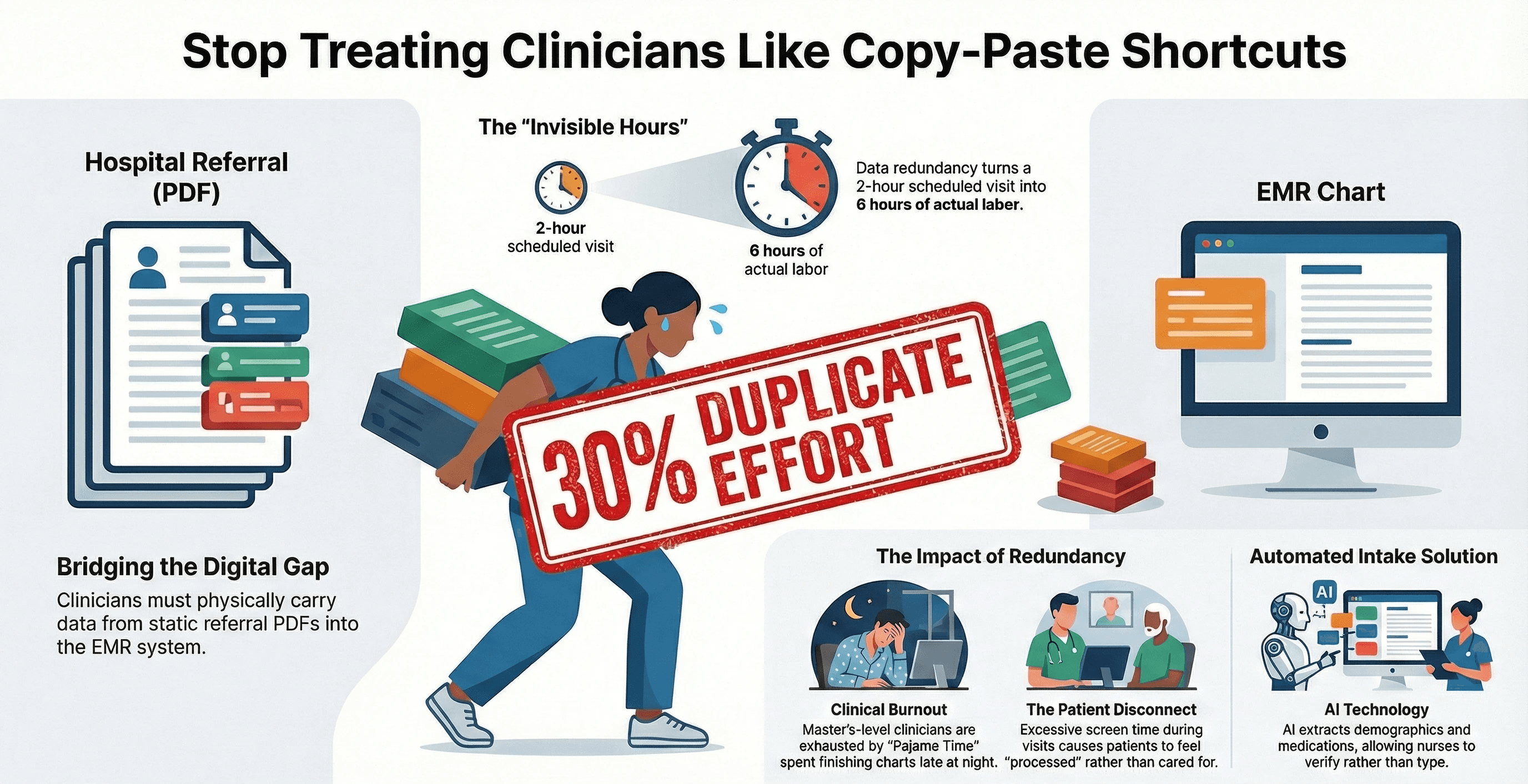
The most frustrating part of this timeline is not the volume of work. It is the repetition.
Roughly 30 percent of the data your nurse types during a Start of Care already exists somewhere else.
The patient's name, date of birth, address, insurance number, medical history, and medication list are all sitting in the PDF referral from the hospital.
Yet we ask nurses to manually retype this information into the EMR.
This is Data Redundancy. It is a primary driver of the health worker burnout crisis. We are taking a master 's-level clinician and forcing them to do the work of a copy-paste shortcut.
The Patient Disconnect
The hidden victim of this process is the patient relationship.
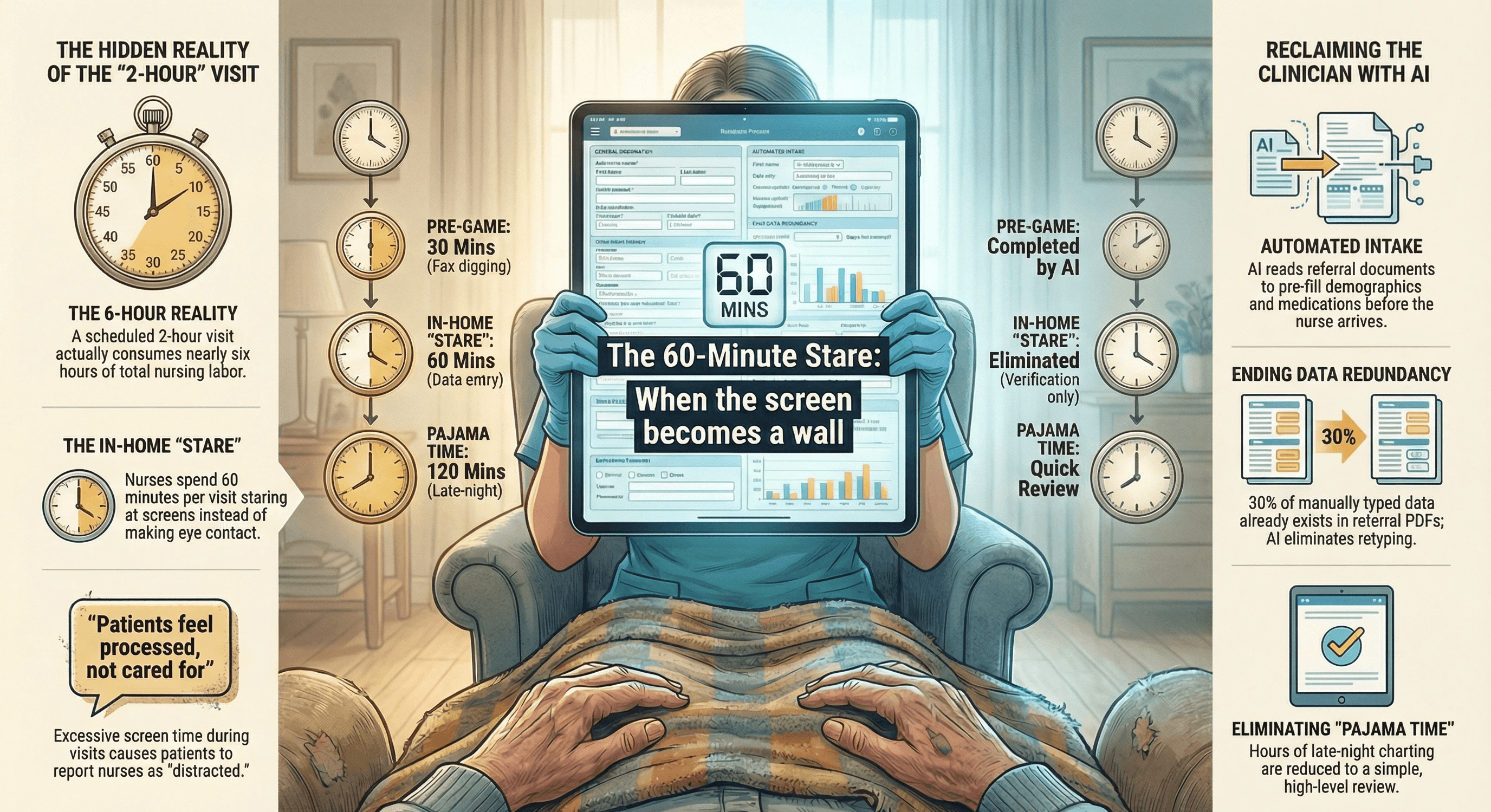
When a nurse has to spend 60 minutes of the visit focused on a screen, she cannot focus on the human being in the room. Eye contact is lost. Nuance is missed.
Patients perceive this. In HHCAHPS satisfaction surveys, they often report that the nurse seemed "rushed" or "distracted," even if the nurse spent two full hours in the home.
They do not feel cared for. They feel processed.
Stop the Manual Entry
The solution is not to tell nurses to type faster. The solution is to stop making them type things that are already written.
Technology has advanced beyond manual data entry.
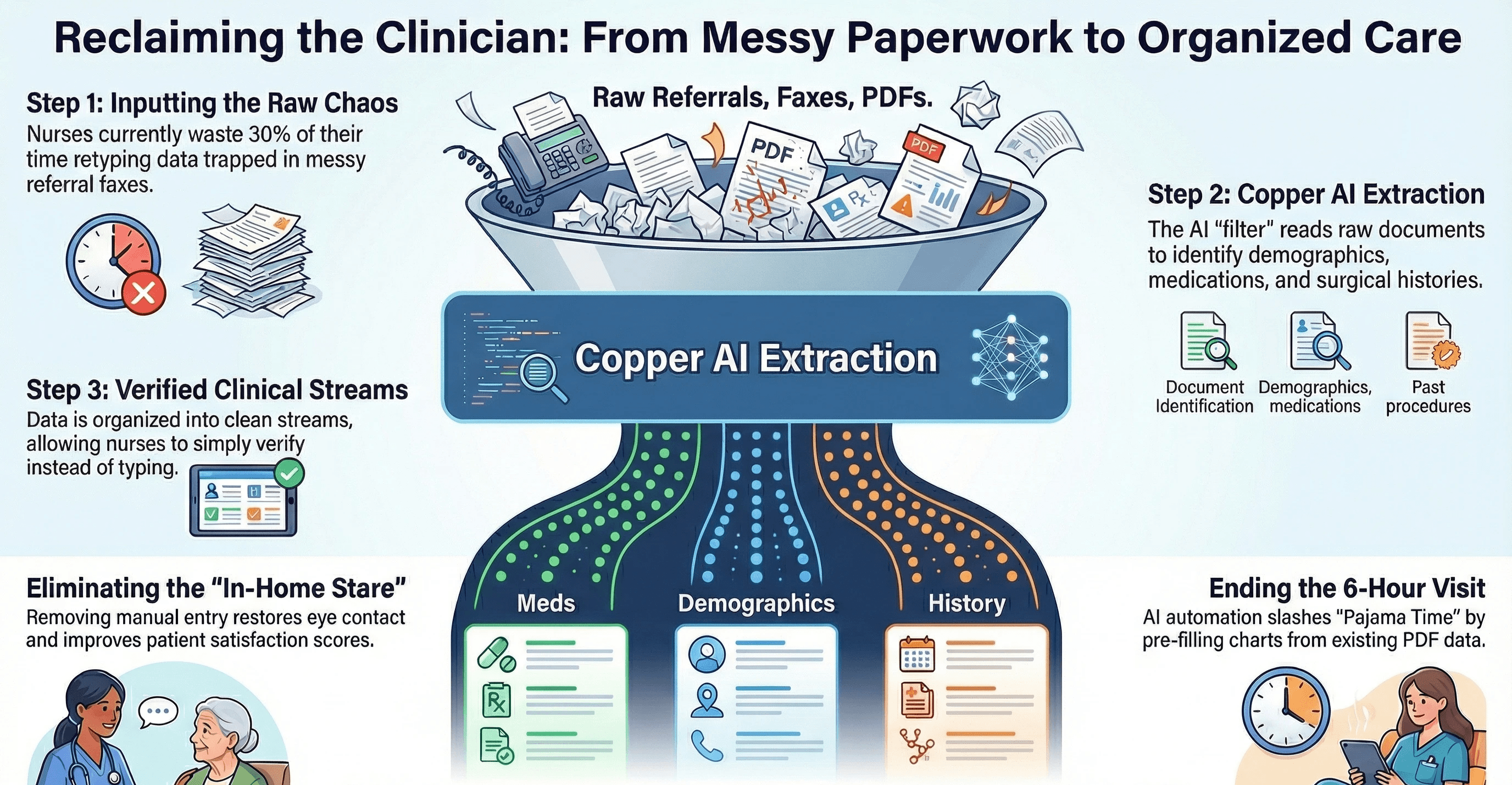
Copper Digital functions as an automated intake coordinator. Our AI reads the raw referral documents before the nurse ever opens the chart.
It extracts the demographics. It pulls the medication list. It identifies the surgical history.
When the nurse arrives at the home, those fields are pre-filled.
The New Timeline
The Pre-Game Done by AI.
The In-Home "Stare" Eliminated. The nurse verifies the data instead of typing it.
The Pajama Time is reduced to a quick review.
Reclaim the Clinician
We are currently in a nursing staffing crisis. You cannot afford to burn out your best nurses with administrative busywork.
By removing the burden of data redundancy, you give your staff the one thing they want most. You give them time to actually be nurses.
See how AI automates the Start of Care. Stop the 6-hour visit.