Blog
Jan 6, 2026
Home Health Nurse Burnout: The Real Cost of Documentation

Arvind Sarin
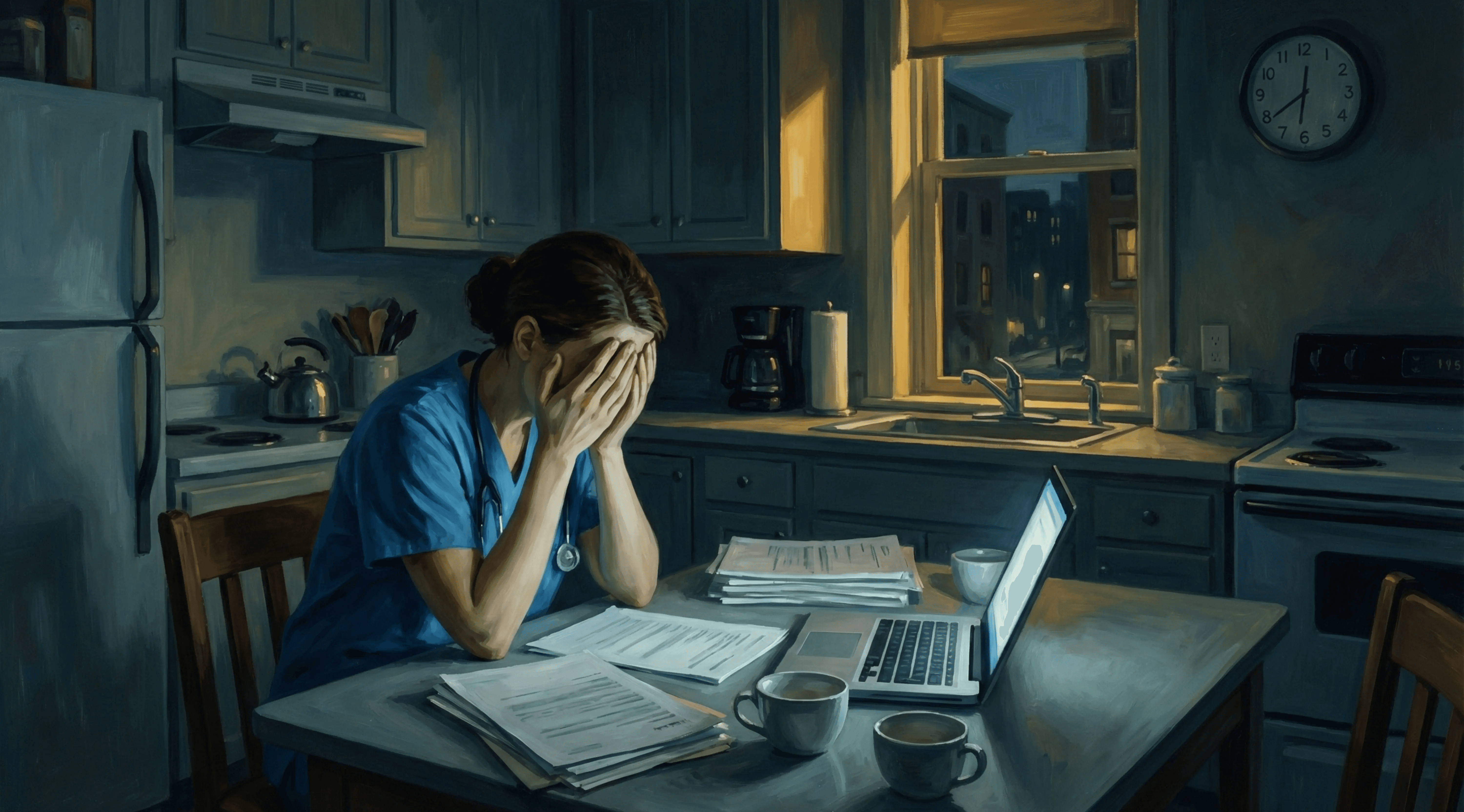
Every agency owner knows the term "Pajama Time."
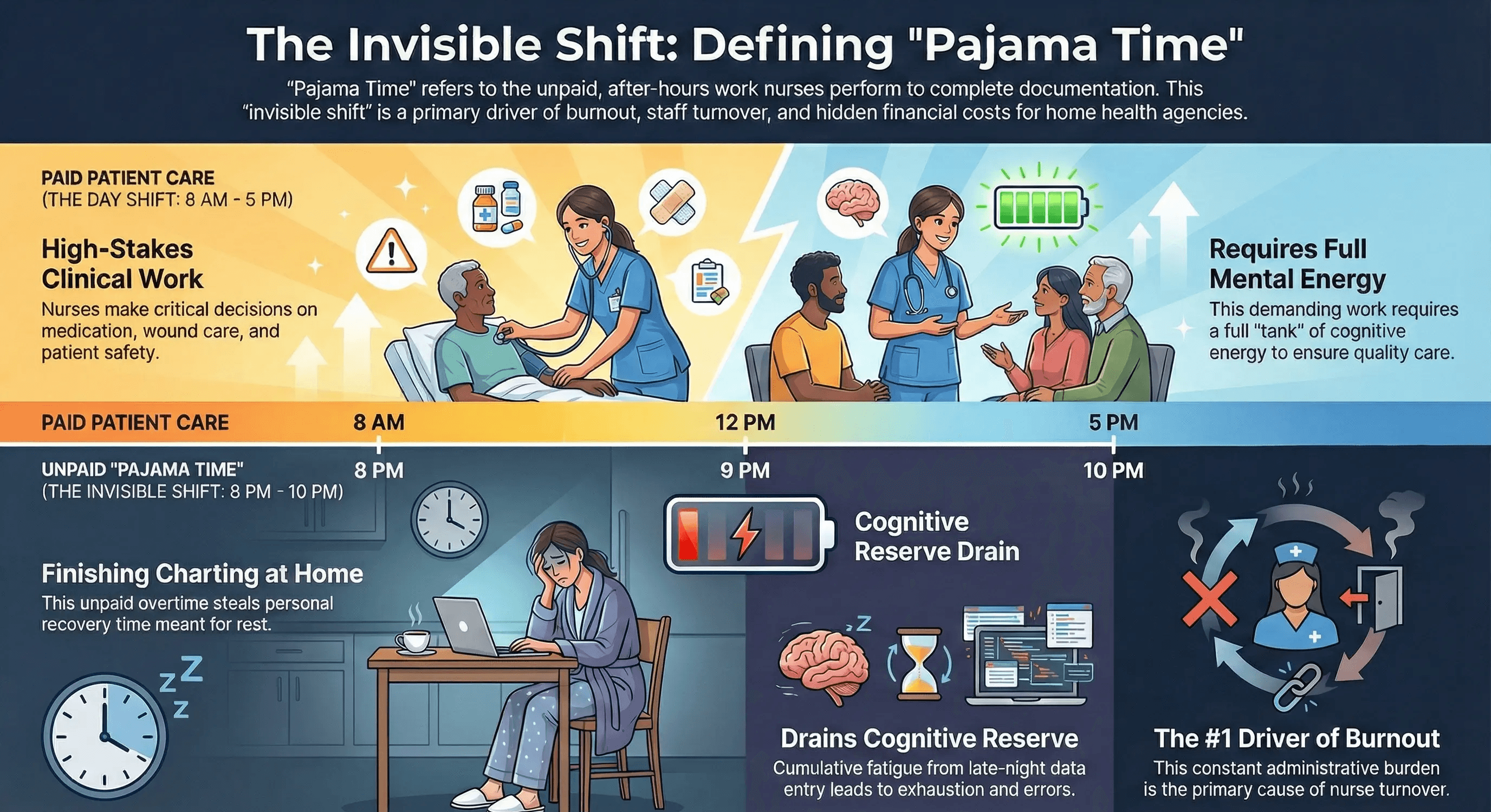
It is that invisible shift that your nurses work between 8 PM and 10 PM. They sit at their kitchen tables after putting their kids to bed, finishing the charting they couldn't get done during the day. For years, we treated this as free labor. We assumed that because we weren't paying overtime for those hours, they cost us nothing.
But in the tight labor market of 2026, that assumption is dead wrong. This unpaid overtime is actually the most expensive line item on your P&L because it is the primary driver of home health nurse burnout.
The industry is currently facing a massive supply and demand imbalance. We have the "Silver Tsunami" of aging patients driving referrals to record highs, yet we have a shrinking pool of qualified clinicians to see them. In this environment, your ability to retain staff is the only competitive advantage that matters. If you burn them out with administrative busywork, they will leave. And when they leave, your ability to generate revenue leaves with them.
What is Unpaid Overtime Actually Costing You
Let’s define the problem clearly before we try to solve it.
Pajama time is unpaid work that steals recovery time. When a nurse spends two hours charting at night, she starts the next day already exhausted. This isn't just about being tired. It is about "Cognitive Load".
Nursing is a high-stakes profession. Your clinicians spend all day making critical decisions about medication management, wound care, and patient safety. That requires a full tank of mental energy. When that energy is drained by data entry late into the night, the cumulative fatigue sets in.
This fatigue leads to errors. It leads to lower patient satisfaction scores because the nurse is rushing. And eventually, it leads to resignation.
We often talk about turnover as a headache for HR, but you need to view it as a financial disaster. The cost of replacing a single full-time nurse in 2026 is roughly $45,000.
That number might sound high, so let’s break it down.
Recruitment Costs
Agency fees and advertising to find a candidate often run $5,000 or more.Onboarding Costs
You have to pay a preceptor and the new hire for weeks of orientation where they are generating zero revenue.Lost Revenue
This is the big one. If a position sits empty for six weeks while you hire, you are turning away referrals. That is six weeks of missed billing that you never get back.
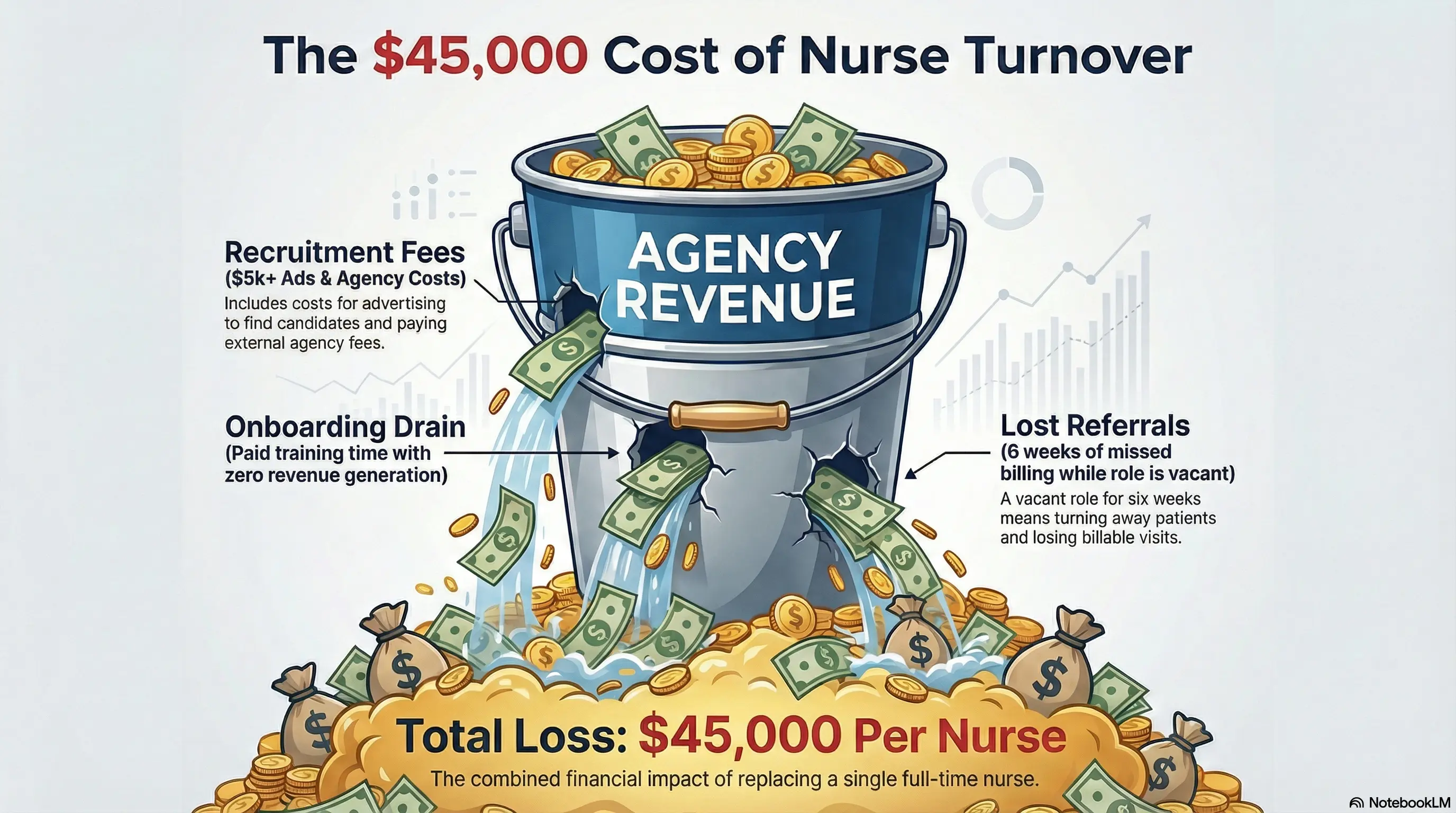
If "free" documentation time causes even one nurse to quit per year, you have already lost more money than you would have spent fixing the problem.
The Hidden Cost of Late Charting
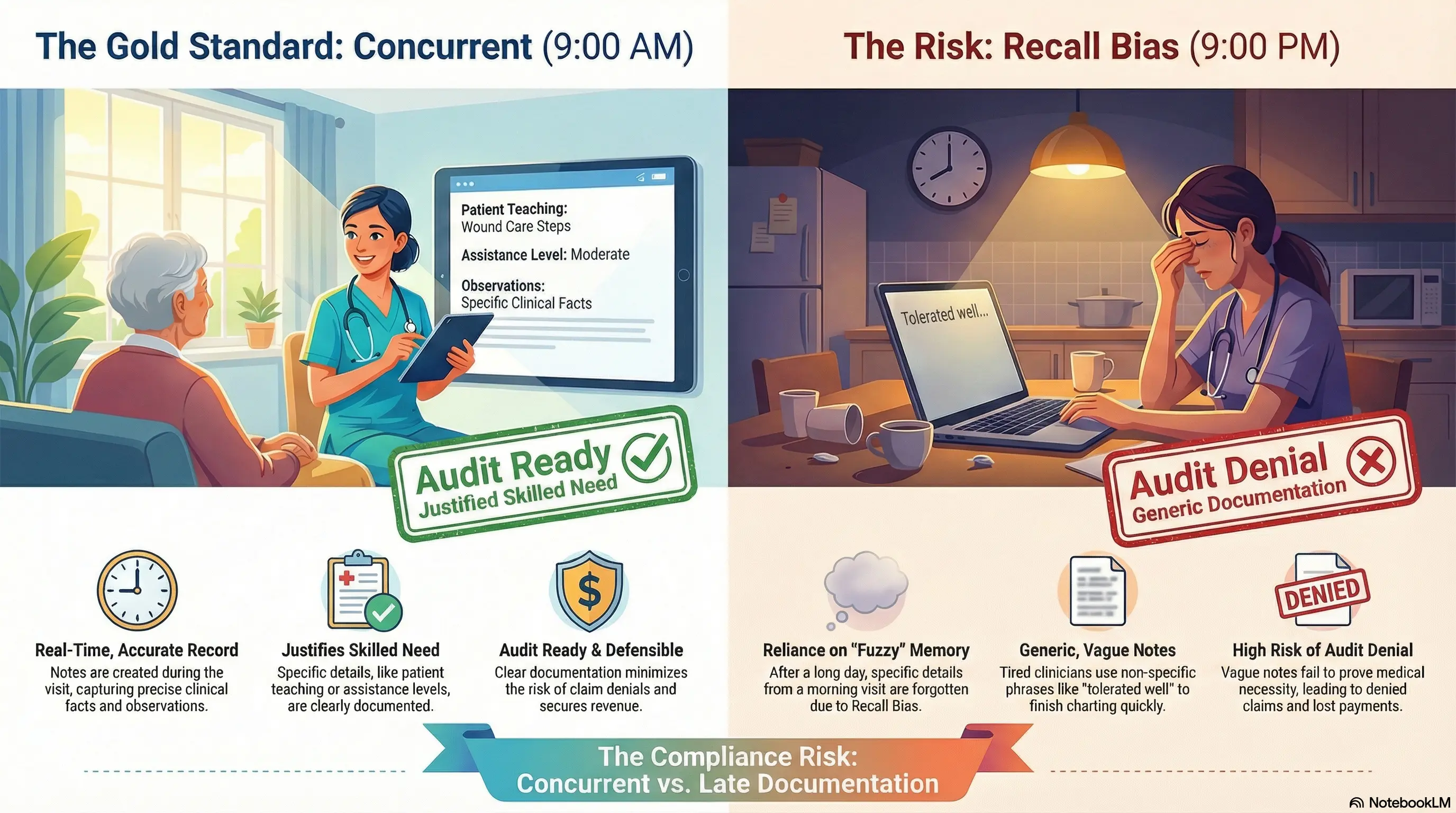
There is another cost to "Pajama Time" that most owners overlook, and that is the risk of an audit denial.
Documentation is supposed to be a record of what happened during the visit. The "Gold Standard" is concurrent documentation, meaning the notes are written while the care is being delivered.
When a nurse charts at 9 PM for a visit that happened at 9 AM, she is relying on memory. This is called "Recall Bias".
After seeing six patients, driving through traffic, and dealing with phone calls, her memory of that first visit is fuzzy. She might forget specifically how much assistance the patient needed with lower-body dressing. She might forget to document the specific teaching she did on the new blood pressure medication.
When she finally sits down to chart, she writes a generic note to get it done. She clicks "tolerated well" and moves on.
Six months later, an auditor looks at that chart. They see a generic note that doesn't justify the skilled need. They deny the claim. You lose the payment.
This is the direct link between home health nurse burnout and revenue cycle leakage. Tired nurses write poor notes. Poor notes lead to denials.
How to Do the Math
You don't need a complex spreadsheet to see the damage. You just need to look at Opportunity Cost.
In economics, opportunity cost is the value of the next best alternative use of a resource. In home health, your most scarce resource is clinician time.
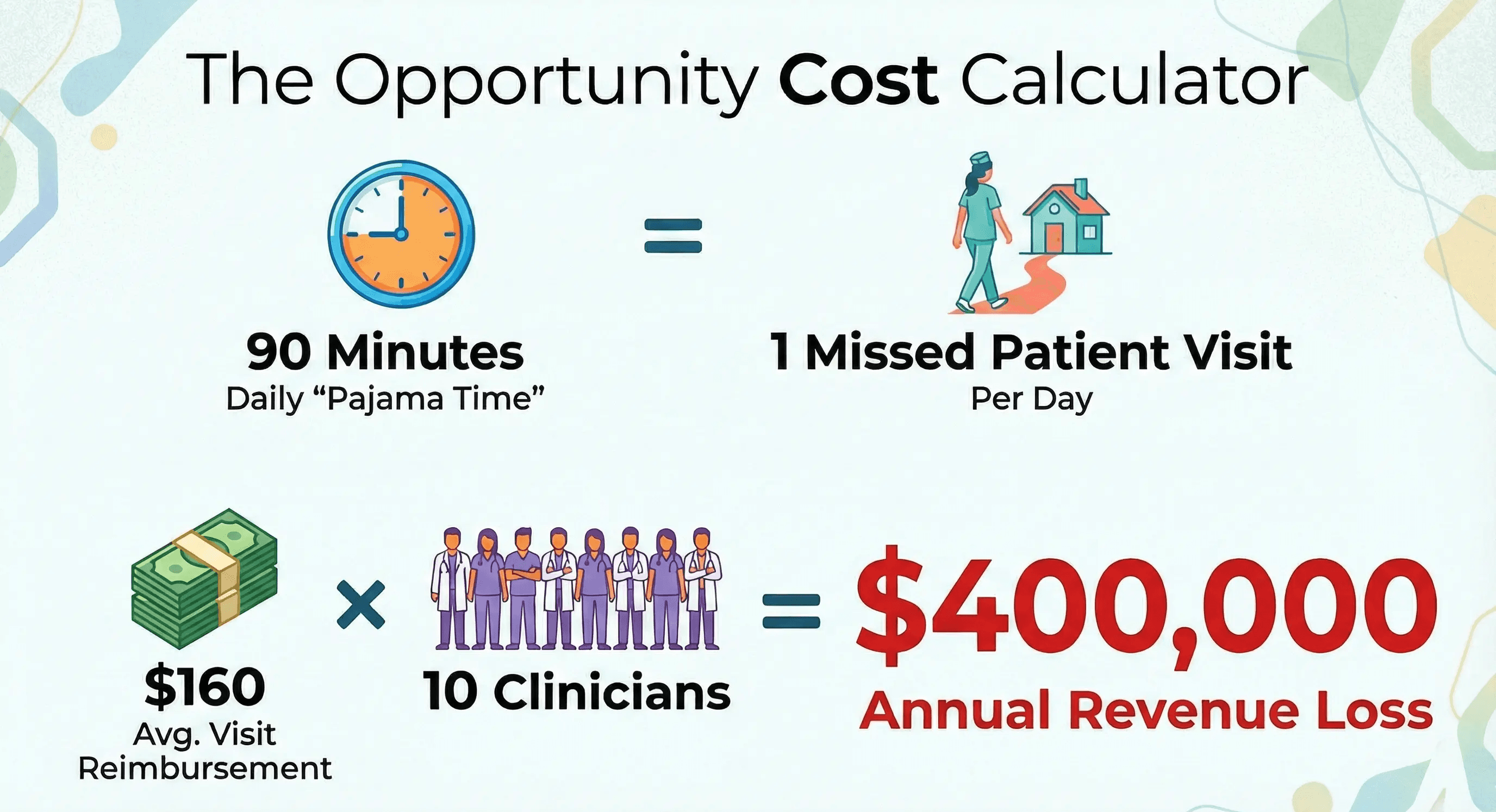
Every hour a nurse spends charting at home is an hour she could have spent seeing a patient if the documentation were more efficient. If we could magically give her those 90 minutes back during the day, she could do one more visit without working a minute longer.
Here is the formula for the lost revenue.
Average Pajama Time: 90 minutes per day.
Average Visit Time: 45 minutes.
Travel & Prep: 45 minutes.
That 90 minutes of "after-hours" work represents one missed visit per day.
Now let’s apply the revenue numbers. If your average reimbursement per visit (blended across Nursing, PT, and OT) is roughly $160, here is what that inefficiency costs you.
Daily Loss $160 per clinician.
Weekly Loss $800 per clinician.
Annual Loss $40,000 per clinician.
If you have 10 full-time clinicians, you are losing $400,000 a year in potential revenue.
You are losing this not because you lack referrals. You likely have a waitlist. You are losing this because your staff is buried in paperwork. You are literally paying for their inefficiency with your growth.
The Driveway Rule
So how do we fix this? We cannot simply tell nurses to "chart faster." That just leads to more errors and more stress.
The goal of modern strategies to fight home health nurse burnout is to change where the documentation happens. We want to move charting from the kitchen table to the driveway.
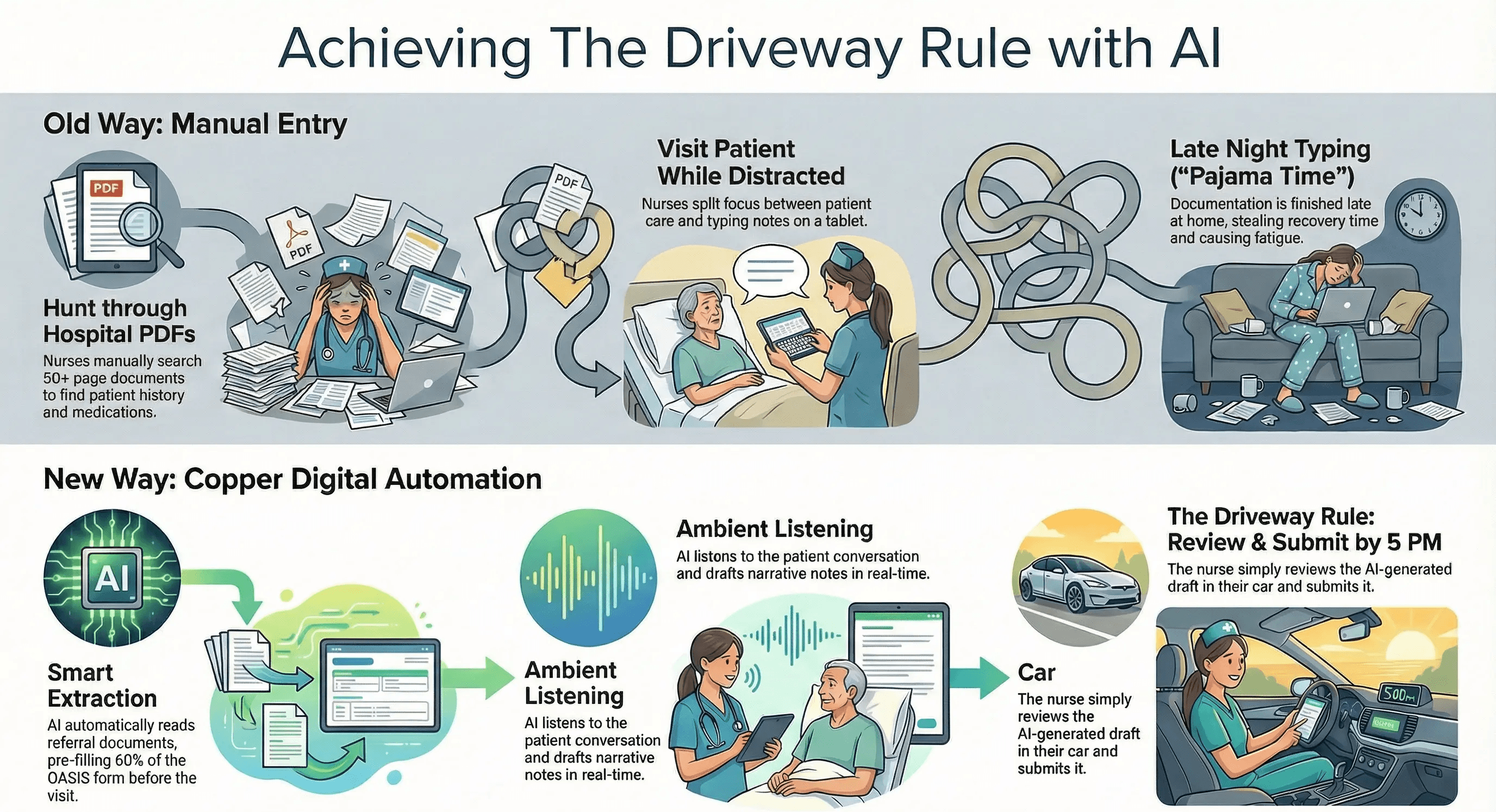
This is the "Driveway Rule." Your nurses should be able to finish 90 percent of their documentation before they put the car in drive to leave the patient's home.
This seems impossible with standard Electronic Medical Records (EMR). Those systems were built for desktops, not tablets. They require hundreds of clicks and endless typing on tiny screens. Expecting a nurse to type a narrative note while providing wound care is unrealistic.
But with Copper Digital's automation tools, the Driveway Rule becomes the new standard.
How Automation Replaces Typing
We have moved from the era of "Data Entry" to the era of "Data Review."
Copper Digital uses AI agents to handle the heavy lifting of documentation so the nurse can focus on the patient. This happens in two specific ways.
1. Smart Extraction (The Pre-Game)
The biggest time sink in an admission visit is typing in the history. The nurse has to hunt through a 50-page hospital PDF to find the medications, the surgery dates, and the diagnosis codes.
Our Smart Extraction engine does this automatically. It reads the referral document before the nurse ever opens the chart. It extracts the demographics, the history, and the medication list and pre-populates the OASIS form.
When the nurse arrives at the home, she isn't starting from a blank page. She is starting with a chart that is already 60 percent complete.
2. Ambient Listening (The Game Time)
During the visit, the nurse shouldn't be looking at a screen. She should be looking at the patient.
Our Ambient Listening agent, Nate, runs in the background on her tablet. It listens to the conversation between the nurse and the patient. It filters out the small talk about the weather and captures the clinical facts.
Nurse "I see you are struggling to get your left arm into that sleeve. Let me help you."
AI Interpretation Captures data for OASIS M1810 (Upper Body Dressing) as "Needs Assistance."
The AI drafts the narrative note and suggests the functional scores in real time. When the nurse gets back to her car, she simply reviews the draft. She checks the scores. She hits submit.
She is done.
Stop Burning Out Your Best Assets
The agencies that win in 2026 will be the ones that respect their nurses' time.
We have to stop thinking of technology as just a "digital filing cabinet." In the past, software was something you bought to store records. Today, software is your workforce multiplier.
If you can use AI to give every nurse on your team 90 minutes of their life back every day, you have done more for their well-being than any pizza party or appreciation bonus ever could.
You give them the ability to put their kids to bed without stressing about the OASIS they still have to finish. You give them their evenings back. You give them a reason to stay with your agency instead of looking for a job at an insurance company.
You cannot afford to treat documentation as an afterthought. It is a retention crisis and a revenue leak wrapped into one problem.
Eliminate pajama time. Protect your staff. Secure your bottom line.
Calculate your savings with Copper Digital. Let us show you how to turn that lost documentation time back into billable visits.
Frequently Asked Questions
What exactly is "Pajama Time"
Pajama Time refers to the unpaid hours nurses spend charting at home after their official shift ends, often late at night. It is a major contributor to burnout because it eliminates work-life balance and recovery time.
How does late documentation affect audit risk?
When nurses chart hours after a visit, they rely on memory rather than real-time observation. This "Recall Bias" often leads to generic, non-specific notes that fail to justify medical necessity, increasing the risk of claim denials during an audit.
Can AI really replace manual typing for OASIS assessments
Yes. AI tools like Smart Extraction can pull up to 60% of the data (medications, history, demographics) directly from referral documents, and Ambient Listening can capture functional scores during the visit, significantly reducing manual data entry.
Is ambient listening compliant with HIPAA?
Absolutely. Modern ambient AI tools process data securely and do not store audio recordings permanently. They transcribe and structure the clinical data directly into the secure EMR environment, maintaining full patient privacy.
How much money can an agency save by eliminating pajama time
By recovering 90 minutes of lost productivity per nurse per day, an agency can typically schedule one additional billable visit per clinician. For an agency with 10 nurses, this can add up to $400,000 in additional annual revenue.