Blog
Jan 5, 2026
Home Health Value-Based Purchasing 2026: The 35% Trap

Arvind Sarin

We need to have a serious conversation about how you are measuring success in 2026.
For the last decade, most agency owners have been obsessed with their Star Ratings. You probably have a dashboard that tracks your HHCAHPS scores in real time. The 2026 Home Health Value-Based Purchasing (HHVBP) model has completely flipped the script. While you were watching your patient satisfaction scores, the reimbursement formula quietly shifted gears.
Now, OASIS accuracy is the single biggest driver of your Total Performance Score.
The Change
Let’s look at the numbers because they tell a brutal story.
In the old days of home health, payment was purely about volume. You did the visit, and you got paid. Then came VBP, which introduced quality into the mix.
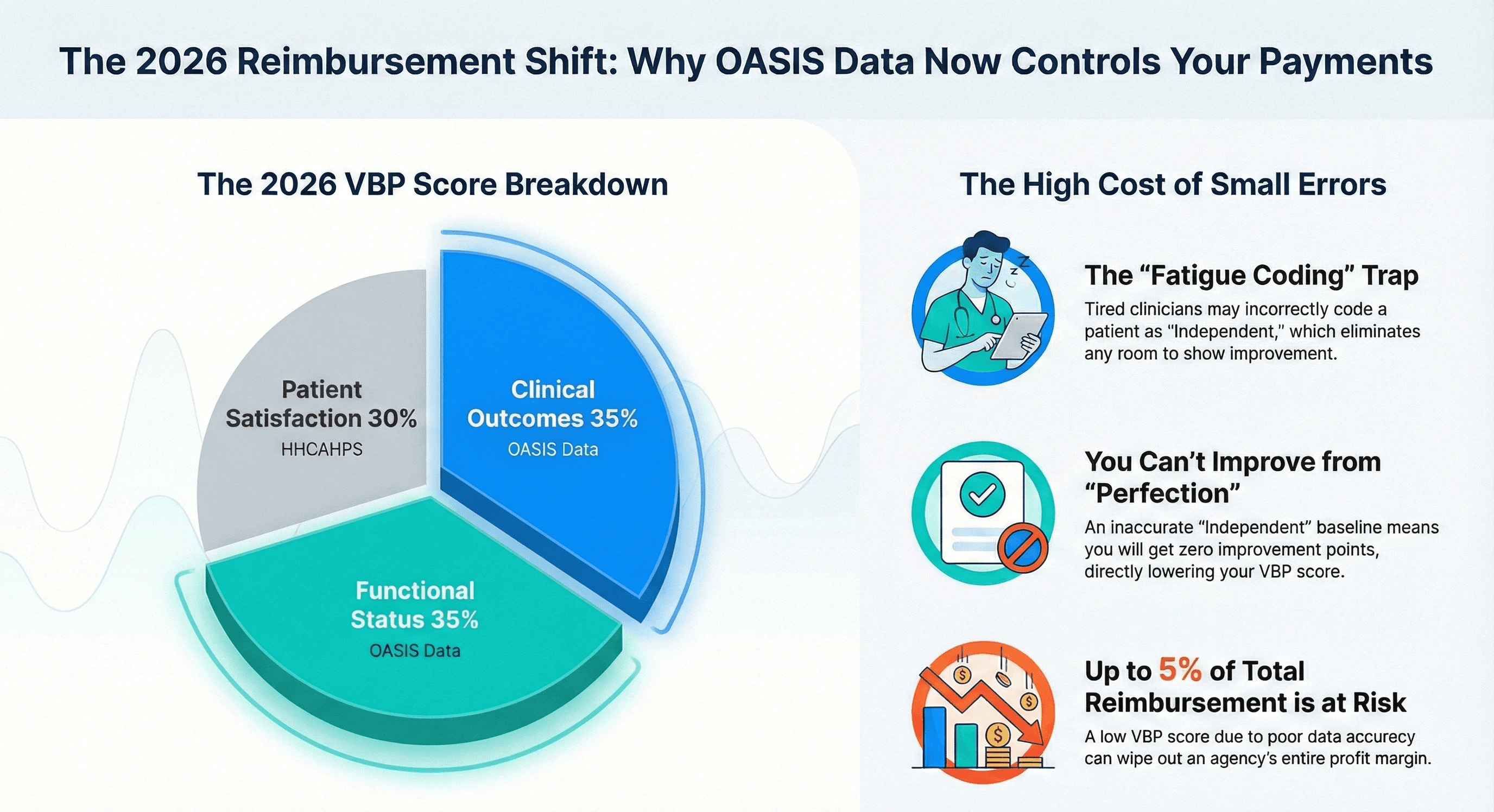
But here is the kicker for 2026. CMS has re-weighted the measures.
Clinical Outcomes now make up 35 percent of your score.
Functional Status, which comes directly from OASIS Section GG and M1800 items, makes up another significant chunk.
Patient Satisfaction (HHCAHPS) is weighted lower than the clinical data.
This means you can have 100 percent patient satisfaction, but if your OASIS accuracy is poor, you will still lose revenue. CMS is essentially saying that they care more about whether the patient actually got better than whether they liked the experience.
The Risk
The problem is that capturing accurate functional data is hard work.
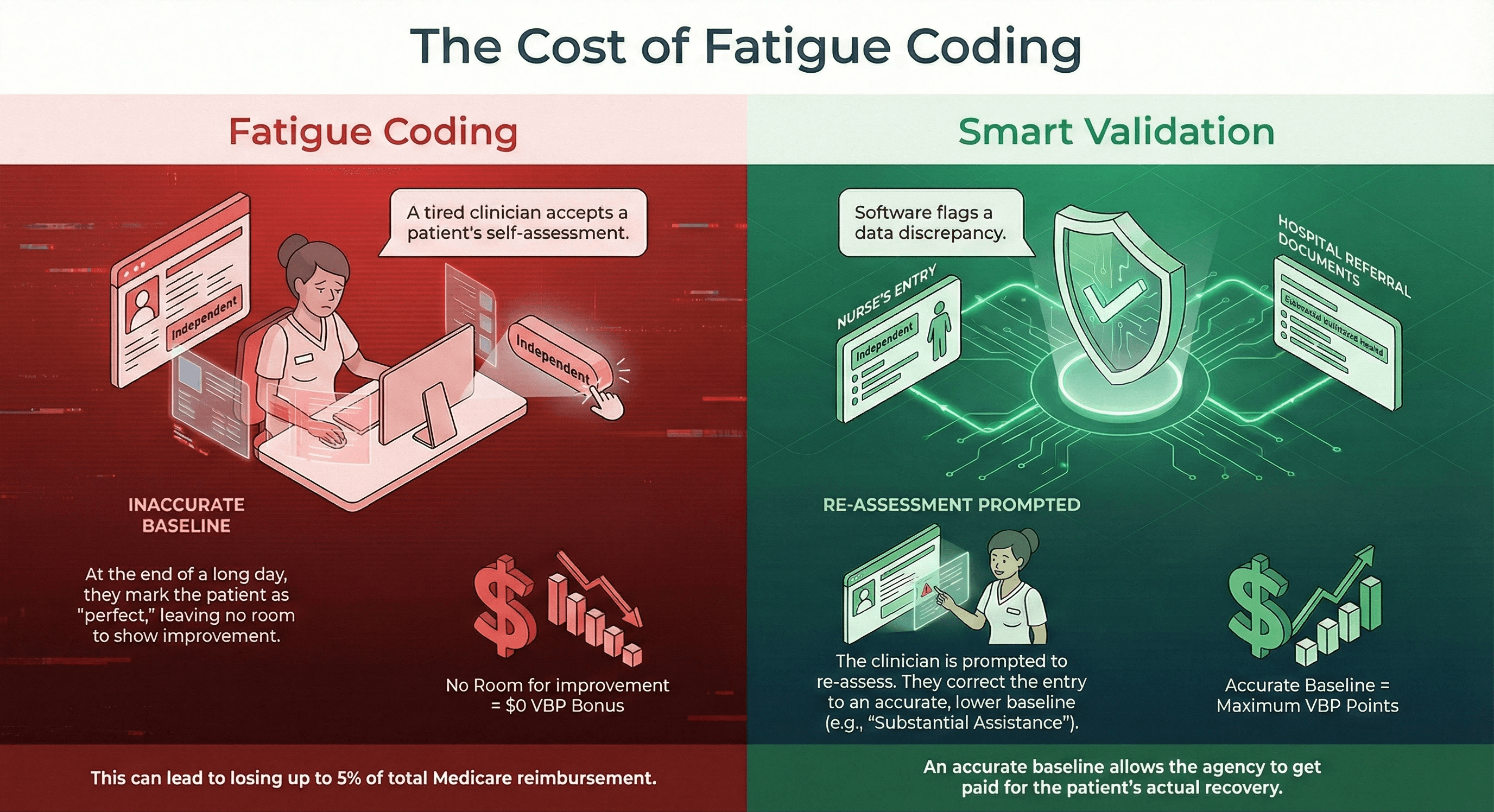
When a nurse is admitting a patient at 5 PM, she is tired. We call this "Fatigue Coding."
She asks the patient if they can walk to the bathroom. The patient says, "Oh yes, I get around fine." The nurse is exhausted. She takes the patient's word for it. She marks "Independent" in Section GG.
She just cost you thousands of dollars.
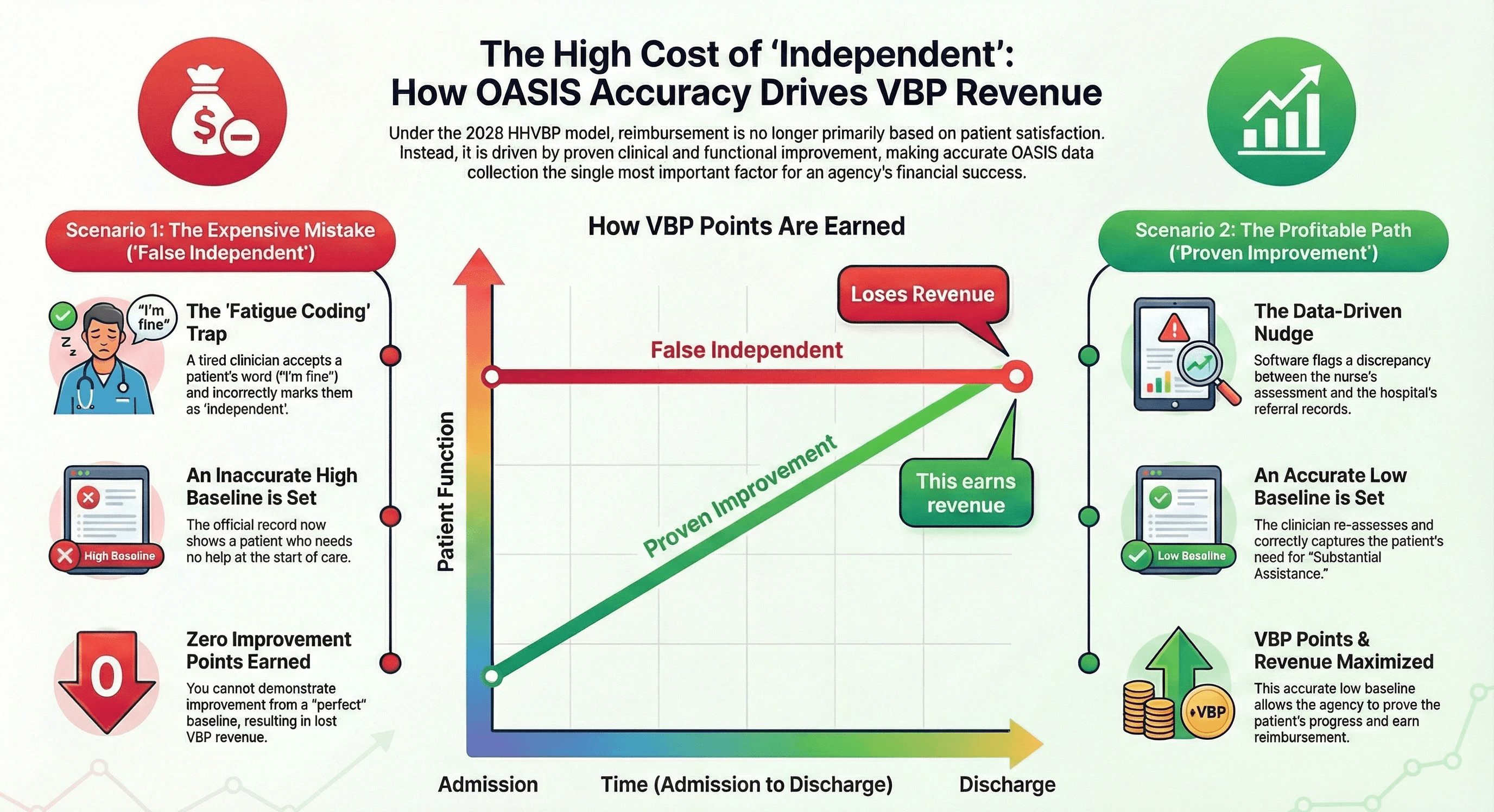
By marking the patient as "Independent" at the start of care, she has eliminated any room for improvement.
The Reality: The patient actually grabs the wall for support and shuffles. They are not independent.
The Data You told CMS, the patient is perfect.
The Consequence: When the patient is discharged, you get zero improvement points because you cannot improve from perfection.
This isn't malicious. It is human nature. Tired clinicians subconsciously choose the path of least resistance, which is usually the "Normal" or "Independent" button. But in a Value-Based Purchasing world, that habit is expensive.
The Solution
You cannot fix this by telling your nurses to "try harder." You have to give them tools that catch the error for them.
This is where OASIS-E automation tools change the game.
At Copper Digital, we believe that the referral document is the source of truth. Our system uses Smart Extraction to read the History and Physical from the hospital before the nurse sees the patient.
It seems that the hospital's physical therapist rated the patient as "Max Assist" for transfers. If your nurse tries to click "Independent," our software flags it.
Wait. The referral says this patient needs help. Are you sure they are independent?
This simple nudge forces the nurse to look again. She realizes, "Oh, wait, you're right. Let me test that again." She corrects the score to "Substantial Assistance."
Now you have an accurate baseline. And because you started low, you can demonstrate improvement when the patient gets better. That is how you maximize your VBP score.
Frequently Asked Questions
What happens if my VBP score is low?
You could lose up to 5 percent of your Medicare reimbursement. For an average agency, that is a massive hit to the bottom line that wipes out your profit margin.
Does this software replace the nurse's judgment?
No. It supports it. The nurse always has the final say. We just provide the guardrails to ensure she notices discrepancies between the history and her assessment.
Which OASIS sections are most important?
Focus on Section GG (Functional Abilities) and the M1800 series. These are the "Functional Status" items that drive the improvement points in the VBP model.
Can we fix these errors later?
It is very difficult. Once the OASIS is locked and submitted, correcting it requires a complex reopening process. It is much cheaper and safer to get it right at the point of care.
Protect Your Reimbursement
The shift to 2026 is not just about rate cuts. It is about data precision.
If you are still relying on tired nurses to memorize the CMS coding manual, you are leaving money on the table. You need a system that validates every single field against the clinical record.
See how our Smart Extraction engine can protect your VBP score and ensure you get paid for the great care you deliver.