Blog
Jan 1, 2026
Survival Guide to the 2026 Home Health Rate Cuts

Arvind Sarin

If you are reading this, you probably saw the 2026 CMS Final Rule and felt that familiar pit in your stomach. The math just doesn’t look good. We are facing a net payment reduction of roughly 1.3 percent, and that is on top of the inflation gap that has been widening for years.
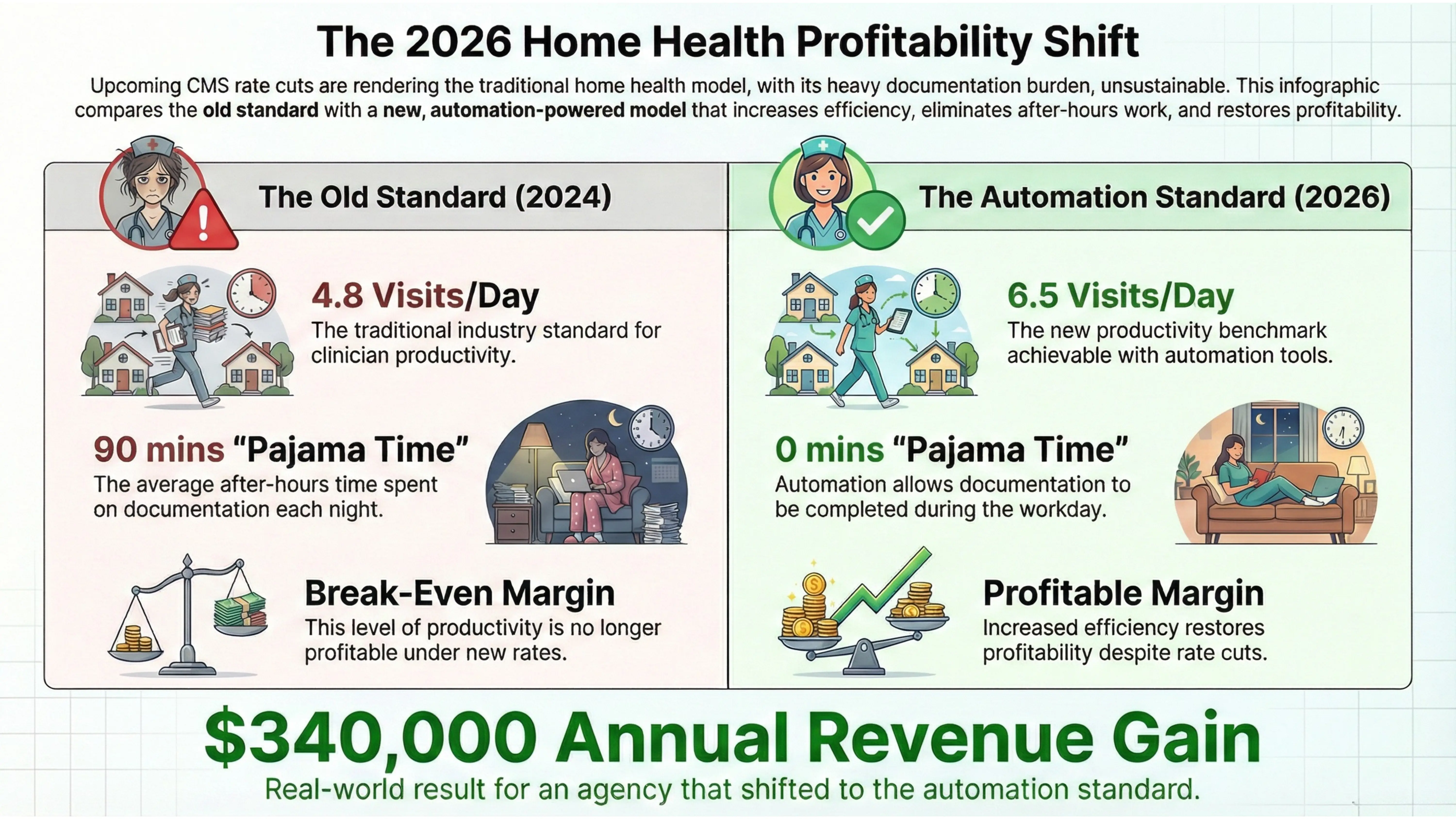
For a long time, the industry standard for clinician productivity was 4.8 visits per day. That was the magic number. If your nurses hit that, you kept the lights on and made a decent margin. But with these new rate cuts, 4.8 is no longer a safety zone. It is a break-even point at best.
So what is the solution? You can’t clone your staff. You certainly can’t ask them to work harder when they are already documenting until 9 PM every night. The only lever you have left to pull is efficiency. This is where OASIS-E automation tools stop being a luxury and start being your survival gear.
In this guide, I am going to walk you through exactly why the old manual way of charting is costing you thousands of dollars a month and how the right OASIS-E documentation software can help your team hit 6.5 visits a day without burning out.
Why Manual Charting is Killing Your Margins
We need to talk about "Pajama Time."
You know exactly what I mean. It is that soul-crushing couple of hours after dinner when your nurses open their laptops on the kitchen table to finish their notes. It is the number one reason nurses leave home health.
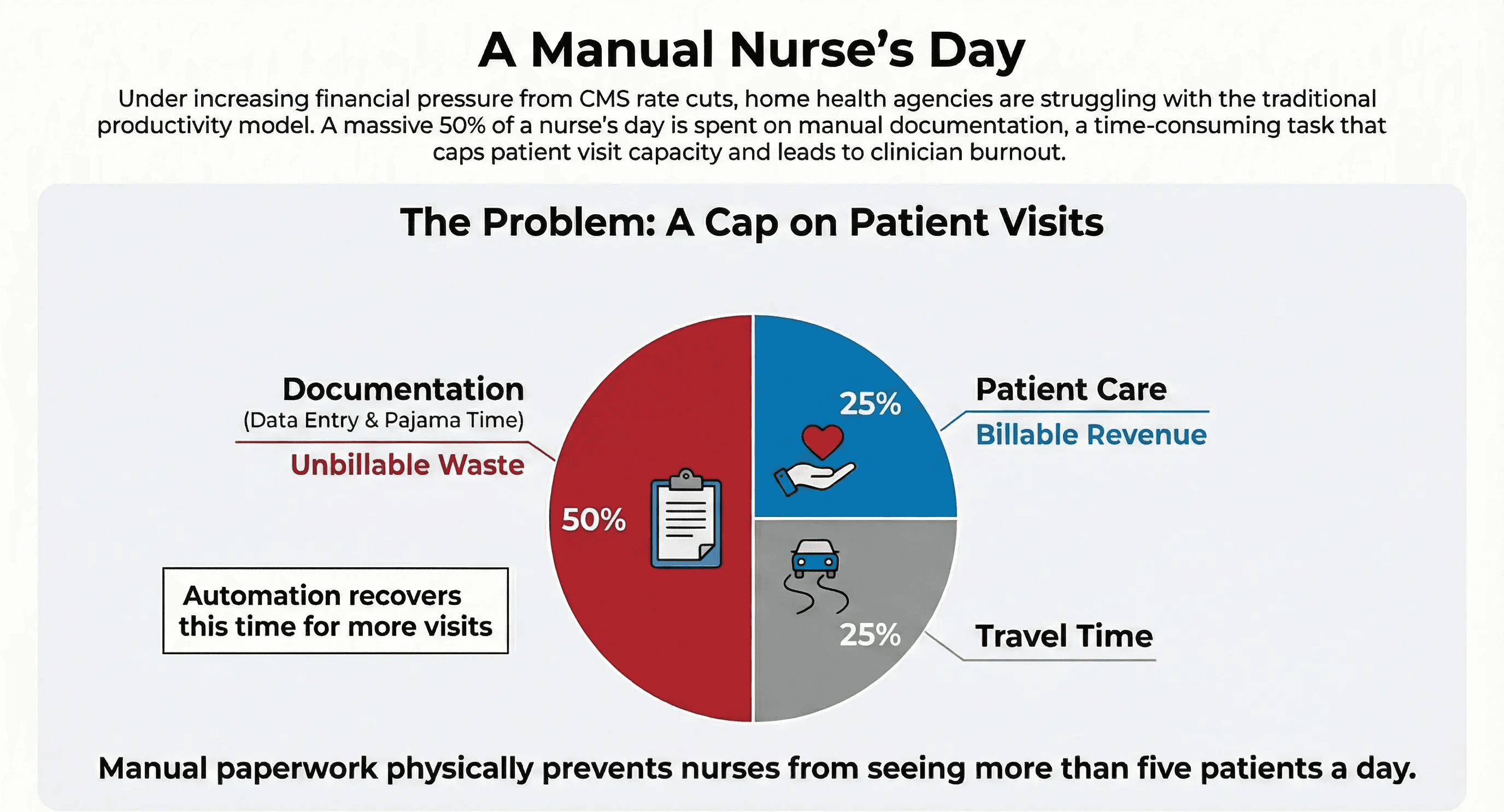
When we audit agencies, we typically see that a nurse spends about 25 percent of their day driving, 25 percent actually treating patients, and a massive 50 percent on documentation. That is an insane ratio. You are paying for a highly skilled clinician, but half the time you are getting a data entry clerk.
The Cost of the Status Quo
If your nurses are manually typing every single OASIS field, you are capping their capacity. They physically cannot see more than five patients because the paperwork for a sixth patient would keep them up until midnight.
This is where home health OASIS-E compliance becomes a bottleneck. The OASIS-E1 data set is a beast. It is long, complex, and high-stakes. If you get it wrong, your Value-Based Purchasing (VBP) score tanks. If you take too long to do it, your visit volume stays low.
How to Automate OASIS-E Assessments with SaaS
So how do we fix this? The answer lies in specialized technology. But I am not talking about basic dictation tools.
A lot of agencies think they are "automating" because they gave their nurses a speech-to-text app. That is not automation. That is just typing with your mouth. Real automation involves changing the workflow entirely.
The Power of Smart Extraction
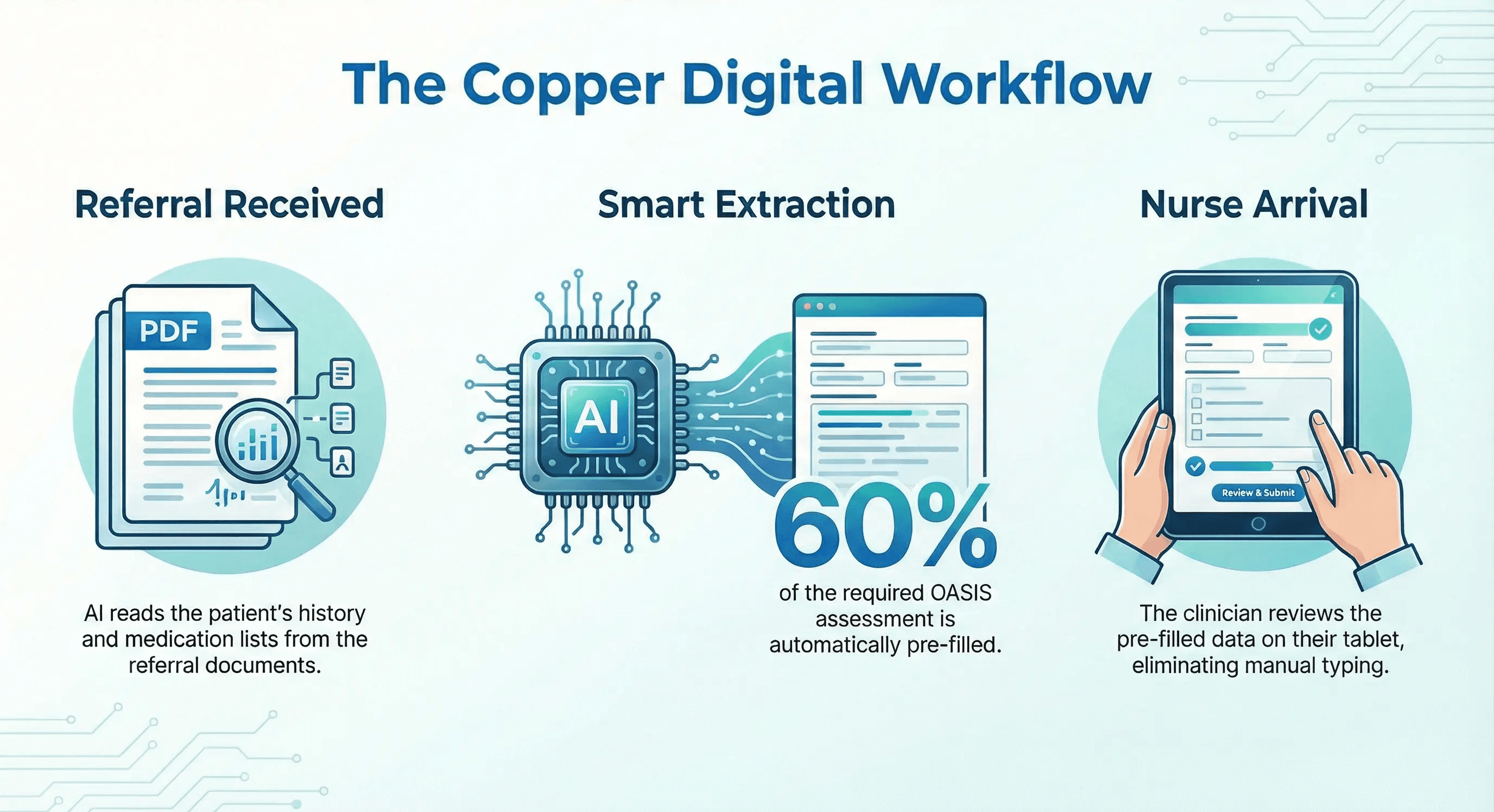
At Copper Digital, we approach this differently. We realized that about 60 percent of the data needed for an OASIS assessment already exists before the nurse even starts her car. It is in the Referral PDF. It is in the History and Physical. It is in the Medication List.
Our OASIS-E documentation software uses a feature called Smart Extraction. It ingests those PDF documents and automatically pre-fills the demographic, historical, and medication sections of the OASIS.
Think about what that does for your nurse. Instead of arriving at the patient’s home and staring at a blank screen, she opens her tablet and sees a note that is already half done. She shifts from "Data Entry" to "Data Review."
Flexible Inputs for the Real World
Field work is messy. Sometimes you are in a quiet living room, and voice dictation works great. Other times, you are in a chaotic environment with a barking dog and the TV blasting.
We built our OASIS-E automation tools to be flexible.
Voice for telling the patient's story
Tap Tap interfaces for quick checkbox navigation
Photos for capturing wound status or medication bottles instantly
This flexibility is key. If you force a nurse into a rigid workflow, they won't use the tool. If you give them options, they adopt them immediately.
The Compliance Safety Net You Need
We have to talk about the scary part of AI. You have probably heard stories about "Generative AI" making things up. In the tech world, they call these "hallucinations." In healthcare, we call them "lawsuits."
You cannot use a generic chatbot to write medical records. It might sound convincing, but it doesn't know the difference between truth and fiction.
Deterministic Rules Engine
This is why Copper Digital uses a Deterministic Rules Engine. We don't guess. We validate.
We cross-reference the visit audio against the referral data
We apply CMS-specific logic to every OASIS item
If a data point is missing or contradicts the rules, we flag it
This ensures home health OASIS-E compliance without the guesswork. It is how one of our recent partners went from seven survey deficiencies down to zero. The software acts as a guardrail, ensuring your clinical documentation supports the reimbursement you are claiming.
Hitting the New Magic Number 6.5 Visits
Let’s go back to the math we started with.
The goal for 2026 is to get your clinicians to an average of 6.5 visits per day. When you remove the 90 minutes of "Pajama Time" by using OASIS-E automation tools, you give that time back to the nurse.
Suddenly, fitting in that extra visit or two doesn't feel like a punishment. It feels doable. The nurse gets to finish her day when the visits are done, not hours later.
We have seen this happen in the real world. One agency using our platform saw its capacity jump from 4.8 to 6.5 visits almost immediately. That efficiency, combined with reduced claim denials, added up to $340,000 in extra revenue for them in a single year.
That is the difference between struggling to survive the rate cuts and thriving despite them.
Frequently Asked Questions
Does the AI make up clinical facts?
No. We use a deterministic approach. If the data isn't in the referral or the visit recording, we don't invent it. We flag it for the nurse to review. This keeps your records accurate and compliant.
Will this work with my current EMR?
Yes. We integrate with major platforms like WellSky, KanTime, Axxess, and MatrixCare. The data flows directly into your system, so there is no double entry.
Is it hard to learn
Most nurses pick it up in a day. Because the system pre-fills so much of the work for them, it actually feels easier than their current process. It is less like learning software and more like getting a digital assistant.
Does it work offline?
Absolutely. We know cell service is spotty in rural areas. The app captures everything locally and syncs to the cloud the moment you get a signal.
Ready to Fix Your Documentation Crisis
The 2026 cuts are coming whether we like them or not. You can try to squeeze more work out of an exhausted staff, or you can give them the tools they need to succeed.
If you are ready to stop the burnout cycle and protect your margins, it is time to look at OASIS-E documentation software that actually works for home health.
Try Copper Digital today. Let us show you how we can pre-fill 60 percent of your OASIS before you even leave the office. Click here to book your strategy session and see the math for yourself.