Blog
May 6, 2026
The Thank You That Home Health Nurses Actually Deserve

Copper Digital
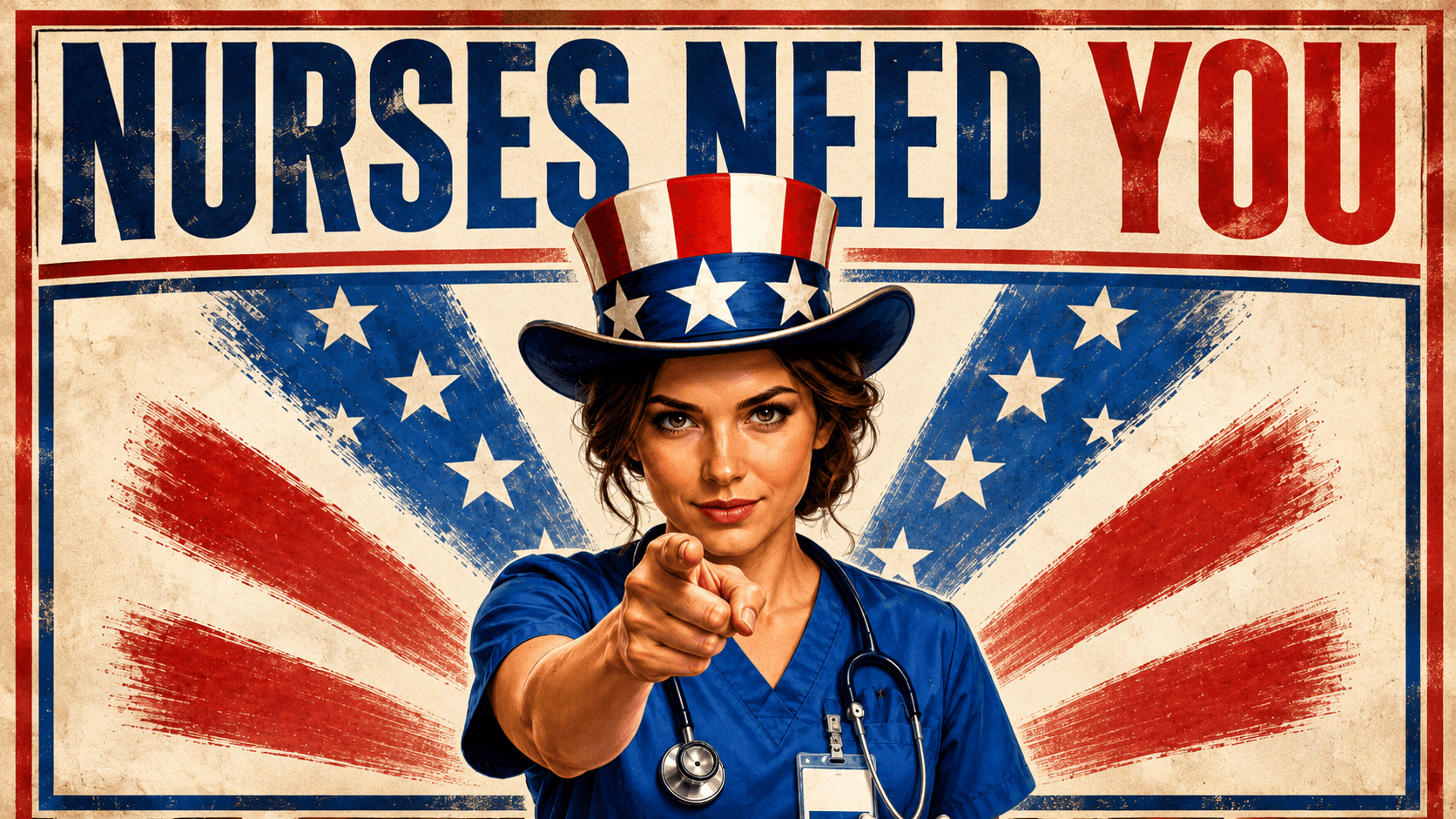
Every year during Nurses Week, the industry produces the same output. Social media posts with stethoscope graphics. Catered lunches that go cold while nurses are still with patients. Gift bags with pens and hand lotion. A banner in the break room that says thank you for all you do, which is both sincere and entirely inadequate.
We are not going to do that.
Not because we do not appreciate nurses. We appreciate them more than we know how to say, and we have spent the past two years building technology specifically to give some of their time and capacity back. But appreciation expressed only in one week, through consumer goods, while the structural conditions that are burning nurses out remain completely unchanged, is not recognition. It is a way of feeling like we did something without doing anything.
So instead of that, we want to say some things that are true and that we think nurses deserve to hear said directly.
The Job Is Harder Than Anyone Who Has Not Done It Understands
Home health nursing is a specific kind of hard. You are not hard in the way that an ER shift is hard, where the intensity is shared with a team in a controlled environment and the shift ends. You are hard in the way that being alone in a stranger's home with your full clinical judgment, your full emotional presence, and your full administrative obligation all activated simultaneously is hard.
You assess a patient's clinical status and decide in real time whether something is wrong that the monitors have not caught yet. You manage a medication reconciliation on a kitchen table with a list that may not match what is actually in the cabinet. You teach a terrified family member how to change a wound dressing while answering the patient's questions and keeping track of what needs to go in the chart. And then you drive to the next patient and do it again.
Somewhere in the middle of all of that, you are expected to complete a 23-page OASIS assessment that determines your agency's reimbursement, your patient's care plan, and your agency's quality scores. The assessment has 150-plus questions with different time references, skip logic, and specific answer parameters that took years to learn. You complete it under time pressure, sometimes in a home with a barking dog and a television at full volume, sometimes on your phone in a parking lot before the next visit.
And then, if there was not time during the day, which there often is not, you finish it at your kitchen table after dinner, while your family has moved on with the evening and you are still in the clinical day that officially ended hours ago.
We know this. We built what we built because we know this.
Forty percent of a home health nurse's cognitive bandwidth goes to documentation. That is not a productivity metric. That is forty percent of the attention that should be on the patient, redirected to a screen. |
The System Was Not Designed for You
This is one of the things that does not get said clearly enough, and we think it should.
The documentation burden in home health is not the result of incompetence or negligence. It is the result of a regulatory and reimbursement structure that grew in complexity over decades without any corresponding investment in making the tools nurses use actually match the work they are doing. The OASIS was developed in the 1990s. The EMRs most agencies use were not designed for field-based clinicians working alone in patients' homes. The documentation requirements exist for legitimate reasons: quality measurement, fraud prevention, reimbursement accuracy. But nobody designed the system around the reality that a nurse completing this documentation is doing so at the end of a physical and emotionally demanding clinical day.
The result is a profession where 67 percent of nurses report burnout and 23 percent say they plan to leave. Those numbers are not a reflection of nurses who cannot handle the job. They are a reflection of nurses who are handling the job and also absorbing a documentation burden that was designed for an administrative function, not a clinical one.
When a nurse leaves home health, she is not leaving nursing. She is leaving a specific set of structural conditions. The patients she cared for go somewhere else. The knowledge she built over years of home health practice goes with her. The profession loses something it cannot easily replace, and the patients who needed her lose a clinician who understood their home, their family, and their clinical picture in a way that a new clinician starting over cannot replicate immediately.
That loss is systemic. It is not a personal failure. And it will not be fixed by a cake.
What You Know That No Machine Will Know for a Long Time
We build AI. We are genuinely excited about what it can do for home health nurses and for the patients they care for. And we want to say clearly: the thing that makes you extraordinary is not something we are building.
You walk into a room and you notice something. Not because a monitor alarmed, not because a lab value crossed a threshold, but because the pattern is different from the pattern you know for this patient. The way he is sitting. The way she answers a question. The energy in the room. You have built a pattern library over years of clinical practice and you carry it into every visit, and when the pattern breaks, you notice before the data catches up.
That is not intuition in the mystical sense. It is clinical knowledge operating faster than language. It is the thing that sent a nurse in a correctional facility to advocate for a patient whose EKG was completely unremarkable and whose only complaint was that his chest hurt, stated very quietly, very directly, completely outside his baseline. That patient underwent a quadruple bypass that night.
No algorithm caught that. The nurse caught it. And she caught it because she knew the baseline and she trusted what she knew.
We think that skill, and the trust required to act on it, deserves to be named and recognized explicitly. Not as a soft skill or an interpersonal quality but as a clinical competency that belongs in the conversation alongside OASIS accuracy and PDGM coding. It is at least as important to patient outcomes as either of those things.
What Real Recognition Looks Like
We have been thinking about this question seriously, and we want to share what we believe.
Real recognition is not a week. It is a sustained commitment to changing the structural conditions that are making the job harder than it needs to be. It looks like workflows that reduce the administrative load enough that a nurse can finish her clinical day when the clinical day ends. It looks like organizations that treat documentation burden as a patient safety issue rather than an efficiency metric, because the cognitive bandwidth that documentation consumes is the same bandwidth that catches early clinical deterioration. It looks like listening when nurses describe what is broken and then actually changing the thing rather than acknowledging the feedback and moving on.
It also looks like saying out loud what nurses already know but do not often hear confirmed: the system was not designed with you at the center. That is not your fault. The burnout you feel is a rational response to an irrational set of demands. The nurses leaving the profession are not failures. They are people who ran out of capacity to absorb a structural problem that nobody asked them to solve alone.
And it looks like being honest that technology, including what we are building, is not a replacement for systemic change. We can reduce documentation time. We can give cognitive space back. We can make the OASIS faster and more accurate and less of a thing that follows a nurse home in the evening. What we cannot do is substitute for a healthcare system that values the people delivering the care at a level proportional to what that care is worth.
The nurses who stayed through a pandemic, who went into patients' homes when the rest of the world was locked inside, who absorbed the full weight of a system that was not designed to support them — those nurses are owed more than a week and a banner. They are owed a profession that is worth staying in. |
To Every Home Health Nurse Reading This
You are working in one of the most demanding and most meaningful clinical roles in healthcare. You are doing it largely alone, with equipment that was not designed for how you work, in documentation systems that were not built around your clinical reality, with a patient population that is among the most vulnerable in the health system.
You are also doing something that no other care setting replicates: you are going into people's lives. Into their homes, their families, their routines. You see the pill bottles on the counter and whether they are organized or scattered. You see whether the refrigerator has food. You see who is carrying the weight of caring for this person and whether that person is going to make it. That clinical picture is available nowhere else in the healthcare system, and you are the only one who sees it.
That matters. The care you deliver matters. The judgment you carry matters. The clinical knowledge you have built over years of practice, the pattern library you bring into every visit, the instinct you have learned to trust even when the data has not caught up, all of it matters.
We built what we built to give some of your time back. To take the documentation weight off the clinical day so the day can end when you leave the last patient's home. We are not done building it and we are not done listening to what you need it to do. This week and every other week.
Happy Nurses Week. From everyone at Copper Digital.