
What 100 Healthcare Startups Taught Me About Building AI
The first thing Paulo Machado asks any founder: have you sat in the chair of the person you're building for? After 100+ healthcare startups, his lesson is simple, the ones that scale focus on the user, not the technology. On EHR mistakes AI is about to repeat, ethics before data, and human-in-the-loop as the adoption strategy.

Key Takeaways
- AI will have a bigger impact on healthcare than EHRs did.
- Give AI ethics before you give it data.
- Human-in-the-loop is the adoption strategy, not a compliance checkbox.
- Disrupt yourself before someone else does.
The first question I asked Arvind Sarin when he showed me Copper Digital's product was not about the technology or the architecture. I asked him to show me what the nurse actually sees when she walks into a patient's home, and whether she feels prepared and confident for the conversation she needs to have with the patient. Arvind has also written about why he started the Inside Home Health podcast instead of waiting for permission.
That UX question is the filter I use for the healthcare startups I work with. Over the last 18 years I have been a fractional co-founder to over 100 healthcare startups, invested in about 50, and am an LP in four funds. I spent my 20s on Wall Street at Salomon Brothers, my 30s at Bristol Myers Squibb across many disease states, countries, and roles, and in 2006 I joined AstraZeneca to build their digital health and partnership strategy. In 2008 I launched Health Innovation to help early-stage healthcare companies design, build, and scale as their fractional co-founder. One pattern that separates the startups that scale from the ones that do not has never changed: the ones that succeed focus on the people, not the technology.
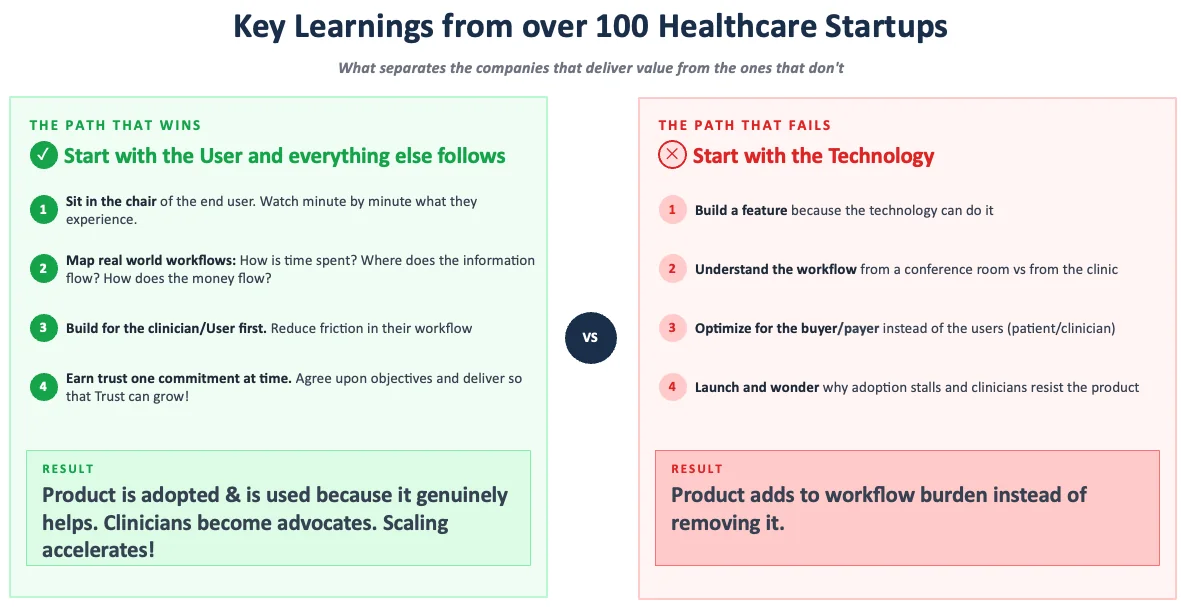
After 100+ startups: the ones that scale start with the user; the ones that stall start with the technology.
AI Will Have a Much Bigger Impact Than EHRs
I believe AI will impact health and care far more than any other emerging technology, including EHRs. EHRs were supposed to reduce administrative burden. Instead they became an administrative burden. Providers who used to handwrite notes in minutes now spend far longer finishing them, because EHRs were built for billing and compliance, not for clinical care or patient experience.
We may repeat this mistake with AI if we do not learn from the EHR rollout. The same forces are driving AI adoption: financial incentives, regulatory pressure, and the assumption that more technology equals better outcomes. Technology deployed without understanding how all users are impacted may not improve health, care, or operations. It could create unnecessary disruption instead.
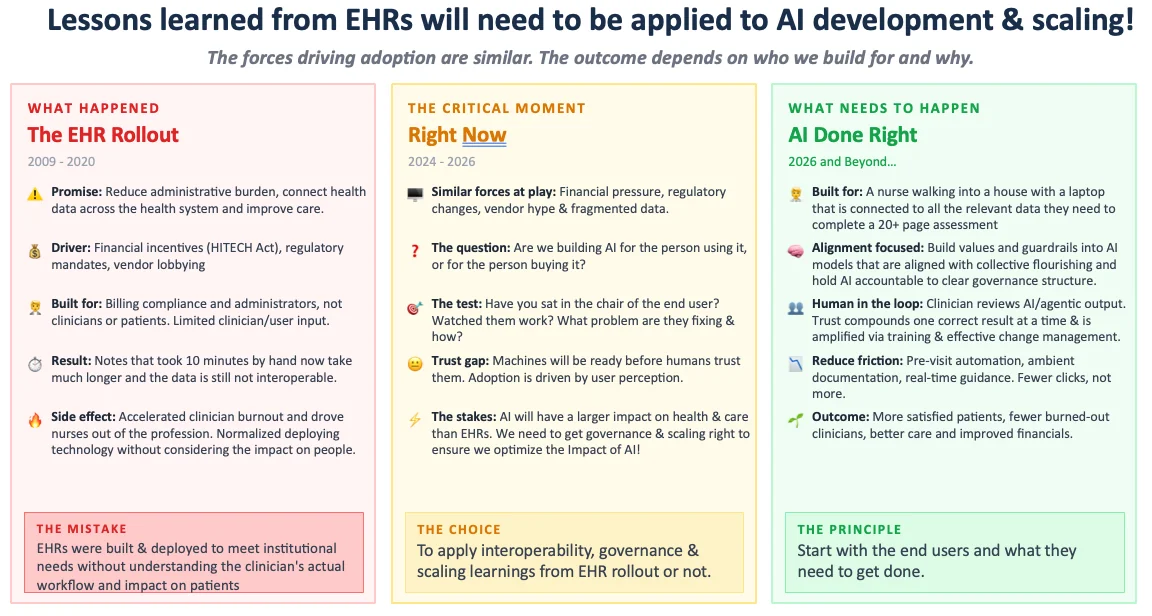
The EHR rollout is the cautionary tale; the AI inflection point is the chance to not repeat it.
The question I keep asking every founder is this: have you sat in the chair of the person you are building for? Not watched a demo. Not read a workflow diagram. Have you physically been in the room, the house, the car, or the clinic and watched what happens in real time? That is where the real product requirements live, not in the feature backlog, but in the lived experience of the person.
Have you sat in the chair of the person you are building for? That is where the real product requirements live.
Give AI Ethics Before You Give It Data
When we raise children, we give them a sense of how others feel and how what we say affects people. We teach kindness, compassion, patience, and consequences. We help them understand that just because they can do something does not mean they should. We have done the opposite with AI. We gave it all the data first, and many groups are now trying to teach it morals after the fact. Imagine downloading the entire internet into a child's brain in one shot, with limited context or ethics. That child has amassed a lot of information but has no framework for what to do with any of it. That is essentially where we are with AI.
I am working with a company called Attune Media Labs that takes a very different approach. Attune built a conversational AI agent called MiM that reads real-time biometric data from the tone of your voice to determine your emotional state, and adjusts its response based on how you are actually feeling in that moment, the way a person does. They also gave MiM an ethical framework and a purpose focused on helping the user flourish, not on maximizing their time on the platform. That is the model every healthcare AI company should be developing: real-time understanding of a user, used to genuinely help.
Human-in-the-Loop Is Not Optional. It Is the Adoption Strategy.
People ask how far out we are from AI doing clinical work autonomously. It depends on how you define clinical work and autonomously. Some clinical work is already being done by AI with clinicians reviewing the output. Waymo's accident rate is already better than a human driver's, yet most people still feel more comfortable getting in a car with a person than a machine. Human beings are very poor at understanding risk; we make most decisions based on perceptions and biases rather than data.
📈 Within five years, AI will be more competent than humans at the majority of administrative, operational, and clinical tasks. But capability will not drive adoption. Trust will.
So human-in-the-loop has to be part of the adoption strategy. Copper Digital's approach of never auto-submitting AI-generated documentation to the EMR and always requiring a clinician to review is exactly where it needs to be today. Not because the AI cannot do the work, but because users need to build trust, and that trust gets built one correct output at a time, reviewed by a human who says, yes, that is right.
Disrupt Yourself Before Someone Else Does
If you run a home health agency, or any healthcare company, and you are not fully leveraging AI, you will struggle to get the attention of buyers or investors. AI has become table stakes. Having an AI strategy does not mean bolting a chatbot onto your website. It means going back to first principles: what does your end user actually experience? Where does their time go? How does information flow? How does money flow? And where can AI genuinely reduce friction and improve the experience without creating new problems?
Disrupting yourself is always a better option than having someone disrupt you. Netflix went from shipping discs to streaming. Blockbuster loved their stores. Only one thrived.
The same dynamic is playing out in home health documentation right now. Agencies that combine AI with their clinical expertise will serve more patients with fewer burned-out nurses. Agencies that keep doing 45-minute manual intakes will lose their referrals to the ones that do it in three minutes. And the opportunity is enormous: over 7 billion people receive inadequate health and wellbeing care. We do not have enough providers and never will. The only way to close that gap is technology that genuinely helps the humans providing care, not technology that adds to their burden.
🎯 Focus on UX and what needs to be done. Everything else follows from there.
🎧 Listen to the full conversation between Paulo Machado and Arvind Sarin on the Inside Home Health podcast. To see how Copper Digital puts UX and human-in-the-loop first, explore AI tools for nurses, pricing, or more resources.
Bottom Line
Across 100 healthcare startups, the lesson is clear: AI will outweigh EHRs in impact, but only with ethics first and human-in-the-loop as the real adoption strategy.

Watch the Full Conversation
Disrupt or Be Disrupted | The Future of Healthcare AI
Arvind Sarin and Paulo Machado on the future of healthcare AI, why UX wins, and how agencies should disrupt themselves before someone else does.

Paulo Machado is CEO and founder of Health Innovation Inc., a fractional co-founder who has worked with over 100 healthcare startups, invested in roughly 50 companies, and is an LP in four funds. His career spans senior leadership at Salomon Brothers, Bristol Myers Squibb, and AstraZeneca, and he serves on the board of the Lung Cancer Foundation of America.
Frequently asked
Frequently asked questions
Because EHRs were built for billing and compliance, not for clinical care or patient experience. Providers who once handwrote notes in minutes now spend far longer finishing them. The risk is repeating the same mistake with AI, since the same forces (financial incentives, regulatory pressure, and the assumption that more technology equals better outcomes) are driving adoption without enough attention to how all users are actually affected.
Join the conversation
Leave a comment
Related reading

The Problem With Healthcare AI Is That Most of It Doesn't Work
We were building AI in healthcare when AI wasn't cool. Nathan Hayman, CEO of Rivvi.ai, on going from 2,000 to 60,000 patient calls a month, bootstrapped and profitable, why he refused to integrate with the EMR, the LinkedIn post that changed everything, and why most healthcare AI ships demos instead of solving problems.
Homecare Homebase vs WellSky (Kinnser) vs Axxess: Which Home Health EMR Is Best for Documentation?
Choosing a home health EMR shapes how nurses document, how fast claims go out, and how efficiently your agency runs. Homecare Homebase, WellSky (Kinnser), and Axxess all support OASIS-E and Medicare compliance, but they differ in usability, scalability, and workflow design. This guide compares all three across documentation, OASIS-E, mobile, compliance, AI, and agency size to help you choose.

How Ambient AI Is Changing Clinical Documentation
Ambient AI passively listens to patient-clinician conversations and automatically generates structured clinical documentation, using speech recognition, NLP, and large language models to capture symptoms, diagnoses, medications, and plans. It reduces after-hours charting and burnout while the clinician reviews and approves every note. In home health, it works best paired with an AI documentation agent that understands OASIS and referral workflows.