
10 Reasons Why Home Health Agencies Are Choosing WellSky (Kinnser)
Selecting an EMR is one of the most important operational decisions a home health agency makes. For more than two decades, WellSky (formerly Kinnser) has stayed a top choice because it was built specifically for home health, not adapted from hospital software. Here are 10 reasons agencies choose it, from OASIS-E and compliance to scheduling, billing, scalability, and AI integration.
Key Takeaways
- WellSky (formerly Kinnser) was built specifically for home health, so its workflows mirror how agencies actually operate.
- Structured OASIS-E workflows with built-in validation reduce documentation omissions and QA rework.
- Compliance is embedded in daily documentation rather than bolted on before billing.
- Point-of-care mobile documentation cuts after-hours pajama charting and improves accuracy.
- Integrated scheduling, billing, revenue cycle, and reporting connect clinical and financial workflows in one platform.
- The platform scales from a single office to multi-branch enterprises and integrates with AI documentation tools.
💡 Quick Answer: Home health agencies choose WellSky (formerly Kinnser) because it was built specifically for home health rather than adapted from hospital software. It combines OASIS-E documentation, embedded Medicare compliance, point-of-care mobile charting, scheduling, billing and revenue cycle, reporting, and enterprise scalability in one platform, and it integrates with AI documentation tools that reduce charting time.
Selecting an electronic medical record (EMR) is one of the most important operational decisions a home health agency will make. Unlike many other software investments, an EMR becomes the center of nearly every workflow inside the organization. From the moment a referral is received until the final claim is paid, clinicians, schedulers, quality assurance teams, coders, billers, and administrators all depend on the same platform to complete their work.
The right system can improve clinical consistency, reduce documentation delays, strengthen compliance, accelerate reimbursement, and give leadership better visibility into agency performance. The wrong system can create documentation bottlenecks, frustrate clinicians, increase administrative overhead, and ultimately impact patient care.
For more than two decades, WellSky Home Health, formerly known as Kinnser, has been one of the most recognized names in the home health industry. Thousands of Medicare-certified agencies rely on the platform to manage clinical documentation, scheduling, billing, quality assurance, and operational reporting. It has kept its position because it was built specifically around the realities of home health care, not adapted from hospital software. Here are the consistent reasons agencies continue to choose it.
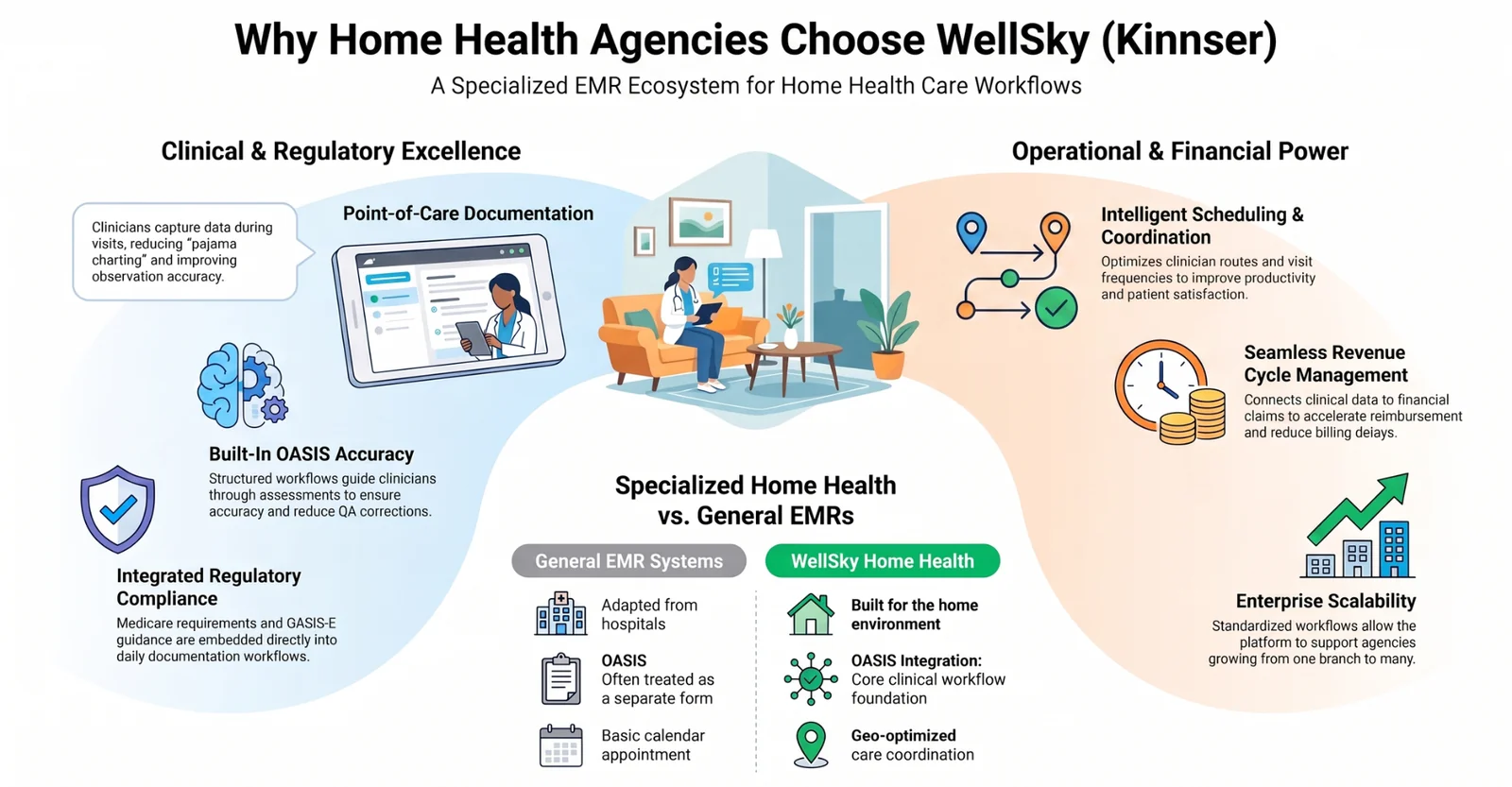
WellSky is built for the home environment, with OASIS as a core clinical workflow rather than a separate form bolted onto hospital software.
1. A Platform Built Specifically for Home Health
One of WellSky's greatest strengths is that it was designed with home health in mind from the beginning. Healthcare is not a single workflow: documentation requirements, reimbursement models, scheduling challenges, and care-team communication all differ between a hospital, a physician practice, a skilled nursing facility, and a home health agency.
Home health is a particularly unique environment because care takes place in the patient's home rather than a controlled clinical facility. Clinicians work independently throughout the day, and every visit requires careful documentation, coordination with physicians, communication with family caregivers, medication reconciliation, and compliance with Medicare Conditions of Participation. WellSky organizes these assessments into structured workflows that follow the natural progression of the visit rather than forcing agencies to redesign their processes around the software.
When software aligns with real clinical workflows, agencies typically experience:
- Shorter onboarding times for new clinicians
- Greater documentation consistency
- Reduced training costs
- Fewer documentation errors
- Improved clinician satisfaction
- Better adoption across the organization
The platform also accommodates the multidisciplinary nature of home health, giving skilled nurses, physical therapists, occupational therapists, speech-language pathologists, medical social workers, and home health aides the documentation workflows each discipline needs while maintaining continuity across the patient's episode of care.
2. Comprehensive OASIS-E Documentation
Few aspects of home health demand as much attention or consume as much clinician time as OASIS documentation. The Outcome and Assessment Information Set (OASIS) is far more than a regulatory requirement: it serves as the clinical foundation for care planning, quality measurement, reimbursement, and public reporting. Every response can influence patient outcomes, agency performance metrics, and Medicare payment.
WellSky organizes OASIS documentation into structured clinical workflows that guide clinicians through each stage of the assessment. Rather than presenting documentation as isolated forms, demographics, clinical history, diagnoses, medications, functional assessments, and care planning are connected in ways that support comprehensive documentation.
Equally important is the platform's ability to identify potential inconsistencies before documentation advances. If documentation suggests a patient needs extensive mobility assistance yet indicates no fall-risk interventions, built-in validation can prompt clinicians to revisit those sections. These safeguards do not replace clinical judgment, but they reduce common omissions that lead to QA corrections, cleaner documentation reaches billing sooner, and clinicians spend less time on chart rework.
3. Regulatory Compliance Embedded in the Workflow
Compliance is often treated as a separate department, but in reality it begins with every patient interaction. Every assessment completed, medication reconciled, physician order obtained, and care plan updated contributes to the agency's ability to demonstrate compliance during surveys and audits.
One reason agencies choose WellSky is its philosophy that compliance should be integrated into everyday workflows rather than treated as a final checkpoint before billing. The platform incorporates many regulatory requirements directly into documentation, helping clinicians capture required information while care is delivered. That proactive approach becomes increasingly valuable as Medicare requirements evolve, including:
- OASIS-E guidance
- Conditions of Participation
- Plan of Care requirements
- Face-to-Face documentation
- Physician certification timelines
- Electronic signatures
- Quality reporting initiatives
- Value-based purchasing programs
WellSky helps agencies create standardized workflows that promote consistency across clinicians, branches, and regions, and gives administrators visibility into documentation status and pending tasks before they become larger problems. That same organization makes survey preparation far less painful.
4. Point-of-Care Documentation That Keeps the Focus on the Patient
For decades, the biggest frustration in home health has not been the visit itself; it is everything that happens after. Many clinicians finish a full day of care only to spend their evenings documenting assessments and responding to QA corrections. This "pajama charting" has become so common that many nurses simply accept it as part of the profession, and delayed documentation means important clinical observations can be forgotten.
WellSky has long invested in mobile documentation workflows that let clinicians capture information during or immediately following the visit. Documenting closer to the point of care improves accuracy because observations are recorded while still fresh, QA teams receive documentation sooner, and billing reaches billing-ready status faster. As agencies focus on reducing clinician burnout, point-of-care documentation remains one of the most valuable investments an organization can make.
5. Intelligent Scheduling and Care Coordination
Scheduling in home health is far more complicated than assigning appointments to a calendar. Every patient has a unique plan of care, and every clinician has different skills, certifications, geographic coverage, productivity expectations, and availability. Unlike a hospital, agencies must coordinate hundreds or thousands of individual visits across entire cities or regions every week.
WellSky treats scheduling as part of the overall patient care workflow rather than an isolated administrative function. Schedulers, Directors of Nursing, clinical managers, and administrators can view clinician availability, patient assignments, and visit frequencies from a centralized system, distributing workloads more evenly while ensuring patients receive physician-ordered visits. Balanced scheduling reduces unnecessary travel, builds stronger patient-clinician relationships through consistency, and helps agencies reassign visits efficiently when illness, weather, or last-minute cancellations occur.
6. Integrated Billing and Revenue Cycle Management
Excellent patient care alone does not guarantee financial stability. Home health operates in one of the most documentation-dependent reimbursement environments in healthcare: a missing signature, an incomplete OASIS assessment, or an overlooked physician order can each delay reimbursement or require costly claim corrections.
WellSky connects clinical documentation with financial workflows, helping agencies move patients from admission through claim submission in a more organized and transparent manner. As clinicians complete documentation, QA teams review records, coders validate diagnoses, and billing staff prepare claims using information already captured, reducing duplicate data entry. Leadership can monitor claim status and recognize bottlenecks before they affect cash flow, which becomes essential as an agency grows from fifty patients to a thousand across multiple branches.
7. Meaningful Reporting and Analytics
Home health agencies generate enormous amounts of operational data every day. The challenge has never been collecting data; it has always been turning that data into useful information. WellSky provides reporting that lets agencies monitor clinical, financial, and operational performance from within a single platform, so leadership can act throughout the patient care process instead of waiting until month-end.
Reporting can help agencies answer questions such as:
- Which clinicians have outstanding documentation?
- Which referrals convert most successfully into admissions?
- Are physician orders being completed on time?
- Which branches have the highest documentation turnaround times?
- How quickly are claims moving through the billing process?
- Where are compliance bottlenecks occurring?
As value-based care expands, the ability to measure performance accurately becomes even more important. For many agencies, reporting is no longer simply a management tool; it has become a competitive advantage.
8. Scalable Technology That Grows Alongside Your Agency
One of the most overlooked factors when selecting an EMR is not whether it meets today's needs, but whether it will still meet the agency's needs three, five, or ten years from now. What once worked for twenty clinicians can become difficult to manage with one hundred as agencies add branches, service areas, and referral partners.
WellSky has supported agencies across every stage of growth, from newly licensed providers to large multi-branch organizations managing thousands of active episodes. It enables organizations to standardize workflows across the enterprise, supports role-based access so each user sees only what they need, and has evolved through multiple generations of regulatory change, including electronic documentation, OASIS revisions, PDGM, and Electronic Visit Verification (EVV). Technology should never become the limiting factor in an agency's expansion.
9. Decades of Home Health Experience
In healthcare technology, experience matters. Innovation is important, but in home health, reliability and regulatory understanding are equally essential, because documentation accuracy directly affects reimbursement, survey readiness, quality reporting, and patient care. WellSky's history within the industry is one of its greatest advantages, having supported agencies through some of the most significant changes in modern home health, including:
- The transition from paper documentation to electronic medical records
- Multiple revisions of the OASIS assessment
- Implementation of the Patient-Driven Groupings Model (PDGM)
- Adoption of Electronic Visit Verification (EVV)
- Increasing emphasis on value-based care and quality reporting
- Growing expectations around interoperability and digital health
New agencies adopting WellSky are not simply purchasing software; they are implementing workflows refined through years of use across organizations of varying sizes. For experienced home health leaders, that institutional knowledge reduces implementation risk, and for long-term technology decisions, stability is often just as important as innovation.
10. A Connected Ecosystem That Supports the Entire Patient Journey
The modern home health agency depends on far more than a single application. Patient care involves continuous collaboration among referral coordinators, intake specialists, clinicians, schedulers, physicians, coders, QA teams, billers, administrators, and external partners. When these systems operate independently, agencies experience duplicate documentation, communication delays, and fragmented workflows.
WellSky focuses on creating a connected operational environment where information flows efficiently across the organization. When a referral arrives from a hospital discharge planner, intake verifies eligibility, a clinician completes the Start of Care, QA reviews, coding validates diagnoses, billing prepares claims, and administrators monitor performance, each department works from shared clinical information rather than isolated records. That centralized data also positions agencies to adopt emerging technologies such as artificial intelligence, predictive analytics, and automated coding assistance, which enhance the EMR rather than replace it.
The Bottom Line: Why WellSky Remains a Trusted Choice
Choosing an EMR is rarely about finding software with the longest list of features. It is about selecting a platform that supports clinicians, strengthens compliance, improves operational efficiency, and adapts as the healthcare landscape evolves. WellSky has earned its position by focusing on the unique realities of home-based care, from OASIS documentation and point-of-care workflows to scheduling, billing, reporting, and enterprise scalability.
Many organizations compare WellSky with platforms such as Axxess and Homecare Homebase before deciding. For a side-by-side breakdown of documentation workflows, OASIS-E, mobile, compliance, and AI, see Homecare Homebase vs WellSky (Kinnser) vs Axxess: Which Home Health EMR Is Best for Documentation?.
At the same time, the future of home health technology is moving beyond traditional documentation systems. Agencies are increasingly exploring AI-powered solutions that complement, rather than replace, their existing EMR. AI documentation platforms like Copper Digital are designed to work alongside systems such as WellSky by helping clinicians complete documentation more efficiently, through AI-assisted note generation, intelligent follow-up questions, documentation completeness checks, and workflow automation, while keeping clinicians in full control of the final chart.
🚀 Modernize documentation without switching EMRs. Copper Digital's AI Documentation Agent works alongside WellSky (Kinnser), capturing the visit by voice, photo, or tap and drafting notes and OASIS-E in real time, with a nurse reviewing and approving every record before it reaches billing. Explore AI tools for home health nurses, see how human-in-the-loop review works, or book a demo.
🎓 Go deeper with peers. Join our Home Health Mastermind Skool community for training on EMR workflows, OASIS accuracy, compliance, and practical strategies to reduce charting burden.
Bottom Line
Agencies choose WellSky (formerly Kinnser) because it was purpose-built for home health: structured OASIS-E and compliance workflows, point-of-care documentation, integrated scheduling and billing, meaningful reporting, and enterprise scalability, and it pairs well with AI documentation tools that reduce charting time.
The Copper Clinical Team brings together nurses and clinical documentation specialists focused on home health, OASIS accuracy, EMR workflows, and human-in-the-loop AI. They write about the tools and workflows helping agencies document faster with less administrative burden.
Frequently asked
Frequently asked questions
WellSky Home Health, formerly known as Kinnser, is a cloud-based electronic medical record (EMR) platform designed specifically for home health agencies. It supports clinical documentation, OASIS assessments, scheduling, billing, compliance, reporting, and care coordination.
Join the conversation
Leave a comment
Related reading
Homecare Homebase vs WellSky (Kinnser) vs Axxess: Which Home Health EMR Is Best for Documentation?
Choosing a home health EMR shapes how nurses document, how fast claims go out, and how efficiently your agency runs. Homecare Homebase, WellSky (Kinnser), and Axxess all support OASIS-E and Medicare compliance, but they differ in usability, scalability, and workflow design. This guide compares all three across documentation, OASIS-E, mobile, compliance, AI, and agency size to help you choose.
OASIS-E1 vs OASIS-E2: A Complete Side-by-Side Comparison for Home Health Agencies
Wondering what changed between OASIS-E1 and OASIS-E2? OASIS-E2 is an incremental update, not a redesign. The framework, five time points, and PDGM methodology stay the same, while CMS refines Section GG, cognitive and behavioral items, SDOH, and SPADEs. This guide compares both versions side by side and gives you a transition plan and checklist.

The Biggest Documentation Challenges Home Health Nurses Face
Home health nurses face heavy documentation challenges: delayed point-of-care charting, excessive administrative time, clunky EHRs, OASIS complexity, strict reimbursement rules, working in isolation, endless QA corrections, and after-hours charting that drives burnout. Reducing documentation burden is now essential for clinician retention, patient outcomes, and agency financial performance.