
AI Scribe vs AI Documentation Agent: Which One Does Home Health Really Need?
An AI scribe transcribes conversations into notes. An AI Documentation Agent goes further: it understands clinical workflows, processes referral PDFs, drafts OASIS-E assessments, assists with medication reconciliation, surfaces missing documentation, and helps nurses complete compliant charts. For home health's OASIS complexity and referral processing, an AI Documentation Agent does more than a transcription-only scribe.

Key Takeaways
- AI scribes transcribe; AI documentation agents complete the full documentation workflow.
- Home health requires OASIS logic, referral processing, and compliance support a scribe can't provide.
- A side-by-side comparison shows the agent covering workflows, referrals, and OASIS the scribe does not.
- Human-in-the-loop review keeps clinicians in control of the final record.
💡 An AI scribe transcribes; an AI Documentation Agent completes. An AI scribe converts conversations into notes. An AI Documentation Agent goes further: it understands clinical workflows, processes referral PDFs, drafts OASIS-E assessments, assists with medication reconciliation, surfaces missing documentation, and helps nurses complete compliant charts. For home health's OASIS complexity and referral processing, an AI Documentation Agent does far more than a transcription-only scribe.
Artificial intelligence is rapidly transforming healthcare documentation.
But one of the biggest misconceptions in healthcare today is that every AI-powered documentation tool does the same thing.
It doesn't.
Two terms are increasingly being used interchangeably:
- AI Scribe
- AI Documentation Agent
While they may sound similar, they solve very different problems.
And for home health agencies, understanding that difference matters.
Because choosing the wrong technology may leave your nurses with the same documentation burden they were trying to eliminate.
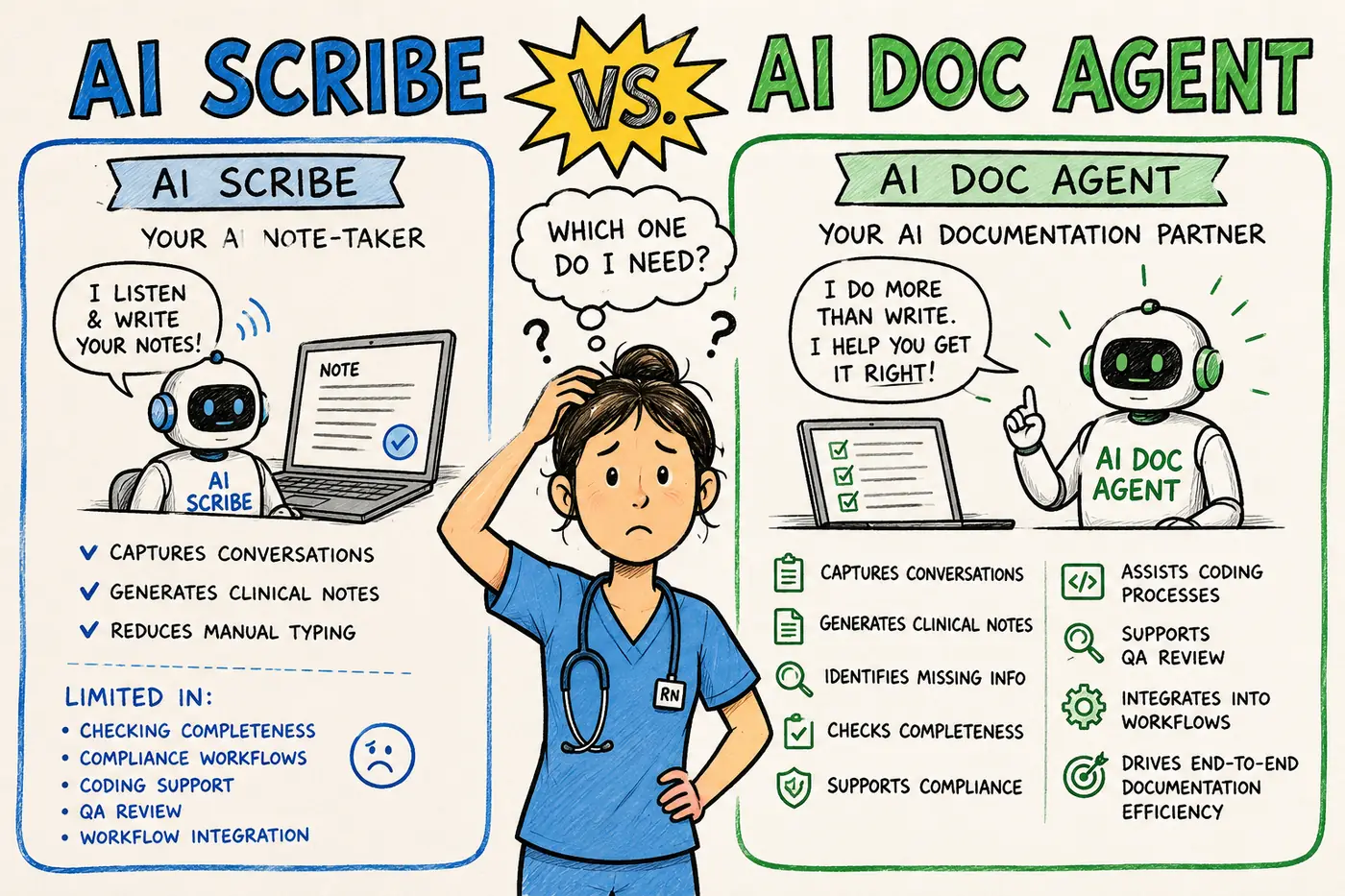
AI Scribe vs AI Doc Agent: which one does home health really need?
What Is an AI Scribe?
An AI scribe primarily focuses on transcribing conversations into documentation.
Think of it as an intelligent note-taker.
A clinician speaks, and the AI converts the conversation into:
- Clinical notes
- Progress notes
- Summaries
- Structured text
AI scribes are becoming increasingly common in:
- Physician offices
- Primary care
- Telehealth
- Behavioral health
- Outpatient clinics
Their primary job is simple:
Listen → Transcribe → Summarize.
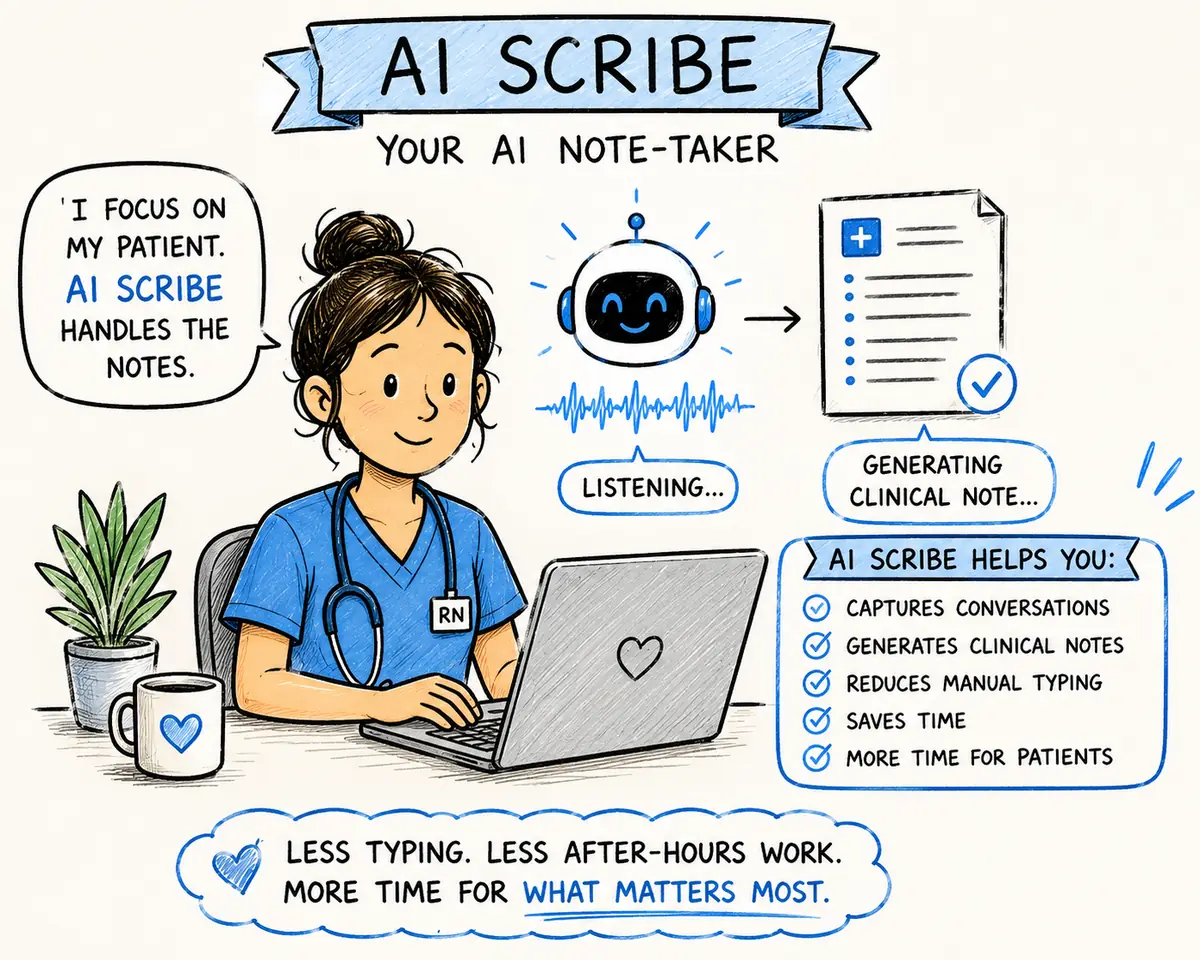
An AI scribe listens, transcribes, and summarizes, so nurses do less typing.
What an AI Scribe Does Well
- ✅ Captures conversations.
- ✅ Creates draft notes.
- ✅ Reduces typing.
- ✅ Saves documentation time.
- ✅ Improves note-taking efficiency.
For many office-based specialties, that's often enough.
But home health is different.
Why Home Health Needs More Than a Dictation Tool
Home health agencies do not simply need a better dictation solution.
They need an AI Documentation Agent.
A basic AI scribe can listen and transcribe.
An AI Documentation Agent goes much further.
It can:
- Process referral PDFs and discharge packets
- Extract medications and diagnoses
- Generate OASIS-E assessment drafts
- Assist with medication reconciliation
- Create care plan narratives
- Surface missing documentation
- Organize information for EHR submission
The challenge in home health isn't writing notes.
The challenge is turning fragmented information into complete, compliant documentation.
What Is an AI Documentation Agent?
An AI Documentation Agent goes beyond transcription.
Instead of simply recording information, it actively assists clinicians throughout the documentation workflow.
Think of it as:
A documentation assistant who understands clinical workflows.
An AI Documentation Agent can:
- Identify missing information
- Organize documentation
- Generate clinical summaries
- Assist with OASIS completion
- Surface inconsistencies
- Suggest interventions and goals
- Extract data from referral documents
- Help prepare documentation for review and billing
Its purpose is not just to write notes.
Its purpose is to help nurses complete documentation accurately and efficiently.
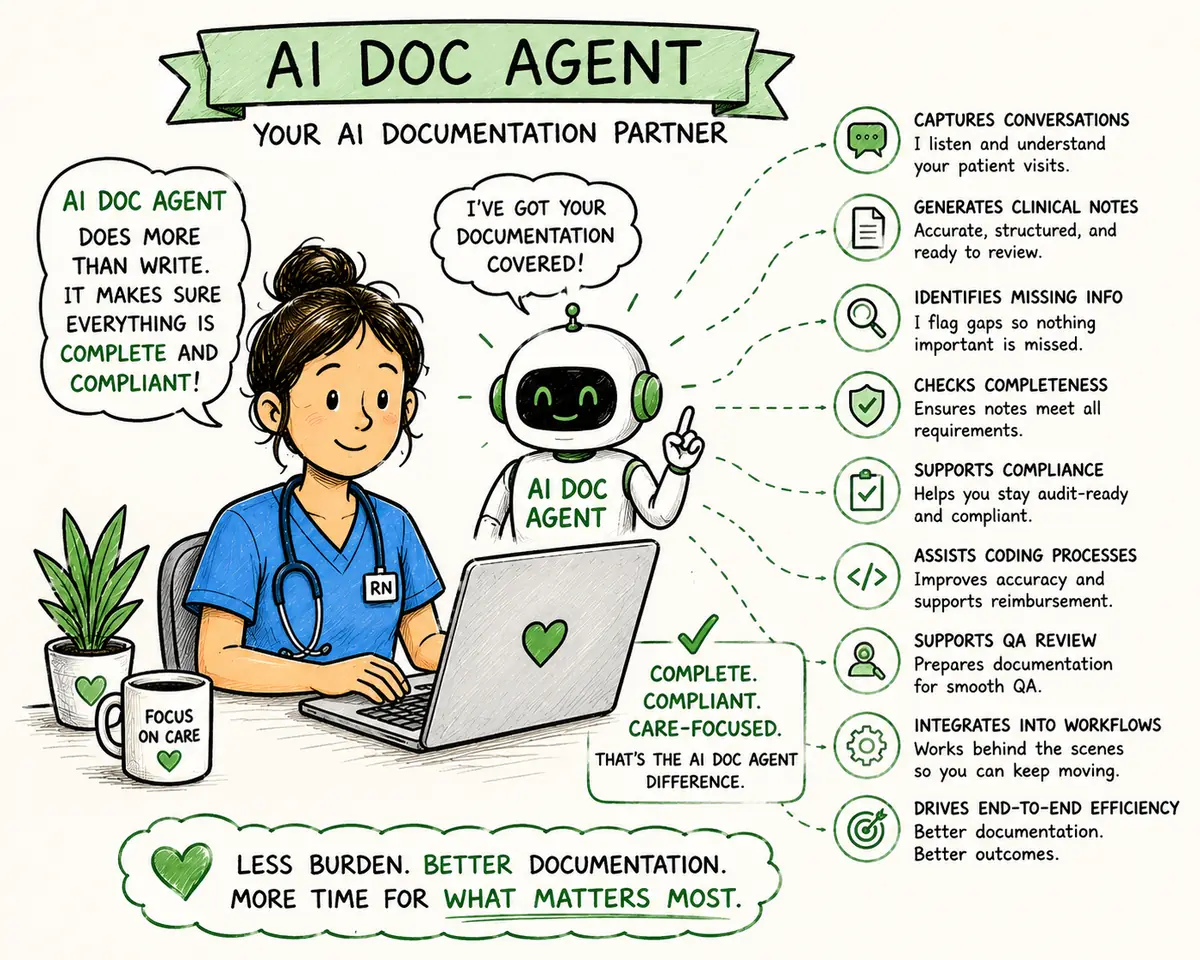
An AI Documentation Agent does more than write: it makes documentation complete and compliant.
AI Scribe vs AI Documentation Agent
| Capability | Basic AI Scribe | AI Documentation Agent |
|---|---|---|
| Converts speech to text | ✅ | ✅ |
| Creates note summaries | ✅ | ✅ |
| Understands clinical workflows | ❌ | ✅ |
| Processes referral PDFs | ❌ | ✅ |
| Supports OASIS documentation | ❌ | ✅ |
| Medication reconciliation | ❌ | ✅ |
| Identifies missing documentation | ❌ | ✅ |
| Flags compliance gaps | Limited | ✅ |
| Suggests goals and interventions | ❌ | ✅ |
| Helps reduce chart corrections | Limited | ✅ |
| Integrates with documentation workflows | ❌ | ✅ |
Why an AI Documentation Agent Outperforms a Basic Scribe
In a family practice clinic, a basic AI scribe may be enough because:
- The EHR is open during the visit.
- Workflows are relatively standardized.
- Documentation requirements are less complex.
Home health requires much more context.
Nurses often need to:
- Review 50- to 100-page referral packets
- Complete lengthy OASIS assessments
- Reconcile medications
- Create care plans
- Document homebound status
- Support billing requirements
- Meet strict compliance standards
Simply transcribing a conversation doesn't solve those challenges.
A documentation agent is designed to support the entire workflow.
Home Health Documentation Is More Than Note Taking
A Start of Care assessment can include:
- OASIS questions
- Medication reconciliation
- Risk assessments
- Clinical narratives
- Care planning
- Patient education
- Visit notes
- Physician orders
Documentation is not a single note.
It's an interconnected workflow that impacts:
- Reimbursement
- Compliance
- Billing
- Quality measures
- Patient outcomes
This is why many agencies are beginning to look beyond AI scribes and toward AI Documentation Agents.
The Human-in-the-Loop Difference
Neither AI scribes nor AI documentation agents should replace clinical judgment.
The best systems are built around a human-in-the-loop model.
In this approach:
- AI generates drafts.
- AI organizes information.
- AI identifies gaps.
- Nurses review and validate.
- Final approval remains with the clinician.
This approach combines:
- Efficiency
- Accountability
- Speed
- Clinical oversight
The nurse remains in control.
Always.
What Should Agencies Look for in an AI Documentation Agent?
If you're evaluating AI solutions, ask these questions.
1. Does AI Documentation Agent Support OASIS Workflows?
Can it differentiate between:
- Start of Care
- Resumption of Care
- Recertification
- Discharge assessments
OASIS logic is one of the biggest differentiators in home health documentation.
2. Can the AI Documentation Agent Process Referral Documents?
Many referrals still arrive as:
- PDFs
- Faxed packets
- Hospital discharge summaries
The ability to automatically extract information can eliminate hours of manual work.
3. Does AI Documentation Agent Reduce Double Entry?
The best documentation platforms integrate with existing systems and reduce:
- Copy-and-paste workflows
- Duplicate documentation
- Administrative burden
4. Does AI Documentation Agent Include Human-in-the-Loop Safeguards?
The clinician should always:
- Review documentation
- Make corrections
- Approve the final chart
AI should assist nurses, not replace them.
5. Does AI Documentation Agent Help Improve Compliance?
The best AI documentation agents can:
- Surface missing information
- Highlight inconsistencies
- Improve documentation completeness
- Support audit readiness
Why Documentation Agents Are Emerging in Home Health
Home health agencies face several challenges:
- Staffing shortages
- Documentation delays
- OASIS complexity
- Nurse burnout
- Reimbursement pressure
- Compliance requirements
An AI scribe addresses one piece of the problem:
Documentation creation.
An AI Documentation Agent addresses the larger workflow:
Documentation completion.
That distinction may seem subtle.
Operationally, it's massive.
The Future of AI Documentation in Home Health
AI scribes are an important step forward.
But home health documentation requires more than transcription.
It requires:
- Context
- Workflow understanding
- Clinical logic
- Compliance support
- Human oversight
The future may not belong to AI that simply writes notes.
It may belong to AI that helps clinicians finish them.
Final Thoughts
Home health agencies don't simply need software that listens.
They need technology that understands the realities of post-acute care.
The real question isn't:
'Does this AI write notes?'
It's:
'Does this AI help nurses complete accurate, compliant documentation without taking work home?'
That's the difference between an AI scribe and an AI Documentation Agent.
🚀 See what an AI Documentation Agent looks like for home health. Copper Digital's AI Documentation Agent processes referral packets, drafts OASIS-E assessments, and surfaces missing documentation, with a nurse in the loop at every step. Explore AI tools for home health nurses, or book a demo.
Bottom Line
An AI scribe transcribes conversations; an AI documentation agent understands workflows, processes referrals, and helps complete OASIS, which is what home health actually needs.

The Copper Clinical Team brings together nurses and clinical documentation specialists focused on home health, OASIS accuracy, and human-in-the-loop AI. They write about the tools and workflows helping clinicians reduce administrative burden and grow their careers.
Frequently asked
Frequently asked questions
No. An AI scribe primarily transcribes conversations and generates notes. An AI documentation agent also understands workflows, identifies missing information, processes referral documents, and assists with documentation completion.
Join the conversation
Leave a comment
Related reading
10 Reasons Why Home Health Agencies Are Choosing WellSky (Kinnser)
Selecting an EMR is one of the most important operational decisions a home health agency makes. For more than two decades, WellSky (formerly Kinnser) has stayed a top choice because it was built specifically for home health, not adapted from hospital software. Here are 10 reasons agencies choose it, from OASIS-E and compliance to scheduling, billing, scalability, and AI integration.
Homecare Homebase vs WellSky (Kinnser) vs Axxess: Which Home Health EMR Is Best for Documentation?
Choosing a home health EMR shapes how nurses document, how fast claims go out, and how efficiently your agency runs. Homecare Homebase, WellSky (Kinnser), and Axxess all support OASIS-E and Medicare compliance, but they differ in usability, scalability, and workflow design. This guide compares all three across documentation, OASIS-E, mobile, compliance, AI, and agency size to help you choose.

The Biggest Documentation Challenges Home Health Nurses Face
Home health nurses face heavy documentation challenges: delayed point-of-care charting, excessive administrative time, clunky EHRs, OASIS complexity, strict reimbursement rules, working in isolation, endless QA corrections, and after-hours charting that drives burnout. Reducing documentation burden is now essential for clinician retention, patient outcomes, and agency financial performance.