
How Much of a Nursing Shift Is Actually Spent on Documentation?
Research commonly places nursing documentation at roughly 25% to 40% of a shift. The real burden spans structured fields, medications, observations, admissions, handover, and end-of-shift synthesis, not only narrative notes.

Key Takeaways
- Published estimates vary by setting and methodology, but documentation-related work can consume several hours of a 12-hour nursing shift.
- A 2025 JMIR Nursing analysis found that time in flowsheets averaged 31.11% per 12-hour shift and cited 631 to 875 flowsheet entries per shift, about one entry each minute.
- Admission, medication administration, continuous observations, handover, discharge, and incident reporting create different kinds of documentation burden.
- Documentation pressure often intensifies around admission, after medication rounds, and before shift handover.
- AI tools focused only on narrative notes may miss the larger burden of structured data entry and fragmented workflows.
- Meaningful time savings require EHR integration, nurse-centered design, clinical review, governance, and measurement of the complete workflow.
✓ Quick answer: Research commonly places documentation-related work at roughly 25% to 40% of a nursing shift, although estimates vary by care setting, methodology, patient acuity, EHR design, and what researchers count as documentation. During a 12-hour shift, that can represent approximately three to five hours of work.
Nursing documentation is essential to patient care. But how much of a nurse's shift is actually spent documenting instead of providing direct care?
The burden is not limited to writing narrative notes. Nurses may enter vital signs, medication information, assessments, risk scores, care-plan information, handover details, discharge documentation, and other structured data throughout the shift.
The important question, therefore, is not simply “How long do nurses spend writing notes?” It is “Where does documentation time actually go during a nursing shift?” Understanding that distinction matters when deciding where technology and AI can genuinely reduce workload.
What Does Nursing Documentation Include?
Nursing documentation covers much more than narrative progress notes. Depending on the care setting, nurses may document:
- Admission and intake assessments.
- Medical history and risk assessments.
- Medication administration.
- Vital signs and pain scores.
- Fluid balance.
- Clinical observations.
- Changes in patient condition.
- Care plans.
- Handover information.
- Discharge summaries.
- Patient instructions.
- Incident reports.
- Referrals and other required documentation.
Much of this information is entered into structured fields rather than typed as traditional free-text notes. That distinction is important because an AI tool that only generates narrative notes may solve one part of the problem while leaving significant documentation work untouched.
How Much Time Do Nurses Spend Documenting During a 12-Hour Shift?
Several studies and operational analyses illustrate the scale of the workload. A 2025 JMIR Nursing multimethod analysis at an academic health system found that time spent in flowsheets averaged 31.11% per 12-hour shift.
The paper also cites prior estimates of 631 to 875 flowsheet entries during a 12-hour shift, approximately one structured entry every minute.
Cleveland Clinic's operational analysis found inpatient nurses spending approximately 144 minutes per 12-hour shift in the EHR. In the JMIR study, participating nurses estimated that 10% to 50% of a shift could involve EHR documentation, illustrating how much results can vary by role and measurement method.
These numbers should not be treated as a universal percentage for every nurse. Documentation workload varies considerably by specialty, staffing model, patient acuity, EHR design, and documentation requirements.
Collectively, however, the evidence points to the same issue: documentation can consume a substantial portion of a nursing shift.
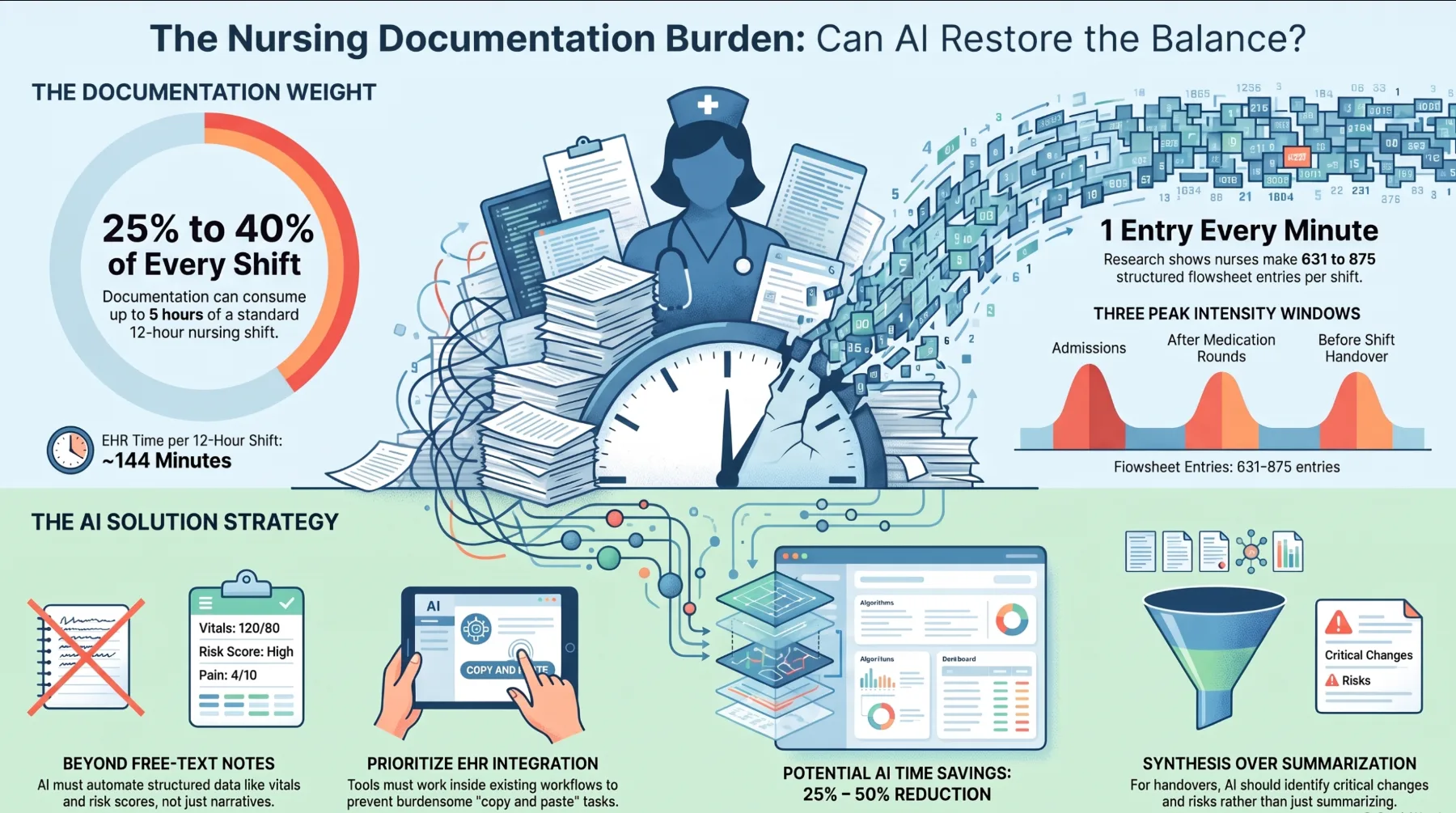
Nursing documentation burden is distributed across continuous structured entries and high-intensity periods. Useful AI must address structured data, EHR integration, and clinical synthesis, not only free-text notes.
Which Nursing Documentation Tasks Take the Most Time?
Not every documentation task contributes equally to the workload. Some occur once but are extremely time-intensive.
Others take only seconds at a time but recur throughout a shift. The major categories include admission documentation, medication administration records, ongoing observations, handover, discharge documentation, and incident reporting.
Why Does Admission Documentation Take So Much Time?
Admission and intake assessments can be among the most documentation-intensive events in a shift. A nurse may need to capture:
- Medical history.
- Risk assessments.
- Medication information.
- Baseline observations.
- Patient needs.
- Structured intake information.
- Care-plan information.
The work is concentrated into a relatively short period and often involves navigating multiple sections of the medical record. Research involving acute and critical care nurses has identified admission, discharge, and transfer components as areas that consume meaningful nursing time.
How Much Documentation Comes From Medication Administration?
Medication administration creates a recurring documentation requirement. Each administration must be recorded, while refusals, omissions, discrepancies, or other exceptions can create additional documentation.
Because this happens repeatedly, small amounts of time can accumulate into a meaningful workload.
Why Do Vital Signs and Clinical Observations Create So Much Documentation?
Clinical observations are different from admission documentation because they happen continuously. Vital signs, pain scores, fluid balance, assessments, and other observations may be recorded at different points throughout the shift.
The research showing hundreds of flowsheet entries demonstrates how quickly these small documentation events accumulate.
The challenge is also cognitive. Nurses are not necessarily sitting down for several uninterrupted hours of charting.
They are often switching between patient care, communication, clinical decisions, and documentation. That constant switching can make documentation feel even more burdensome than the raw number of minutes suggests.
How Much Time Do Nurses Spend on Handover Documentation?
Handover is one of the most important documentation activities because the incoming nurse relies on the information communicated by the outgoing nurse. At the end of a shift, information collected over several hours must be synthesized into a clear, clinically useful summary.
- What changed during the shift?
- What needs follow-up?
- What medications or treatments were provided?
- What risks should the next nurse know about?
- What needs to happen next?
A 2026 phenomenological study of AI-enabled shift handover identified fragmented documentation and the tension between documentation demands and direct patient care as important themes. This is why handover should not be treated as just another note-generation problem.
It is an information-synthesis problem.
Why Can End-of-Shift Documentation Become a Problem?
Some documentation tasks accumulate toward the end of the shift. A nurse may have spent hours collecting observations, administering medications, responding to patient needs, and documenting individual events.
Then comes the need to bring that information together.
Discharge documentation, summaries, patient instructions, referrals, and end-of-shift notes can create additional pressure when fatigue and cognitive load are already high. This creates an important design question: should AI help nurses document after the work is finished, or help capture and organize information throughout the shift?
When During a Nursing Shift Does Documentation Take the Most Time?
Documentation does not happen evenly throughout a shift. Three periods can create especially high documentation intensity:
- The admission window.
- Periods following medication rounds.
- The period leading up to handover.
Admission brings multiple assessments and intake activities together. Medication rounds create recurring documentation requirements.
The end of the shift requires nurses to synthesize information for handover and closing tasks. Documentation burden is therefore about both how much nurses document and when they must do it.
Why Does Nursing Documentation Take So Much Time?
One reason is that documentation is distributed across many small tasks. A nurse may enter one piece of information, return to patient care, enter another, respond to an alert, administer medication, document it, return to the bedside, and later complete another assessment.
The individual tasks may appear small. Collectively, they create a persistent workload.
Duplication adds another layer: when nurses enter the same information in multiple places or move between disconnected workflows, documentation becomes more than recording care; it becomes managing the documentation system itself.
This pattern is also visible in home-based care, where clinicians may complete extensive assessments and revisit the same information across systems. Read more about the biggest documentation challenges home health nurses face.
Does Nursing Documentation Contribute to Nurse Burnout?
Documentation is one of several factors associated with workload and burnout, and it should not be treated as the sole cause. However, its scale makes it an important workforce issue.
The KLAS Arch Collaborative's 2025 research, based on 80,147 acute-care nurses across 179 organizations, found that 79% reported losing time to unproductive charting. Nurses described bureaucratic tasks, inconsistent standards, duplicative flowsheets, and excessive required fields as sources of friction.
The implication is straightforward: if technology is supposed to reduce administrative burden, it needs to reduce the work nurses actually experience, not simply make one type of note faster. The same principle applies to late nursing documentation and after-hours charting.
Can AI Reduce Nursing Documentation Time?
Potentially, yes. A 2025 discussion paper in the International Journal of Nursing Studies estimated that AI-enabled documentation could reduce charting time by approximately 25% to 50%, while warning that the efficiency gain could be converted into higher patient throughput rather than more direct-care time.
That distinction matters. Saving 30 minutes does not automatically mean a nurse gets 30 minutes back with patients.
The organization must decide what happens to the time. The best-case scenario is that technology removes unnecessary administrative work and allows more time for clinical care, communication, judgment, and patient interaction.
ℹ️ Important: AI time-saving estimates are not guaranteed outcomes. Results depend on the task, setting, integration, training, adoption, governance, and whether the organization redesigns the surrounding workflow.
What Nursing Documentation Tasks Can AI Help With?
AI can potentially support several parts of the documentation workflow:
- Converting spoken information into structured documentation.
- Drafting clinical notes.
- Extracting information into structured fields.
- Summarizing information for handover.
- Identifying missing information.
- Reducing duplicate documentation.
- Organizing information gathered throughout a shift.
- Supporting documentation inside existing workflows.
Do not begin with “Where can we put AI?” Begin with “Which documentation task is creating the most friction for nurses?”
This task-first approach also clarifies the difference between an AI scribe and an AI documentation agent.
Why Should AI Nursing Tools Focus on Structured Data, Not Just Free-Text Notes?
A major portion of nursing documentation consists of structured information, including vital signs, pain scores, medication records, fluid balance, risk assessments, checklists, and other clinical fields.
Tools focused exclusively on free-text notes may address only one visible part of the burden. If a nurse enters hundreds of structured data points during a shift, reducing the time required for those entries may have a larger cumulative effect than making narrative notes faster.
Why Does AI-Assisted Handover Need a Different Approach?
Handover is not simply another clinical note. It requires synthesis.
An effective AI system must identify relevant information, organize it appropriately, and present it in a way that supports the incoming nurse.
Accuracy is critical. Research on AI-assisted handover found that nurses' acceptance depended on accuracy, clinical oversight, and workflow integration.
That is not resistance to technology; it is a reasonable expectation for a tool operating in a high-stakes environment.
How Should AI Tools Handle Interruptions During a Nursing Shift?
Nursing documentation rarely happens in a quiet office. It happens while nurses are responding to patients, communicating with families and physicians, administering medications, reacting to clinical changes, moving between rooms, and handling unexpected events.
An AI tool that adds more clicks, screens, logins, or context switching can unintentionally create another burden. The technology needs to fit the reality of an interrupted nursing workflow.
AI should reduce cognitive load, not create another system nurses have to manage.
Why Does EHR Integration Matter for AI Nursing Documentation?
Imagine a nurse speaks information into an AI tool and the AI creates a note, but the nurse must then open another application, copy the information, paste it into the EHR, verify formatting, and complete the documentation there. The technology may have generated the note faster without reducing the full workflow.
A 2025 generative-AI nursing documentation study underscores the importance of workflow integration and careful implementation. For AI documentation, fewer steps matter as much as faster generation.
What Should Healthcare Organizations Ask Before Buying an AI Nursing Documentation Tool?
Does the tool reduce structured documentation work?
Determine whether it supports structured fields and recurring documentation tasks or only generates narrative notes.
Can it support admission and intake workflows?
Evaluate structured assessments, medication reconciliation, baseline observations, and the other tasks concentrated at admission.
Can it support handover?
Ask whether the system synthesizes relevant information across the shift rather than summarizing a single note.
Does it integrate with the existing EHR?
Confirm whether the workflow removes steps or creates another application that nurses must manage.
Was the technology tested with nurses?
A tool should be evaluated under realistic conditions, including interruptions, workload pressure, and actual clinical documentation patterns. The American Nurses Association's OJIN review emphasizes involving nurses in AI design and implementation.
How is accuracy handled?
There should be appropriate clinical review, governance, monitoring, and accountability around AI-generated content.
What happens to the time saved?
If AI saves documentation time, does the nurse gain more time with patients, or simply receive more administrative work? Technology cannot answer that question alone.
Leadership and workflow design must address it.
How Can Healthcare Leaders Measure Whether AI Is Actually Reducing Documentation Burden?
Instead of relying only on vendor claims, organizations should establish a baseline before implementation. Useful measures include:
- EHR time per shift.
- Documentation time per shift.
- Number of manual entries.
- Duplicate documentation.
- Time spent on end-of-shift documentation.
- Time spent preparing handover.
- After-hours charting.
- Nurse-reported documentation burden.
- Adoption and continued use.
- Documentation accuracy.
- Patient-care time.
The right outcome question is not only “Did AI generate notes faster?” It is “Did the nurse's overall documentation workload decrease?”
What Does the Future of AI Nursing Documentation Look Like?
The most useful AI documentation systems may not look like traditional AI scribes. They may work across the entire workflow:
Capture → Structure → Draft → Review → Update → Handover
Instead of waiting until the end of a shift and asking AI to write a summary, systems could reduce manual data entry throughout the workflow. A Journal of Advanced Nursing position paper proposes that multimodal AI could eventually integrate information from patient encounters and dynamically update records, while emphasizing ethical, legal, privacy, and bias considerations.
The technology is promising. Implementation matters just as much as the model.
What Does Safe AI Adoption Require in Nursing Documentation?
AI-generated documentation should not be treated as automatically accurate. Safe implementation requires:
- Nurse training.
- Clinical oversight.
- Governance.
- Accuracy monitoring.
- Transparency around AI-generated content.
- Workflow integration.
- Evaluation of clinical outcomes.
The evidence base is still developing. A 2025 integrative review of generative AI in clinical nursing concluded that potential documentation gains depend on how tools are implemented, governed, evaluated, and integrated into practice.
✓ The objective: Use AI to remove unnecessary documentation work while keeping nurses in control of the clinical record.
Sources and Further Reading
- JMIR Nursing: Evaluating Nurses' Perceptions of Documentation in the Electronic Health Record.
- Cleveland Clinic: Streamlining Electronic Documentation to Reduce Nursing Burden.
- KLAS Arch Collaborative: Reducing Nursing Documentation Burden 2025.
- International Journal of Nursing Studies: Prioritizing Nurse-Patient Relationships in Digital Transformation.
- Journal of Advanced Nursing: Nurses' Experiences of AI-Enabled Shift Handover.
- Journal of Advanced Nursing: An AI-Enabled Nursing Future With No Documentation Burden.
- Journal of Clinical Nursing: Generative AI at the Bedside.
- PMC: Generative AI-Based Nursing Diagnosis and Documentation Recommendation.
- OJIN: Artificial Intelligence in Nursing Practice.
Home Health Documentation Playbook
The complete guide to OASIS-E, Medicare compliance, PDGM, and AI-assisted documentation. Learn how top agencies reduce documentation time without sacrificing compliance.
Bottom Line
Nursing documentation can consume several hours of a shift, but the burden is distributed across structured entries, recurring tasks, and clinical synthesis; effective AI must reduce the entire workflow while keeping nurses in control of the record.

Arvind Sarin is the founder of Copper Digital. For the past year he has spent three days a week inside a 500+ census Texas home health agency, building AI documentation that finishes OASIS and visit notes the same day, with a nurse reviewing and approving every note. He writes about home health documentation, OASIS, Medicare compliance, and applying AI responsibly in clinical workflows.
Frequently asked
Frequently asked questions
Research commonly places documentation-related work at roughly 25% to 40% of a nursing shift, although estimates vary by study, care setting, role, EHR design, and what researchers count as documentation.
Join the conversation
Leave a comment
No comments yet. Be the first to share your thoughts.
Related reading

Can AI Help Reduce Nurse Burnout?
Nurses now spend nearly as much time documenting care as delivering it, and the result is unprecedented burnout. AI can help, but only when it is designed to support nurses rather than replace them. This guide breaks down how AI reduces cognitive load, ambient documentation, predictive deterioration detection, human-in-the-loop safety, and what it means for retention and home health.
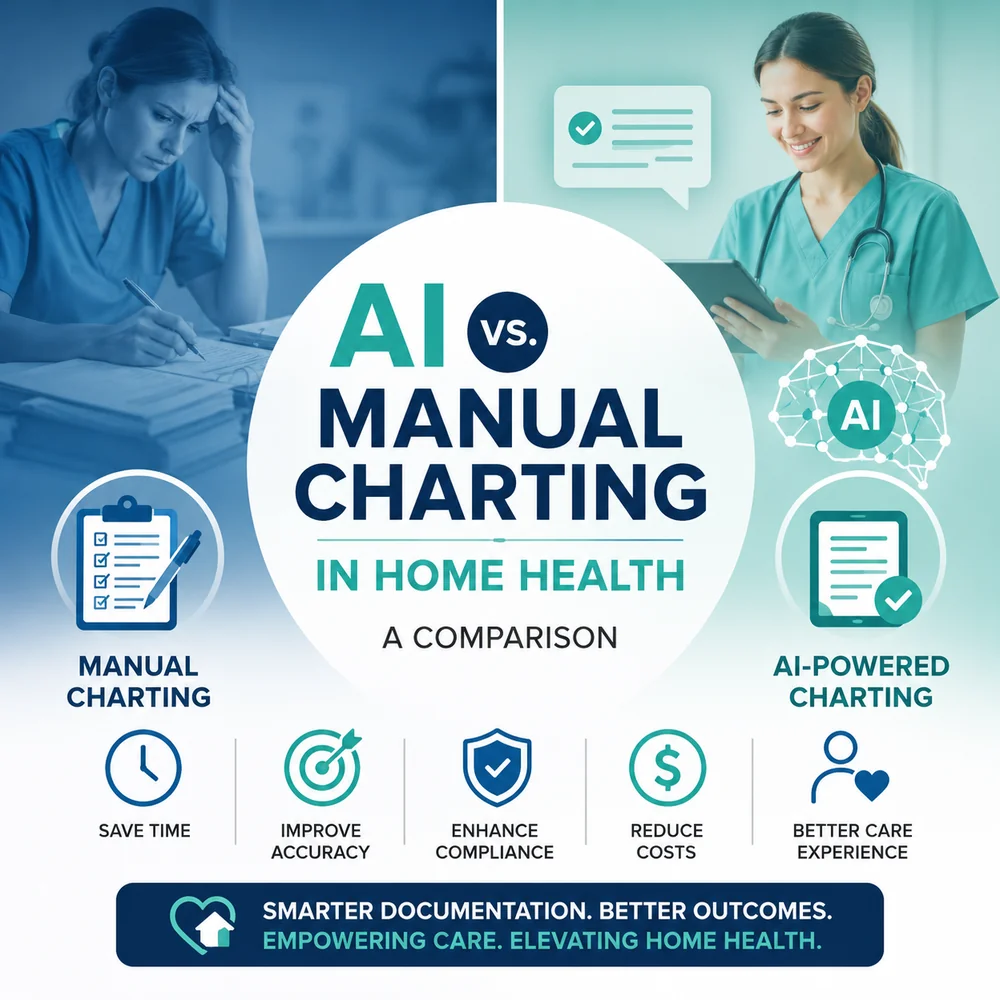
AI vs. Manual Charting in Home Health: An Honest Comparison
Manual charting has been the home health standard for decades, but AI-assisted documentation is changing how notes get done. This honest comparison weighs both across time, accuracy, compliance, cost, clinician experience, and patient care, and explains why the best workflows combine AI efficiency with clinician judgment.
Home Health Documentation Workflow: What Actually Slows Nurses Down?
Home health documentation is one of the biggest administrative burdens clinicians carry, but it is rarely slow for the reasons people assume. The problem usually isnt the nurse, its the workflow surrounding the note: medication reconciliation, OASIS, duplicate entry across disconnected systems, interruptions, and after-hours charting. Here is what actually slows nurses down and how to fix it.