Blog
Jan 9, 2026
The 5-Day Lag in Home Health Revenue Cycle Management

Arvind Sarin

You check your Days Sales Outstanding report, and the number is climbing. You blame the payers. You blame the slow Medicare processing times. You blame the new denial management team.
But if you want to find the real source of your cash flow problem, you need to look closer to home. You need to look at your QA queue.
In most home health agencies, there is a hidden time thief that nobody talks about. It is the lag time between a nurse closing a visit and the bill actually going out the door.
We call this "The 5-Day Lag." And it is costing you more than just time. It is costing you leverage.
The Anatomy of a Delay
Let us walk through a typical week in a busy agency.
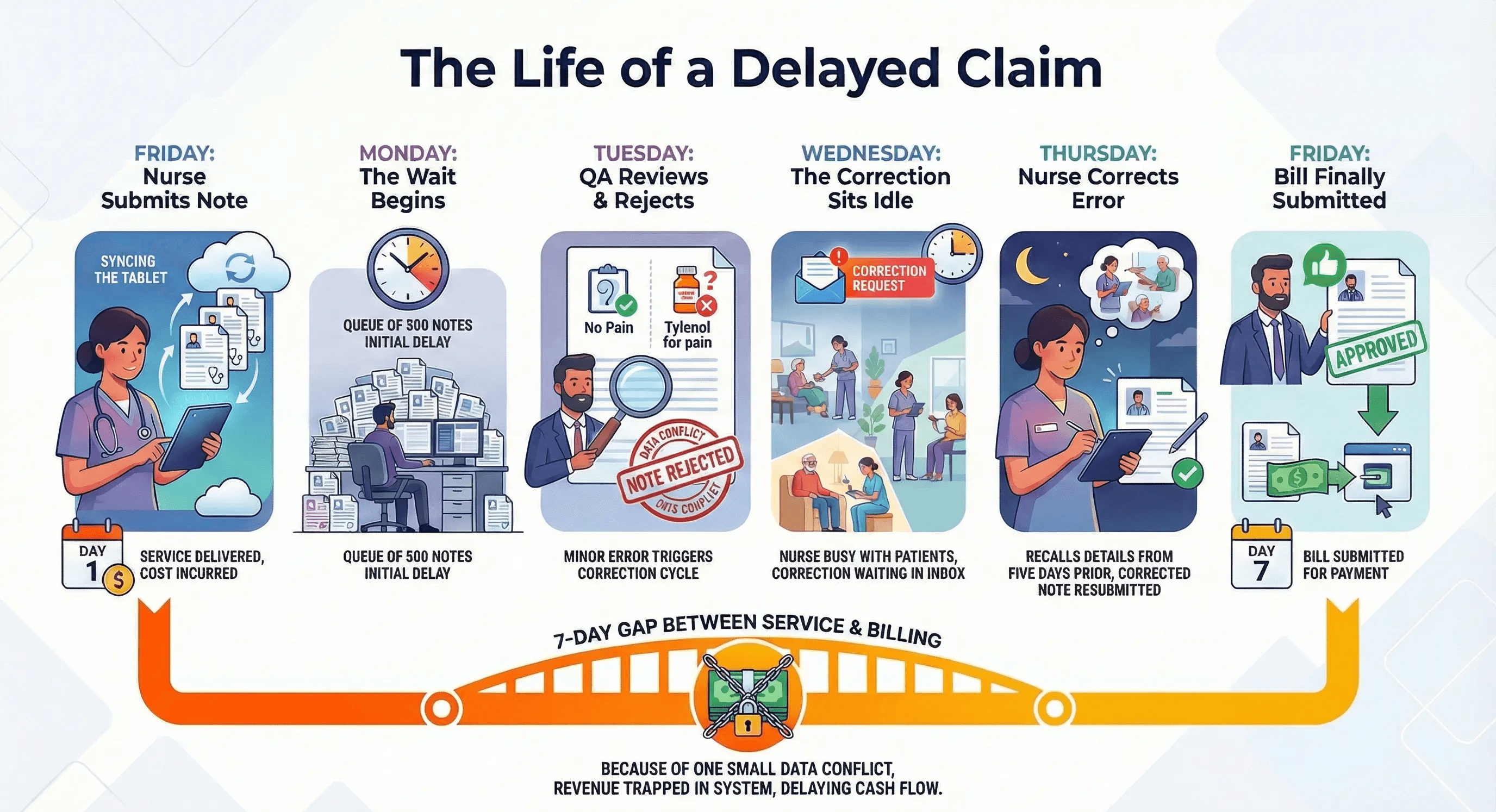
Friday Afternoon Your field nurse finishes her week. She rushes to sync her tablet and submits ten clinical notes before the weekend.
Monday Morning Your QA manager walks in. She has 500 notes in her queue from the weekend. She starts at the top.
Tuesday Afternoon She finally gets to the nurse's notes. She finds a conflict. The nurse marked the patient as having "No Pain" in the pain assessment, but documented "Administered Tylenol for pain 6/10" in the narrative.
Wednesday Morning The QA manager returns the note to the provider. The nurse is busy seeing patients. She does not see the correction request until that evening.
Thursday The nurse opens the note. She is annoyed. She tries to remember what happened five days ago. She corrects and resubmits.
Friday The QA manager approves the note. The bill drops.
That visit happened seven days ago. The care was delivered. The cost was incurred. But because of one small data conflict, the revenue was trapped in your system for a full week.
The High Cost of the "Ping Pong" Game
This back-and-forth process is the single biggest inefficiency in home health.
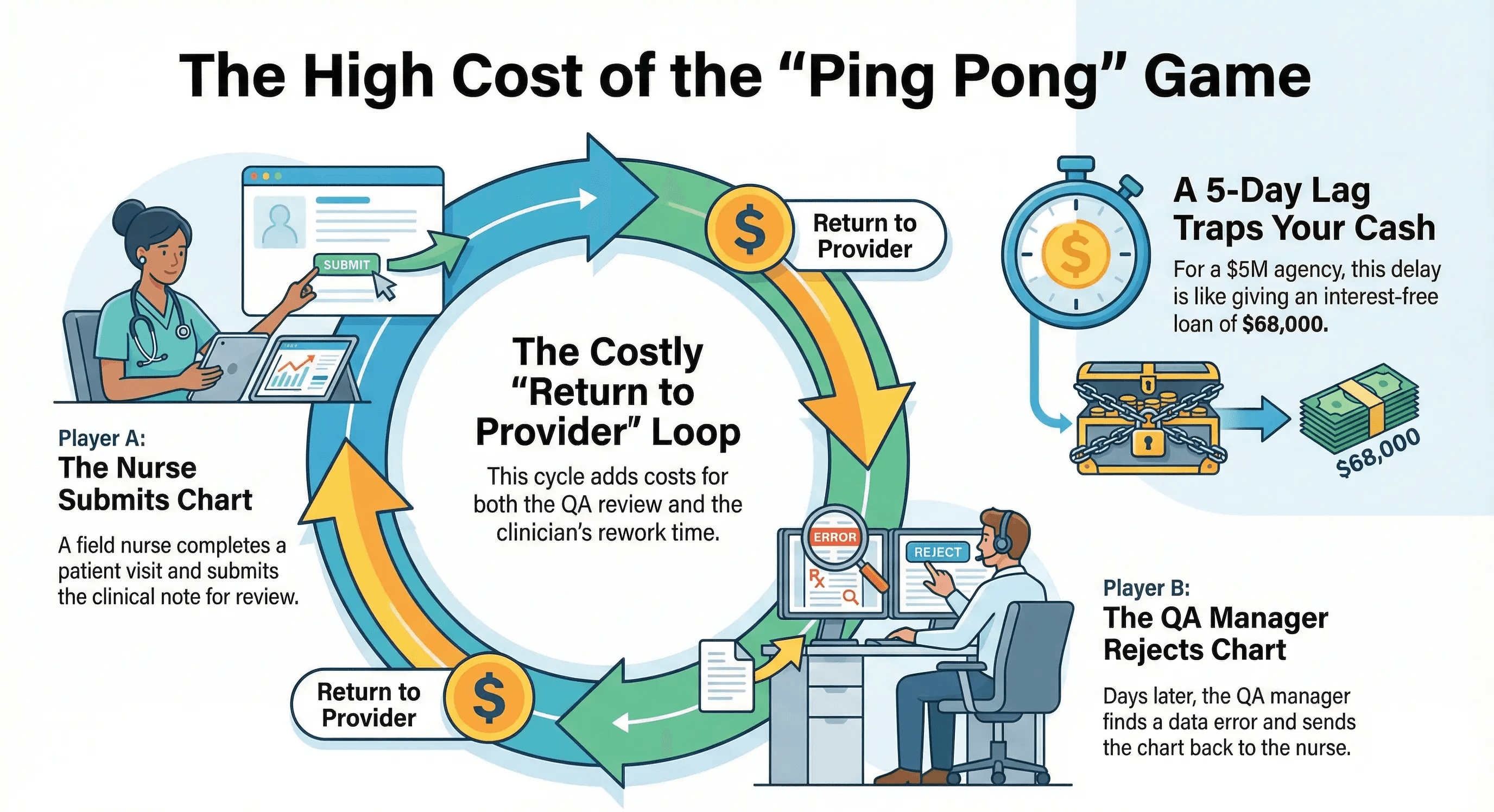
Every time a chart is "Returned to Provider," you are paying twice. You pay the QA manager to find the error. You pay the clinician to fix the error. And you pay a third time in the form of delayed cash flow.
If your agency bills $5 million a year, a 5-day lag on every claim means you are effectively lending the government $68,000 at any given moment, interest-free.
That is payroll money. That is expansion money. That is survival money.
QA Burnout Is a Genuine Concern
The tragedy is that your QA nurses are highly skilled clinicians. They should be looking for complex clinical issues that impact your Value-Based Purchasing score. They should ensure that the Plan of Care matches the diagnosis.
Instead, they are spending 80 percent of their time acting as spell checkers.
They are fixing date errors. They are flagging missing signatures. They are catching mismatched medication lists.
This is not "Quality Assurance." This is data janitor work. And it burns out your best office staff faster than anything else. When a QA manager quits, you do not just lose an employee. You lose the gatekeeper who protects your license.

The Solution is Pre-Submission Validation
You cannot solve this problem by hiring more QA staff. That just adds more cost to an already expensive department.
The answer is to stop the errors before they enter the queue.
Copper Digital uses AI to act as an instant "Pre-Check" for your field staff.
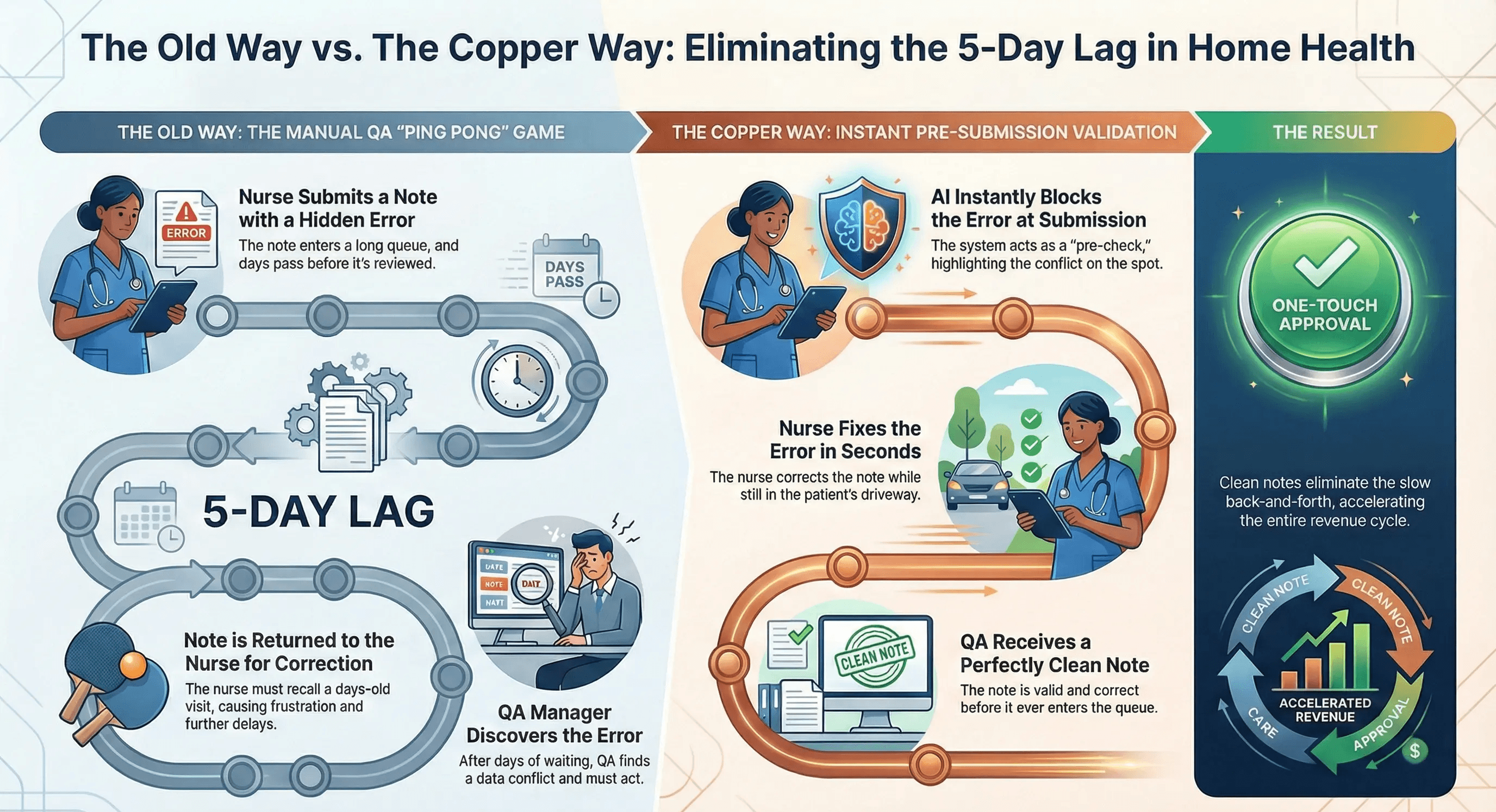
Instant Feedback: When the nurse tries to submit that note with the pain discrepancy, your system stops her. It highlights the conflict immediately.
The Correction Happens Now: The nurse is still in the patient's driveway. The visit is fresh in her mind. She fixes the error in ten seconds.
The Clean Handoff: The note hits the QA queue clean. The QA manager sees that the data is valid. She spends her time reviewing the clinical logic rather than hunting for typos. She approves it on Monday morning.
Frequently Asked Questions
Will this software replace my current QA staff?
No. The goal is not to replace your QA team but to elevate them. By automating the detection of simple data errors and conflicts, you free your QA nurses to focus on high-value tasks. They can spend their time on complex clinical reviews and denial prevention rather than fixing simple date discrepancies or missing signatures.
How much can this really reduce my Days Sales Outstanding
Agencies using automated pre-submission validation typically see a reduction in DSO by 3 to 5 days within the first quarter. By catching errors before the note enters the QA queue, you eliminate the "return to provider" loop that causes the majority of billing delays.
Does this work with my existing EMR?
Yes. Copper Digital integrates directly with major platforms like Homecare Homebase, WellSky, and KanTime. We sit on top of your existing workflow, acting as a gatekeeper that cleans the data before it is finalized in your system of record.
Is it difficult for older nurses to learn
We designed the interface specifically for non-technical users. It does not require complex training. If a nurse can use a smartphone, she can use our validation tool. It simply appears as a helpful prompt when she tries to submit a note with errors.
Shift Your RCM Strategy
Revenue Cycle Management does not start when you send the claim to CMS. It starts the moment the nurse touches her tablet.
If you want to lower your DSO, you have to attack the lag. You have to remove the friction that slows down chart approval.
Stop letting simple data errors hold your revenue hostage. Equip your team with automated validation tools and watch your cash flow accelerate.
See Copper Digital in action. Turn that 5-day lag into a 5-minute fix.