
Common OASIS Documentation Mistakes That Lead to Payment Delays
Common OASIS documentation mistakes, such as incomplete assessments, incorrect diagnosis coding, inaccurate Section GG scoring, medication and homebound-status errors, weak skilled-need documentation, and missing physician signatures, are among the biggest causes of home health payment delays. Because OASIS data drives PDGM reimbursement, most of these errors are preventable with point-of-care charting, strong QA, and AI-powered documentation validation.

Key Takeaways
- Incomplete OASIS assessments and inaccurate Section GG scoring are among the most common causes of payment delays.
- The primary diagnosis drives PDGM payment, so vague or unsupported coding reduces reimbursement.
- Weak homebound-status and skilled-need documentation trigger denials and ADRs.
- Inconsistencies between the OASIS and visit notes are a fast way to trigger an audit.
- Point-of-care charting, pre-billing QA, and AI validation catch errors before Medicare does.
💡 Common OASIS documentation mistakes are among the biggest causes of home health payment delays. Incomplete assessments, incorrect diagnosis coding, inaccurate Section GG scoring, medication and homebound-status errors, weak skilled-need documentation, and missing physician signatures can all delay reimbursement or trigger claim denials. Because OASIS data drives PDGM reimbursement, most of these errors are preventable with point-of-care charting, strong QA, and AI-powered documentation validation.
For most home health agencies, reimbursement depends on one thing: accurate and timely OASIS documentation.
Unfortunately, many agencies lose revenue every year because of avoidable OASIS documentation errors. A single mistake can lead to:
- Payment delays
- Returned claims
- Additional Documentation Requests (ADRs)
- Compliance audits
- Revenue loss
- Rework for clinicians and office staff
Because OASIS data directly impacts PDGM reimbursement, quality scores, and Medicare billing, documentation mistakes have consequences far beyond paperwork.
The good news? Most OASIS payment delays are entirely preventable.
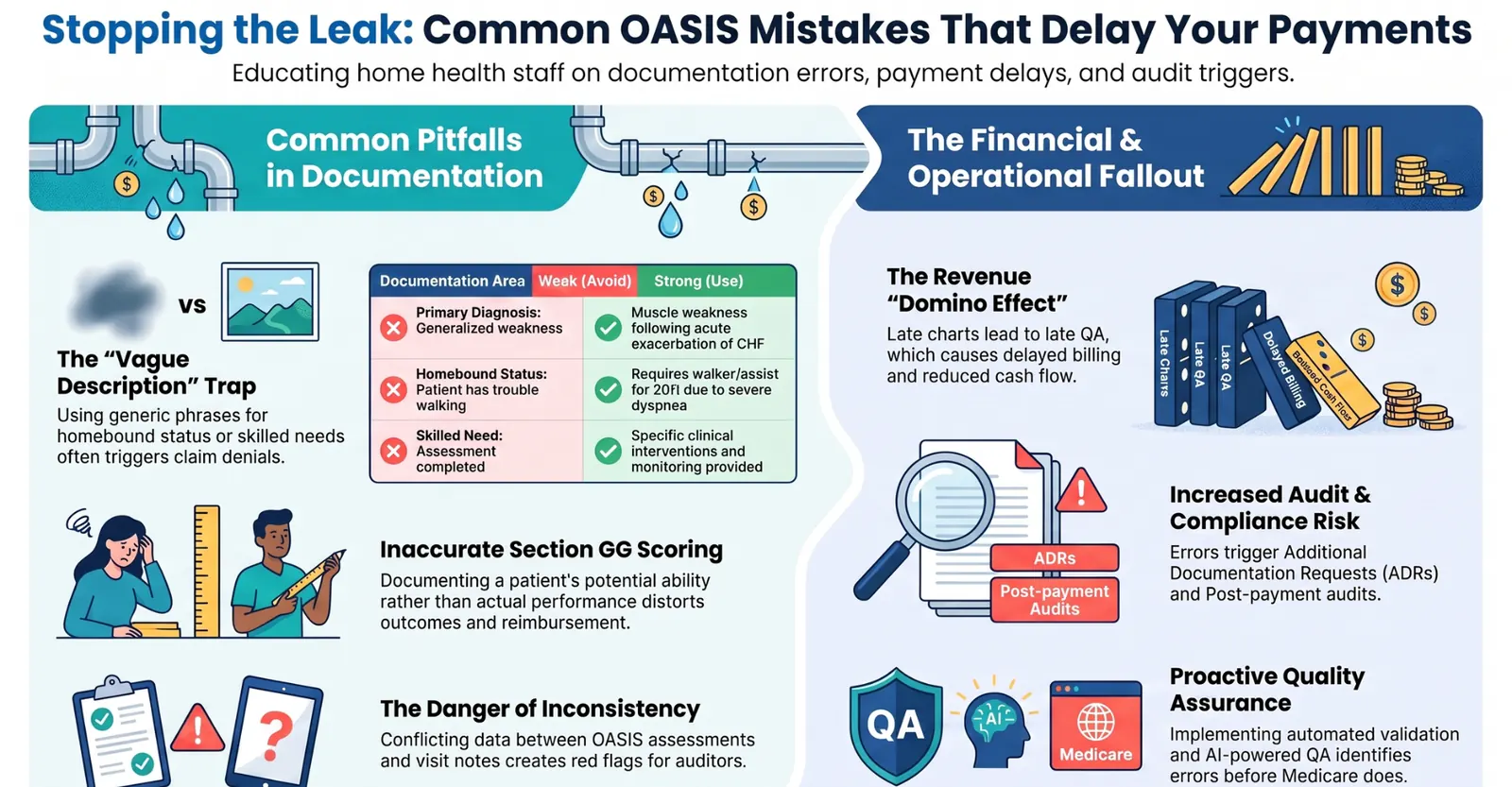
OASIS documentation errors are a slow leak on agency revenue, and most of them are preventable.
Let's look at the most common OASIS documentation mistakes that create billing problems for home health agencies.
1. Incomplete OASIS Assessments
One of the most common OASIS documentation mistakes that leads to payment delays is submitting an incomplete OASIS assessment. Home health nurses are responsible for documenting more than 100 assessment items during a Start of Care (SOC), Resumption of Care (ROC), Recertification, or Discharge assessment. These items cover everything from diagnoses and medications to functional abilities, cognitive status, wound care, and social determinants of health.
Because the assessment is so extensive, it is easy for nurses to accidentally leave fields blank or miss required information, especially when documentation is completed after hours or under time pressure.
Unfortunately, even one missing field can have significant consequences. Incomplete OASIS documentation may:
- Trigger validation errors
- Delay claim submission
- Require corrections and rework
- Increase administrative burden
- Slow down reimbursement timelines
Incomplete assessments also increase the risk of inaccurate PDGM grouping, which can directly impact agency revenue.
Common Missing Items Include:
- Medication reconciliation fields
- Functional assessment questions
- Homebound status documentation
- Caregiver availability information
- Risk assessment sections
Best Practice
Use documentation validation tools and encourage point-of-care charting whenever possible to reduce incomplete OASIS assessments.
2. Incorrect Primary Diagnosis Coding
The primary diagnosis is one of the most important pieces of information in OASIS documentation because it drives Medicare reimbursement under the Patient-Driven Groupings Model (PDGM).
An incorrect diagnosis can place a patient into the wrong payment category, resulting in:
- Reduced reimbursement
- Payment delays
- Returned claims
- Compliance concerns
- Additional documentation requests
Home health agencies often struggle with diagnosis coding because patients typically have multiple chronic conditions, recent hospitalizations, and complex medical histories. A common mistake is selecting a diagnosis that:
- Is too vague
- Does not support homebound status
- Does not explain the need for skilled services
- Uses an outdated ICD-10 code
Since Medicare requires agencies to demonstrate medical necessity, diagnosis accuracy is critical.
⚖️ Example. ❌ Weak diagnosis: Generalized weakness. ✅ Better diagnosis: Muscle weakness following hospitalization due to acute exacerbation of congestive heart failure.
Best Practice
Develop strong collaboration between clinicians and coding teams to ensure accurate diagnosis selection.
3. Inaccurate Section GG Functional Scoring
Section GG has become one of the most heavily scrutinized areas of OASIS documentation because it directly impacts:
- Functional impairment scoring
- PDGM reimbursement
- Quality reporting
- Patient outcomes measurement
Many home health nurses unintentionally document what a patient is capable of doing rather than what the patient actually performed during the assessment. This is one of the biggest OASIS documentation mistakes because Medicare expects clinicians to assess a patient's usual performance, not their potential ability.
For example, a patient may be physically capable of dressing independently but currently requires assistance because of pain or fatigue. Documenting the wrong functional level can:
- Reduce reimbursement
- Increase audit risk
- Distort patient outcomes data
- Create inconsistencies across the medical record
Common Errors Include:
- Estimating instead of observing
- Incorrect scoring of transfers
- Underestimating assistance needs
- Overestimating patient independence
Best Practice
Observe the patient performing tasks whenever possible rather than relying solely on patient or caregiver reports.
4. Inaccurate Medication Reconciliation and Medication Documentation
Medication reconciliation is one of the most important components of OASIS documentation, yet it is also one of the most common reasons for payment delays and compliance issues. Home health nurses frequently receive incomplete referral packets, outdated medication lists, or handwritten discharge instructions that don't match the patient's actual medications at home.
Missing medications, incorrect dosages, duplicate medications, or failure to document high-risk drugs can create major discrepancies between the physician's orders and the OASIS assessment. Because medication management directly impacts patient safety, CMS and Medicare Advantage plans closely scrutinize medication documentation during audits.
Medication documentation errors can result in:
- Returned claims and Requests for Additional Documentation (ADR)
- Delayed RAP and final claim payments
- Increased risk of hospital readmissions
- Compliance citations during surveys
- Higher liability exposure for agencies
Best Practices
- Conducting medication reconciliation at every Start of Care (SOC) and Resumption of Care (ROC)
- Verifying medications directly from pill bottles whenever possible
- Using standardized medication reconciliation workflows
- Leveraging AI-powered documentation tools that extract medications from referral PDFs and compare them with clinician-entered information
Accurate medication reconciliation protects both patient safety and agency revenue.
5. Missing or Incomplete Homebound Status Documentation
One of the most expensive OASIS documentation mistakes is failing to properly document why a patient is considered homebound. Medicare reimbursement for home health services requires patients to meet specific homebound criteria. Unfortunately, many nurses document generic statements such as:
- 'Patient rarely leaves home.'
- 'Patient has difficulty ambulating.'
- 'Patient needs assistance.'
These vague descriptions often fail to satisfy Medicare requirements. Homebound status documentation must clearly explain:
- Why leaving home requires considerable effort
- Physical limitations preventing independent mobility
- Need for assistive devices or caregiver support
- Medical conditions restricting the patient's ability to leave home safely
For example, instead of writing 'Patient has trouble walking,' a stronger statement would be: 'Patient requires a walker and one-person assistance to ambulate more than 20 feet due to severe dyspnea and generalized weakness following hospitalization.' The more specific the documentation, the easier it becomes to defend medical necessity during audits.
Poor homebound documentation can lead to:
- Claim denials
- Delayed reimbursement
- Medicare recoupments
- Additional documentation requests
- Increased survey deficiencies
Because homebound status forms the foundation of Medicare eligibility, this section of the OASIS assessment deserves significant attention.
6. Weak Skilled Need Documentation
Home health reimbursement depends heavily on demonstrating why skilled nursing services are medically necessary. Unfortunately, many visit notes fail to clearly articulate the skilled interventions being performed. Phrases like 'Patient doing okay,' 'Education provided,' or 'Assessment completed' do not adequately support skilled need.
Medicare expects documentation that answers:
- Why does the patient require skilled services?
- What assessment was performed?
- What interventions were provided?
- Why can't these services be performed safely by a caregiver?
Strong skilled need documentation includes:
- Clinical assessments
- Medication management
- Wound care complexity
- Disease management education
- Changes in patient condition
- Ongoing monitoring requirements
Poor skilled documentation is one of the leading causes of payment delays because reviewers cannot determine whether the services meet Medicare coverage requirements. This often triggers:
- Medical review requests
- Additional Development Requests (ADR)
- Payment suspensions
- Post-payment audits
- Claim denials
Detailed skilled documentation protects reimbursement and demonstrates the value nurses provide.
7. Missing Physician Orders and Signature Delays
Even perfectly completed OASIS assessments can experience payment delays if physician documentation is incomplete. Home health agencies frequently struggle with:
- Unsigned plans of care
- Missing physician orders
- Delayed verbal order signatures
- Incomplete certification documentation
Because Medicare requires physician certification for home health services, missing signatures can halt billing entirely. Common causes include:
- Manual fax processes
- Inefficient communication workflows
- Missing documentation packets
- Delayed physician follow-up
Payment delays caused by unsigned orders can extend for weeks and significantly impact agency cash flow.
Best Practices
- Automated physician signature tracking
- Electronic order management systems
- Early physician outreach
- Daily monitoring of unsigned orders
Reducing physician order delays can dramatically improve Days Sales Outstanding (DSO) and overall revenue cycle performance.
8. Documentation Inconsistencies Across OASIS and Visit Notes
One of the fastest ways to trigger an audit is when information documented in the OASIS assessment contradicts information documented elsewhere in the patient record. Examples include:
- OASIS indicates patient is independent, but visit notes describe extensive assistance.
- Fall risk scores do not align with mobility documentation.
- Wound measurements differ between assessments.
- Medication lists vary across notes.
Documentation inconsistencies create red flags for Medicare reviewers, managed care organizations, surveyors, and RAC auditors. These discrepancies often result in:
- Payment delays
- Claim denials
- Additional documentation requests
- Increased audit risk
Consistency is critical because OASIS drives PDGM reimbursement, quality reporting, Star Ratings, and compliance evaluations. Agencies should implement regular chart audits and use technology solutions that automatically identify conflicting information before claims are submitted.
9. Delayed OASIS Submission and Missed Filing Deadlines
Timing matters just as much as documentation accuracy. CMS has strict OASIS submission requirements, and late submissions can have significant financial consequences. Many agencies experience delays because:
- Nurses complete documentation after hours.
- Large caseloads create backlog.
- Manual workflows slow chart completion.
- Supervisors spend days correcting documentation errors.
Late OASIS submissions can result in:
- Payment delays
- Compliance citations
- Reduced cash flow
- Increased administrative burden
- Operational inefficiencies
For many agencies, documentation delays create a domino effect: late chart, late QA review, late billing, delayed payment. Reducing documentation turnaround time is one of the fastest ways to improve both clinician satisfaction and financial performance. AI-assisted documentation platforms are increasingly helping agencies reduce OASIS completion times from hours to minutes while improving submission timeliness.
10. Failing to Perform Internal QA and Documentation Reviews
Perhaps the most preventable OASIS documentation mistake is submitting assessments without a robust quality assurance process. Many payment delays occur because errors were never identified before claims were submitted. Common QA issues include:
- Missing OASIS fields
- Incorrect coding
- Documentation inconsistencies
- Incomplete narratives
- Medication discrepancies
- Missing signatures
A strong pre-billing QA process can significantly reduce payment delays, claim denials, audit findings, revenue leakage, and staff rework. Leading home health agencies increasingly use:
- Automated QA workflows
- AI documentation review tools
- Coding validation systems
- OASIS completeness checks
- Clinical documentation improvement programs
The goal is simple: identify errors before Medicare does. A proactive documentation review process not only accelerates reimbursement but also reduces nurse frustration and protects agencies from costly compliance issues.
The Cost of OASIS Documentation Mistakes
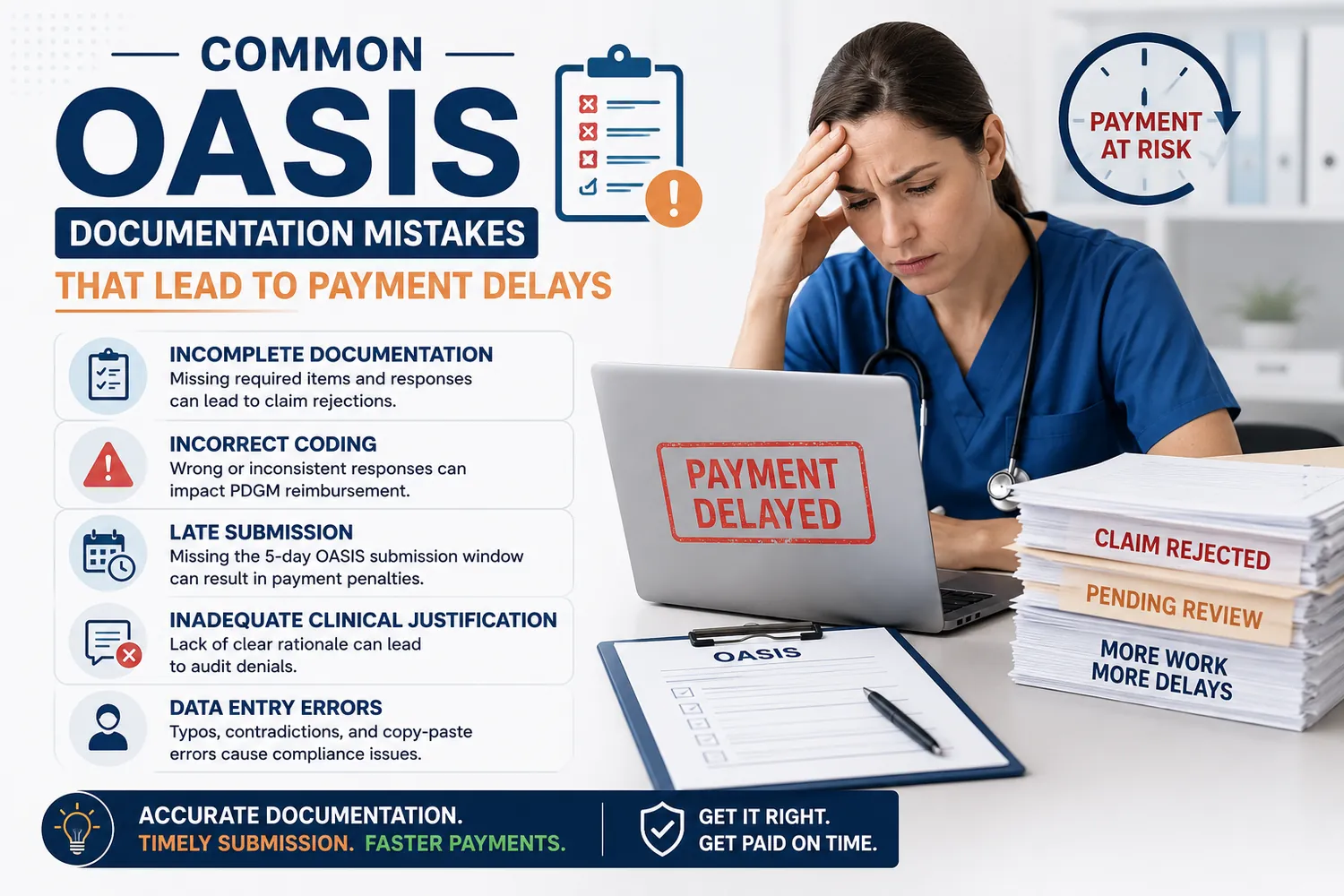
Accurate documentation, timely submission, faster payments: get it right, get paid on time.
Common OASIS documentation mistakes lead to:
- Payment delays
- Claim denials
- Revenue loss
- Increased audit risk
- Lower quality scores
- More after-hours charting
- Higher nurse burnout
For many agencies, improving documentation accuracy isn't just about compliance. It's about protecting revenue and retaining clinicians. This is also one of the biggest drivers of OASIS documentation burnout among home health nurses.
How Technology Can Help Prevent OASIS Payment Delays
Modern home health agencies are increasingly adopting:
- AI-powered documentation platforms
- Automated medication reconciliation
- Referral data extraction
- Real-time documentation validation
- OASIS completion alerts
- EMR integrations
These tools help nurses spend less time documenting and more time caring for patients while reducing costly documentation mistakes. The strongest platforms pair an AI documentation agent with a human-in-the-loop review so nurses approve every record before it reaches billing.
Final Thoughts
OASIS documentation mistakes may seem minor, but their impact on reimbursement can be significant. The most successful home health agencies treat documentation as a strategic priority because accurate OASIS assessments affect:
- Payment
- Compliance
- Quality outcomes
- Staff satisfaction
- Financial performance
Improving OASIS documentation accuracy is one of the fastest ways to reduce payment delays and build a healthier, more sustainable home health organization.
🚀 Turn OASIS accuracy into faster payments. Copper Digital's AI Documentation Agent extracts medications and diagnoses from referral packets, validates completeness in real time, flags inconsistencies before billing, and drafts the OASIS-E, with a nurse reviewing and approving every record. Explore AI tools for home health nurses, see how we finish a Start of Care assessment in under 10 minutes, or book a demo.
🎓 Want to master OASIS and avoid costly payment delays? Watch Module 5.2: OASIS-E Explained for Home Health Agencies inside our Home Health Mastermind Skool community, where we break down how OASIS impacts PDGM reimbursement, Section GG scoring, documentation best practices, common coding mistakes, and strategies to improve compliance and cash flow.
Bottom Line
Most OASIS payment delays trace back to preventable documentation errors, from incomplete assessments and Section GG scoring to weak homebound and skilled-need notes.

The Copper Clinical Team brings together nurses and clinical documentation specialists focused on home health, OASIS accuracy, and human-in-the-loop AI. They write about the tools and workflows helping clinicians reduce administrative burden and grow their careers.
Frequently asked
Frequently asked questions
The most common OASIS documentation mistakes include incomplete assessments, inaccurate Section GG scoring, medication reconciliation errors, incorrect diagnosis coding, weak homebound and skilled-need documentation, missing physician signatures, and inconsistencies between the OASIS and visit notes.
Join the conversation
Leave a comment
Related reading
OASIS-E1 vs OASIS-E2: A Complete Side-by-Side Comparison for Home Health Agencies
Wondering what changed between OASIS-E1 and OASIS-E2? OASIS-E2 is an incremental update, not a redesign. The framework, five time points, and PDGM methodology stay the same, while CMS refines Section GG, cognitive and behavioral items, SDOH, and SPADEs. This guide compares both versions side by side and gives you a transition plan and checklist.

Why OASIS Documentation Is Burning Out Your Nurses
OASIS documentation is the CMS-required Outcome and Assessment Information Set that home health nurses complete for Medicare patients. With more than 100 data elements and a Start of Care assessment that takes 60 to 90 minutes, it often follows nurses home as after-hours 'pajama time,' making it a leading cause of home health nurse burnout. AI-powered documentation with human-in-the-loop review can cut charting time and give nurses their evenings back.

The Biggest Documentation Challenges Home Health Nurses Face
Home health nurses face heavy documentation challenges: delayed point-of-care charting, excessive administrative time, clunky EHRs, OASIS complexity, strict reimbursement rules, working in isolation, endless QA corrections, and after-hours charting that drives burnout. Reducing documentation burden is now essential for clinician retention, patient outcomes, and agency financial performance.