
Why OASIS Documentation Is Burning Out Your Nurses
OASIS documentation is the CMS-required Outcome and Assessment Information Set that home health nurses complete for Medicare patients. With more than 100 data elements and a Start of Care assessment that takes 60 to 90 minutes, it often follows nurses home as after-hours 'pajama time,' making it a leading cause of home health nurse burnout. AI-powered documentation with human-in-the-loop review can cut charting time and give nurses their evenings back.

Key Takeaways
- OASIS documentation directly affects PDGM reimbursement, Star Ratings, and compliance.
- A Start of Care assessment can take 60 to 90 minutes and follow nurses home as pajama time.
- OASIS complexity and after-hours charting fuel burnout, turnover, and the nursing shortage.
- AI documentation can cut charting time while a nurse reviews and approves every record.
💡 OASIS documentation is the CMS-required assessment home health nurses complete for Medicare patients, and it has become a leading cause of nurse burnout. With more than 100 data elements and a Start of Care assessment that takes 60 to 90 minutes, OASIS charting often follows nurses home as after-hours 'pajama time.' AI-powered documentation with human-in-the-loop review can cut charting time while keeping clinicians in control, giving nurses their evenings back.
Home health nurses didn't choose this profession because they love paperwork.
They became nurses to care for patients, build relationships, and make a difference in people's lives. Yet for thousands of clinicians across the country, the workday doesn't end when the last patient visit is complete.
It follows them home.
Many home health nurses spend hours every evening finishing OASIS assessments, updating care plans, reconciling medications, and completing documentation required for compliance and reimbursement. This phenomenon, often called 'pajama time', has become one of the leading contributors to home health nurse burnout.
The reality is stark: OASIS documentation has evolved into one of the biggest administrative burdens in home health care.
As patient complexity increases and regulatory requirements continue to grow, many nurses now spend nearly one-third of their day charting instead of delivering care.
The result?
- Emotional exhaustion
- Poor work-life balance
- Higher turnover
- Staffing shortages
- Reduced job satisfaction
If home health agencies want to improve retention and support their clinicians, addressing the burden of OASIS documentation has become essential.
What is OASIS Documentation?
The Outcome and Assessment Information Set (OASIS) is a standardized assessment required by the Centers for Medicare & Medicaid Services (CMS) for Medicare-certified home health agencies.
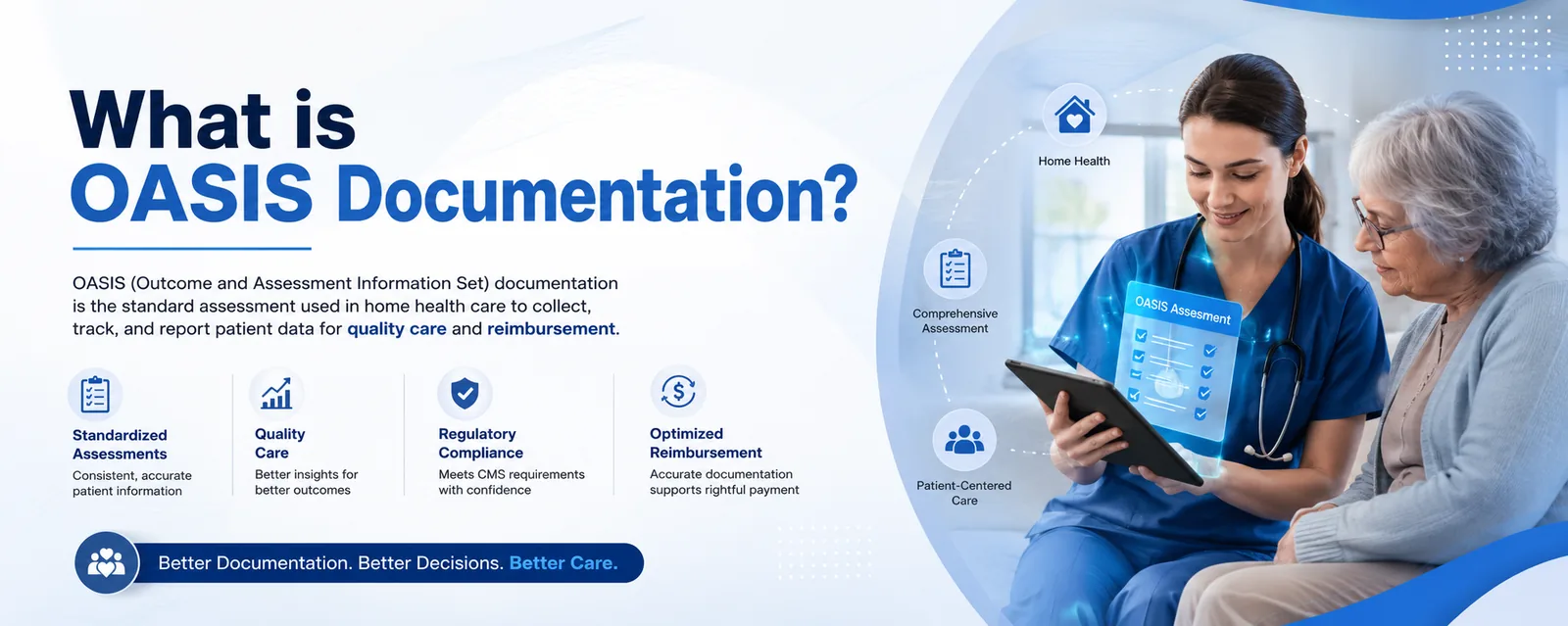
OASIS is the standardized assessment home health uses for both quality care and reimbursement.
OASIS documentation captures information about:
- Functional status
- Clinical conditions
- Medication management
- Hospitalization risk
- Care planning
- Patient outcomes
The assessment directly impacts:
- Medicare reimbursement
- PDGM payment calculations
- Quality reporting
- Star ratings
- Regulatory compliance
Because so much depends on getting OASIS documentation right, the pressure on nurses is enormous.
A Brief History of How OASIS Documentation Started
The OASIS documentation system was first introduced in 1999 as part of CMS's efforts to improve the quality, consistency, and accountability of home health care across the United States. Before OASIS, home health documentation varied significantly between agencies, making it difficult to measure patient outcomes, compare provider performance, and ensure accurate Medicare payments.
Over the years, OASIS has evolved through multiple versions, including OASIS-C, OASIS-D, and the current OASIS-E, which introduced more standardized patient assessment data elements (SPADEs) and expanded requirements around social determinants of health, functional status, and care coordination.
Today, OASIS documentation is much more than a clinical assessment form. It serves four major purposes:
- Measures patient outcomes and quality of care
- Determines Medicare reimbursement under PDGM
- Supports Star Ratings and value-based purchasing initiatives
- Creates a standardized patient record for care coordination and compliance
For home health agencies, accurate OASIS documentation is both a clinical and financial necessity.
What does OASIS Documentation Consist of?
Many people are unaware that an OASIS assessment comprises over 100 individual data elements and assessment fields that nurses must complete accurately.
These questions span nearly every aspect of the patient's health and home environment. Major OASIS documentation categories include:
Patient Demographics
- Insurance information
- Living arrangements
- Emergency contacts
- Caregiver support
Clinical Diagnoses
- Primary diagnosis
- Secondary diagnoses
- Comorbidities
- Recent hospitalizations
Medication Reconciliation
- Medication management ability
- Medication changes
- High-risk medications
- Adherence concerns
Functional Assessments
- Grooming
- Dressing
- Bathing
- Toileting
- Feeding
- Ambulation
- Transferring
- Bed mobility
Cardiac and Respiratory Status
- Shortness of breath
- Oxygen use
- Cardiac symptoms
- Vital signs
Skin and Wound Assessments
- Pressure injuries
- Surgical wounds
- Skin integrity
- Wound measurements
Cognitive and Behavioral Assessments
- Memory deficits
- Confusion
- Anxiety
- Depression
- Decision-making ability
Pain Assessments
- Frequency of pain
- Impact on activities
- Pain management effectiveness
Social Determinants of Health
- Transportation challenges
- Financial limitations
- Food insecurity
- Housing concerns
Risk Assessments
- Fall risk
- Hospitalization risk
- Emergency department utilization risk
Care Planning
- Patient goals
- Interventions
- Skilled needs
- Education requirements
Why is OASIS so Time-Consuming?
Because nurses are not simply checking boxes. They are:
- Observing the patient
- Interpreting clinical findings
- Conducting functional assessments
- Reviewing medications
- Documenting narratives
- Verifying compliance requirements
- Ensuring reimbursement accuracy
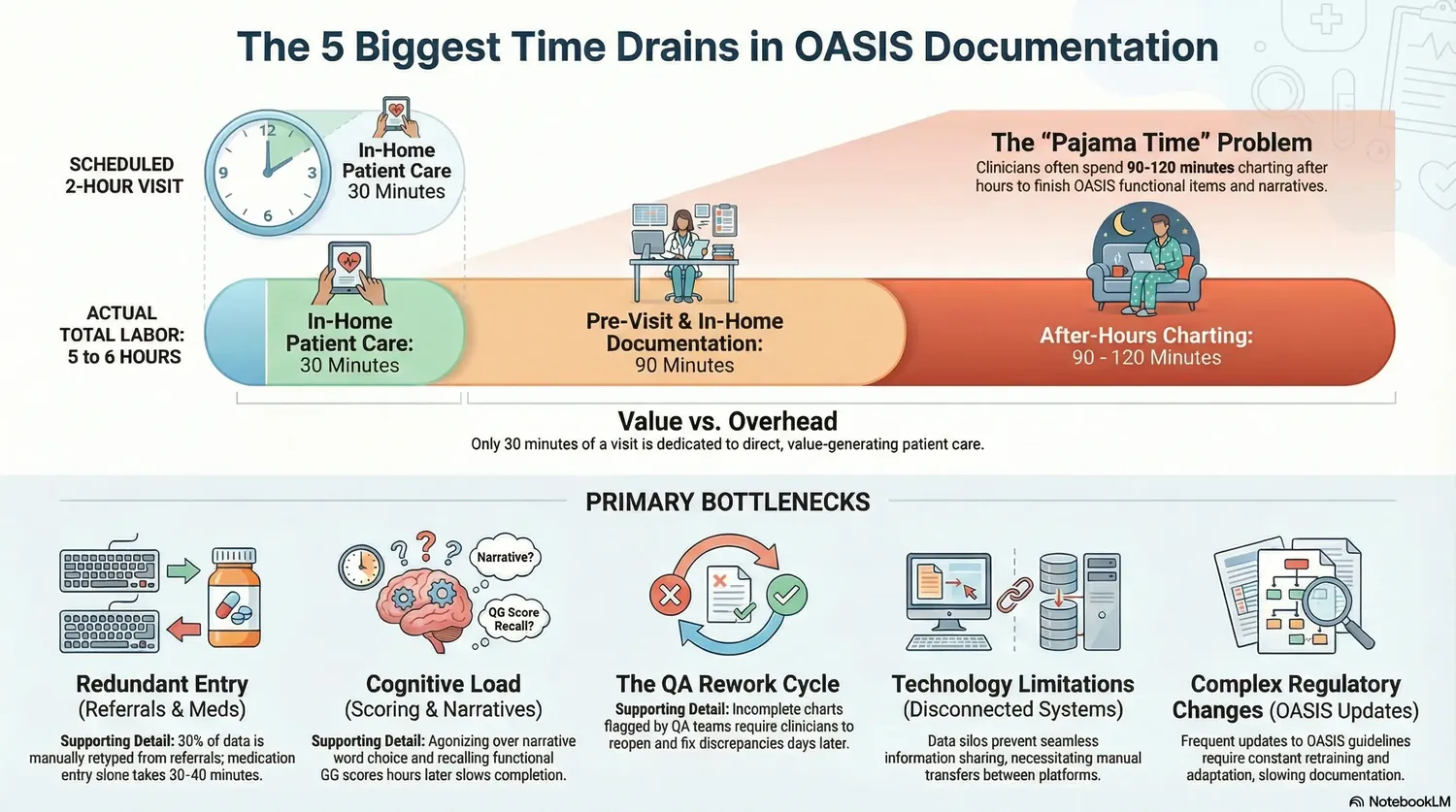
A scheduled 2-hour visit can become 5 to 6 hours of total labor once documentation is counted.
An average Start of Care (SOC) OASIS assessment can take 60 to 90 minutes or longer, especially for complex patients.
What is OASIS Documentation in Home Health?
In home health, OASIS documentation is the comprehensive assessment that clinicians complete for Medicare patients at specific points in care, including:
- Start of Care (SOC)
- Resumption of Care (ROC)
- Recertification
- Significant Change in Condition
- Transfer
- Discharge
The purpose of OASIS in home health is to create a complete picture of the patient:
- Medical condition
- Functional limitations
- Cognitive status
- Medication profile
- Living situation
- Caregiver support
- Risk factors
- Clinical needs
Unlike hospital documentation, home health nurses often complete OASIS assessments in the patient's home, where there may be:
- Limited internet connectivity
- No clinical support team nearby
- Multiple distractions
- Time pressures
- Extensive documentation requirements
Because Medicare reimbursement is directly tied to OASIS data, home health nurses carry enormous responsibility. A single missed assessment detail can affect:
- PDGM payment categories
- Risk adjustment
- Quality scores
- Reimbursement
- Compliance audits
This is one of the biggest reasons why OASIS documentation is frequently cited as a major contributor to nurse burnout and after-hours charting in home health.
What Happens if OASIS Documentation is Not Filed on Time?
Timely OASIS submission is not optional. CMS has strict timelines for both completing and transmitting OASIS assessments. Late or incomplete OASIS documentation can have serious consequences for home health agencies.
1. Payment Delays
Claims cannot be processed properly if OASIS assessments are incomplete or inaccurate, leading to cash flow issues and delayed reimbursement.
2. Reduced Medicare Payments
CMS can reduce reimbursement when required documentation timelines are missed. Even small delays can impact revenue significantly for agencies with high patient volumes.
3. Compliance Risks and Audits
Incomplete or inconsistent OASIS documentation can trigger:
- ADRs (Additional Documentation Requests)
- Medical reviews
- Compliance investigations
- CMS audits
4. Increased Claim Denials
Vague documentation, missing eligibility details, or incorrect OASIS coding can lead to:
- Denied claims
- Returned claims
- Payment recoupments
5. Lower Quality Scores and Star Ratings
OASIS data directly impacts:
- Quality measures
- Star Ratings
- Value-Based Purchasing performance
Poor documentation can affect an agency's reputation and future referrals.
6. More Nurse Burnout
Perhaps the biggest consequence is the impact on clinicians. When nurses miss documentation deadlines, they often spend evenings and weekends catching up on charting, creating:
- After-hours documentation
- Emotional exhaustion
- Work-life imbalance
- Higher turnover rates
This is why many home health agencies are investing in AI-powered OASIS documentation platforms and AI documentation agents that help nurses complete assessments faster while maintaining accuracy and compliance.
🎓 Want to go deeper into OASIS? Watch Module 5.2: OASIS-E Explained for Home Health Agencies inside our Home Health Mastermind Skool community. Learn how OASIS impacts reimbursement, Star Ratings, and compliance, and why documentation accuracy can make or break a home health agency.
Why OASIS Documentation is Driving Nurse Burnout
1. OASIS Documentation Creates a 'Double Shift'
One of the biggest reasons for home health nurse burnout is that OASIS documentation creates what many clinicians call a second shift.
A home health nurse may spend six to eight hours visiting patients and then return home to complete another two or three hours of documentation. This after-hours charting, often referred to as 'pajama time,' has become one of the most significant contributors to burnout in home health.
Many Start of Care visits require:
- Clinical assessments
- Medication reconciliation
- Care plan documentation
- OASIS-E functional scoring
- Narrative writing
- Compliance checks
By the end of the day, many nurses are mentally exhausted, yet their work isn't finished.
The result is:
- Poor work-life balance
- Increased emotional exhaustion
- Higher stress levels
- Reduced job satisfaction
- Greater nurse turnover
For many clinicians, OASIS documentation burnout is not caused by patient care itself; it's caused by the documentation that follows them home every night.
2. Nurses Spend Nearly One-Third of Their Day Charting
Studies consistently show that clinicians spend a significant portion of their workday on documentation and administrative tasks. In home health, nurses can spend nearly one-third of their shift charting, reviewing records, and completing OASIS documentation.
This administrative burden means nurses spend less time:
- Educating patients
- Building relationships
- Performing assessments
- Coordinating care
Instead, they spend more time:
- Clicking through screens
- Completing forms
- Searching for information
- Correcting documentation errors
This imbalance contributes directly to home health nurse burnout and is one of the biggest reasons nurses say they feel disconnected from the profession they love.
3. Traditional EMRs Make OASIS Documentation Even Harder
Many home health clinicians don't dislike documentation itself. They dislike the systems they are forced to use.
Traditional home health EMRs such as WellSky, Axxess, and MatrixCare were largely built to satisfy regulatory requirements and billing workflows, not to create an intuitive experience for nurses.
As a result, clinicians frequently experience:
- Repetitive data entry
- Duplicate documentation
- Multiple screens for one assessment
- Excessive clicking
- Slow workflows
- Poor mobile experiences
Many nurses report spending more time navigating software than interacting with patients. This is one of the biggest home health documentation challenges facing agencies today.
Poor technology experiences directly contribute to:
- Documentation fatigue
- Nurse dissatisfaction
- Increased after-hours charting
- Higher turnover rates
4. OASIS-E Assessments are Incredibly Complex
Another major contributor to OASIS documentation burnout is the complexity of the assessment itself. OASIS-E requires nurses to document highly detailed information about a patient's:
- Functional abilities
- Respiratory status
- Cardiac conditions
- Medication management
- Fall risk
- Cognitive status
- Caregiver support
Many functional questions require clinicians to accurately observe activities such as:
- Moving from lying to sitting
- Transferring safely
- Walking specific distances
- Managing daily activities
For nurses without extensive rehabilitation experience, these assessments require significant cognitive effort. Every question demands careful observation, interpretation, and documentation. As patient complexity continues to rise, the mental load associated with completing OASIS assessments continues to increase as well.
5. OASIS Documentation Creates Constant Fear of Mistakes
Unlike many other clinical notes, OASIS documentation directly impacts agency revenue and compliance. A single mistake can potentially affect:
- Reimbursement
- Quality scores
- Audit findings
- Claims processing
- Star ratings
- Agency performance metrics
As a result, many nurses carry the constant fear of getting something wrong. Questions constantly run through their minds:
- Did I answer correctly?
- Did I miss an eligibility detail?
- Will QA reject this?
- Could this lead to a claim denial?
- Could this trigger a CMS audit?
The pressure to be perfect creates enormous anxiety. For many home health nurses, documentation becomes emotionally exhausting because every chart feels like a high-stakes test.
6. OASIS Documentation Has Become a Financial and Legal Responsibility
For many home health clinicians, OASIS documentation feels like much more than paperwork. It has become:
- A reimbursement tool
- A compliance requirement
- A legal document
- A financial safeguard
Nurses know that one missed detail can:
- Delay billing
- Trigger CMS recoupments
- Cause payment reductions
- Increase audit risk
- Cost the agency thousands of dollars
This invisible pressure places an enormous burden on clinicians. They aren't simply documenting patient care. They often feel responsible for protecting the financial health of the organization.
7. Documentation Is Taking Time Away From Patients
The biggest tragedy of excessive OASIS documentation is that it takes time away from the reason nurses entered healthcare in the first place: caring for patients.
Every additional hour spent charting is an hour not spent:
- Educating families
- Building relationships
- Listening to concerns
- Supporting recovery
- Being present with patients
Documentation is essential. But when administrative work consumes such a large percentage of a clinician's day, patient care inevitably suffers. This is why reducing home health documentation burden has become one of the most important workforce challenges facing the industry today.
OASIS Documentation Is Fueling the Nursing Shortage
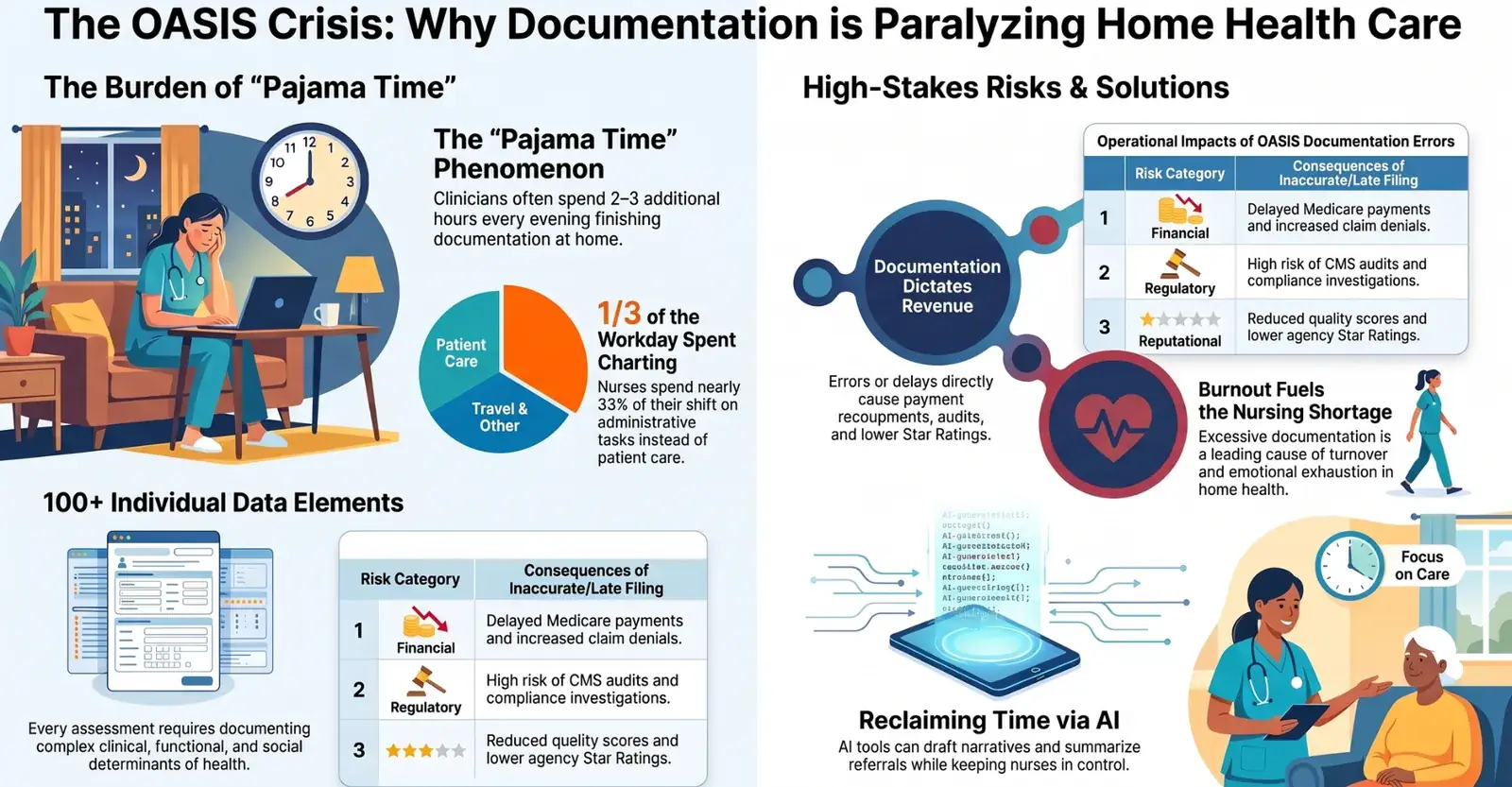
OASIS documentation errors carry financial, regulatory, and reputational risk, and the burden fuels the nursing shortage.
The nursing shortage and documentation burden create an endless cycle. More documentation leads to:
- Increased stress
- Emotional exhaustion
- Lower job satisfaction
- Higher turnover
As more nurses leave, the workload on remaining clinicians becomes even heavier. This creates even more burnout and even more resignations.
Healthcare leaders increasingly recognize that solving the workforce crisis isn't simply about hiring more nurses. It's also about reducing the administrative burden that is driving them away.
How AI Is Changing OASIS Documentation
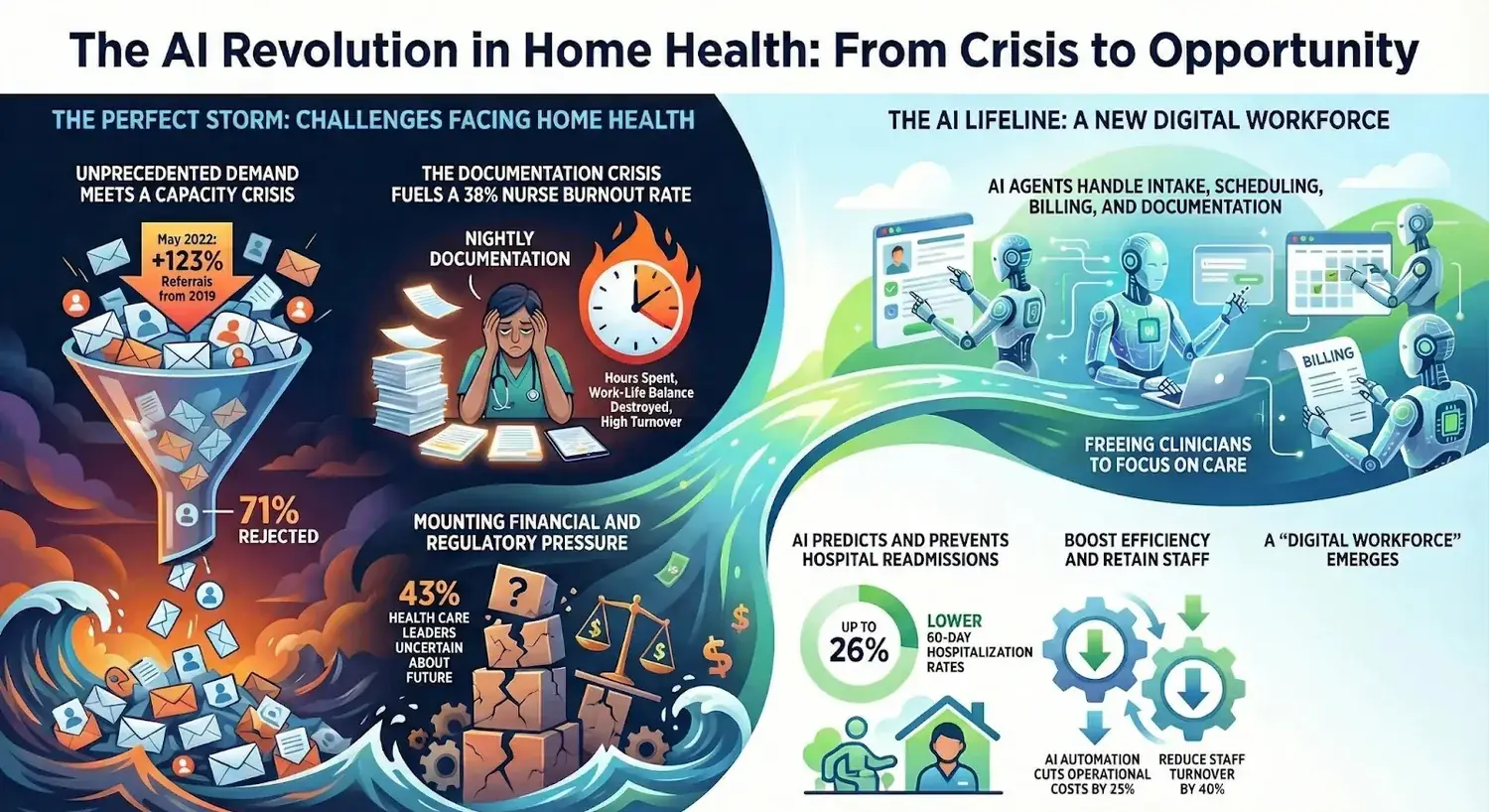
AI is turning the documentation crisis into an opportunity, handling the busywork so nurses can focus on care.
New AI-powered documentation tools are helping agencies reduce the burden of OASIS charting. Modern AI documentation platforms can:
- Summarize referral documents
- Assist with medication reconciliation
- Generate draft narratives
- Capture voice notes
- Reduce duplicate data entry
- Improve documentation completeness
The best solutions use a human-in-the-loop approach, ensuring nurses remain in control of all clinical decisions and final documentation. The goal isn't to replace nurses. It's to give them their time back.
How Copper Digital Is Helping Home Health Agencies Reduce Documentation Burnout
At Copper Digital, we believe nurses should spend more time caring for patients and less time fighting documentation.
Our AI-powered documentation solutions are designed specifically for home health workflows and help agencies:
- Reduce after-hours charting
- Accelerate OASIS completion
- Improve documentation quality
- Reduce administrative burden
- Support nurse retention
Because every minute spent charting after hours is a minute taken away from rest, family, and recovery.
Final Thoughts
OASIS documentation is essential. But the way many agencies manage OASIS documentation today is unsustainable. When nurses spend hours every evening completing charts, burnout becomes inevitable.
Reducing the burden of OASIS documentation isn't simply about efficiency. It's about protecting the people who care for our patients. And that may be one of the most important investments a home health agency can make.
🚀 Ready to give your nurses their evenings back? Copper Digital's AI Documentation Agent captures the visit by voice, photo, or tap, drafts the OASIS-E and narratives, and flags gaps, with a nurse reviewing and approving every record. Explore AI tools for home health nurses, see how we finish a Start of Care assessment in under 10 minutes, or book a demo.
🎧 Related listening: On the Inside Home Health podcast, we break down why OASIS is the single hardest document in home health, the skip-logic, the goals and interventions, and the real cost of getting it wrong.
Bottom Line
OASIS is a 100-plus-item, CMS-required assessment that often takes longer than the visit itself, making it one of the biggest drivers of home health nurse burnout.

The Copper Clinical Team brings together nurses and clinical documentation specialists focused on home health, OASIS accuracy, and human-in-the-loop AI. They write about the tools and workflows helping clinicians reduce administrative burden and grow their careers.
Frequently asked
Frequently asked questions
OASIS documentation is complex because it combines clinical assessments, regulatory requirements, reimbursement rules, and quality reporting into one comprehensive process.
Join the conversation
Leave a comment
Related reading

The Biggest Documentation Challenges Home Health Nurses Face
Home health nurses face heavy documentation challenges: delayed point-of-care charting, excessive administrative time, clunky EHRs, OASIS complexity, strict reimbursement rules, working in isolation, endless QA corrections, and after-hours charting that drives burnout. Reducing documentation burden is now essential for clinician retention, patient outcomes, and agency financial performance.

Can AI Help Reduce Nurse Burnout?
Nurses now spend nearly as much time documenting care as delivering it, and the result is unprecedented burnout. AI can help, but only when it is designed to support nurses rather than replace them. This guide breaks down how AI reduces cognitive load, ambient documentation, predictive deterioration detection, human-in-the-loop safety, and what it means for retention and home health.

The Hidden Cost of Late Nursing Documentation
Late nursing documentation is far more than an administrative inconvenience. Delayed charting increases patient safety risks, creates handoff gaps, triggers claim denials and undercoding, raises legal and audit exposure, and accelerates nurse burnout and turnover, costing healthcare organizations millions. Most delays happen because nurses lack time to chart in real time, and AI and point-of-care documentation tools can give that time back.