
Home Health Nurse Scheduling Is Broken
A spreadsheet taped to the nurses' station once ate Laurel Chiaramonte's weekends. Then an algorithm turned 18 hours of schedule writing into five minutes. Here is why home health scheduling is the harder problem, and what fair, human-overseen AI scheduling actually looks like.
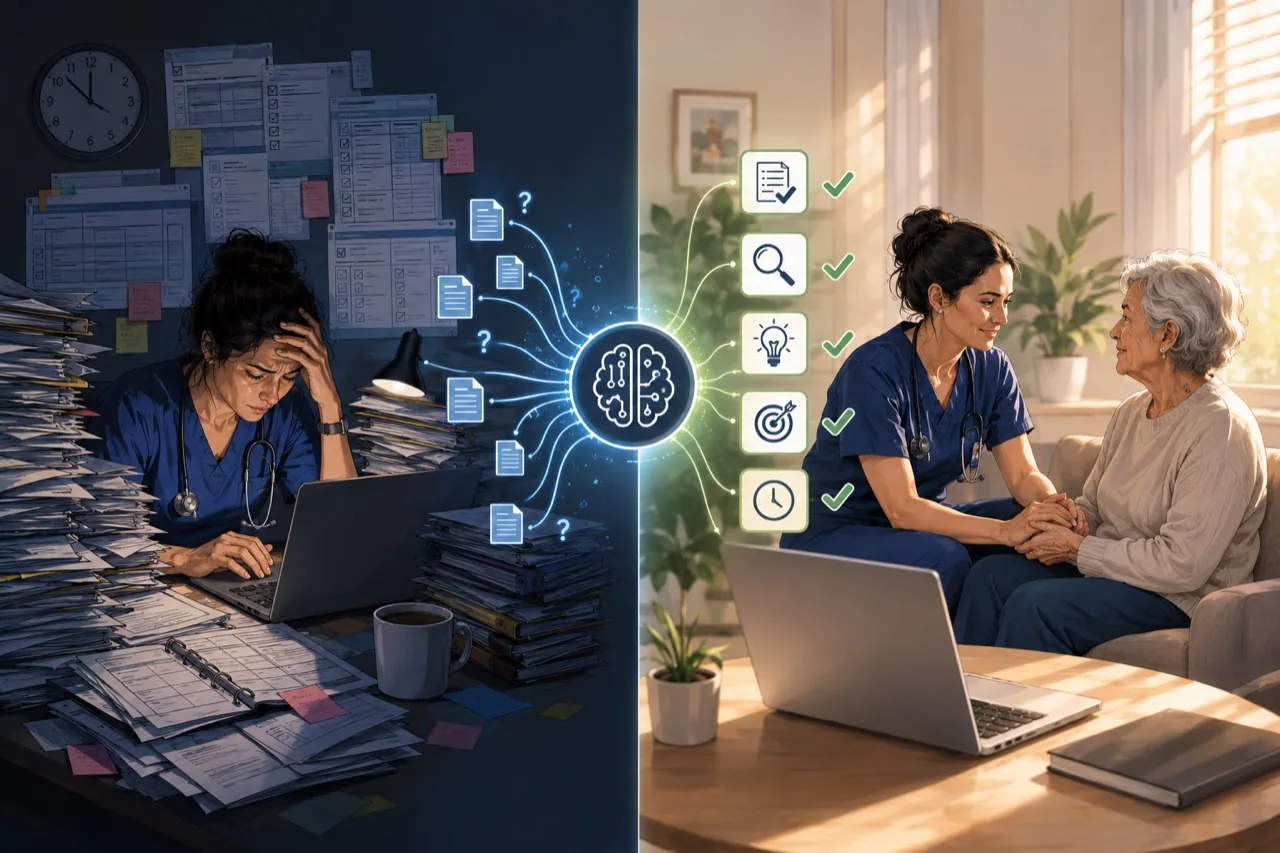
Key Takeaways
- Home health scheduling is harder than hospital scheduling because of geography and variability.
- AI can handle the bulk of scheduling with a human overseeing the rest.
- Better scheduling reduces missed visits and coordinator burnout.
- Human oversight keeps the schedule clinically sound.
Let me tell you about how a spreadsheet tried to ruin my life.
It was taped to the door of the nurses' station about a month before the schedule was supposed to go out. I would ask everyone to fill in the days they could not work. Two weeks later, I would pull it down and disappear into my office for a weekend of schedule writing. Sometimes it took 12 hours. Sometimes 18. Often more than that.
I was a charge nurse on a small military floor, maybe 40 nurses total. I would sit there manually trying to account for who needed weekends off, who was certified to be charge nurse, who was already carrying extra shifts, and who had a conflict I remembered from a conversation two weeks earlier. I would come up with one or two possible configurations, pick the least bad option, tape the schedule to the door, and wait for the complaints. And there were always complaints.
My husband watched this process a few times. He was working on his PhD in industrial engineering. He looked at what I was doing and said it could be fixed with algorithms. I did not fully understand what that meant at the time. What I understood was that I was exhausted, my nurses were unhappy with any schedule I produced, and some genuinely believed I was playing favorites. I was not. I was just trying to get through it.
He spent months researching the problem. Even for my small floor, there were over 7,000 variables in play when I wrote that schedule. My brain could realistically hold a few alternative configurations at a time. His algorithm looked at tens of thousands of potential schedules and returned the best one in under five minutes.
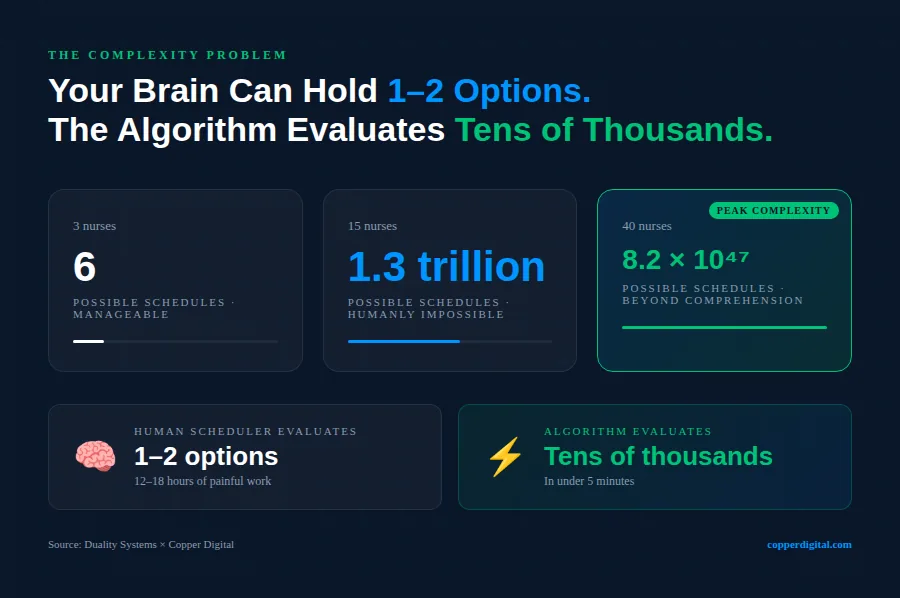
A single schedule hides thousands of interacting variables, far more than any person can evaluate by hand.
The results were measurable and shocking. Scheduling time dropped by more than 99 percent. Nurse satisfaction with the schedule improved by 56 percent. And the perception of bias disappeared, because you cannot accuse a computer of having favorites. More than anything, I got to go back to being a nurse and a leader.
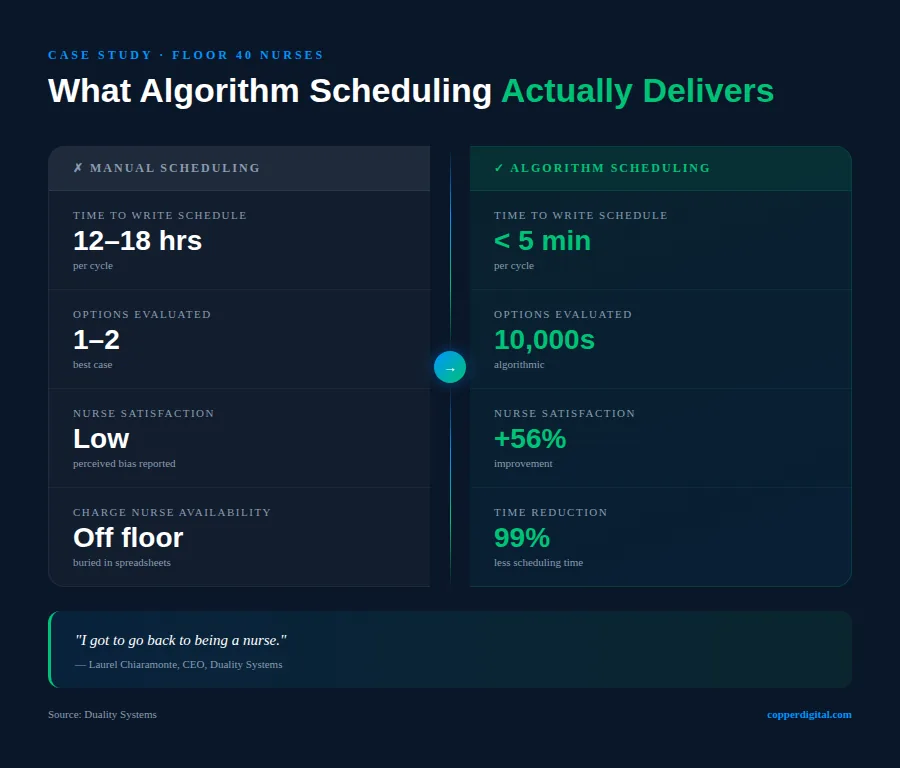
What algorithm scheduling actually delivers: 12 to 18 hours down to under five minutes, +56% satisfaction, 99% less time.
The Part Nobody Talks About
There is a version of this story where we immediately built a company, took it to market, and hospitals lined up to buy it. That is not what happened. We went to market in 2021. COVID had just happened. Hospital budgets were wrecked. And we ran into something I have since heard from many health-tech founders: the people who feel the pain are rarely the people who hold the budget.
The people who feel the pain are very rarely the people who hold the budget.
I knew exactly how much that scheduling problem cost me: the hours I was not being a nurse, the patients I was not with, the nurses I was not leading because I was buried in a spreadsheet. But the person three rungs above me saw a problem that was, technically, getting solved. The schedule got made. Why pay for something else to do it? They did not see the ground floor. They rarely do.
This is not a Duality Systems problem specifically. A 2025 study in JMIR Formative Research found that nurses consistently report scheduling practices as a driver of burnout and turnover, and that management rarely has visibility into the day-to-day experience of unfair or inflexible schedules. The gap between what nurses experience and what leadership measures is real.
So we pivoted. We are a veteran-owned small business, about 85 percent veterans on a team of eight. We went to the Department of Defense and found the scheduling problem looks almost identical no matter the setting: drone pilots, satellite watch floors, missile silo operations. Different certifications, different stakes, same structure, thousands of variables, 24-hour coverage, and billions of possible configurations a human brain cannot fully evaluate.
We took a team of Air Force drone pilots and civilian contractors spending 700 combined hours a month writing and maintaining a schedule. We got that to 15 minutes. The technology works. That has never been the question.
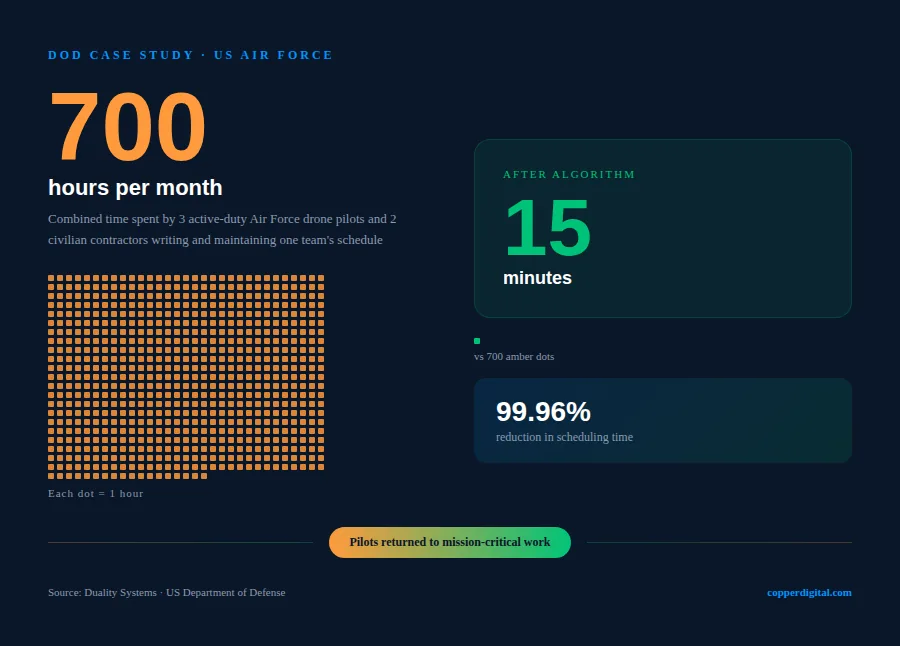
The same optimization, applied to military scheduling: 700 combined hours a month down to 15 minutes.
Why Home Health Scheduling Is a Harder Version of the Same Problem
When I talked with Arvind Sarin of Copper Digital recently, something he said stopped me. Among the dozens of home health agencies he speaks with every month, roughly 70 percent are still doing scheduling manually. On paper. In 2026.
Home health scheduling is actually a harder problem than hospital scheduling. In a hospital, you assign nurses to floors. In home health, you route clinicians across a geography, match certifications to patient needs, and account for drive time, with a workforce that is already stretched thin.
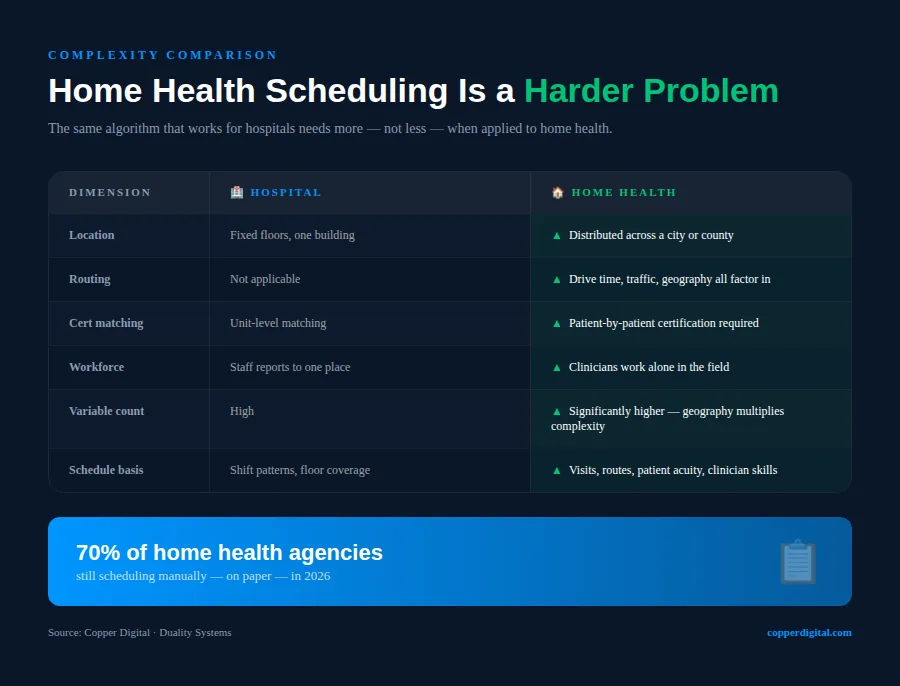
Home health scheduling adds geography and routing on top of hospital-style constraints.
The math is not forgiving. The number of possible configurations grows factorially as you add staff and patients. A scheduler managing 15 nurses across a metro area faces a problem space that is, effectively, impossible to optimize by hand. They are making the best choice they can see, not the best choice that exists. The U.S. AI nurse scheduling software market was valued at $55 million in 2024 and is projected to reach $516 million by 2033, largely because manual methods are finally being recognized as structurally insufficient, not just inconvenient.
Copper Digital focuses on the documentation side of this problem. OASIS documentation automation is their Act 1, and it is the right call: if a clinician spends two to three hours on paperwork after every visit, that is the first fire to put out. But scheduling is the fire in the next room. Both are burning.
What Makes People Resistant, and Why That Is Changing
When people hear that we use AI, the conversation often goes sideways. Most people think AI means a large language model, something that takes a prompt and generates text. Our AI is not that. It is combinatorial optimization: algorithms that evaluate possible schedule configurations at a scale no human can match. It is not going to write your emails or summarize your meeting notes.
But in an environment where the word AI triggers either excitement or fear, that distinction is hard to communicate quickly. Add HIPAA concerns, security concerns, change fatigue inside large healthcare organizations, and the reality of being eight people trying to get a meeting with a hospital system, and you start to understand why selling into healthcare is harder than it looks from the outside.
There is also a structural procurement problem. Home health agencies, even mid-sized ones, often run intake, scheduling, and documentation on separate, disconnected systems. Each requires its own buying decision, its own champion, and its own implementation. The agencies that struggle most are often the ones trying to solve every problem at once, or none at all.
⏱️ If it is taking you more than an hour to write a schedule, you are spending that time somewhere you could be spending it better.
I still believe healthcare is where this belongs. My whole career as a Clinical Nurse Specialist has been oriented around one thing: improving the efficiency and effectiveness of healthcare delivery. Not in the abstract, but at ground level. Nurses cannot take care of patients when they themselves are not okay, and a lot of what makes nurses not okay is fixable with the schedule.
The 85-to-90 Percent Solution
Here is something that changed how I thought about what we were building. Self-scheduling sounds like it gives nurses control. In practice it creates a different problem. If you are first to self-schedule, you get a good schedule. If you are last, you get whatever is left. Some nurses end up with schedules they can live with, and some feel like they are always at the bottom of the pile. It can also put a lot of work back on the manager who has to balance the schedule before release. The inequality is real, and people feel it.
What I wanted was to flatten that curve. Giving everyone a perfect schedule is not possible. But you can give everyone an 85-to-90 percent solution, every single time.
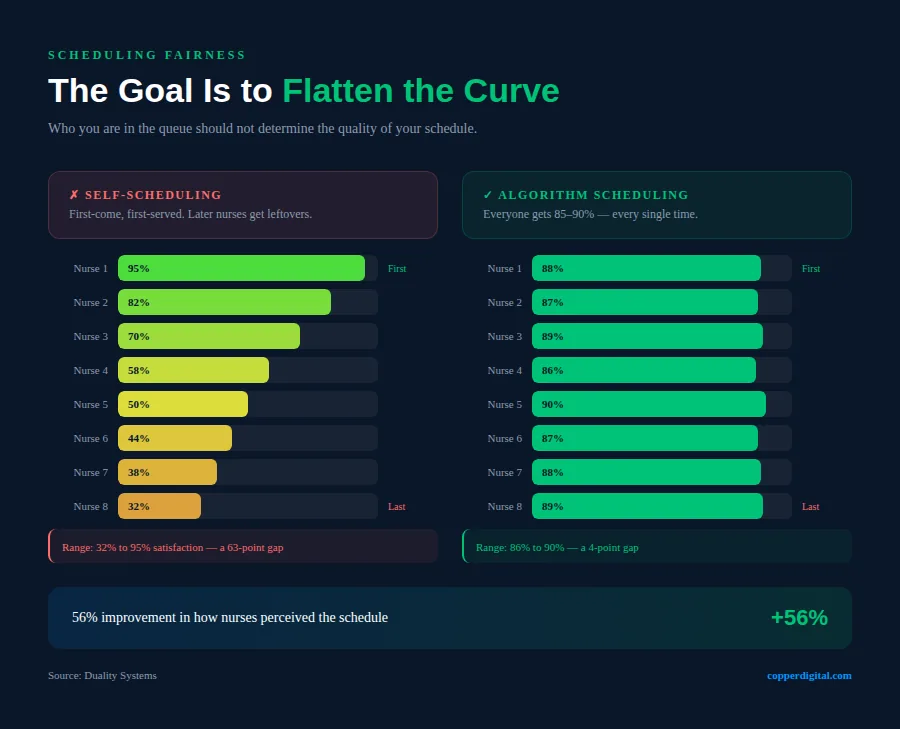
Flatten the curve: self-scheduling rewards whoever goes first; algorithmic scheduling gives everyone 85 to 90 percent, every time.
That means if I prefer to work weekends, that preference goes into the algorithm as a variable. If I need a specific pattern for a family situation, that goes in too. The algorithm does not just minimize conflicts, it maximizes fairness across the whole group. And it provides transparency, so when a nurse wonders why she got a shift, there is an answer that has nothing to do with whether the scheduler likes her.
We are also developing a shift bidding system. When a shift is not filled, instead of defaulting to a travel nurse, you can open it internally first. Leadership sees in real time what filling it internally with overtime would cost versus externally with travel nurses, and can make that call with data. Unplanned overtime and travel nurse costs are among the top margin pressures for home health agencies right now. Making those tradeoffs visible before the decision changes the math entirely.
A Word About Human Oversight
I want to be direct, because the AI conversation in healthcare tends to land in one of two wrong places: dismiss it entirely, or let it take the wheel completely. We always want a human to review the output. The algorithm produces a schedule that a person should then critically evaluate to ensure it makes sense.
That review step is not a failure of the technology. It is the point.
You must know what right looks like before you can evaluate what the algorithm gives you. If you skip that step because the output looks plausible, you are not using AI as a tool. You are outsourcing your judgment to a machine and hoping for the best. The JMIR study cited earlier concluded that a hybrid approach, integrating AI recommendations with human decision-making, is optimal for nurse scheduling: not full automation, not manual scheduling with a software veneer, but genuine collaboration between algorithm and human judgment.
Copper Digital takes the same approach with documentation. Their system does not replace the clinician's judgment; it handles the structural work so the clinician can focus on the actual assessment. The difference between brittle automation and intelligent automation is whether there is a guardrail, and that distinction matters enormously in healthcare, where the cost of a wrong output is not just an inconvenience.
What This Means for Home Health Agencies Right Now
The nursing shortage is not going away. According to the American Nurses Association, the U.S. is projected to need more than 200,000 new nurses per year through 2026 to meet demand. Home health is competing for those nurses against hospitals, SNFs, and outpatient clinics, and losing, largely because the job is harder and the support infrastructure is thinner.
You cannot out-recruit a structural problem. You can only make the job worth staying in. That means better pay where possible, but also schedules that respect people's time, intake processes that do not dump unnecessary admin work on clinicians, and documentation systems that do not require two hours of paperwork after every visit.
The agencies that figure this out first will have a retention advantage that compounds. The ones that keep treating scheduling, documentation, and intake as separate manual problems will keep paying for travel nurses, keep losing their best clinicians to less chaotic environments, and keep wondering why their referral sources are calling someone else. CMS has been transparent about the link between staffing consistency and HHVBP quality scores. Consistent staffing requires consistent scheduling, and consistent scheduling requires a system built for the actual complexity of the problem.
What I Know for Sure
Nurses are natural innovators. We sit at the bedside and see the problems. The scheduling problem my husband solved for me was not something I went looking for. It was handed to me as an additional duty, it was awful, and eventually someone who loved me got sick of watching me suffer through it. That is a lot of how healthcare innovation works: someone gets close enough to the pain to actually feel it, and then they build something.
The tools we have now make that faster and more powerful than at any previous point. But the tools only work if the people using them understand the problem they are solving and can evaluate whether the output is getting them there. I got back on the floor because an algorithm took 18 hours of schedule writing and turned it into five minutes. My nurses got a fairer schedule, and they knew it. Nobody was accusing me of favorites anymore.
That is what this is supposed to feel like.
🎧 Hear the full conversation with Arvind Sarin on the Inside Home Health podcast. To see how Copper Digital automates OASIS documentation so clinicians get their time back, explore AI tools for nurses, pricing, or more resources.
Home Health Documentation Playbook
The complete guide to OASIS-E, Medicare compliance, PDGM, and AI-assisted documentation. Learn how top agencies reduce documentation time without sacrificing compliance.
Bottom Line
Home health scheduling is a uniquely hard optimization problem; AI can solve most of it with human oversight, freeing coordinators and reducing missed visits.

Watch the Full Conversation
From 18-Hour Nurse Scheduling to AI Algorithms Used by the Military
Arvind Sarin and Laurel Chiaramonte on how an 18-hour scheduling ordeal became a five-minute algorithm, and what that means for home health.

Laurel (Huber) Chiaramonte is a Clinical Nurse Specialist, nurse entrepreneur, and innovator. After an algorithm turned her 18-hour scheduling ordeal into five minutes, she helped build Duality Systems, a veteran-owned company applying combinatorial optimization to nurse and military scheduling.
Frequently asked
Frequently asked questions
Algorithmic optimization is a type of AI that evaluates a very large number of possible schedule configurations and identifies the one that best satisfies all constraints: certifications, shift patterns, coverage requirements, staff preferences, and more. Unlike rules-based scheduling software, it does not just check whether a schedule is valid. It finds the best possible valid schedule from billions of options in minutes.
Join the conversation
Leave a comment
Related reading
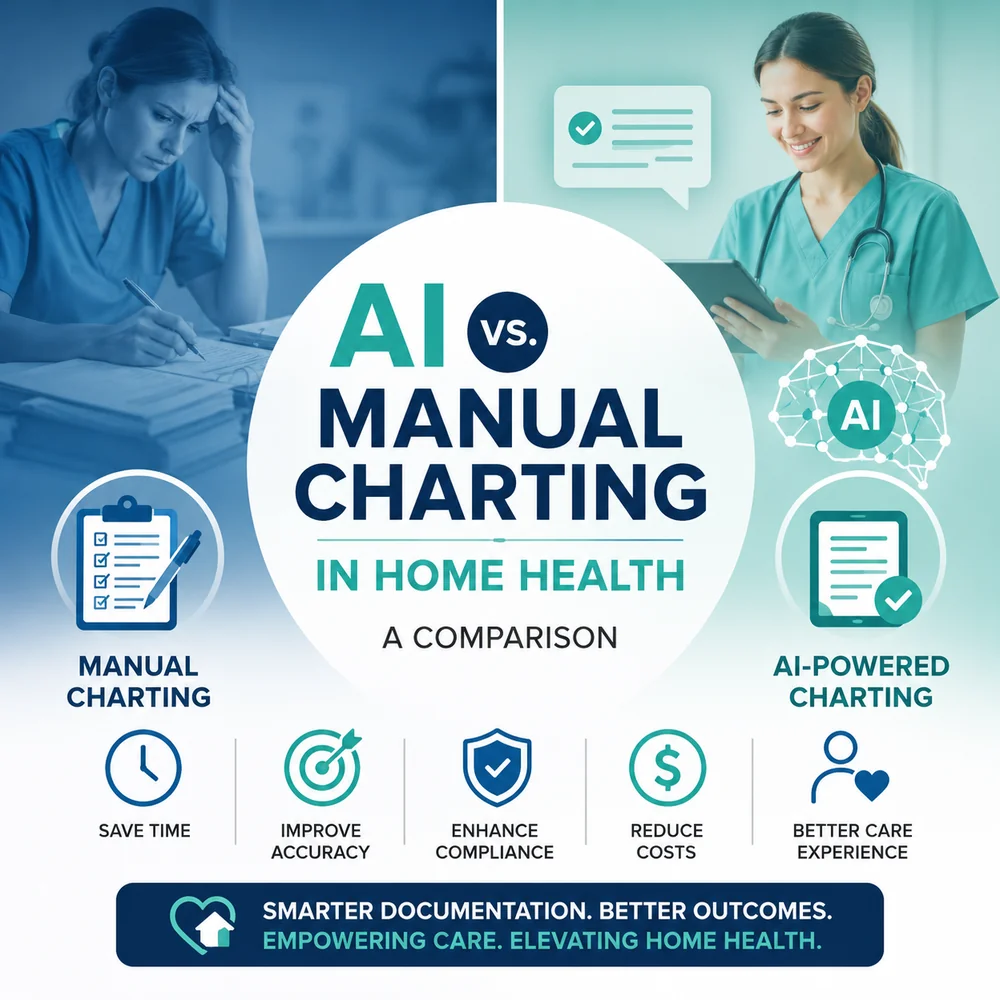
AI vs. Manual Charting in Home Health: An Honest Comparison
Manual charting has been the home health standard for decades, but AI-assisted documentation is changing how notes get done. This honest comparison weighs both across time, accuracy, compliance, cost, clinician experience, and patient care, and explains why the best workflows combine AI efficiency with clinician judgment.
Home Health Documentation Workflow: What Actually Slows Nurses Down?
Home health documentation is one of the biggest administrative burdens clinicians carry, but it is rarely slow for the reasons people assume. The problem usually isnt the nurse, its the workflow surrounding the note: medication reconciliation, OASIS, duplicate entry across disconnected systems, interruptions, and after-hours charting. Here is what actually slows nurses down and how to fix it.

Can AI Help Reduce Nurse Burnout?
Nurses now spend nearly as much time documenting care as delivering it, and the result is unprecedented burnout. AI can help, but only when it is designed to support nurses rather than replace them. This guide breaks down how AI reduces cognitive load, ambient documentation, predictive deterioration detection, human-in-the-loop safety, and what it means for retention and home health.