
A Nurse Leader's Guide to Medicare Star Ratings and Surveys
Two star ratings, two different things, and a state survey that can range from a clean two-day exit to a 23-day immediate-jeopardy clock. Kathy Duckett, MSN, RN, explains how Medicare star ratings and surveys really work, and why almost every deficiency traces back to documentation.

Key Takeaways
- Quality and patient-satisfaction Star Ratings measure two different things.
- Star Ratings drive your referral pipeline.
- Almost every survey deficiency traces back to documentation.
- Build documentation accuracy into operations before the next survey.
Arvind Sarin invited me onto Inside Home Health to walk through how Medicare Care Compare star ratings actually work, what happens during a state survey, and why so many agencies get caught off guard by both. I agreed because I have lived through it from every angle.
I have been the new Director of Nurses who inherited an agency with condition-level deficiencies and watched my heart sink when the surveyor pulled out the paperwork. I have also been the leader who, two years later, walked that same agency through a deficiency-free survey.
The difference was not luck. It was understanding exactly what the system measures and building processes to meet those measurements every day, not just the week before a surveyor walks in.
Here is what I wish every agency owner and clinical leader understood.
Two Star Ratings, Two Completely Different Things
When someone looks up your agency on Medicare Care Compare, they see two ratings and almost no explanation of what either one means. The first is the quality of patient care star rating.
The second is the patient satisfaction star rating. They measure entirely different things, and you can score high on one and low on the other.
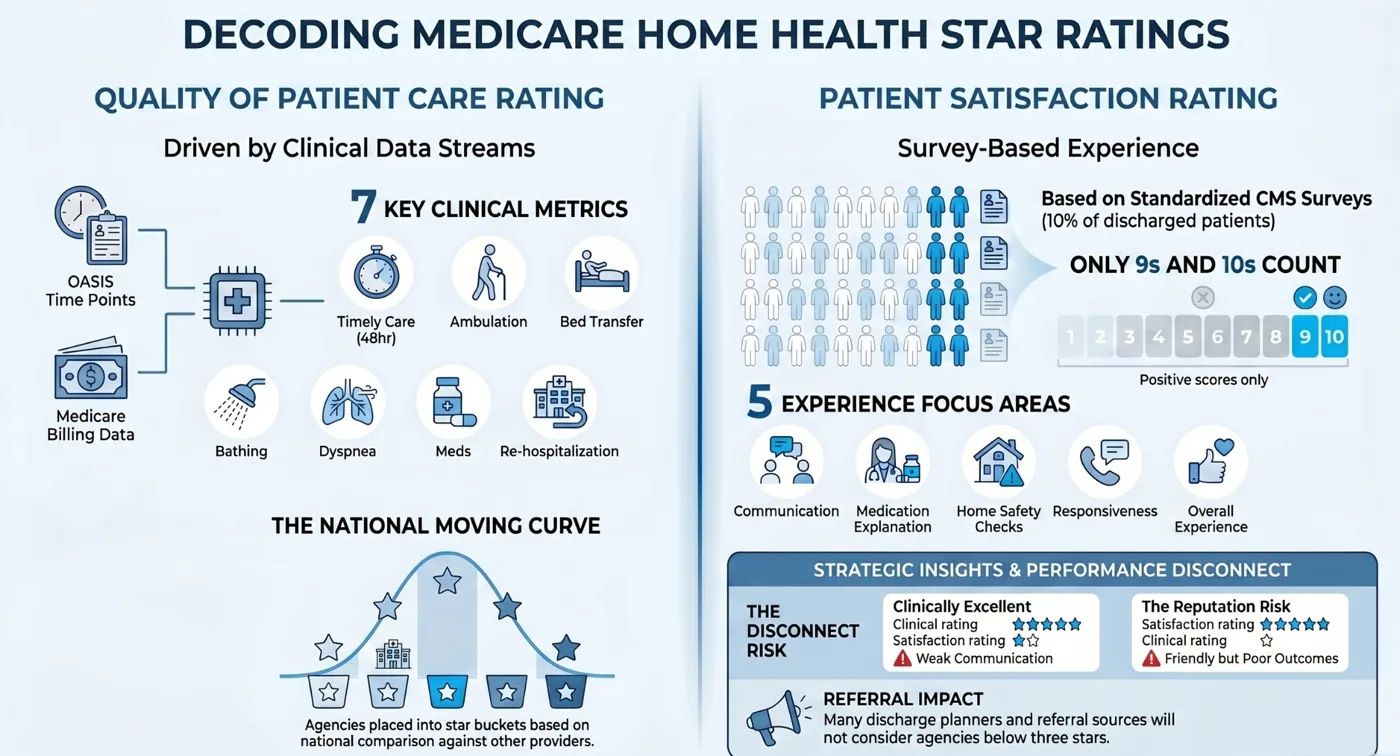
Two ratings, two data sources: clinical outcomes from OASIS and billing, versus survey-based patient experience.
The quality of patient care stars pull from seven data points: timely initiation of care (did you see the patient within 48 hours of referral unless the physician ordered a specific later start date), improvement in ambulation, improvement in bed transfer, improvement in bathing, improvement in dyspnea, improvement in managing oral medications, and your patients' rate of acute care re-hospitalization. Those seven metrics are scored from OASIS time points at start of care versus discharge, plus your Medicare billing data.
CMS compares your agency against itself and against every other agency nationally, then places you into star buckets on a moving curve.
The patient satisfaction stars come from a completely separate process. CMS sends a standardized survey to roughly 10 percent of your discharged Medicare patients.
Patients have no obligation to return it. The ones who do answer questions about whether their clinician explained medications, whether someone assessed the safety of their home, whether they felt cared for, and whether the office responded when they called.
The questions use a 1 to 10 scale, and only 9s and 10s count as positive. Medicare keeps shifting the rules underneath these ratings, so it helps to track the 5 biggest changes to Medicare in 2026.
⭐ Only 9s and 10s count. An agency loaded with eights still scores poorly, because eight is not considered excellent. CMS wants agencies setting the standard, with 10 being the best home health care possible.
Where agencies get tripped up is the disconnect between the two. I have seen clinically excellent teams earn high quality stars because their OASIS is clean and their outcomes are strong, but get hammered on patient satisfaction because their communication is weak.
And I have seen warm, friendly agencies earn high satisfaction stars while their clinical outcomes sit at the bottom of the distribution. Both are problems.
Both show up on the same Care Compare page. And the people making referral decisions are looking at both.
Why the Stars Actually Matter for Your Referral Pipeline
The most important thing I can tell an agency owner is that star ratings are not vanity metrics. I have worked with referral sources that will not even look at an agency rated below three stars.
Discharge planners often list agencies in order of star rating when they present options to patients and families, and we all know people look at the top three, not the twentieth entry on page two. If you are sitting at two stars for quality and one for satisfaction, you can tell me you give excellent care, but your ratings are telling a different story, and referral partners will believe the ratings.
The stars also overlap significantly with Home Health Value-Based Purchasing. Many of the measures that move your VBP payment adjustment are the same measures feeding your star calculation.
That means a star problem is usually a payment problem at the same time. Agencies that treat star ratings as something to look at next quarter are making a mistake that shows up in revenue, referrals, and reputation simultaneously.
What Actually Happens When a Surveyor Walks In
State surveys happen roughly every three years. You do not know the exact day.
One morning, a surveyor walks into your lobby, shows their badge, and says they are there to conduct a survey. What happens in the next 30 seconds sets the tone for the rest of the visit.
Every front-desk person should know the protocol: keep the surveyor in the lobby, do not let them wander, and immediately notify the Clinical Director and the Administrator. The surveyor is already observing everything from the moment they arrive.
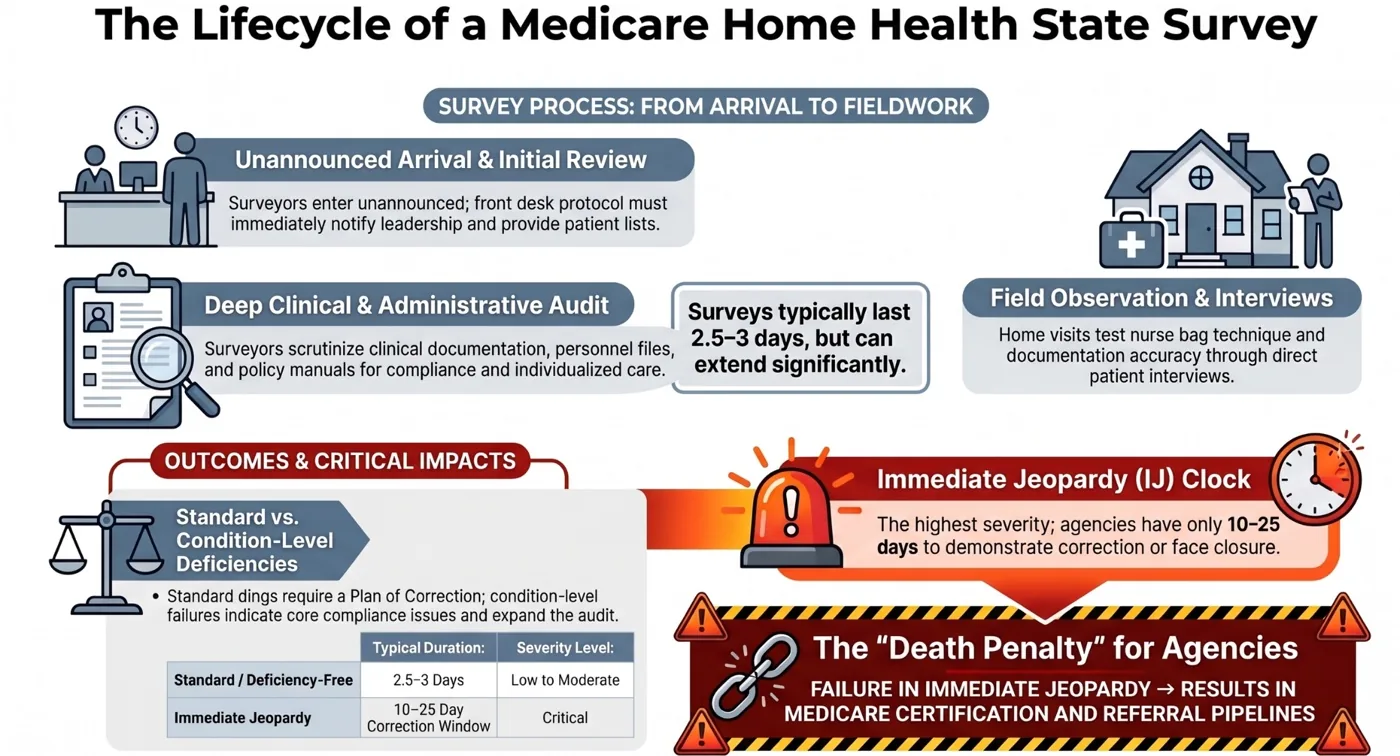
From unannounced arrival to outcomes: a standard survey runs 2.5 to 3 days, but immediate jeopardy starts a 10 to 25 day clock.
Most standard surveys run two and a half to three days when things are going well, depending on the size of your agency. The surveyor asks for a patient list, picks the charts they want to review, reviews personnel files and policy manuals, and always goes out to patients' homes to observe actual visits.
You have to call those patients, explain that a surveyor will accompany the nurse, and get permission, because the home is theirs, not yours. The surveyor will watch the nurse's bag technique.
They will check whether the documentation in the chart matches what they see in the home. They will ask the patient questions.
If everything goes well, the exit interview is short and you either get a deficiency-free survey or a standard-level deficiency with a clear window to submit a plan of correction. If things do not go well, the survey extends.
Condition-level deficiencies mean you are not meeting one of the core conditions of participation, and the survey expands to more charts and processes. Immediate jeopardy means the surveyor believes patient care is actively at risk, and you have a finite window, sometimes 10 days, sometimes 23 or 25, to demonstrate correction.
If you miss that window, you lose Medicare certification, which for most agencies effectively closes the business, because Medicaid and referral sources both use it as the gold standard for quality.
Almost Every Deficiency Traces Back to Documentation
After decades of surveys, I can tell you that the deficiencies you see over and over are not usually clinical failures. They are documentation failures.
The verbal order that was not signed and dated with matching dates across the chart. The home health aide supervisory visit that slipped past the 14-day requirement because scheduling missed it.
The plan of care that did not list the wound care supplies actually being used in the home. The 10 charts that read identically because clinicians copied and pasted instead of individualizing them.
The documentation that did not establish skilled need clearly enough across the episode, which from a surveyor's angle can start to look like fraud even when the reality is just rushing.
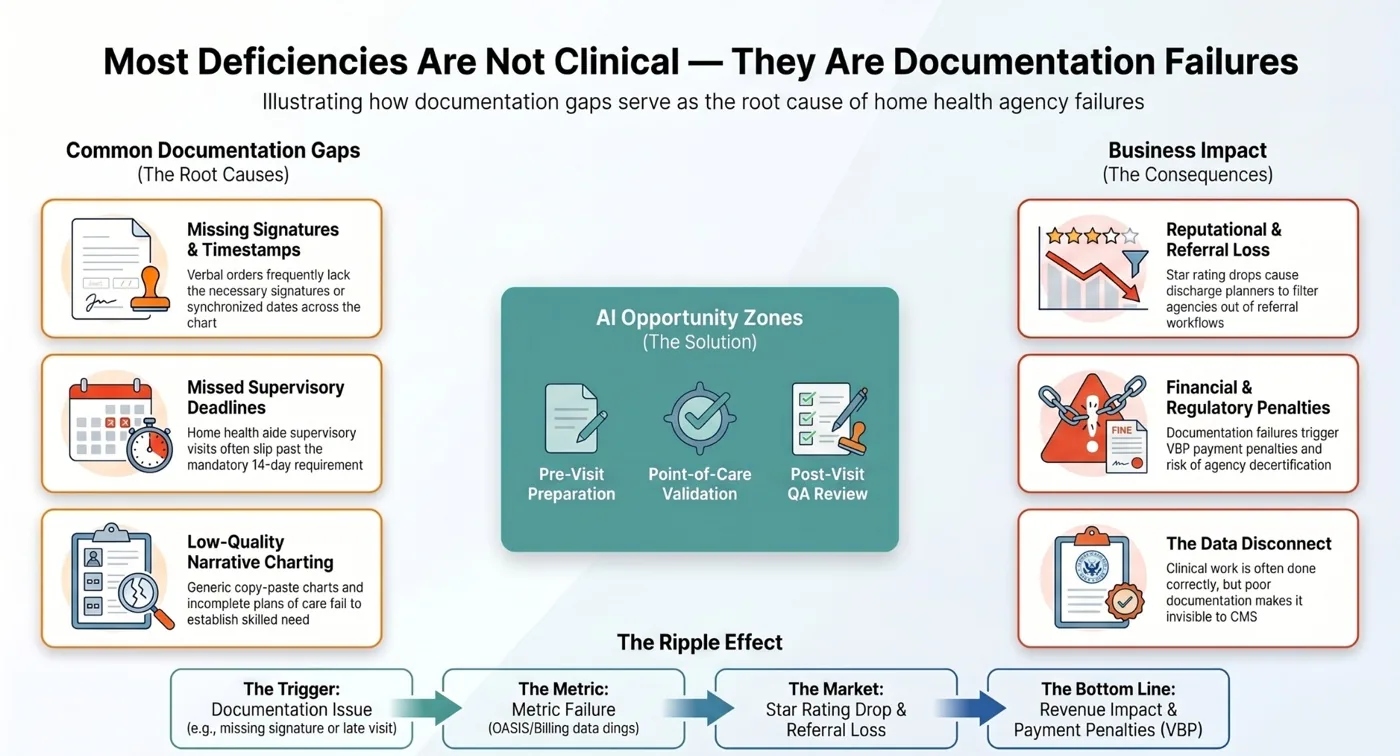
Most deficiencies are documentation failures, and the ripple runs from a missed date to metric failure to a star drop and payment penalties.
This is where the connection to technology becomes impossible to ignore. Every structural documentation problem in home health creates a star rating problem, a survey problem, and a value-based purchasing problem simultaneously.
Timely initiation of care becomes a ding because the verbal order changing the start date was not captured. Functional improvement scores look weak because the OASIS was not scored accurately at start of care.
Coordination-of-care deficiencies come up because the call to the physician was made but not documented. The clinical work was done correctly in almost every one of these cases.
The documentation did not reflect it.
If you solve documentation, you solve a substantial percentage of your star rating risk and your survey risk in the same move.
That is why I have become increasingly interested in AI platforms that address documentation at the point it actually breaks, whether that is pre-visit preparation, point-of-care accuracy, or post-visit validation. The technology is not a shortcut around clinical rigor.
It is a structural fix for a documentation burden that has overwhelmed every agency I have worked with.
What to Build Into Your Operations Before the Next Survey
Here are the operational checks and balances I put into every agency I have led or consulted with. None are complicated.
They are just consistent.
- Run a daily missed-timely-SOC report. Every patient not admitted within 48 hours needs a documented reason, and the reason cannot be staffing. Catch the gaps daily, not quarterly, and act on the patterns fast.
- Automate the 14-day home health aide supervisory tracker. This is the most common standard-level ding I see, and it is 100 percent preventable with a scheduling alert.
- Build a verbal order workflow that tracks the date of the verbal order, the date it was sent for signature, and the date it was returned. These dates have to match across the chart, or it is a citation.
- Review your own policies quarterly against your own documentation. Surveyors will cite you for not meeting the frequency your own policy states, even if it exceeds the CMS minimum.
- Audit for individualized plans of care. If 10 charts read the same, you have condition-level exposure. This is where AI cross-validation and QA review are worth their weight in preserved certification.
- Encourage patients to respond to the CMS survey. You cannot tell them the questions, but you can tell them it matters and remind them of the care you provided at discharge.
- Train the front desk on the survey protocol: who gets notified, where the surveyor waits, what to pull, and who covers if the Clinical Director is off site. Make it a written procedure every front-desk person reads on day one.
A Note on Turning Agencies Around
When I inherited the agency with condition-level deficiencies, the first survey was painful. The deficiencies were real.
The paperwork was not where it needed to be. The processes that should have caught the gaps did not exist.
I had to let some nurses go who could not meet the standard of care we needed. I had to rebuild the documentation culture from the ground up.
Two years later, the next survey came back deficiency-free. That did not happen because of one checklist.
It happened because the entire organization committed to documentation as a core clinical responsibility rather than a back-office chore.
If you are sitting today looking at a two-star rating or remembering a bad survey, the path back is absolutely possible. It requires hard work, honest assessment, and a refusal to let documentation be something that happens after care is delivered rather than something that reflects care faithfully.
Remember the old home health adage.
If it wasn't documented, it wasn't done. Make sure your documentation accurately reflects the great care you are giving your patients.
The agencies I see thriving in 2026 are the ones that have stopped treating documentation as paperwork and started treating it as part of patient care.
🎧 This post is based on session seven of the Inside Home Health podcast hosted by Arvind Sarin, CEO of Copper Digital. To see how Copper helps agencies fix documentation at the source, explore AI tools for nurses or more resources.
Home Health Documentation Playbook
The complete guide to OASIS-E, Medicare compliance, PDGM, and AI-assisted documentation. Learn how top agencies reduce documentation time without sacrificing compliance.
Bottom Line
Medicare Star Ratings and surveys are two different things, and almost every deficiency traces back to documentation, so operations built on accurate charting protect both.

Watch the Full Conversation
What Makes OASIS Documentation So DIFFICULT?
Arvind Sarin and Kathy Duckett go deep on OASIS documentation, goals and interventions, and why getting it right is the foundation of star ratings and survey readiness.

Kathy Duckett, MSN, RN, is the founder of K. Duckett Consulting and a home health nurse leader with more than 30 years of experience across clinical, regulatory, financial, and operational leadership. She holds an MSN in Nursing Innovation from Drexel University and a BSN from Michigan State University, and has served as Director of Advanced Care at Home for Home Health Foundation and Chief Clinical and Compliance Officer at CareGroup Parmenter Home Care and Hospice.
Frequently asked
Frequently asked questions
Medicare Care Compare publishes two separate ratings per agency. The quality of patient care star rating measures clinical outcomes pulled from OASIS time points and Medicare billing data across seven metrics: timely initiation of care, improvement in ambulation, bed transfers, bathing, dyspnea, and oral medication management, plus re-hospitalization. The patient satisfaction star rating comes from standardized CMS surveys sent to roughly 10 percent of discharged patients, measuring communication, empathy, and perceived care quality. An agency can score high on one and low on the other because they measure different things.
Join the conversation
Leave a comment
No comments yet. Be the first to share your thoughts.
Related reading
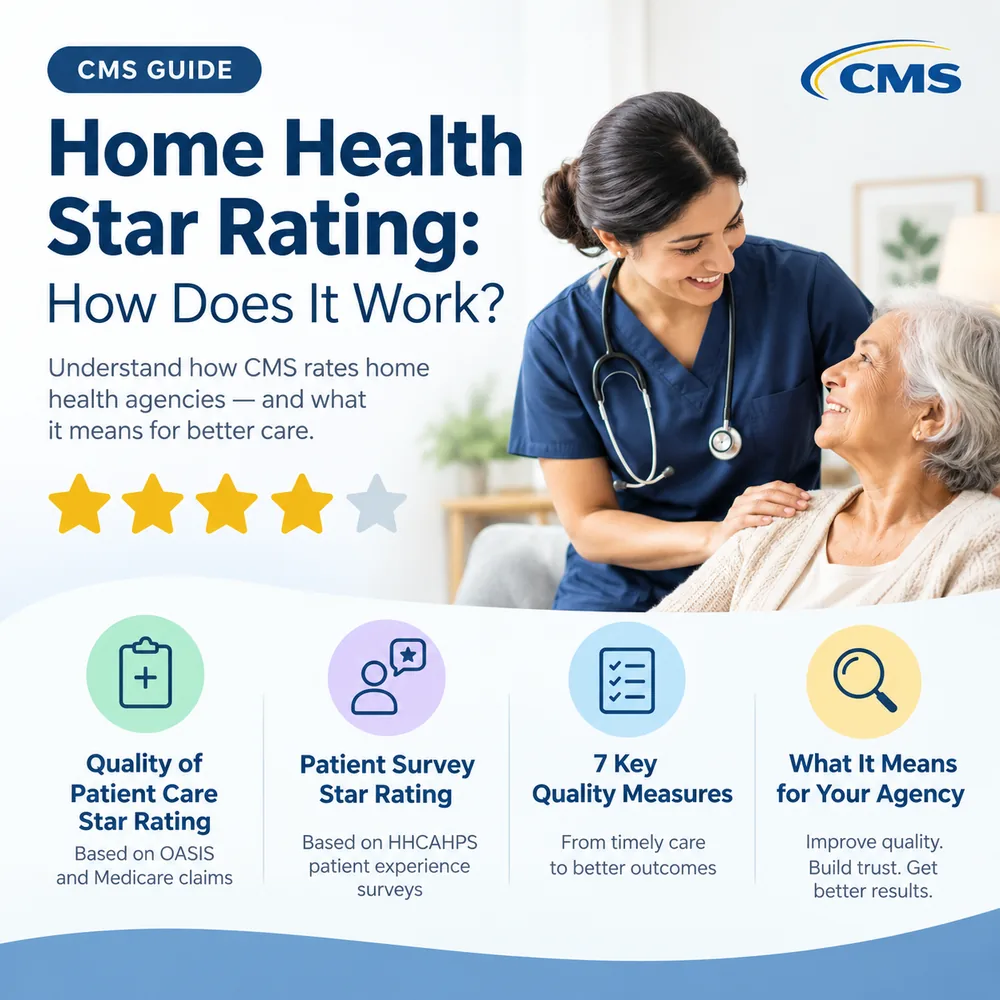
Home Health Star Rating: How Does It Work?
CMS publishes two separate Home Health Star Ratings on Care Compare. Learn what each rating measures, how OASIS and HHCAHPS affect the scores, and what agencies can improve.
Medicare Advantage Star Ratings 2027: What Home Health Agencies Need to Know
Understand the 2027 Medicare Advantage Star Ratings changes, how plan-level measures differ from home health agency ratings, and practical steps to strengthen care coordination.
Top Features to Look for in Home Health Documentation Software
A practical guide to evaluating home health documentation software, including OASIS support, mobile charting, EMR integration, QA, security, workflow automation, and clinician-reviewed AI.