
Home Health Is Not What Most People Think It Is
Most people, even those who work near the industry, misunderstand what home health is. Kathy Duckett, RN, explains the bridge it was designed to be, how it differs from home care and hospice, why OASIS accuracy is everything, and where AI can genuinely help nurses.
Key Takeaways
- Home health is a bridge, not a destination, and differs from home care and hospice.
- People often recover faster at home.
- The workforce problem reshapes everything about delivery.
- OASIS is central to home health, and most people don't know it exists.
This post is drawn from a conversation between Kathy Duckett, RN, and Arvind Sarin, CEO of Copper Digital, recorded for the Inside Home Health podcast series.
I started my career carrying a bag in Detroit. I knocked on doors in neighborhoods I did not grow up in, walked into homes where people were figuring out which medications they could afford that month, and sat with patients trying to recover from surgery in whatever space and with whatever support they had. That experience taught me something that still guides everything I do: sick people are sick people. How someone responds to illness is how they respond to illness. My job, then and now, is to help them get back to the level of independence that is possible for them.
More than 30 years later, I am doing the most interesting work of my career. I joined Copper Digital as a clinical advisor to help shape AI tools for home health documentation. When Arvind asked me to talk about why home health matters, I realized how much confusion still exists, even among people who work adjacent to the industry, about what home health actually is, what it is designed to do, and why getting the documentation right is so consequential. I want to clear some of that up, and then explain why, after 30 years, I believe we are finally at the point where technology can genuinely help.
Home Health Was Designed as a Bridge, Not a Destination
When Medicare was created in the 1960s, home health was built into the program as a specific benefit with a specific purpose. The idea was straightforward: after a hospitalization, patients needed a bridge between being completely cared for in a hospital and being fully independent at home. Home health was that bridge.
That design intention has not changed. Home health is intermittent, short-term, and episodic. The expectation is that you will need it for a finite, predictable period, generally 30 to 60 days, though we do recertify patients who need more time. The goal when I walk through a patient's door is never to take over their care indefinitely. It is to figure out, from the moment I arrive, when and how we are going to help this person stop needing us.
That is the mandate. Get you to independence, or get you the resources that make independence possible, whether that means outpatient therapy after a hip replacement, hospice when the clinical picture changes, or a different care setting if the home environment cannot safely support recovery.
When we walk in the door, we have to figure out when we are going to stop taking care of you. That is not a limitation. That is the design.
Home Health vs. Home Care
This is the distinction I spend the most time clarifying, including with people who have worked in and around this industry for years. Home health and home care are not the same thing, and the confusion between them creates real problems for patients, families, and agencies.
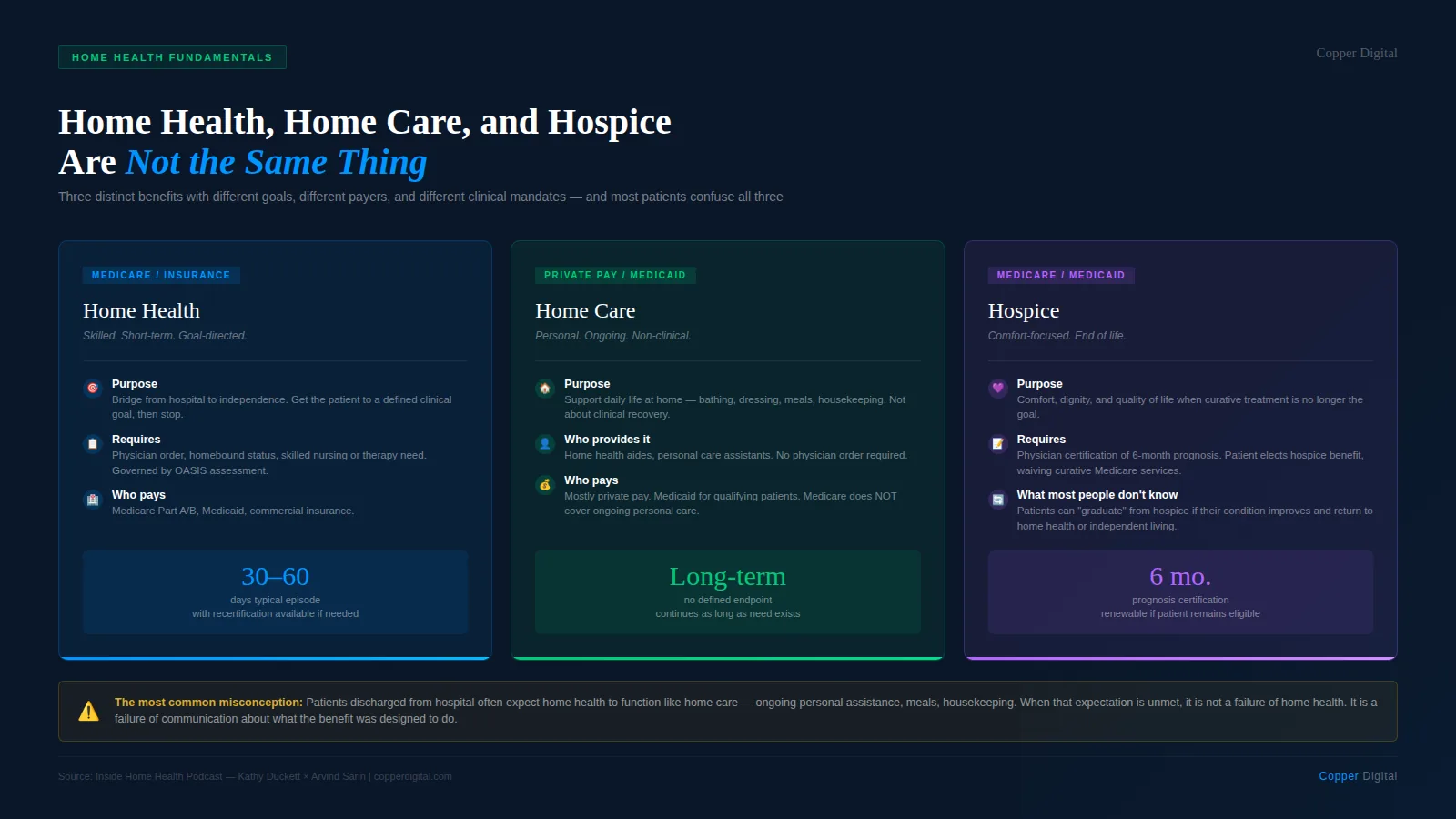
Home health, home care, and hospice are three distinct benefits with different goals, payers, and mandates.
Home health, as paid by Medicare and most insurance, is a skilled care benefit. It requires a physician's order. It is tied to a homebound status determination. It is clinically driven. A registered nurse does a full assessment. Physical therapy evaluates functional ability. The plan of care is based on what the patient needs to reach a defined clinical goal. It is not open-ended.
Home care is different. It refers to personal care support: help with bathing, dressing, meal preparation, and housekeeping. It is not a skilled benefit under Medicare. Most of it is paid privately or through Medicaid, depending on the state and the patient's situation. It is often long-term because the need it addresses is not episodic.
The confusion matters because patients frequently come home from the hospital expecting home health to do both. They think someone is coming to take care of them. They want to show us the spare bedroom. When we explain that our job is to help them become independent, not to provide ongoing personal care, it can feel like a disappointment. Families counting on support they thought was covered find out it is not. That is a real problem, and it starts with a fundamental misunderstanding of what the benefit was designed to do.
Hospice Is Also Misunderstood, Including the Part About Graduating
Another distinction worth drawing clearly: hospice is its own benefit, and it operates on completely different terms than home health. Hospice care is for patients at the end of life, typically with a prognosis of six months or less if the disease follows its expected course. The focus shifts from curative or restorative goals to comfort and quality of life. It is a different clinical model, different staffing, and a different reimbursement structure.
What most people do not know is that hospice is not always a one-way door. Prognosis is medicine's best estimate, not a guarantee. I have had patients placed on hospice who, six months later, were doing significantly better. In those cases, they can graduate from the hospice benefit. We stop the service because the clinical picture no longer supports it, and they transition back to home health or to independent living.
I ran a hospice alongside a home health agency for years and saw this happen more than once. The benefit is written the way it is because we have to work within how Medicare defines these services. But the clinical reality is more nuanced than the benefit structure suggests, and patients and families deserve to understand that.
Why People Recover Faster at Home
There is solid evidence behind moving care out of hospitals and into home settings. Patients heal faster in their own environment. Infection rates are significantly lower at home than in institutional settings. Patients with dementia experience considerably less confusion and behavioral disruption in a familiar environment rather than displaced to a hospital.
The hospital is a clinical environment built for clinical efficiency. You get woken up when staff need to check on you. Tests happen on the hospital's schedule. You share a room with a stranger. The bed is not comfortable. None of that is conducive to healing, and we have known that for a long time. That is the logic behind hospital at home, a model that has been growing rapidly: for lower-acuity patients with the right support, managing recovery at home produces better outcomes at lower cost.
💰 A hospital day costs roughly $3,100. A day of care at home costs roughly $1,100. Compounded across the population, that difference is significant.
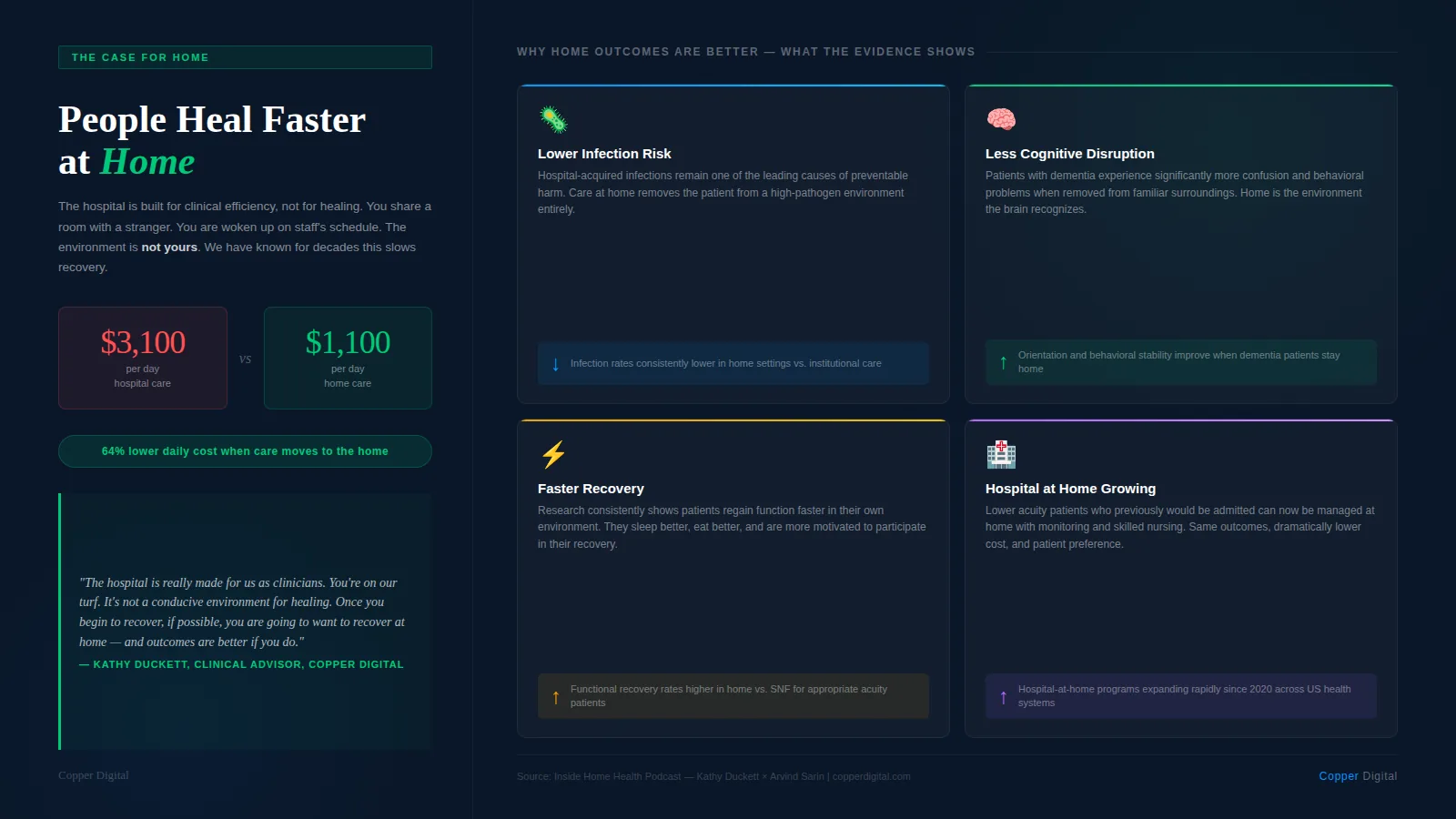
Why home outcomes beat the hospital for patients past the acute phase.
People get better faster when they are in their own home. We know that. Infection rates drop. Outcomes improve. The challenge is figuring out how to deliver that care effectively with the workforce we have.
The Workforce Problem Is Real, and It Changes Everything
Home health is capacity-constrained in a way hospital care is not. In a hospital you have teams, backup, colleagues in the next room. In home health, a nurse goes into a patient's home alone. She cannot see more than one patient at a time. Her daily capacity is limited by drive time, assessment complexity, and documentation burden.
We do not have enough nurses. That is not a new statement, but it is an increasingly urgent one. And the way we currently ask those nurses to spend their time, including the hours on documentation after the visit, is a significant part of why we cannot retain the ones we have.
If we are serious about shifting care to the home, we have to make home health nursing sustainable. That means reducing the documentation burden without sacrificing accuracy, building tools that work with clinical workflows instead of against them, and understanding that every hour a nurse spends reconstructing visit notes from memory is an hour of clinical risk, not just an HR cost.
The OASIS Is Central to Everything, and Most People Do Not Know It Exists
For anyone outside the industry, OASIS stands for Outcome and Assessment Information Set. It is the standardized assessment Medicare-certified home health agencies use at the start of care, at key time points during an episode, and at discharge. It has been part of the Medicare home health program since the late 1990s and has gone through several iterations, most recently OASIS-E and the upcoming OASIS-E2 changes.
The OASIS is not just a form. It is the foundation of almost everything that matters in home health. The answers determine the patient's reimbursement under PDGM. They feed the agency's quality measures and star ratings on CMS Care Compare. They establish the baseline from which outcomes are measured. They inform the plan of care. And they are subject to audit.
What I tell clinicians is that accurate OASIS coding is both a clinical and a financial imperative, and the two are not in conflict. Coding accurately is coding honestly. It is describing what you actually found when you walked in, using the specific parameters CMS has defined for each question, not coding the patient as sick as possible to maximize reimbursement, and not coding them as healthy as possible to look good on outcomes.
Why nurses get it wrong more often than they get it wrong on purpose
In my experience, the vast majority of OASIS inaccuracies are not fraud. They are errors. Nurses are working from memory hours after a visit. They are rushing through 150 or more questions after a complex two-hour assessment. They answer one section without realizing it contradicts something three screens earlier. The EMR does not catch it. Nobody catches it until QA, or worse, an auditor does.
The other thing I consistently see is that nurses over-assess patient ability on admission. They see the patient at their best, or give credit for what the patient used to be able to do rather than what they can do today. That creates a documentation problem at discharge: if the patient looked functional on admission, demonstrating meaningful improvement becomes very difficult.
The challenge is not that nurses want to commit fraud. The challenge is that they do not understand the specific parameters of each OASIS question, or they are answering from memory at six in the evening about a patient they saw at eight in the morning.
Where AI Can Actually Help
I want to be precise, because I have seen the field get carried away with what AI promises. AI is not going to replace clinical judgment. It cannot observe a patient. It cannot read the room. It cannot pick up the subtle signs that something has changed between the last visit note and what is happening right now in the patient's living room.
What AI can do, and what I believe Copper Digital is working toward in a way that takes the clinical reality seriously, is handle the pieces of documentation that do not require clinical judgment. A 30-page hospital discharge packet gets faxed over. The nurse does not have time to read it before walking in, so she walks in without the context she needs.
AI can extract the relevant clinical nuggets from that referral. It can synthesize what matters for this visit. It can pre-populate the administrative fields that do not require assessment. It can flag contradictions between sections of the OASIS before they become an audit finding. And it can prompt the nurse when something appears to be missing, during the visit, not hours after.
The pre-visit briefing Arvind and I discussed is a good example. Before walking in, the nurse should receive a short paragraph: here is what happened on the last visit, here is the plan for today, and here is what has changed since the last nursing contact, including labs, physician visits, and therapy notes. AI can produce that. That is not replacing the nurse. That is giving her what she needs to walk in prepared rather than reconstructing context from a cold chart.
Why I Joined Copper Digital
I have spent my career at the intersection of clinical practice and technology. I was an early advocate for remote patient monitoring. I helped agencies build telemedicine programs before telemedicine was mainstream. I have seen a lot of technology promise to fix home health documentation, and I have seen most of it make the problem worse by adding complexity without clinical understanding.
What drew me to Copper Digital is that Arvind is asking the right question. Not what can AI do, but what does the nurse actually need in the patient's home, and how do we build around that reality rather than asking her to adapt her workflow to fit a tool? My job is to make sure clinical empathy is built into the product design from the beginning, not added later, not treated as a compliance checkbox.
Home health deserves better technology. It has been underinvested in for decades, partly because it is not glamorous, partly because the regulatory environment is complex, and partly because the people closest to the problem, the field nurses, are never the ones in the room when the product decisions get made. That is what I am here to help change.
🎧 Listen to the full conversation with Arvind Sarin on the Inside Home Health podcast. To see how Copper Digital builds AI agents that support home health documentation and OASIS accuracy, explore pricing or AI tools for nurses, and browse more resources.
Bottom Line
Home health is skilled, intermittent, Medicare-covered care designed as a bridge to independence; it differs from home care and hospice, and OASIS sits at the center of it all.
Watch the Full Conversation
What's the FUTURE of Home Health EMR?
Gaurav and Kathy unpack the EMR disconnect every home health nurse lives with, and how AI can finally bridge the gap between the visit and the chart.
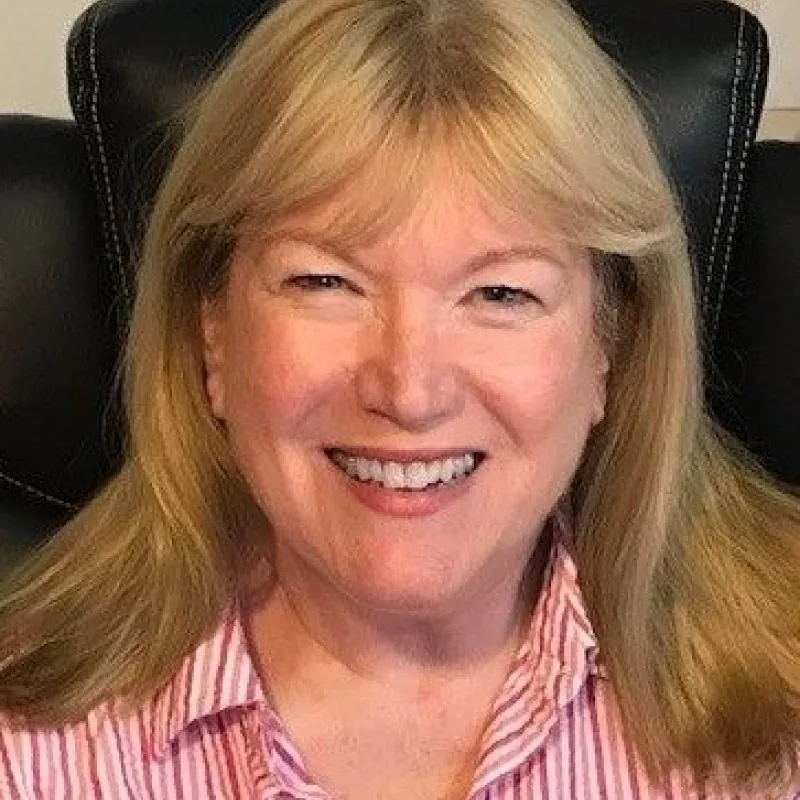
Kathy Duckett is a nationally recognized leader in home health and hospice operations, clinical practice, and healthcare technology strategy. She has spent over 30 years at the intersection of nursing practice and technology, from field nurse to Chief Clinical Officer to Director of Advanced Care at Home, and joined Copper Digital as a Clinical Advisor in 2026 as a voice for clinician-centered product design.
Frequently asked
Frequently asked questions
Home health is a skilled, physician-ordered Medicare benefit tied to homebound status: a nurse and therapists assess the patient and build a plan toward a defined clinical goal over a finite episode. Home care is personal-care support (bathing, dressing, meals, housekeeping), is not a Medicare skilled benefit, is usually paid privately or through Medicaid, and is often long-term. Families frequently expect home health to provide ongoing personal care, which it was never designed to do.
Join the conversation
Leave a comment
Related reading
Homecare Homebase vs WellSky (Kinnser) vs Axxess: Which Home Health EMR Is Best for Documentation?
Choosing a home health EMR shapes how nurses document, how fast claims go out, and how efficiently your agency runs. Homecare Homebase, WellSky (Kinnser), and Axxess all support OASIS-E and Medicare compliance, but they differ in usability, scalability, and workflow design. This guide compares all three across documentation, OASIS-E, mobile, compliance, AI, and agency size to help you choose.
The Biggest Documentation Challenges Home Health Nurses Face
Home health nurses face heavy documentation challenges: delayed point-of-care charting, excessive administrative time, clunky EHRs, OASIS complexity, strict reimbursement rules, working in isolation, endless QA corrections, and after-hours charting that drives burnout. Reducing documentation burden is now essential for clinician retention, patient outcomes, and agency financial performance.

Why Home Health Documentation Is Driving Your Best Nurses Out the Door
Home health was designed as a short-term bridge from the hospital to independence at home. Veteran nurse Kathy Duckett explains how we buried that purpose under 150+ OASIS questions, and why fixing documentation, not blaming nurses, is how agencies keep their best clinicians.