
Nursing Intuition vs Clinical Judgment: What's the Difference?
Every experienced nurse has felt it: the vital signs look normal, the labs haven't changed, but something feels wrong. Is that intuition or clinical judgment? They're two distinct but complementary skills. This guide explains how each works, how intuition develops, why clinical judgment turns a gut feeling into safe action, and what AI can and can't do about it.
Key Takeaways
- Nursing intuition is experience-based pattern recognition that helps nurses identify subtle patient changes.
- Clinical judgment is the structured, evidence-based process used to assess, decide, and act.
- Intuition and clinical judgment are complementary, not competing, skills: intuition raises the question, clinical judgment provides the answer.
- New nurses develop intuition over time through mentorship, patient experience, and reflective practice.
- AI can support clinical judgment by reducing administrative burden, but it cannot replace human intuition or compassionate patient care.
- The strongest nursing practice combines intuition, critical thinking, and evidence-based decision-making to improve patient outcomes.
💡 Quick Answer: Nursing intuition is the ability to recognize subtle patient changes through experience and pattern recognition, often before objective data confirms a problem. Clinical judgment is the structured process of assessing information, interpreting evidence, making decisions, and evaluating outcomes. Experienced nurses use both together to deliver safe, effective patient care.
Every experienced nurse has experienced a moment that doesn't fit neatly into a checklist. A patient's vital signs appear normal. Lab results haven't changed. The chart doesn't indicate an emergency. Yet something feels wrong.
Many nurses describe this as a "gut feeling." But is it intuition? Or is it clinical judgment? While these terms are often used interchangeably, they represent two distinct yet complementary skills that influence patient outcomes every day.
Understanding the difference is essential for nursing students, new graduates, experienced clinicians, and healthcare leaders seeking to improve patient safety and nurse retention.
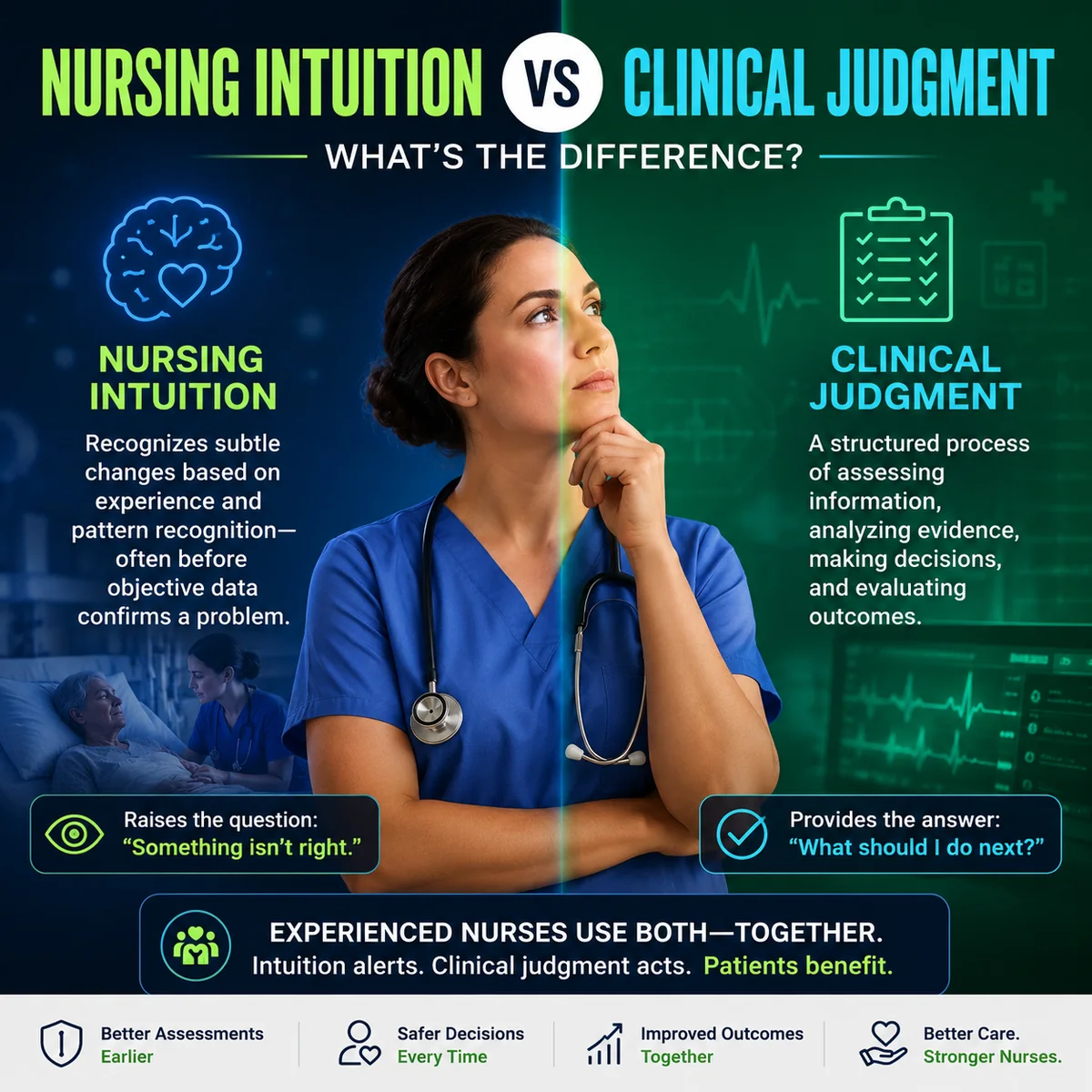
Intuition raises the question, clinical judgment provides the answer. Experienced nurses use both together.
What Is Nursing Intuition?
Nursing intuition is the ability to recognize subtle changes in a patient's condition based on experience, pattern recognition, and situational awareness. It isn't guesswork, nor is it a mystical ability. Instead, intuition develops through repeated exposure to thousands of patient interactions over time.
Experienced nurses begin noticing details that may not immediately appear in clinical documentation, including:
- Changes in skin color
- Facial expressions
- Breathing patterns
- Body language
- Mental status
- Family concerns
- Overall patient appearance
These subtle observations often create an internal sense that something isn't quite right, even before measurable clinical indicators change. This type of intuition reflects the brain's ability to recognize familiar patterns faster than conscious reasoning. It is one of the most powerful skills in nursing that no one formally trains.
What Is Clinical Judgment?
Clinical judgment is the deliberate process nurses use to assess patient information, analyze evidence, prioritize care, make decisions, and evaluate outcomes. Unlike intuition, clinical judgment follows a structured pathway grounded in evidence-based practice.
It typically includes:
- Collecting patient data
- Identifying clinical problems
- Interpreting findings
- Prioritizing interventions
- Implementing care
- Evaluating patient outcomes
Clinical judgment combines medical knowledge, critical thinking, clinical reasoning, professional standards, and evidence-based guidelines. Every nursing intervention depends on sound clinical judgment.
Nursing Intuition vs Clinical Judgment: Key Differences
| Nursing Intuition | Clinical Judgment |
|---|---|
| Based on experience and pattern recognition | Based on structured assessment and evidence |
| Often subconscious | Deliberate and analytical |
| Recognizes subtle changes | Determines appropriate interventions |
| Develops over years of practice | Begins developing during nursing education |
| May occur before objective data changes | Uses available clinical evidence |
| Alerts nurses that "something is wrong" | Determines what to do next |
Rather than competing, these skills work together. Intuition raises the question. Clinical judgment provides the answer.
How Does Nursing Intuition Develop?
Unlike pharmacology or anatomy, nursing intuition cannot be learned from a textbook. It develops through repeated patient encounters. Over time, nurses begin recognizing patterns associated with patient deterioration.
For example, an experienced emergency nurse may notice a patient speaking more slowly than before, slight confusion during conversation, a change in posture, mild skin discoloration, or increased anxiety among family members. Individually, these changes may appear insignificant. Together, they can signal that a patient's condition is changing.
The nurse's brain rapidly compares these observations to previous experiences, creating what feels like intuition. In reality, it's a highly refined form of pattern recognition.
Why Clinical Judgment Still Matters
Intuition should never replace clinical judgment. Instead, it should trigger further assessment. If a nurse feels something isn't right, the next step isn't immediate treatment. It's gathering more information:
- Repeat vital signs
- Reassess the patient
- Review medications
- Consult colleagues
- Notify the physician if appropriate
Clinical judgment transforms intuition into safe, evidence-based action. Without it, intuition remains only a feeling.
The Role of Critical Thinking
Critical thinking bridges intuition and clinical judgment. It allows nurses to ask: What am I observing? Why does this concern me? What evidence supports my concern? What additional assessment is needed? What intervention is appropriate? Strong critical thinking prevents cognitive bias while strengthening clinical decision-making.
Why Do New Nurses Often Struggle With Intuition?
One of the biggest challenges facing new graduate nurses is that intuition requires experience. Nursing school teaches anatomy, physiology, pharmacology, care planning, and clinical procedures, but it cannot replicate thousands of real patient encounters.
As a result, many new nurses rely heavily on protocols and checklists. Experienced nurses, however, often integrate those protocols with years of observational learning. This is why mentorship and extended orientation programs remain essential for building clinical confidence, and why reducing burnout and turnover matters so much: every experienced nurse who leaves takes years of hard-won intuition with them.
Can Nursing Intuition Be Taught?
Not directly. But it can be developed. Healthcare organizations can accelerate its growth by encouraging mentorship programs, clinical debriefings, case-based learning, simulation training, reflective practice, and exposure to diverse patient populations.
When experienced nurses explain why they became concerned about a patient, not just what they did, new clinicians begin building the mental library that supports intuition.
Can AI Replace Nursing Intuition?
Artificial intelligence is becoming increasingly valuable in healthcare. Modern AI systems can analyze vital signs, identify documentation gaps, predict patient deterioration, organize clinical information, and reduce administrative burden.
However, AI cannot replicate the human ability to notice subtle interpersonal and environmental cues. AI may recognize abnormal laboratory trends. A nurse may recognize a patient's hesitation to answer questions, fear in a caregiver's voice, an unusual expression, or changes in behavior that don't appear in structured data.
The future of healthcare isn't about replacing nursing intuition. It's about using AI to reduce administrative work so nurses have more time to observe, think, and connect with patients.
Why Both Skills Improve Patient Safety
Patient safety depends on both intuition and clinical judgment. Intuition helps nurses recognize that something may be changing. Clinical judgment determines the safest course of action. Together they enable:
- Earlier recognition of patient deterioration
- Faster interventions
- Better communication with physicians
- Improved clinical decisions
- Better patient outcomes
Neither skill is sufficient on its own. Together, they form the foundation of expert nursing practice.
🧭 Why trust this guide? This article is developed with input from experienced clinicians, nursing educators, and healthcare technology specialists who work closely with hospitals and home health organizations. It also incorporates practical perspectives shared by emergency nurse educator Jennifer Johnson, whose work focuses on nursing intuition, critical thinking, and clinician resilience. It is written for educational purposes and is not a substitute for professional medical advice or employer-specific policies. Watch Jennifer's conversation below.
🚀 Give nurses more time to notice what matters. Copper Digital's AI Documentation Agent captures the visit by voice, photo, or tap and drafts notes and OASIS-E in real time, with a nurse reviewing and approving every record before it reaches billing. Explore AI tools for home health nurses, or book a demo.
🎓 Go deeper with peers. Join our Home Health Mastermind Skool community for training on clinical judgment, documentation workflows, OASIS accuracy, and practical strategies to mentor new nurses and reduce charting burden.
Bottom Line
Nursing intuition and clinical judgment are two distinct but complementary skills: intuition recognizes that something is wrong, and clinical judgment determines the safest thing to do about it. Expert nursing practice depends on using both together.

The Copper Clinical Team brings together nurses, nursing educators, and clinical documentation specialists focused on home health, patient safety, and human-in-the-loop AI. They write about the clinical skills, tools, and workflows that help nurses deliver safer care with less administrative burden.
Frequently asked
Frequently asked questions
Nursing intuition is experience-based pattern recognition that helps a nurse sense a subtle change before objective data confirms it. Clinical judgment is the structured, evidence-based process of assessing information, making decisions, and evaluating outcomes. Intuition raises the concern; clinical judgment determines the safe response.
Join the conversation
Leave a comment
Related reading
The Most Powerful Skill in Nursing No One Trains
Clinical intuition is not a mystical gift. It is pattern recognition operating faster than conscious thought, and it flags patient deterioration before the monitors catch up. Critical care nurse Desiree Paige on why the system silences the most powerful skill in nursing, and why reducing documentation burden is a patient safety intervention.

Can AI Help Reduce Nurse Burnout?
Nurses now spend nearly as much time documenting care as delivering it, and the result is unprecedented burnout. AI can help, but only when it is designed to support nurses rather than replace them. This guide breaks down how AI reduces cognitive load, ambient documentation, predictive deterioration detection, human-in-the-loop safety, and what it means for retention and home health.
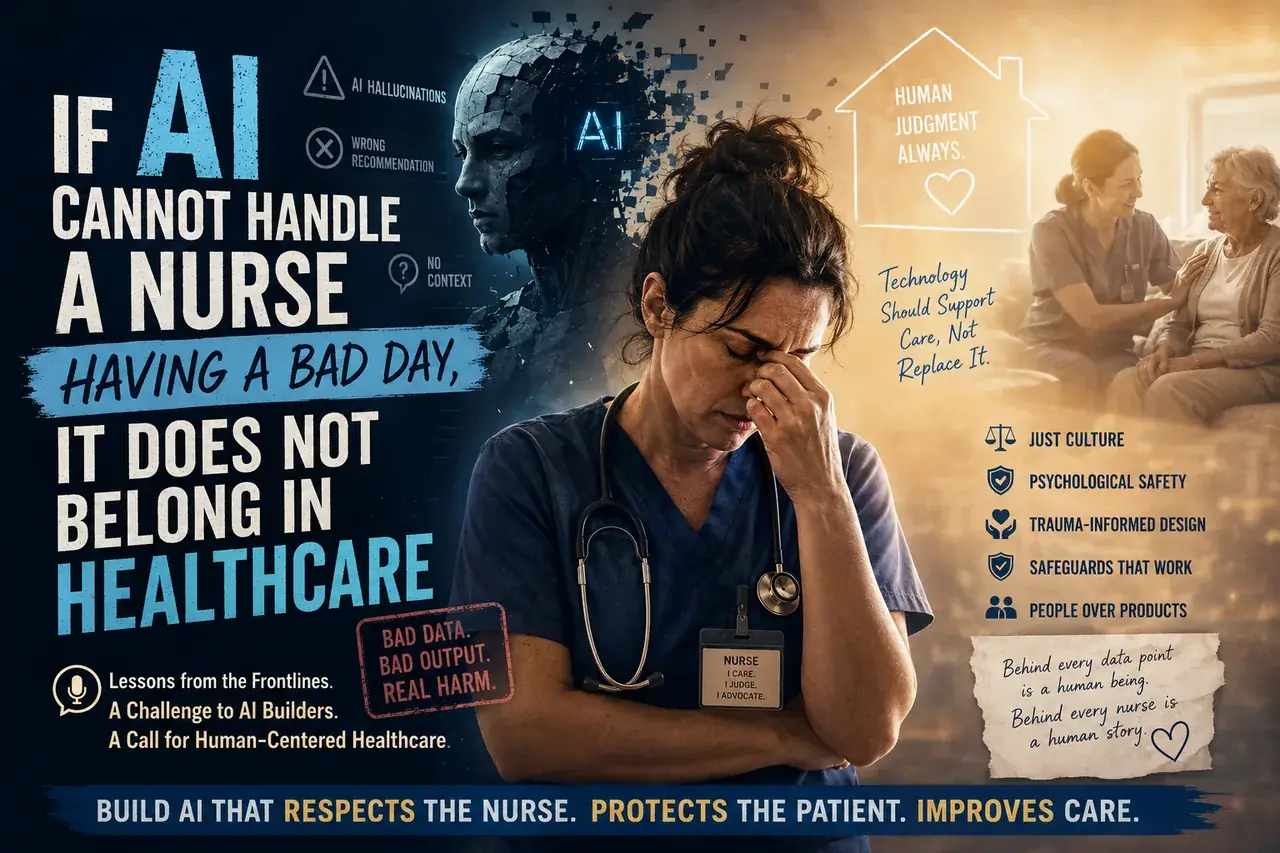
If AI Cannot Handle a Nurse Having a Bad Day, It Does Not Belong in Healthcare
AI is advisory. The nurse's judgment is sacred. Susie Branagan, RN, who calls herself AI's clinical conscience, on applying Just Culture to AI, the real danger of hallucinations in home health, trauma-informed design, and why deploying technology into a broken culture only gives it more efficient ways to do harm.