
The Problem With Healthcare AI Is That Most of It Doesn't Work
We were building AI in healthcare when AI wasn't cool. Nathan Hayman, CEO of Rivvi.ai, on going from 2,000 to 60,000 patient calls a month, bootstrapped and profitable, why he refused to integrate with the EMR, the LinkedIn post that changed everything, and why most healthcare AI ships demos instead of solving problems.

Key Takeaways
- The gap between an impressive demo and a working product is where most healthcare AI fails.
- The EMR problem is about workflow and integration, not just data.
- Voice AI in healthcare has to handle real clinical complexity, not scripted demos.
- Building lean forces a focus on shipping a product that actually works.
Nathan Hayman is the founder and CEO of Rivvi.ai, a conversational AI platform handling voice-based patient outreach for primary care groups, pharmacies, and clinical trial organizations. Rivvi is bootstrapped, profitable, and went from 2,000 outbound calls per month to over 60,000 without raising a VC round. This post draws from his conversation with Arvind Sarin on the Inside Home Health podcast.
I like to start every conversation with this: we were building AI in healthcare when AI wasn't cool.
Two years ago, voice AI in healthcare was taboo. Not skeptical. Not early. Taboo. If you told someone you were having an AI system make phone calls to patients, they looked at you like you were describing something illegal. People wanted governance documentation, safety frameworks, and clinical oversight structures before they would even consider a pilot. That was before most people had even heard of large language models. We built anyway. The problem was right in front of us, the solution was obvious, and waiting for the industry to get comfortable was not a strategy.
📈 Two years later: bootstrapped and profitable, from 2,000 outbound calls a month to over 60,000, no VC round, and every deal closed from a LinkedIn DM.
How It All Started
I am not going to dress up the origin story. I was not analyzing market opportunity or studying TAM. My girlfriend was coming home every single day from her job at a primary care call center, and she was miserable. She was one of thirty agents handed a giant Excel spreadsheet and told to call patients for whatever campaign was running that week. Nobody wants to receive those calls. Nobody wants to make them. The agents spent less than five percent of their time on actual outbound work because the process was so painful. The notes column in the spreadsheet was the only record of what happened on any call.
From a technical standpoint, this was a blueprint for automation. Structured data coming in, outbound calls going out, structured insights coming back. The fact that thirty human beings were doing it manually with an Excel sheet was not a healthcare problem. It was a process problem with an obvious fix. The first goal, genuinely, was to stop my girlfriend from crying. We accomplished that early. The reality is we changed the jobs of thirty call center agents: they do not do outbound anymore, we took them from 2,000 to 60,000 calls a month, and their inbound handle rate actually went up.
I never say we are building AI products. I never say we have the best AI. We are solving a problem. If voice AI needs to be part of the solution, that is what it needs to be.
Coming From Outside Healthcare Is an Advantage
I dropped out of college. I taught myself to engineer. I worked the 4 a.m. shift at Target moving boxes while doing online engineering courses, and eventually told my manager I quit because I got a software job. I have built products for solar companies, CBD brands, and e-commerce. None of that is what you would put on a healthcare AI founder's resume.
But here is the thing about coming into healthcare from outside: you are genuinely shocked by what you see. Everyone who has been in the industry for years has normalized the dysfunction, the Excel sheets, the manual processes, the fax machines, the absence of basic technical infrastructure. When you come from outside and see a large primary care organization running its outreach on a spreadsheet in 2023, you are not desensitized to it. That shock is useful. It prevents you from accepting the standard explanation that healthcare is just complicated and slow. Healthcare is complicated, but Excel sheets are not a compliance requirement, and manual outbound calling is not mandated by regulation. The best thing I did early was talk to everyone, agents, managers, population health teams, not to validate my solution but to understand the actual problem at every layer.
The EMR Problem Is Not What You Think It Is
If you come from outside healthcare and think about building anything that touches patient data, your first instinct is: we need to integrate with the EMR. Scheduling an appointment? API call. Confirming a visit? API call. That is normal software thinking. That is not how it works in healthcare.
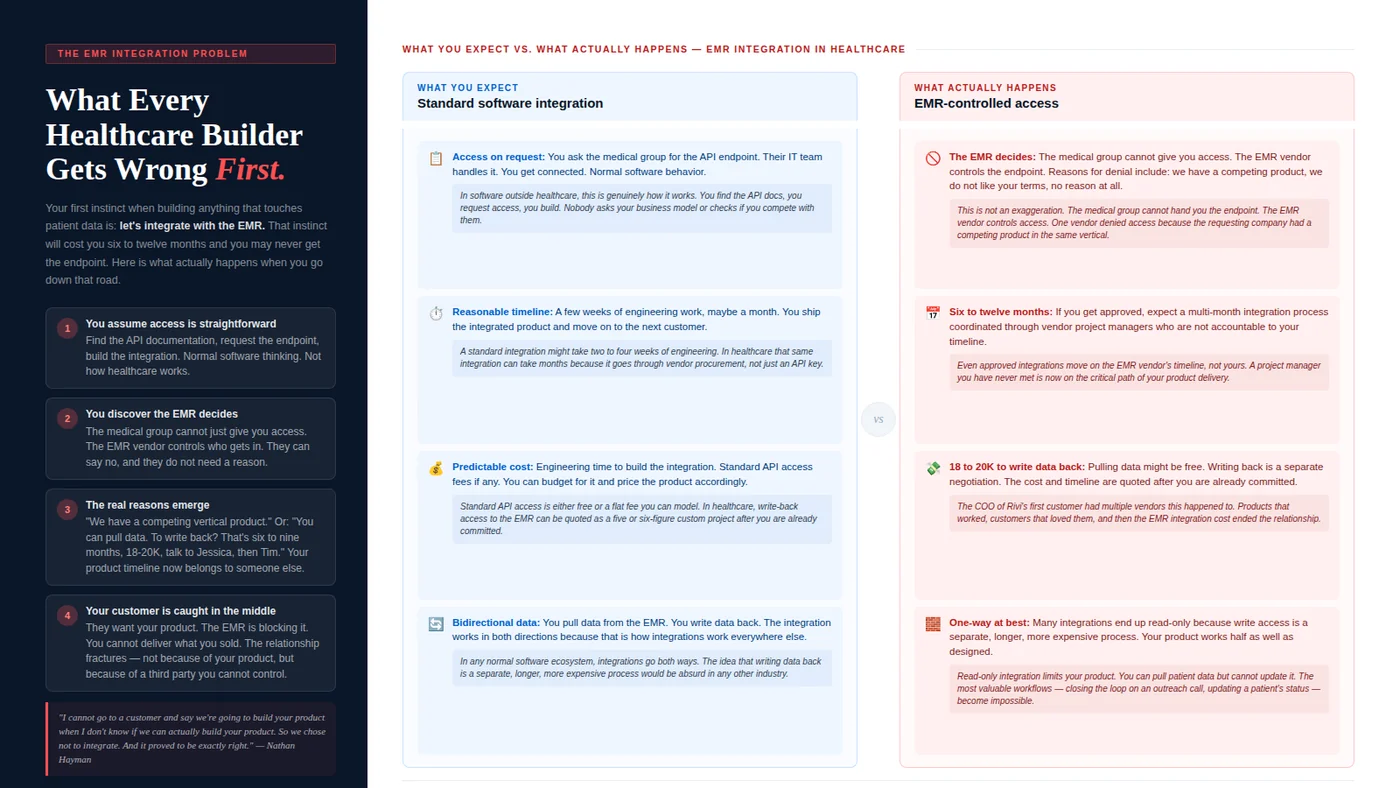
What you expect (open APIs) versus what actually happens (the EMR vendor decides who gets access, when, and at what cost).
The EMR vendor does not have to give you access. The medical group cannot just hand you an endpoint. The vendor decides whether you get access, on what timeline, at what cost. One vendor was told no because the EMR had a competing product in the same vertical. Another was told yes for data pull, then informed that writing data back would take six to nine months, cost up to twenty thousand dollars, and require a project manager and a timeline that had nothing to do with the product. In any other software industry, competing tools integrate freely and that competition drives better products. In healthcare, the EMR decides who gets access to the core infrastructure. That is not a technology problem. It is a structural one.
If you tell a customer you integrate with the EMR, you are triggering a process that might take twelve months and has nothing to do with whether your product actually works. We choose not to. If we can deliver value without it, why add a dependency we cannot control?
The LinkedIn Post That Changed Everything
We spent about six or seven months building in stealth. When I decided to post on LinkedIn for the first time, I did not think about the algorithm or the optimal posting time. I thought about what I was genuinely frustrated about and could talk about for hours. The EMR situation was the obvious answer. I was nervous, but I had found that Marc Benioff did something similar in Salesforce's early days, publicly calling out the incumbents who later became his customers. That gave me enough confidence to post.
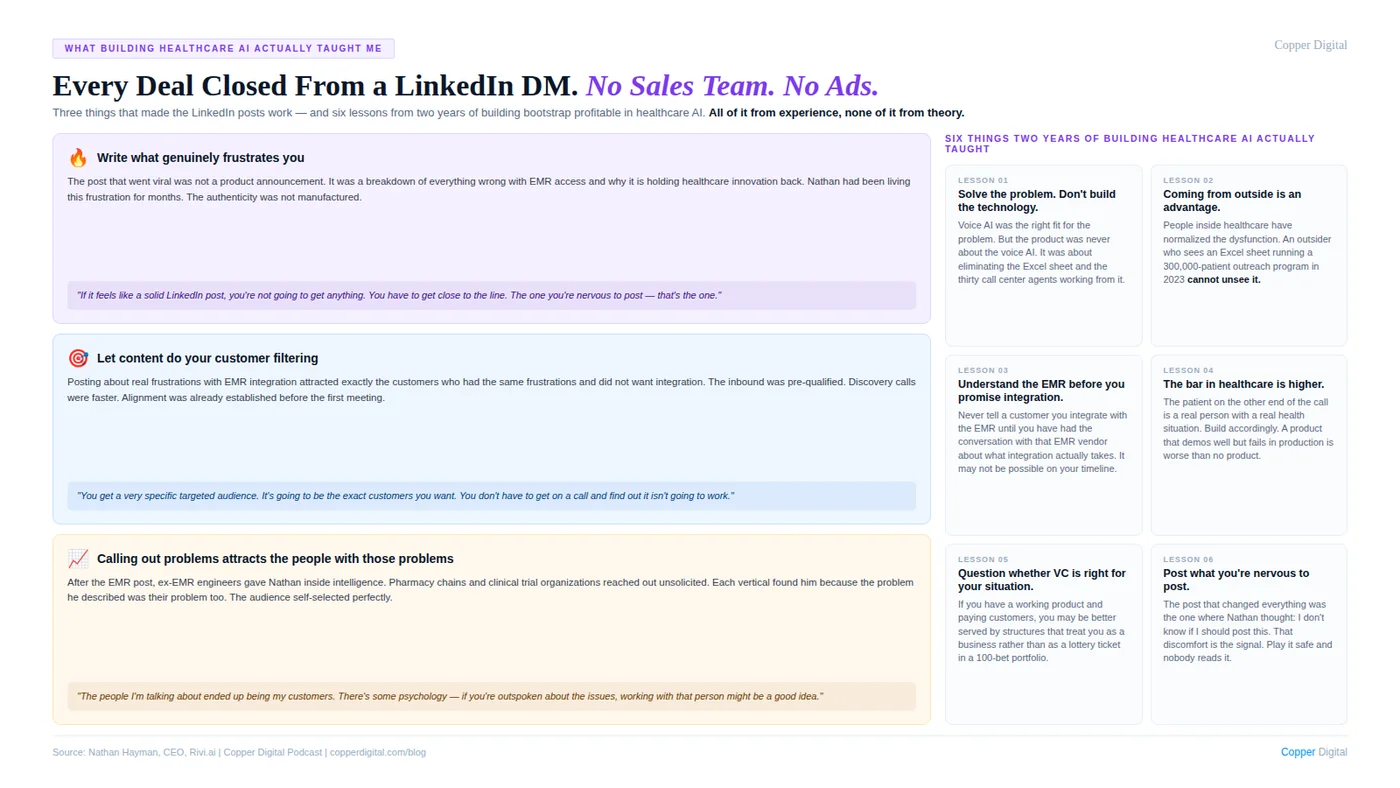
Honest posts about real problems became the entire pipeline: every deal closed from a LinkedIn DM.
The post went viral for healthcare LinkedIn. My DMs were full within hours, not just complaints about EMRs, but ex-EMR engineers explaining why things work the way they do, people from other verticals saying we have the same problem, and a community pharmacy chain saying we have a giant Excel sheet of patients to call, can you help? Every deal we have closed since came from a LinkedIn DM. No paid marketing, no sales team. And the filter is valuable: the people who reach out already know we do not integrate with the EMR and agree with the reasoning, so discovery is almost frictionless.
Write about something that, right before you post it, makes you think maybe I should not post this. That is the post that will land. If it feels like a safe LinkedIn post, you are playing it too safe.
Why Bootstrap Worked for Us
We were not ideologically opposed to raising money. We applied to YC multiple times and talked with Andreessen Horowitz after they put us in their B2B voice agent market map. None of it materialized, and I believe that was the right outcome. If you are pre-seed with an idea and no customers, VC is the right vehicle. But if you have a working product, paying customers, and real fundamentals, the VC model is designed to treat you as a lottery ticket, betting on a hundred companies hoping one returns the fund. That math requires most bets to fail. I do not want to be optimized for that.
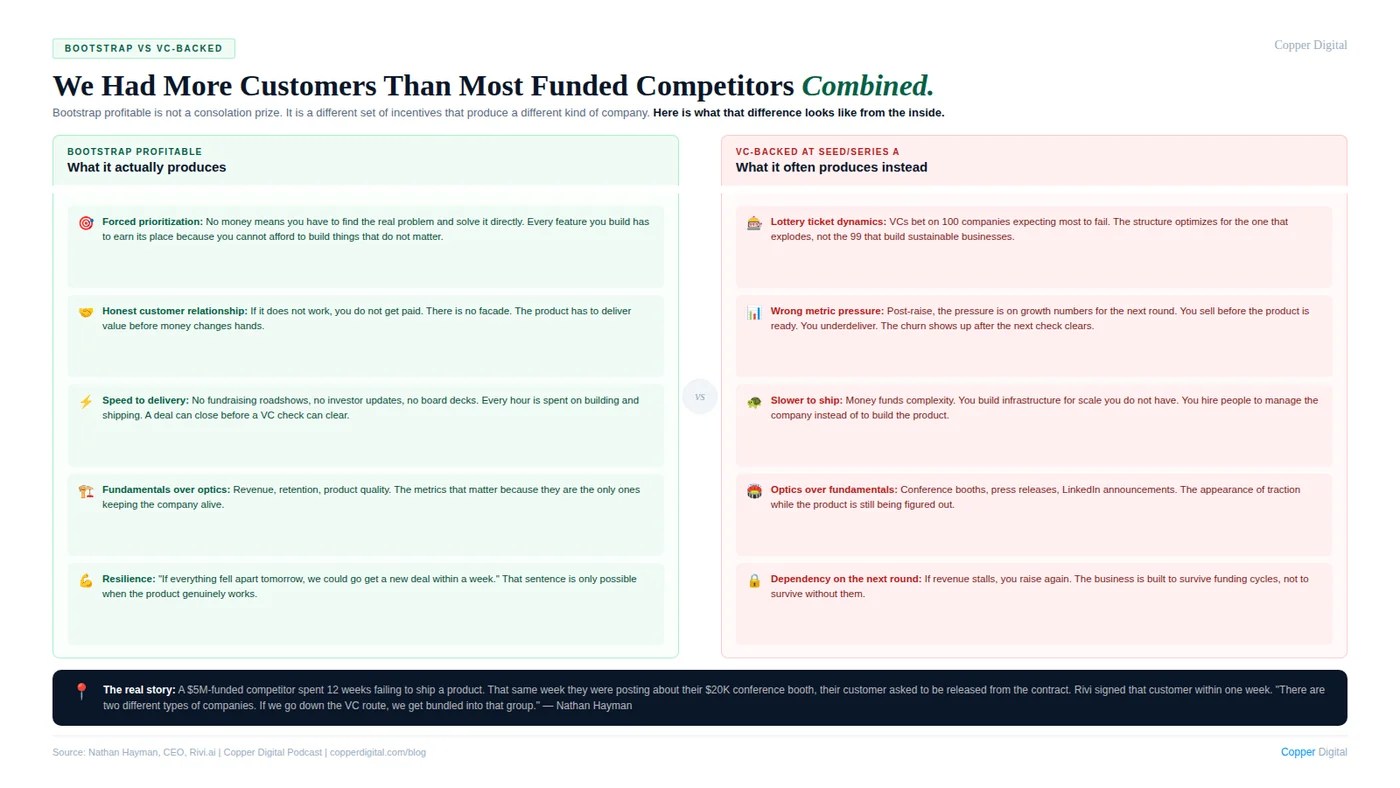
More customers and call volume than most funded competitors combined, because constraint forces you to solve the real problem.
Too much capital is its own problem. When money is not a constraint, prioritization gets hard. You solve problems that are not the most important ones, build infrastructure for scale you do not have yet, and hire to manage complexity rather than build the product. The constraint of bootstrap forces you to find the real problems and solve them in the most direct way possible.
What Voice AI in Healthcare Actually Requires
People ask what makes voice AI actually work in healthcare as opposed to in demos. The honest answer is that the clinical part is simpler than most people think; the hard part is everything around it. Getting an AI to have a reasonable phone conversation about an appointment reminder or a refill is not technically difficult in 2025. What is difficult is the full infrastructure: how the data gets in, how the AI handles edge cases and escalations, how output gets structured and stored, and how the whole thing operates reliably across tens of thousands of calls a month.
The governance question is real. People now ask for HIPAA documentation, security reviews, BAA provisions, and clinical oversight, and we have all of it. Companies that treat governance as a checkbox will run into problems, because the patients on the other end are real people with real health situations. The bar for what counts as working is higher in healthcare than in pizza delivery. And the specific use case matters more than the technology: the same infrastructure that handles appointment reminders handles medication adherence and trial enrollment screening, but the workflow integration, script logic, data flows, and escalation protocols are deeply specific to each customer. The edges are where healthcare problems live.
Working Product vs. Impressive Demo
Three weeks before I wrote this, a company kept asking on our first call: how fast can you get this live? I said a week, to under-promise; in the back of my head I was thinking a day. It turned out they had been working with another voice AI company for twelve weeks. That company had raised five million dollars the year before and delivered nothing. The customer asked to be released from the contract on a Friday. We signed them the following week. That same company was posting about its twenty-thousand-dollar conference booth the same week it released that customer.
We do not have that problem because we do not have that structure. If we do not deliver value, we do not get paid. That is a much simpler and more honest relationship with our customers.
What I Would Tell Someone Starting Now
- Find the problem before you find the technology. Our problem was a giant Excel sheet and thirty call center agents. Voice AI was the right tool, but the product was never about the technology.
- Get close to the actual work. Talk to the call center agents and the clinical pharmacists spending forty hours a week on the phone. They will tell you everything you need to know.
- Understand the EMR situation before you promise integration. Do not tell a customer you will integrate until you have had the conversation with that vendor about what it actually takes.
- Post what you are actually frustrated about, not what you think the algorithm wants. The post you are nervous to publish is the one that resonates.
- Question whether VC is the right vehicle for your situation. With a working product and paying customers, you may be better served by structures that treat you as a business, not a lottery ticket.
- The bar for healthcare is higher. The patient on the other end of the call is a real person with a real health situation. Build accordingly.
🎧 Listen to the full conversation between Nathan Hayman and Arvind Sarin on the Inside Home Health podcast. To see how Copper Digital takes the same problem-first, human-in-the-loop approach to home health documentation, explore AI tools for nurses, pricing, or more resources.
Bottom Line
Most healthcare AI doesn't work in the real world because it's built as an impressive demo, not a working product that fits EMRs and the messy realities of care.

Watch the Full Conversation
She Came Home Crying Every Day…So He Built an AI Company
Arvind Sarin and Nathan Hayman on building Rivvi.ai the hard way: bootstrapped, profitable, no VC round, and no EMR integration.

Nathan Hayman is the founder and CEO of Rivvi.ai. A self-taught engineer and college dropout who built his first software product while working the 4 a.m. shift at Target, he built products across seventeen industries before starting Rivvi two years ago, when AI in healthcare was genuinely taboo. Rivvi is now bootstrap-profitable, handling over 60,000 patient calls a month, and featured in the Andreessen Horowitz B2B voice agent market map.
Frequently asked
Frequently asked questions
Because EMR access is controlled by the vendor, not the customer. Vendors can say no for non-clinical reasons (like having a competing product), and even a yes can mean six-to-nine-month timelines and five-figure costs to write data back. Telling a customer you integrate with the EMR triggers a roughly twelve-month procurement process that has nothing to do with whether your product works. Rivvi delivers value without it, avoiding a dependency it cannot control.
Join the conversation
Leave a comment
Related reading

What 100 Healthcare Startups Taught Me About Building AI
The first thing Paulo Machado asks any founder: have you sat in the chair of the person you're building for? After 100+ healthcare startups, his lesson is simple, the ones that scale focus on the user, not the technology. On EHR mistakes AI is about to repeat, ethics before data, and human-in-the-loop as the adoption strategy.

How Ambient AI Is Changing Clinical Documentation
Ambient AI passively listens to patient-clinician conversations and automatically generates structured clinical documentation, using speech recognition, NLP, and large language models to capture symptoms, diagnoses, medications, and plans. It reduces after-hours charting and burnout while the clinician reviews and approves every note. In home health, it works best paired with an AI documentation agent that understands OASIS and referral workflows.

Healthcare AI Trust: Why Great Care Technology Fails Without Earning It
Healthcare AI fails when users don't trust it. Successful healthcare technology must be transparent, reliable, easy to use, protect patient data, fit naturally into caregiving workflows, and strengthen, not replace, the human relationships at the center of care.