
Where Home Health Fits in the Care Continuum: A Nurse's Map
When a discharge planner says home health, most families hear help is coming. What they get is a skilled nurse working from day one toward making herself unnecessary. Kathy Duckett, RN, maps the American care continuum, and the one question that determines where a patient actually belongs.
Key Takeaways
- Home health is skilled, intermittent, Medicare-covered care meant to be a bridge, not a destination.
- Home care, SNF, LTACH, assisted living, and hospice each serve different needs.
- The threshold question is always what the patient needs and where they are safest.
- Hospital-at-home is an emerging option reshaping the continuum.
When a hospital discharge planner says the words home health, most families hear something like: help is coming. Someone will be there to take care of things. What they picture varies. Sometimes a full-time caregiver. Sometimes a nurse who will manage everything the hospital was managing. Sometimes just a warm body so they do not have to worry.
What they get is a skilled nurse who comes several times a week, assesses the patient's progress, delivers specific clinical interventions, and is working from day one toward the moment she makes herself unnecessary. That gap between expectation and reality is not anyone's fault. It is a navigation problem. The American healthcare system has multiple levels of post-acute care, each with a distinct purpose, funding mechanism, and set of clinical criteria. They are not interchangeable. Moving someone to the wrong level is not just wasteful; it can be genuinely harmful. And most families, facing a health crisis with no preparation, have no map. I wish I had this map when I was trying to explain our healthcare system to my patients.
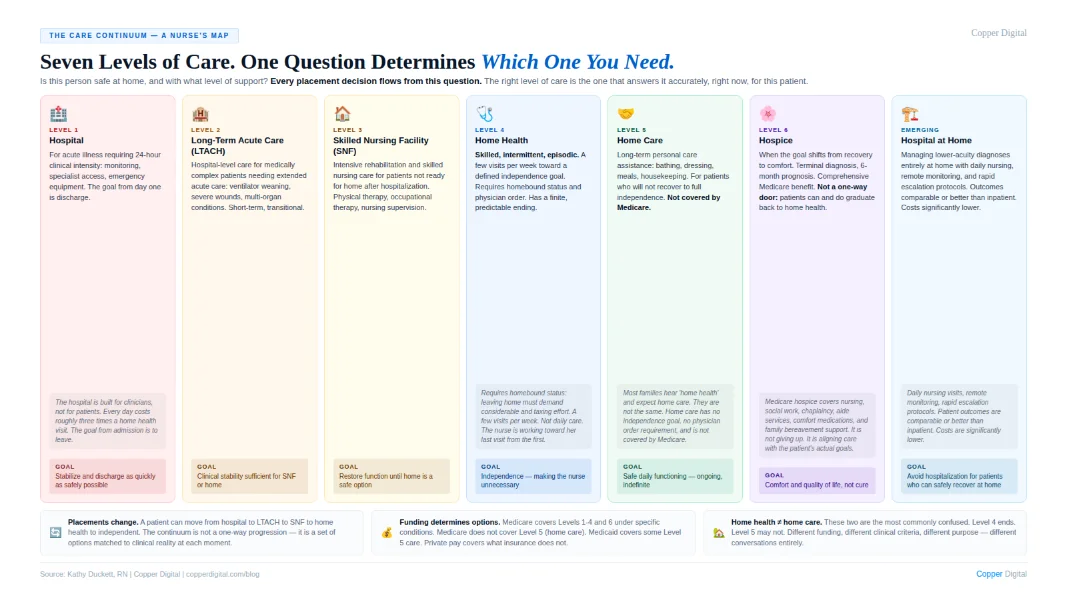
The care continuum is not a ladder you climb in order. It is a set of options, and the right one depends on the clinical picture.
Start Here: The Question That Determines Everything
Before I walk through each level of care, there is one question that sits underneath all of it, the question that determines where a patient should be at any given point in their recovery or decline:
🧭 Is this person safe at home, and with what level of support? Not what the family would prefer. Not what is most convenient. Not what the insurance will pay for without argument. What does this person actually need to be safe, and where can that need be met?
When they need 24-hour monitoring and specialist access at any hour, they belong in a hospital. When they need intensive rehabilitation but cannot manage at home yet, they belong in a rehab setting. When they can go home with skilled clinical support a few times a week and a plan to reach independence, that is home health. When they need help with daily activities indefinitely because they will not recover to independence, that is home care or a facility. When the focus has shifted from recovery to comfort, that is palliative care, and when it has shifted to end-of-life, that is hospice. Each is a different answer to the same question.
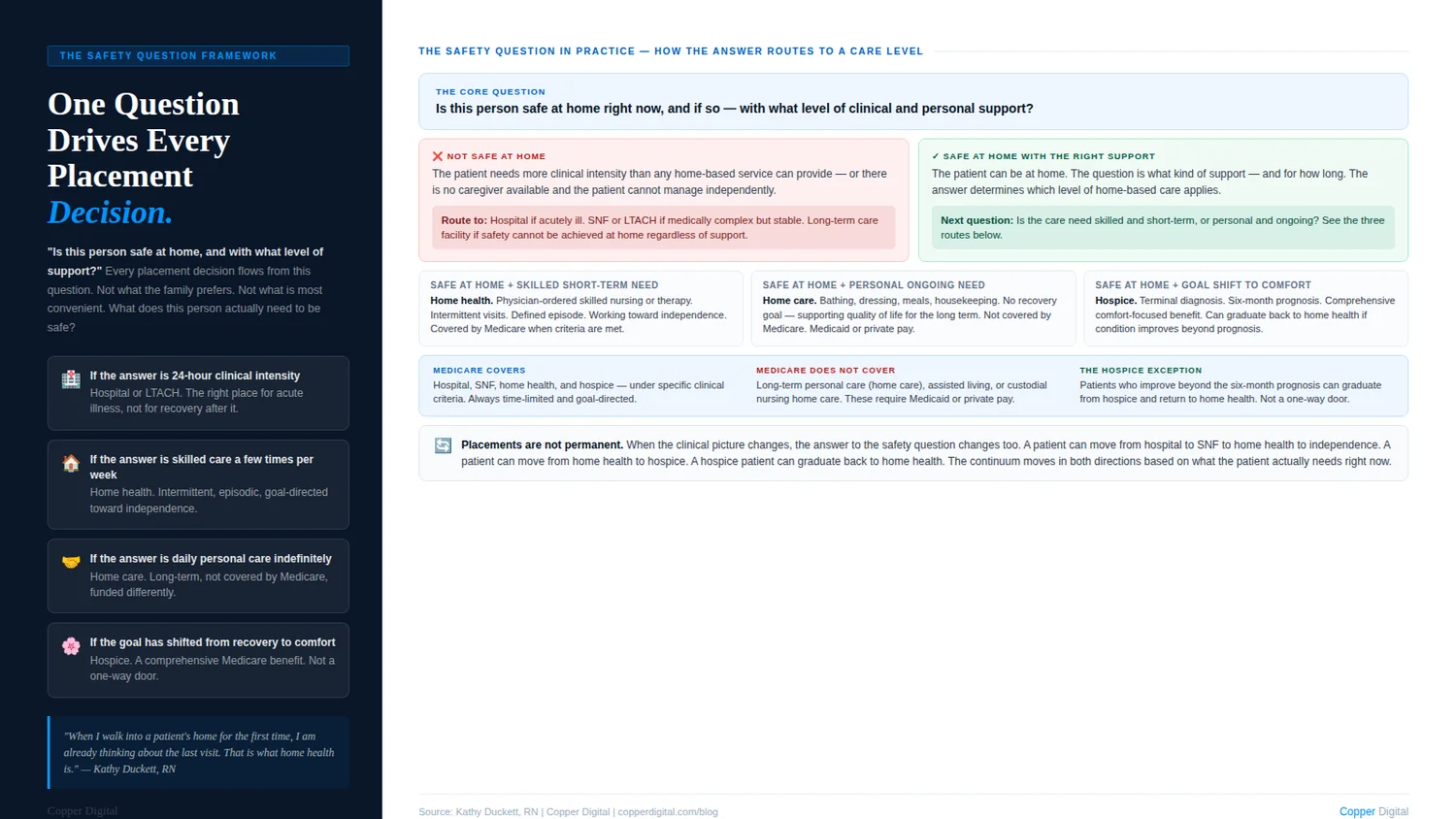
One question drives every placement decision, and how you answer it routes the patient to the right level of care.
The Hospital: Where You Go When You Are Acutely Sick
The hospital is built for acute illness. A heart attack, a stroke, a serious infection, a surgical emergency, or any condition requiring continuous monitoring and intensive intervention belongs there. But the hospital is also expensive, disorienting, and not conducive to recovery once the acute phase has passed. You are on the clinicians' schedule, the beds are uncomfortable, and everything about the environment is designed for clinical efficiency, not healing.
We know patients generally recover faster in their own home, that patients with dementia have significantly more confusion when moved out of familiar environments, and that infection rates are generally lower at home. A hospital day costs roughly three times what a home health visit costs, not because hospitals are inefficient but because you are paying for 24-hour nursing, housekeeping, the kitchen, the lab, and every other piece of infrastructure required to run a clinical institution. When you no longer need all of that, staying is both expensive and counterproductive. The goal of most hospital stays, from admission, is discharge. The question is always: where to, and with what support?
SNF and LTACH: The Bridge When Home Is Not Ready
When a patient cannot go directly from hospital to home because they need more intensive rehabilitation or skilled care than home health can provide, there are two primary institutional options.
Skilled nursing facilities (SNF)
A SNF provides short-term rehabilitation and also long-term skilled nursing care in a residential setting. After a hip replacement, a stroke, or a severe illness that left someone deconditioned, a SNF provides the intensive physical therapy, occupational therapy, and nursing supervision needed to get a patient to where home is safe. SNF care is covered by Medicare for qualifying stays following a hospitalization, subject to criteria and duration limits, and used that way it is transitional, not permanent. SNF care is also provided long-term for individuals who need help with activities of daily living and 24-hour nursing supervision but not acute medical care.
Long-term acute care hospitals (LTACH)
An LTACH provides hospital-level care for medically complex patients who need extended acute care beyond a typical hospital stay, such as those recovering from prolonged mechanical ventilation, severe wounds, or multi-organ conditions. LTACHs are transitional; a patient may spend months working toward the stability that makes either home or a SNF appropriate. The destination is still, where possible, home. The decision between a SNF, an LTACH, and home health is made on the intensity of skilled care required, the availability of a safe home and caregiver support, and the patient's clinical trajectory, not simply what the family prefers or what insurance covers most easily.
Home Health: The Bridge to Independence
Home health is the level most people misunderstand most completely, including families in the middle of receiving it. I wrote about this in detail in Home Health Is Not What Most People Think It Is, but the core is this: home health is not ongoing care. It is a bridge. When Medicare created the benefit in the 1960s, the design was explicit: a short-term, skilled, intermittent service bridging the gap between needing professional clinical care and being independent at home. That design has not fundamentally changed.
Home health requires a physician order. It requires the patient to be homebound, meaning leaving home takes a considerable and taxing effort. It requires that the care be skilled, needing the training and judgment of a licensed clinician. And it is intermittent, a few visits a week, not around-the-clock coverage. My job is specific: I assess where you are clinically, develop a plan of care with the physician, deliver the skilled interventions you need, and work with you and your family toward the goals we set at the start of care. The goal is always your independence.
When I walk into a patient's home for the first time, I am already thinking about the last visit. What does this person need to be able to do before I can safely say they do not need me anymore? My job is to make myself unnecessary.
What home health can do
- Skilled nursing visits for wound care, medication management, disease-management education, and assessment of complex conditions.
- Physical, occupational, and speech therapy to restore function and help patients return to independence with daily activities.
- Home health aide services for temporary help with bathing and personal care during recovery.
- Medical social work for navigating community resources, caregiver support, or complex discharge planning.
What home health cannot do
- Provide ongoing custodial or personal care indefinitely. That is home care, funded and structured differently.
- Replace the need for a caregiver in the home. Home health assumes someone is available to support the patient between visits if needed.
- Serve patients who are not homebound. If a patient can get to outpatient appointments without considerable effort, outpatient may be more appropriate.
Home Care: The Long-Term Support System
Home care is what families often think they are getting when they hear home health. It is ongoing personal care assistance, help with bathing, dressing, meals, housekeeping, and activities of daily living, for patients who cannot manage independently and will not recover to the point where they can. It is not covered by Medicare. It is covered in some cases by Medicaid depending on the patient's finances and the state's program, by private long-term care insurance for policyholders, or paid out of pocket, which can be extremely expensive, or provided by family members.
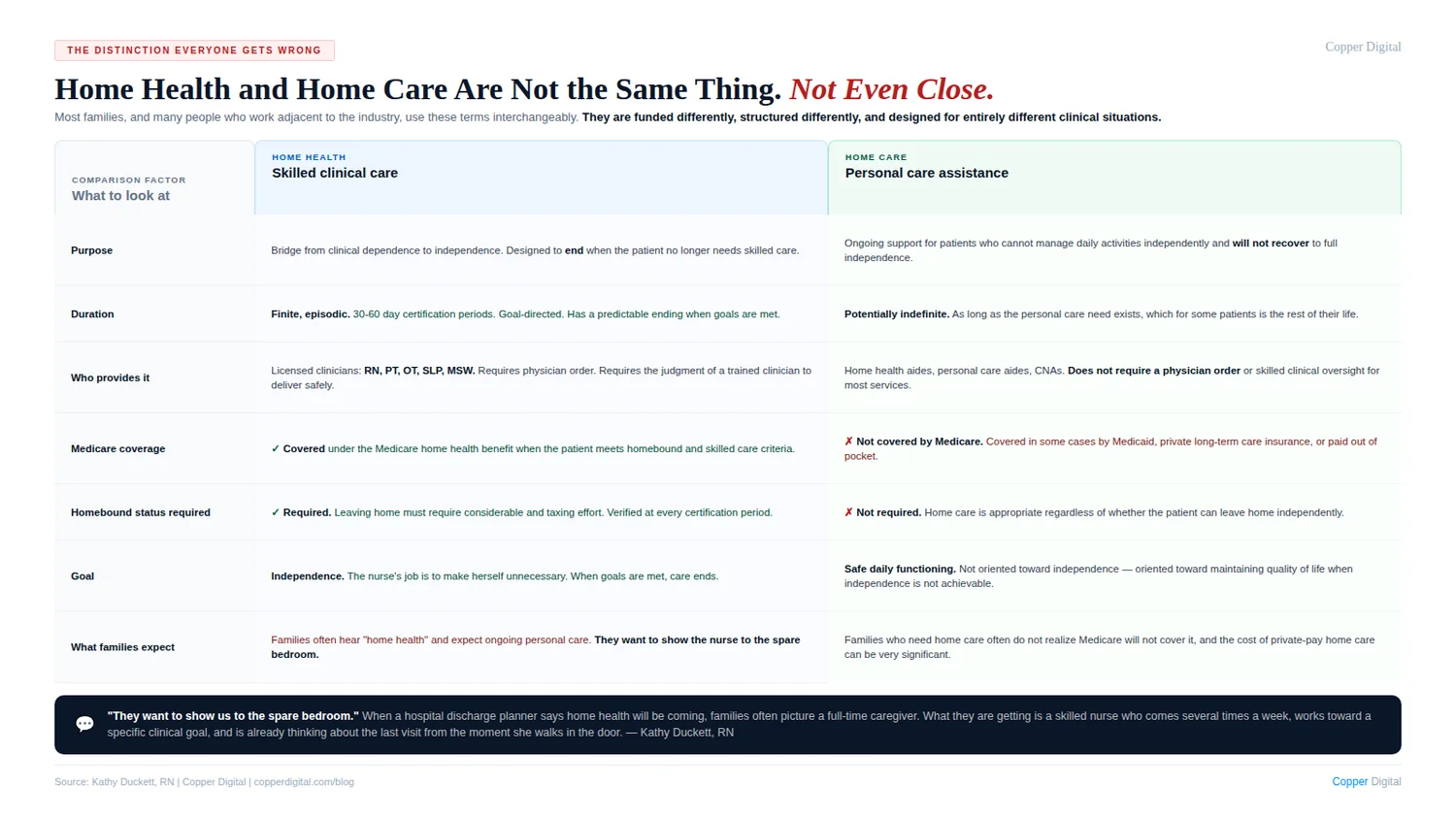
Home health and home care are not the same thing: different funding, different criteria, different purpose.
This is where the hard conversations happen. A patient with advanced dementia who needs help with every activity of daily living and will not improve does not need home health. They need home care, and the question of who provides it and how it gets paid for is often the most difficult conversation in the entire care-planning process. The funding reality is stark: if you have money, you can stay home with private-pay caregivers regardless of how much support you need; if you qualify for Medicaid, the state helps fund care at home or in a facility; if you fall in between, options become much more limited. That is not a clinical problem. It is a structural one.
Assisted Living and Long-Term Care Facilities: When Home Is Not the Answer
Sometimes, despite everyone's best efforts, home is not the right answer. A patient with very high personal care needs, no family support, and no financial resources for private care may genuinely be safer in a facility. Assisted living facilities provide housing with support services for people who need help with daily activities but not the medical care a SNF provides; they vary enormously in cost and are almost entirely private pay. Long-term care facilities provide housing and ongoing nursing care for patients with complex medical needs who cannot be safely managed at home, funded through Medicaid for qualifying patients and privately for others. The decision is never made lightly, but placing a patient in the wrong setting out of a commitment to keeping them home can cause real harm. The question is always: what does this person actually need to be safe?
Hospice: When the Goal Shifts to Comfort
Hospice is the most misunderstood part of the continuum, perhaps even more than home health. Families often resist it because they associate it with giving up. That framing does not serve patients. Hospice is appropriate when a patient has a terminal diagnosis with a prognosis of six months or less if the disease follows its expected course, and the goal has shifted from curative treatment to comfort and quality of life. The Medicare hospice benefit covers a comprehensive package: nursing care, medical social work, chaplaincy, aide services, medications related to the terminal diagnosis, and bereavement support. The patient gives up Medicare coverage for curative treatment of the terminal diagnosis in exchange for that comfort-focused benefit. Most hospice care happens at home, though it can also be delivered in a nursing facility, a dedicated hospice facility, or a hospital.
The graduation nobody talks about
Here is something families almost never know: hospice is not a one-way door. Patients can improve to the point where they no longer meet the six-month prognosis criteria and graduate from hospice. I have run agencies where patients graduated multiple times, particularly with conditions like heart failure and COPD, where the trajectory is unpredictable. The benefit stops and the patient transitions back to home health or other appropriate services; if their condition later deteriorates to end-of-life again, they can access the hospice benefit again. The option of returning from hospice should be part of the conversation when families decide whether to enroll.
Hospital at Home: The Emerging Option
There is a growing movement that does not fit neatly into the traditional categories: hospital at home. Some patients who would traditionally be hospitalized for lower-acuity diagnoses, pneumonia, heart failure and COPD exacerbations, and certain infections, can be safely managed at home with enough clinical support. The evidence supports it: outcomes are comparable or better than for traditionally hospitalized patients with similar diagnoses, infection rates are lower, satisfaction is higher, and costs are substantially lower. These programs are more resource-intensive than traditional home health, typically involving daily nursing visits, remote patient monitoring, and rapid response protocols, but they keep patients in the environment where they heal best. The model is expanding rapidly, and home health agencies are at the center of it.
How to Use This Map
- Ask the safety question first: is this person safe at home, and with what level of support? The answer tells you which part of the continuum is relevant.
- Understand what is temporary and what is not: home health, SNF rehab stays, and hospital care are transitional; home care, assisted living, and long-term care may be permanent.
- Understand how each is funded: Medicare covers home health, SNF for limited stays, and hospice under specific conditions, but not long-term personal care. Medicaid covers long-term care for qualifying patients. Private pay fills the gaps.
- Know that placements can change: a patient can move from hospital to LTACH to SNF to home health to independence, or from home health to hospice, or graduate from hospice back to home health. Nothing is permanent until it is.
- Ask what the goal of care is: recovery and independence, ongoing support for a condition that will not improve, or comfort at the end of life. The goal determines the right level, and when the goal changes, the level often changes with it.
🎧 This post grew out of Kathy's conversation with Arvind Sarin on the Inside Home Health podcast. Copper Digital builds AI documentation tools designed around the clinical reality of what home health nurses actually do, explore AI tools for nurses, pricing, or more resources.
Bottom Line
Home health is the bridge to independence in the care continuum; knowing how it differs from home care, SNFs, hospice, and hospital-at-home helps families choose the right setting.

Watch the Full Conversation
Why OASIS Is Every Nurse's Biggest Nightmare
Arvind Sarin and Kathy Duckett on the OASIS crisis, the care continuum, and the future of home health documentation.

Kathy Duckett, RN, BSN, MSN, has over 30 years of experience in home health nursing, from direct patient care in Detroit and Los Angeles to executive roles including Chief Clinical Officer and regional director. She joined Copper Digital as a clinical advisor to help shape AI documentation tools that reflect the clinical reality of home health nursing.
Frequently asked
Frequently asked questions
Home health is skilled, physician-ordered, Medicare-covered care tied to homebound status: a nurse and therapists deliver intermittent clinical care over a finite episode with the goal of independence. Home care is ongoing personal care assistance (bathing, dressing, meals, housekeeping) for patients who will not recover to independence; it is not a Medicare skilled benefit and is usually paid by Medicaid, private long-term care insurance, or out of pocket. Families frequently expect home health to provide ongoing personal care, which it was never designed to do.
Join the conversation
Leave a comment
Related reading
53 Million People Are Providing Care Right Now. Nobody Prepared Them for It.
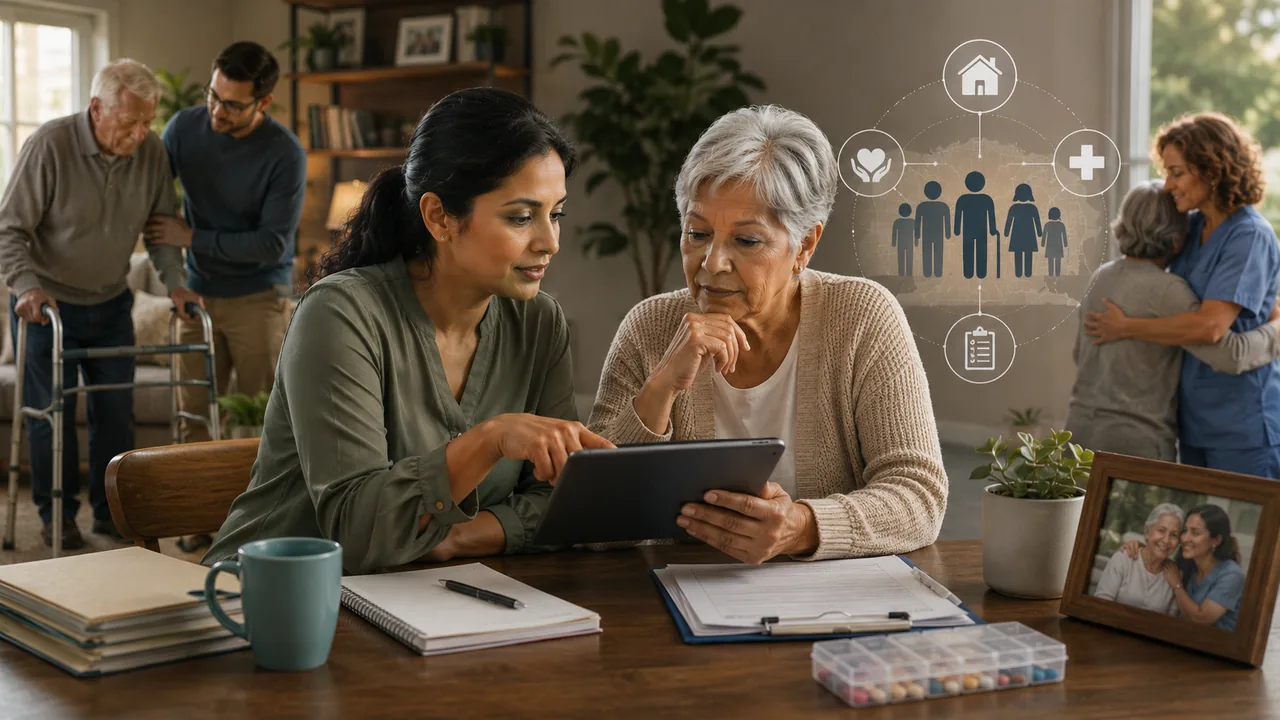
There are at least 53 million unpaid family caregivers in the United States, untrained, unpaid, and uncounted. Dr. Pooja Patel, OT and founder of Aging Together, on the care-literacy gap, proactive care planning, and why technology keeps getting built for providers instead of the families holding care together.

The Biggest Documentation Challenges Home Health Nurses Face
Home health nurses face heavy documentation challenges: delayed point-of-care charting, excessive administrative time, clunky EHRs, OASIS complexity, strict reimbursement rules, working in isolation, endless QA corrections, and after-hours charting that drives burnout. Reducing documentation burden is now essential for clinician retention, patient outcomes, and agency financial performance.
Home Health Is Not What Most People Think It Is
Most people, even those who work near the industry, misunderstand what home health is. Kathy Duckett, RN, explains the bridge it was designed to be, how it differs from home care and hospice, why OASIS accuracy is everything, and where AI can genuinely help nurses.