
What 40 Years in Nursing Taught Me About Surviving a Broken System
67% of nurses report burnout. Those are not staffing metrics. Nurse leader Kimberly Maurer on the suitcase of unprocessed trauma every nurse carries, the lateral violence nobody names, and the third path between staying stuck and walking away.
Key Takeaways
- Nurses carry an emotional load the system rarely acknowledges.
- Surviving and thriving are not the same thing.
- Lateral violence and documentation burden drive nurses out.
- You're not broken; you may be in the wrong place.
📊 67% of nurses report burnout. 23% are considering leaving the profession within two years. Those are not staffing metrics.
I know this not just from statistics but from living it. I spent nearly 40 years in healthcare, more than 20 of them in labor and delivery. I traveled across the United States certifying nurses in every aspect of OB. I loved this profession with everything I had. And then COVID happened, I got sick, and I spent six months fighting to be heard while my own colleagues treated me like I was drug-seeking. I lost my identity, my marriage, and for a period of time, I lost my will to stay in nursing at all.
But I did not leave. And I did not stay stuck. I found a third path. And that is what I want to talk to you about.
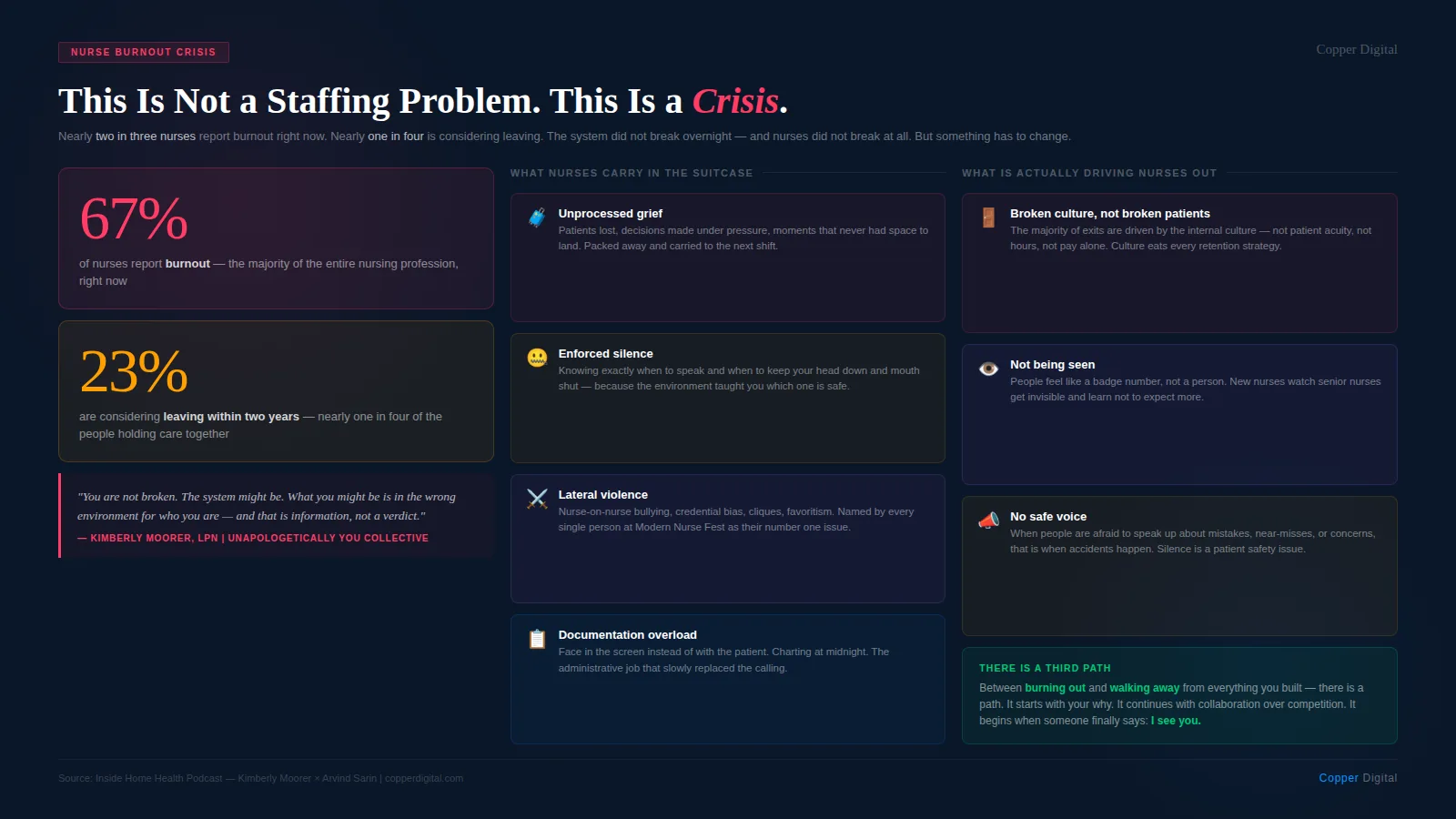
This is not a staffing problem. It is a crisis of unprocessed grief, lateral violence, and documentation overload.
The Suitcase We All Carry
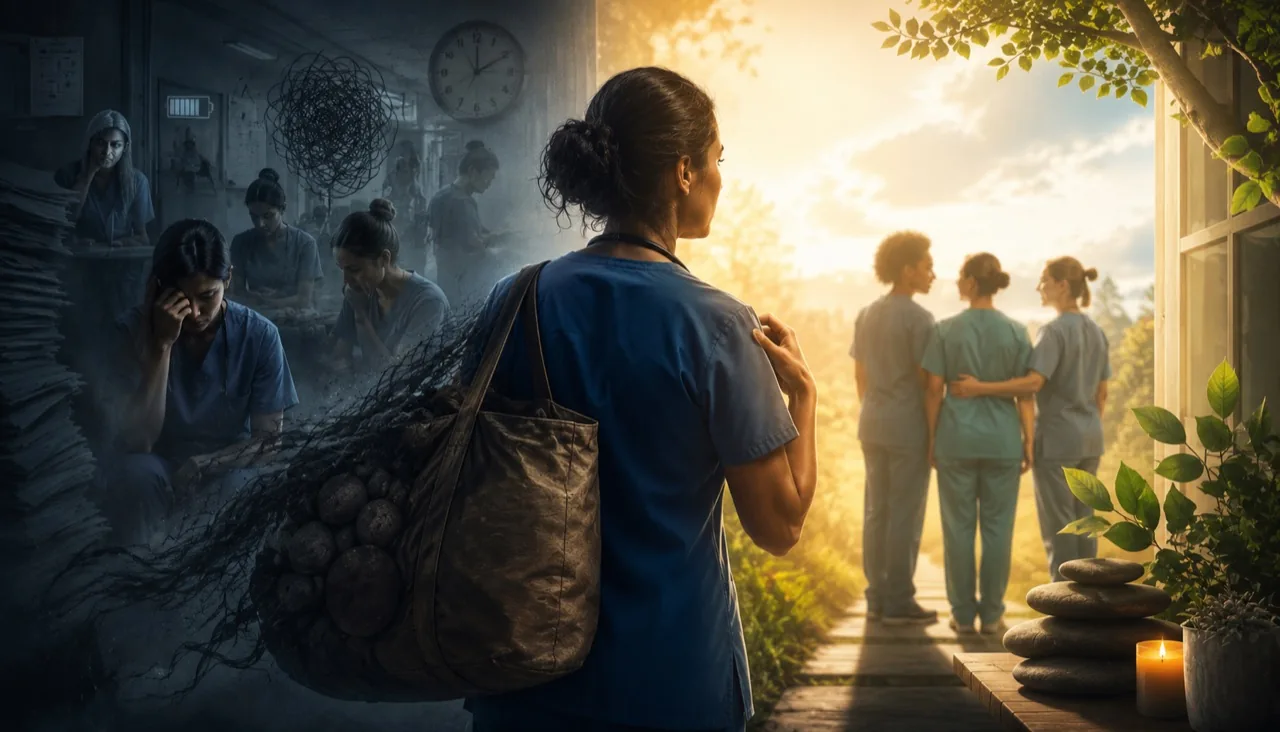
I talk about this image a lot: the suitcase. Every shift, you pack something into it. A patient who did not make it. A colleague who threw you under the bus. A manager who looked the other way. A comment that made you feel small. You zip it up, throw it in the closet, grab a new one in the morning, and start all over.
We have been doing this for so long that most of us do not even notice the weight anymore. We call it resilience. We call it professionalism. We call it just part of the job. But what we are actually doing is carrying unprocessed trauma from one shift to the next, from one year to the next, and eventually it shows up in how we treat our patients, how we treat each other, and how we treat ourselves.
COVID did not create this problem. It exposed it. It accelerated it. It stripped away the last layers of protection that were keeping some of us functional and revealed what was underneath: exhaustion so deep it feels like a personality, grief that never had a place to land, and a profession-wide identity crisis about what nursing is even supposed to look like anymore.
We pack it all in a suitcase, and we carry it around with us. We bring it home, put it in the closet, grab another one, and start all over. At some point, you have to stop and open the suitcase.
What I Saw from the Other Side of the Bed
When I got sick, I did not immediately tell people I was a nurse. I have watched enough nurses get treated differently when they reveal their credentials. Some get the benefit of the doubt. Others get dismissed as someone who thinks she knows everything. I had seen it enough times that I chose to stay quiet and just be a patient.
What I witnessed over the course of several emergency department visits, six months of falls and being dismissed, and a brain tumor diagnosis that finally came only because I kept refusing to stop advocating for myself, was devastating. Not because the people caring for me were bad people, but because the system had ground them down to a point where the human in front of them had stopped registering as a full human being.
I sat in that bed and thought: I am so ashamed of what I am seeing. And then I thought: but I understand it. Because I had been on that side of the curtain for 20 years. I knew the double shifts. I knew the charting at midnight. I knew the culture of just keep going, just push through, just do not show weakness. And the result of all of that pushing and not opening the suitcase was right there in the room with me.
I wrote about all of this in my book, The Healthcare Mafia: A Nurse's Testament. Forty-eight chapters. Not because I wanted to tell a sad story but because I wanted to be the person who said out loud what so many nurses are only saying in the break room, or in the car on the way home, or to themselves at three in the morning. We do not talk about these things. And the silence is making it worse.
Surviving vs. Thriving: The Difference Is Not Small
When I ask nurses whether they are surviving or thriving, I usually already know the answer. I can see it. The nurses who are just surviving show up, do the tasks, and go home. They have stopped asking questions. They have stopped pushing back. They have tuned out the things that used to bother them because the energy required to stay bothered ran out a long time ago.
That is numbness. And it matters clinically, not just personally. When nurses are numb, patients feel it. Families feel it. The new nurse coming in on their first week feels it and learns from it, learns exactly when to speak up and when to keep their head down. And that is when accidents happen. That is when people fall through the cracks.
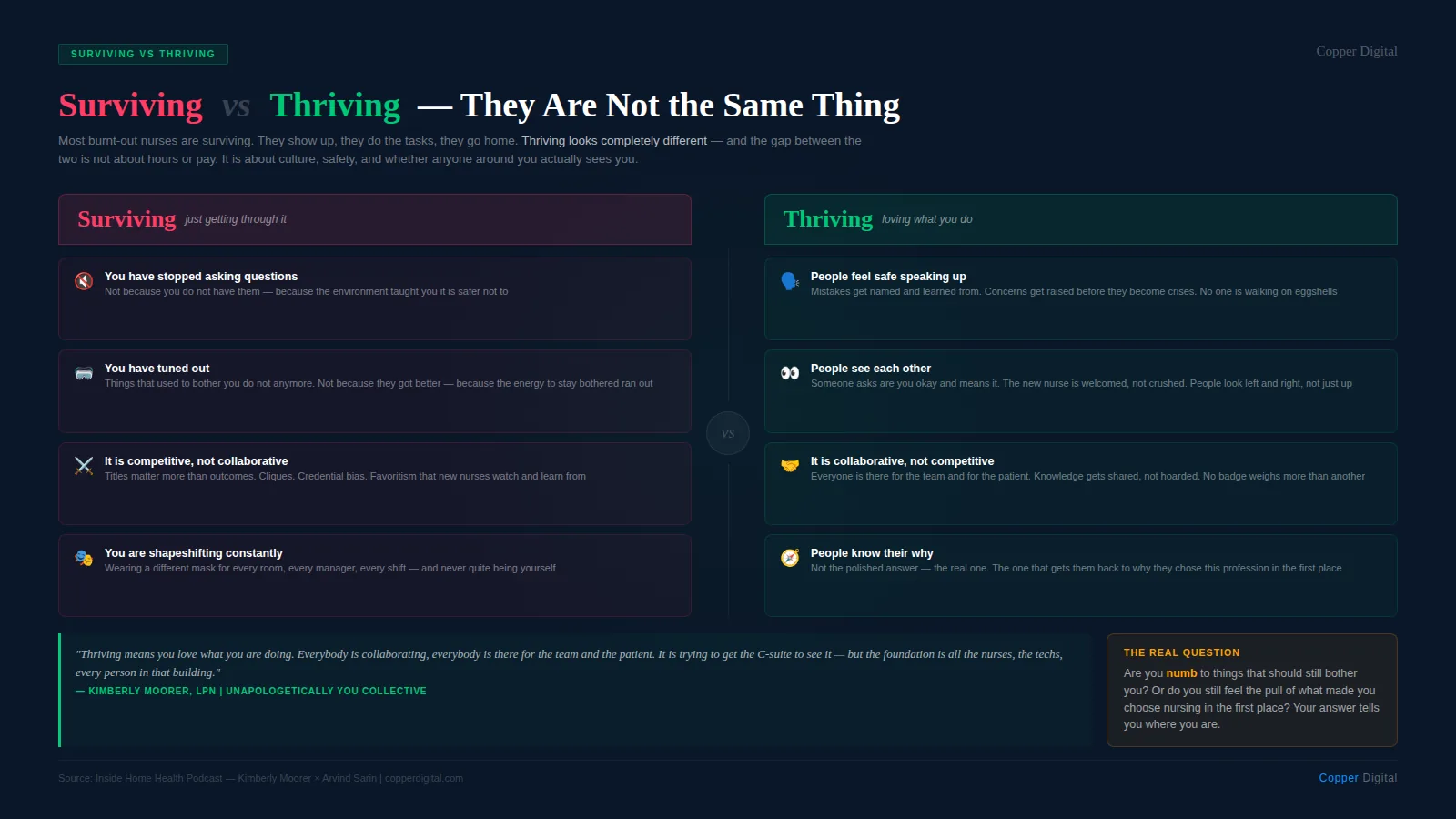
Surviving and thriving are not the same thing, and the difference is culture, made one interaction at a time.
Thriving looks different. It looks like showing up knowing your why. It looks like people covering for each other because they genuinely want their colleague to succeed, not because they are managing an uncomfortable situation. It looks like nurses who feel safe enough to say I made a mistake, or I do not understand this, or something about this patient is not right, even when they cannot prove it yet. The difference between those two environments is not primarily about staffing ratios or technology or pay, although all of those matter. The difference is culture. And culture is made by people, one interaction at a time.
You can only give great care when you feel safe, valued, and seen. The healers need to heal the healers. You protect the protectors.
The Lateral Violence Nobody Wants to Name
I am going to say the thing people do not want to say: a significant portion of what is driving nurses out of this profession is not the patients, not the hours, not even the administration. It is each other.
Lateral violence. Nurse-on-nurse bullying. The hierarchy. The credential bias. The cliques. The favoritism. The mean-girl energy that we all experienced in high school and somehow never left behind, it just put on scrubs and got a badge. I have lived it. I have witnessed it. When I did a presentation at Modern Nurse Fest about being silenced, I asked every person in the room to write down one thing they refused to be silent about anymore. Every single one of them wrote down bullying. Not one exception.
Here is what I want to say to the nurses who have bullied: you did not suddenly become a bully when you got your title. The behavior was already there. The title just gave it more reach. And if you look honestly at why you are doing it, you will usually find something in that suitcase that has been sitting there a long time.
And here is what I want to say to the nurses who are being bullied: your silence is not protecting you. It is protecting the behavior. It only ends when people feel safe enough to speak up. If you have gone to your manager and nothing has changed, go above them. There is a ladder for a reason. You have a voice. Do not let anyone shrink you.
The credential bias problem
I experienced this recently in a LinkedIn comment thread. I posted about the third path for nurses, about collaboration, about bringing everyone along. And someone responded that because I only have LPN behind my name, I did not have what it took to speak on the topic. I did not debate him. I am not interested in debating credentials. What I am interested in is this: no badge weighs more than another when we are all standing at the same bedside trying to keep a patient alive.
The idea that experience, insight, and real-world wisdom are invalidated by the letters after your name, or the absence of certain letters, is exactly the kind of thinking that is fracturing this profession from the inside. Education matters. I applaud everyone who climbs the ladder. But the point of climbing it is to bring people up with you, not to use it to knock them back down.
The Third Path: What It Actually Looks Like
When I talk about the third path, I mean the space between staying stuck in a role that is draining you and walking away from everything you have built. Most nurses who are burning out believe those are their only two options. They are not.
More nurses than ever are becoming entrepreneurs. They are taking their clinical expertise into consulting, education, coaching, writing, content creation, and advocacy. They are building things that did not exist before because they saw a gap that only someone with their experience could see. That is a path. And it does not require abandoning what you love about nursing. It requires figuring out what that actually is.
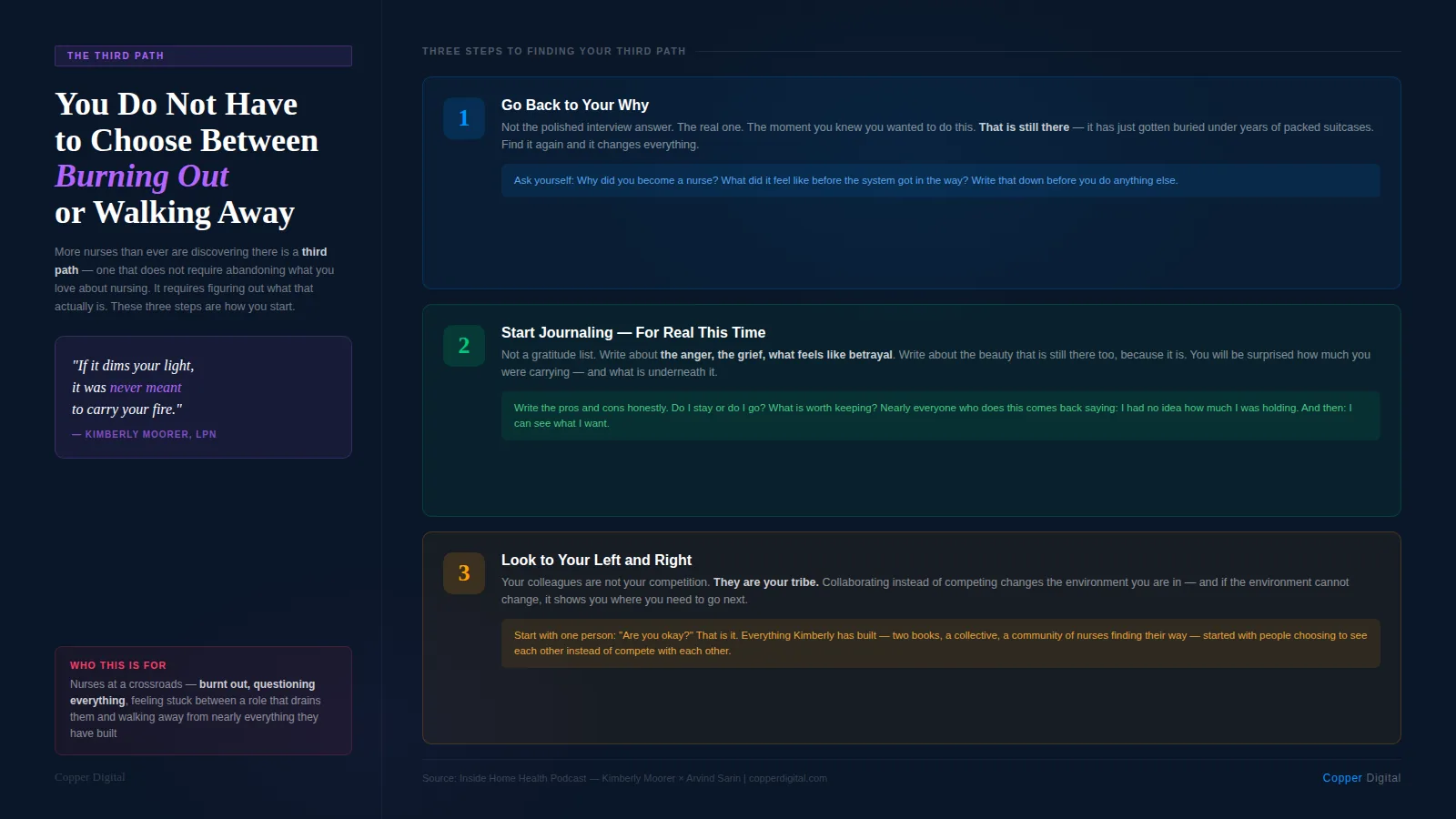
You do not have to choose between burning out and walking away. The third path starts with three steps.
Step one: go back to your why. This is always where I start with clients. Not with the resume, not with the job search, not with a five-year plan. With the question: why did you become a nurse? Not the polished interview answer. The real one. For me, it was my grandfather. I was his hospice nurse. I was 17, working as a CNA, and I had the most extraordinary director of nursing, Dee Duret, showing me what it looked like to show up for people at the hardest moments of their lives. When I lost sight of it, I lost sight of myself. Your why is still there. It has just gotten buried under the suitcase.
Step two: journal. I have every client start journaling. Not a gratitude list, not bullet points. Write about it. Write about why you are staying and why you are thinking about leaving. Write about the anger. Write about what feels like betrayal. Write about the beauty that is still there, because it is still there. Every person who comes back to me after this says the same thing: I had no idea how much I was carrying. And then, underneath that: I can see what I want.
Step three: look to your left and right. Your colleagues are not your competition. They are your tribe. The game changes the moment you start actually seeing the people next to you, asking them if they are okay, sharing what you know, and building something together instead of protecting your piece of a pie that was never big enough to hoard anyway. I have built my best work in collaboration. My first book came out of a collaboration with Ashley Scott, a nurse who turned her trauma into poetry. We were both in dark places. We both came out changed, not because we competed but because we showed up for each other.
A Note on the Documentation Burden
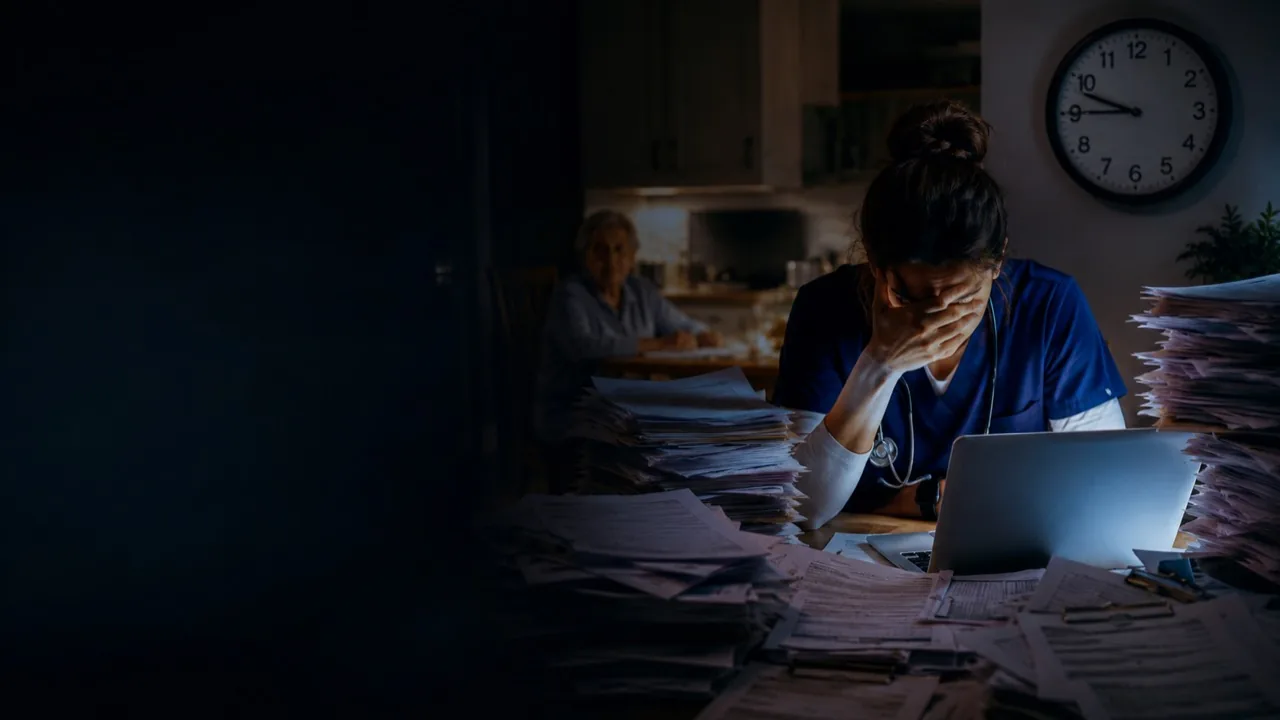
I want to say something directly to the home health nurses reading this, because I know your specific version of this exhaustion. You are driving between patients, managing complex cases in people's homes with no backup in the building, and then spending your evenings at the kitchen table finishing documentation: the OASIS assessment, the care plan, the clinical notes, the justifications. You went into nursing to care for people. You did not go into nursing to become a data entry specialist.
I spoke with Arvind Sarin at Copper Digital about what they are building, and what struck me is the framing: documentation burden is not just a workflow problem. It is a burnout driver. Every hour a nurse spends reconstructing a visit from memory at 9 p.m. is an hour she is not recovering, not sleeping, not being present for her family. Getting that time back is not about efficiency metrics. It is about keeping good people in this profession.
You Are Not Broken. But You Might Be in the Wrong Place.
I want to say this to every nurse who is questioning everything right now: you are not broken. You came into this profession with something real, a calling, a care for people that most of the world does not have in the same way. That has not gone away. It may be buried, exhausted, or protected behind walls you built so you could keep functioning. But it is still there. The system may be broken. Parts of the culture may be broken. But you are not.
What you might be is in the wrong environment for who you are and where you are in your journey. And that is information, not a verdict. There are other roles, other settings, other paths, and other ways to do this work that do not require you to sacrifice yourself to survive in them. Finding that path starts with a decision to stop treating your own discomfort as something to be endured and start treating it as something worth paying attention to.
The most sacred thing I can tell you is this: if it dims your light, it was never meant to carry your fire.
🎧 Listen to the full conversation between Kimberly Maurer and Arvind Sarin on the Inside Home Health podcast. Her book, The Healthcare Mafia: A Nurse's Testament, is available on Amazon, and you can connect with her on LinkedIn. To see how Copper Digital is giving nurses their evenings back, explore AI tools for nurses, pricing, or more resources.
Bottom Line
Forty years in nursing shows the system is broken, not the nurses; surviving means naming lateral violence, reducing documentation burden, and finding the third path.

Watch the Full Conversation
Stay or Leave Nursing? What That Third Path Actually Looks Like
Arvind Sarin and Kimberly Maurer on burnout, lateral violence, and the third path between staying stuck and walking away from nursing.

Kimberly Maurer, LPN, spent nearly 40 years in healthcare, more than 20 of them in labor and delivery. She is the founder of the Unapologetically You Collective, a women's health advocate and speaker, and the author of The Healthcare Mafia: A Nurse's Testament.
Frequently asked
Frequently asked questions
The third path is the space between staying stuck in a role that is draining you and walking away from nursing entirely. Most burning-out nurses think those are the only two options. The third path means taking your clinical expertise into consulting, education, coaching, writing, advocacy, or entrepreneurship, without abandoning what you love about nursing. It starts with reconnecting to your why, journaling honestly, and leaning on your colleagues instead of competing with them.
Join the conversation
Leave a comment
Related reading
Clinician Burnout Is the Patient Experience Problem
Burnout isn't a yoga-and-pizza-party problem. Patient experience advisor Valerie Choniuk reframes clinician burnout as a system problem, and a patient experience problem, and explains how protecting presence (not just adding technology) is what actually heals care.

Can AI Help Reduce Nurse Burnout?
Nurses now spend nearly as much time documenting care as delivering it, and the result is unprecedented burnout. AI can help, but only when it is designed to support nurses rather than replace them. This guide breaks down how AI reduces cognitive load, ambient documentation, predictive deterioration detection, human-in-the-loop safety, and what it means for retention and home health.

Why Nurses Quit? The Real Reasons Behind the Nursing Shortage
Nurses are leaving the profession because of burnout, documentation overload, chronic staffing shortages, loss of autonomy, mental health strain, workplace violence, and better non-bedside opportunities. This isn't a shortage of people who care, it's a shortage of systems that support them. Solving it means reducing administrative burden and building healthcare around clinicians.