
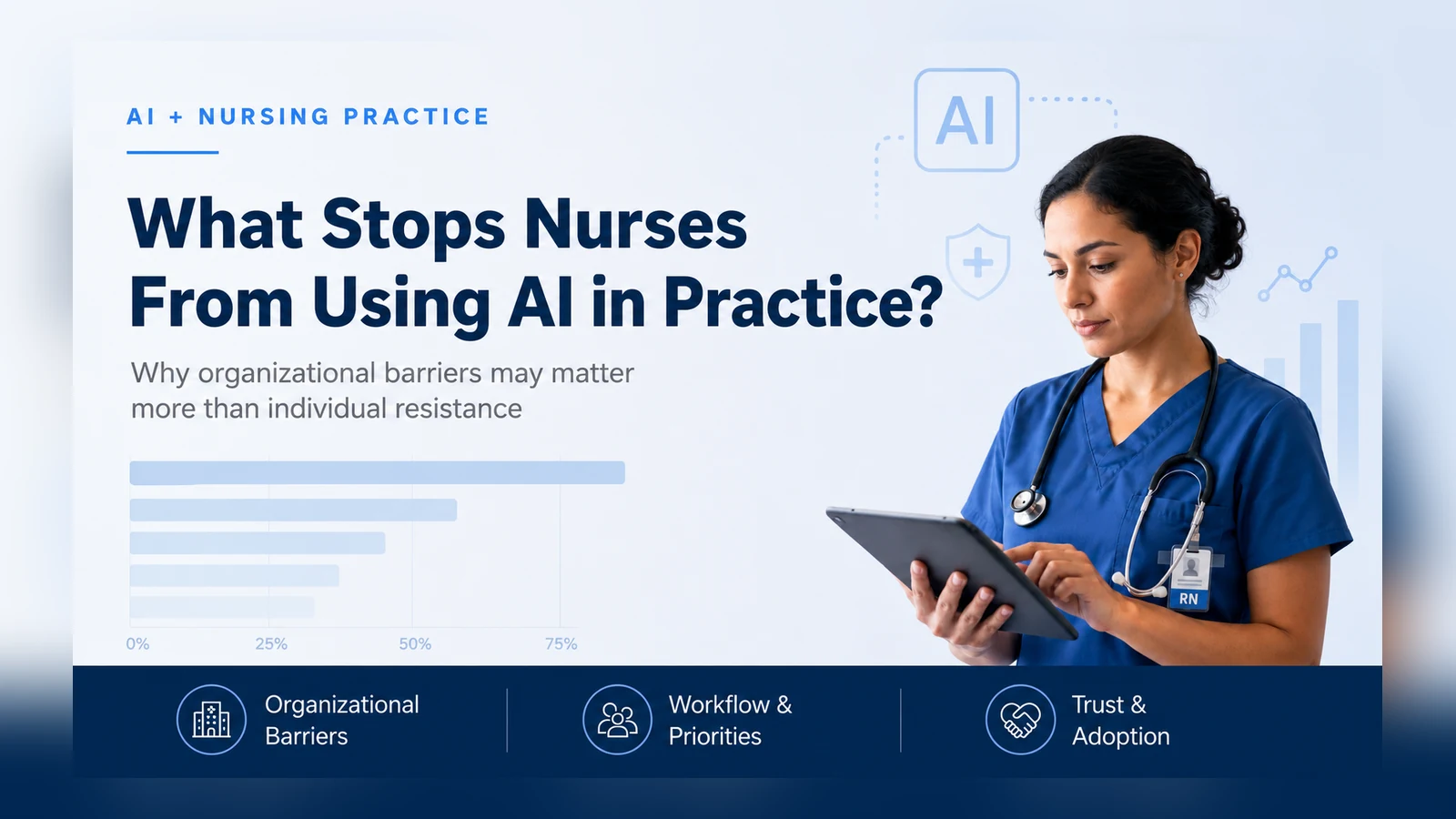
What Stops Nurses From Using AI in Practice?
AI adoption is usually framed as a clinician problem, but a 42-nurse course evaluation found the top barrier was organizational policy and IT restrictions (21 of 42), not distrust or fear. This guide breaks down 12 real barriers (governance, patient trust, competing priorities, time, workflow friction, privacy, burnout, and more) and the seven conditions that make nurses actually adopt AI.
Key Takeaways
- In a 42-nurse AI course evaluation, organizational policy or IT restrictions was the most-selected barrier (21 of 42), more than patient trust, competing priorities, or time.
- The largest barrier to AI adoption may sit outside the nurse: policies, IT restrictions, workflows, and governance can block adoption even after investment and training.
- Different barriers need different fixes, access problems need policy, distrust needs transparency and validation, and workflow overload needs fewer steps, not more training.
- AI has to earn its place in the workflow; a tool that saves 10 minutes generating a note but adds 15 minutes of copying and correcting has moved the problem, not solved it.
- Keep clinicians in control with human-in-the-loop: AI generates → nurse reviews → nurse edits → nurse approves, with the system directing attention to gaps.
- Divide the labor: AI handles repetition, organization, summarization, and drafting; clinicians keep judgment, empathy, context, communication, and ethical decisions.
- 'Resistance' is often rational, if adoption means more clicks, logins, and review, the real problem is bad workflow design, not the nurse.
💡 Quick Answer: The biggest barriers to nurses using AI can include organizational policy and IT restrictions, patient trust concerns, competing priorities, limited time, workflow friction, uncertainty about AI accuracy, privacy concerns, burnout, and insufficient training. In a 42-person nursing AI course evaluation, organizational policy or IT restrictions were selected most frequently (21 of 42) — suggesting AI adoption is often an organizational design problem as much as a clinician behavior problem. When AI solves a real problem, fits the workflow, protects patient information, and keeps clinicians in control, adoption stops being a persuasion problem and becomes a value problem.
AI adoption in healthcare is often framed as a clinician problem. Nurses are described as resistant to change. Leaders assume they do not trust technology. Vendors assume they need more training. Organizations sometimes conclude that clinicians simply need to become more comfortable with AI. But a small nursing AI course evaluation points to a different problem.
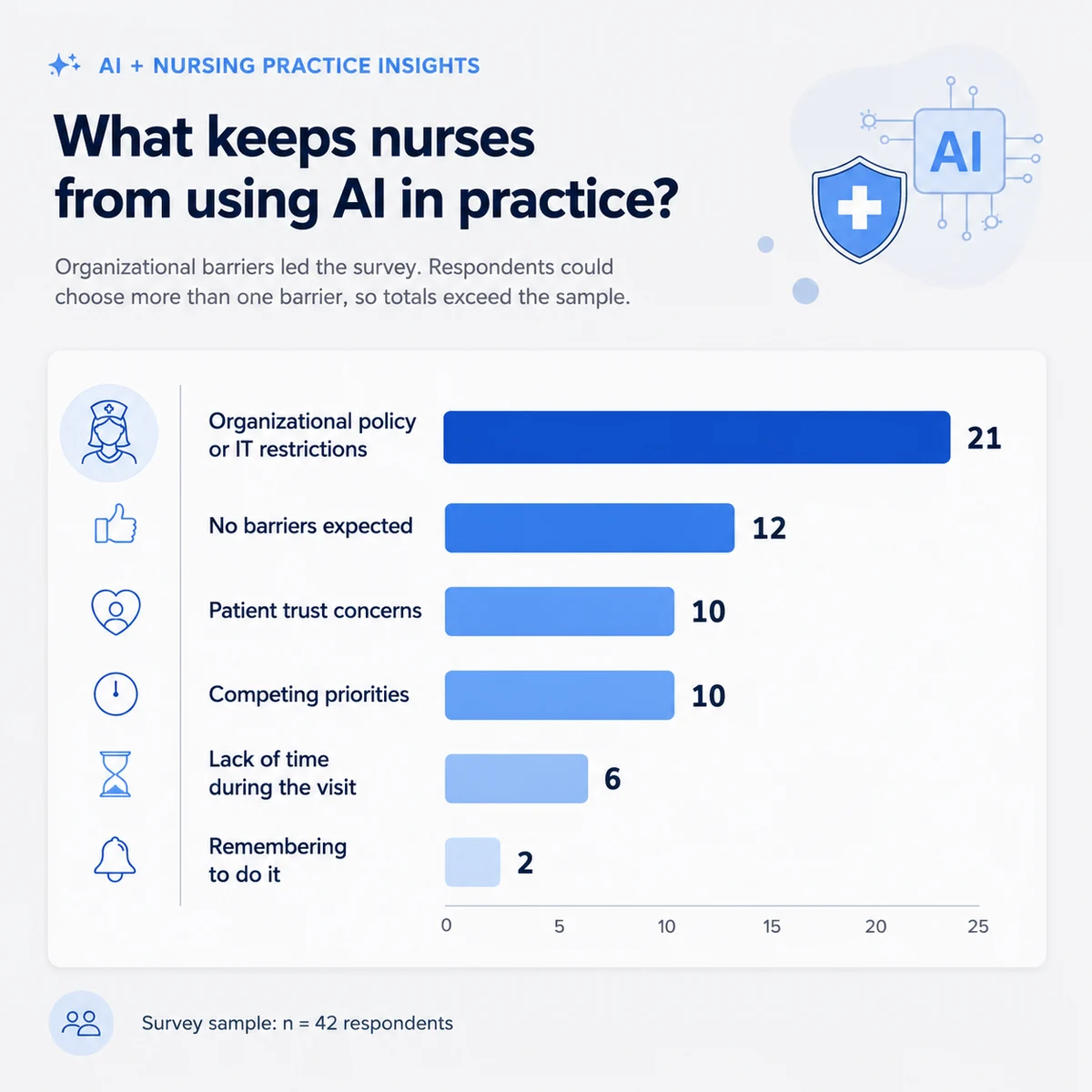
Among 42 respondents, organizational policy or IT restrictions was the most frequently selected barrier, the largest obstacle may sit outside the nurse.
Among 42 respondents, 21 identified organizational policy or IT restrictions as a barrier to using AI in practice, the most frequently selected barrier. Other responses: 12 expected no barriers, 10 cited patient trust concerns, 10 cited competing priorities, 6 cited lack of time during the visit, and 2 cited remembering to use AI. Respondents could select more than one answer, so the counts exceed the sample size.
The most interesting finding is not that nurses have concerns about AI. It is that the largest barrier may sit outside the nurse entirely. Healthcare organizations can invest in AI platforms, announce pilots, train employees, and still see limited adoption if policies, IT restrictions, workflows, leadership decisions, or governance structures make the technology difficult to use. That changes the question, from "why aren't nurses using AI?" to "what is preventing nurses from using AI effectively?"
What Are the Biggest Barriers to AI Adoption for Nurses?
The main barriers include organizational restrictions, patient trust concerns, competing clinical priorities, workflow limitations, lack of time, uncertainty about AI accuracy, privacy concerns, insufficient training, burnout, and poorly designed technology. The course evaluation adds an important dimension: organizational policy and IT restrictions may be a more immediate barrier than personal resistance to AI. That distinction matters because different barriers require different solutions, a nurse who does not understand a tool needs training; a nurse who cannot access it because of policy does not; a nurse who distrusts output needs transparency and validation; a nurse who already has eight applications open does not need another dashboard. Successful implementation starts by identifying which problem actually exists.
1. Organizational Policy and IT Restrictions
This was the most frequently selected barrier, 21 of 42 respondents. That should get the attention of healthcare leaders. Many organizations are simultaneously telling clinicians to explore AI while restricting access to the tools they might actually use. Sometimes those restrictions are justified, organizations need controls around protected health information, approved AI systems, user access, cybersecurity, data storage, vendor agreements, model training, clinical use cases, and human review. The problem begins when governance becomes indistinguishable from prohibition. If the policy is simply "do not use AI," clinicians have no safe path for learning how AI might support their work.
Governance should create safe lanes, not roadblocks
A more mature policy answers practical questions: which AI tools are approved? What information can clinicians enter? Which use cases are permitted? Where is human review mandatory? What should never be delegated to AI? Who should clinicians contact when uncertain? Clear boundaries can actually increase adoption because clinicians no longer have to guess what is allowed. The goal of AI governance should not be unrestricted access, it should be safe, understandable access.
2. Patient Trust Concerns
Ten respondents identified patient trust as a potential barrier. This is particularly important for nurses because nursing care is deeply relational. A patient may be comfortable with a nurse taking notes but feel differently if they believe a machine is listening, recording, analyzing, or generating information about them. That reaction cannot simply be dismissed as resistance to technology. Patients may reasonably want to know why AI is being used, what information it receives, whether conversations are recorded, where their information goes, who can see the output, and whether the clinician still makes the final decision.
Transparency matters more than technical explanations
Patients probably do not need a lesson in large language models. They need a clear answer to a simple question: "what is this technology doing during my care?" Clinicians need language they can use comfortably and honestly, for example: "This tool helps me organize the information from our visit, but I review the documentation and remain responsible for your care." That preserves the clinician-patient relationship while explaining AI's supporting role.
3. Competing Priorities
Ten respondents also selected competing priorities, one of the most underestimated barriers to healthcare technology adoption. Nurses do not begin their day wondering "how can I use more AI today?" They are thinking about patients, medication issues, symptoms, safety, documentation, physician communication, scheduling, caregiver concerns, changes in condition, and the next and previous visit. A technology can be useful and still fail because clinicians have more urgent things competing for their attention. AI has to earn its place in the workflow. If using it requires clinicians to stop, open another system, enter information manually, wait, review, copy it somewhere else, and return to their clinical workflow, adoption will struggle. The technology may work; the workflow does not. Healthcare AI succeeds when it becomes part of the work clinicians already need to perform.
4. Lack of Time During the Visit
Six respondents identified lack of time during the visit, especially relevant in home health. A home health nurse may be assessing the patient, reconciling medications, evaluating safety, speaking with a caregiver, providing education, completing wound care, documenting findings, coordinating with a physician, and watching the clock before the next visit. An AI tool that requires additional interaction during this process may feel like another responsibility.
🎯 The test is simple. Ask the nurse: "did this save you time?" Not "did the AI generate something?", not "did the pilot technically work?", not "did the system process the visit?" The technology should improve the clinician's day, that is the metric that ultimately determines sustained adoption.
5. Lack of Trust in AI Output
Even when access and workflow problems are solved, clinicians still need to trust the output, and they have good reasons to be cautious. AI can produce information that sounds correct while being incomplete or wrong. The strongest implementations do not ask clinicians to blindly trust AI, they make it easier to verify what the system produced and understand when human review is required. For a nurse, the questions are practical: did the AI capture what I observed? Did it leave something important out? Did it change the meaning? Did it introduce information that was never discussed? Can I easily verify the output? Trust has to be designed into the system, through highlighting source information, identifying uncertain sections, allowing edits, flagging potential omissions, and clearly showing when human review is required. The goal is not blind trust, it is appropriate trust with clinician control.
6. Fear That AI Will Replace Clinical Judgment
Many nurses are not afraid of technology itself, they are concerned about what organizations intend to do with it. When leaders repeatedly describe AI as a way to automate nursing work, clinicians may reasonably wonder where that automation stops. Healthcare AI needs a clearer division of responsibility: AI handles information processing; clinicians handle clinical judgment. AI may help organize a patient history, draft a clinical narrative, identify possible documentation gaps, summarize several visits, or surface information that deserves attention, but the clinician still decides what matters. The better question is not "can AI do what the nurse does?" It is "what work can AI remove so the nurse has more capacity for the work that requires a nurse?"
7. AI That Does Not Fit the Workflow
This may be the difference between an impressive AI demonstration and an AI tool clinicians actually use. Imagine a home health nurse completes a visit and the AI produces a note, but the nurse then has to open another application, locate the patient, review the generated note, copy the content, open the EHR, find the correct documentation area, paste the information, reformat it, correct anything that did not transfer, and review it again. The organization sees automation. The nurse sees ten more steps. Adding another application can make the workflow more complicated rather than less.
➡️ Good healthcare AI should disappear into the workflow. The ideal experience is closer to: Patient interaction → AI assists → Clinician reviews → Final documentation. Every unnecessary step between those stages reduces the probability that clinicians will keep using the tool. (This is the core difference explored in AI vs. ambient scribe for home health nurses.)
8. AI That Creates More Work Instead of Less
This is one of the most practical reasons AI adoption fails. An AI tool can technically automate one task while creating several new ones. Before AI, the nurse spends time completing documentation. With poorly implemented AI, the nurse may spend time recording additional information, correcting AI output, moving information between systems, reformatting content, reviewing every section manually, and troubleshooting workflow issues. The organization reports "AI-generated documentation." The nurse experiences "another workflow." The technology should be judged by what happens to the clinician's day, not by how impressive the demo looks. Useful outcomes may include less documentation time, fewer repetitive steps, faster chart completion, less after-hours work, lower cognitive burden, easier access to patient information, and fewer unnecessary handoffs between systems. If none of those improve, the AI may be functioning technically while failing operationally.
9. Lack of Practical AI Training
AI literacy matters, but healthcare organizations often teach the wrong things. Clinicians do not necessarily need to understand neural networks, embeddings, transformer architecture, or model parameters. They need answers to: what can this tool do for me? What can it get wrong? What should I verify? When should I not use it? How does it fit into my workflow? What should I do if the output is wrong? Training becomes more effective when it demonstrates one meaningful workflow rather than twenty features, show clinicians the current process, then the same process with AI, and let them decide whether the difference matters.
10. Burnout Leaves Little Room for Another Technology Rollout
A tool can be useful and still fail because clinicians do not have enough cognitive space to learn it. Nurses may already be managing clinical complexity, documentation, staffing pressures, scheduling, communication, and after-hours work. Then the organization introduces a new system and says "we need everyone to learn this." Even a potentially useful tool can initially feel like another obligation. Implementation itself creates workload, clinicians need time to learn, practice, ask questions, give feedback, and support when something goes wrong. AI may be introduced to reduce burnout, but poorly implemented AI can temporarily increase it, which is why rollout strategy matters almost as much as the tool. (Documentation burden is a leading driver of turnover, explored in can AI help reduce nurse burnout?)
11. Privacy and Data Security Concerns
AI adoption in healthcare cannot be separated from patient information. Before clinicians use an AI system, they need confidence that the organization has answered where patient data goes, how it is transmitted, where it is stored, who can access it, whether information is retained, whether data is used to train other models, what security controls exist, and which use cases are approved. These concerns should not be pushed onto individual nurses, privacy, security, vendor evaluation, and governance are organizational responsibilities. Clinicians should not be forced to make cybersecurity decisions at the bedside. (These are exactly the questions to put to vendors, see five questions to ask your AI documentation vendor.)
12. Fear of AI Making a Clinical Error
Clinicians know AI can be wrong, which makes human oversight essential. For documentation, a practical human-in-the-loop model can be:
➡️ AI generates → Nurse reviews → Nurse edits → Nurse approves.
This keeps the clinician in control of the final output. But human oversight should not mean making nurses inspect every AI output from scratch, a good system should help direct attention by highlighting potential inconsistencies, missing information, unclear statements, and possible documentation gaps. The human remains accountable, but the AI should make review easier, not heavier.
The Biggest Barrier May Not Be AI at All
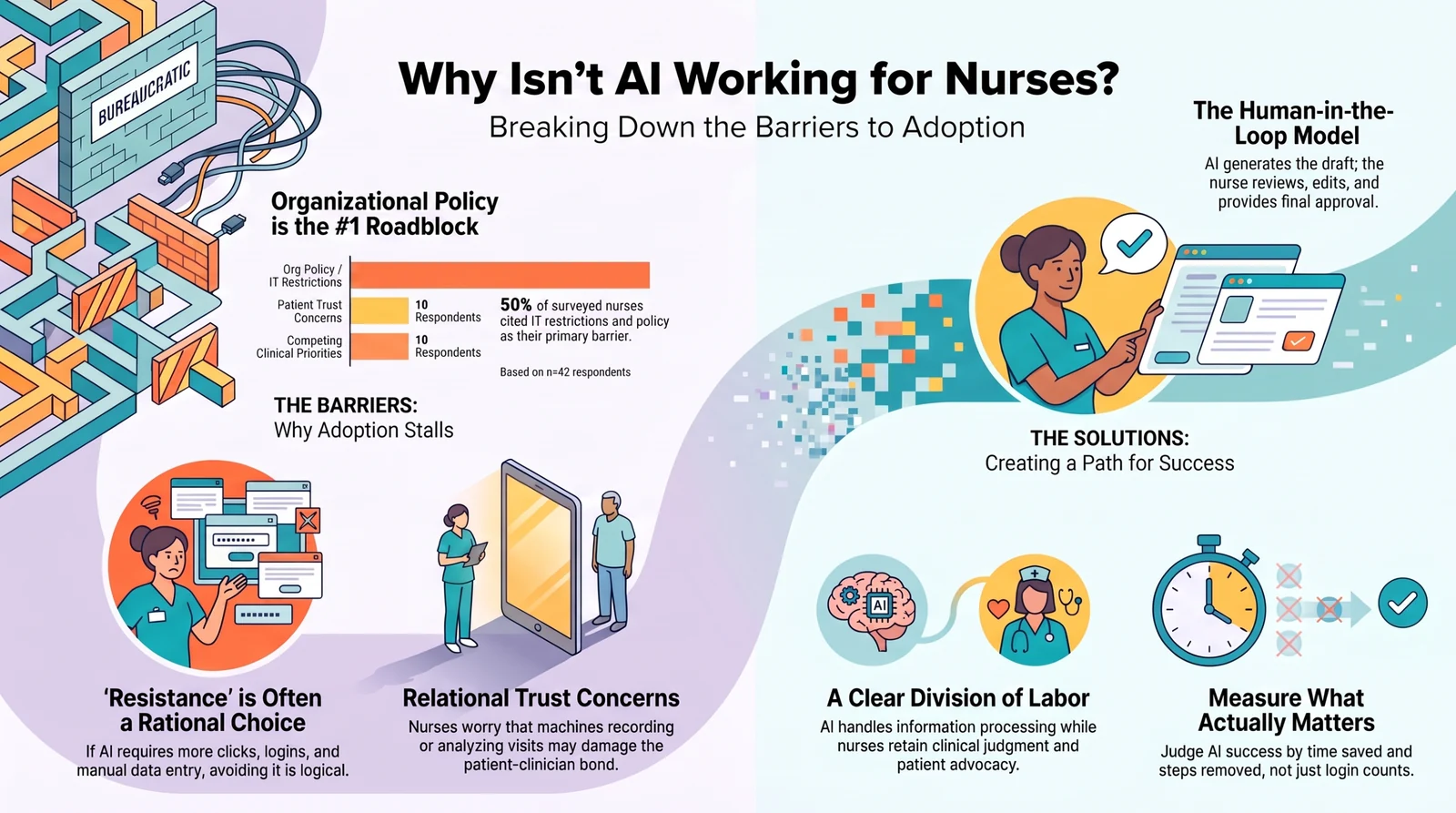
When adoption requires more clicks, logins, and review, resistance may be rational, the fix is workflow design, not persuasion.
When organizations say "our clinicians aren't adopting AI," the instinct is often to blame the users, maybe they are resistant, not tech-savvy, or afraid of change. But organizations should ask a different question: "what is the technology asking clinicians to do?" If adoption requires more clicks, more logins, more review, more training, and more administrative work, then resistance may actually be rational. The real issue may not be resistance to AI, it may be resistance to bad workflow design. That is a much more useful way to think about AI adoption.
AI Adoption in Home Health Has an Additional Challenge
These implementation questions become even more important in home health. A home health clinician may move from patient to patient throughout the day, work independently, experience inconsistent connectivity, document across multiple workflows, and still have substantial charting left after visits. AI can potentially assist with voice-supported documentation, visit summaries, clinical narratives, documentation completeness, patient education documentation, longitudinal record summarization, OASIS-related workflows, and identification of potential inconsistencies. But adding AI to an inefficient workflow does not automatically create an efficient workflow. The nurse still needs control, the technology still needs to fit the visit, and the output still needs to make the clinician's work easier.
What Makes Nurses Actually Use AI?
Healthcare organizations trying to improve AI adoption should focus on seven practical conditions:
- Solve a problem nurses already have — "implement AI" is not a meaningful objective; "help nurses finish documentation with less after-hours work" is.
- Remove friction — AI should eliminate steps rather than introduce another workflow.
- Give clinicians control — users should be able to review, edit, reject, correct, and approve AI-generated information.
- Make limitations visible — clinicians need to know when an AI output deserves additional scrutiny.
- Establish clear organizational policies — tell clinicians what tools are approved, what information may be used, and where human review is required.
- Involve nurses in implementation — clinical users should have a role in selecting, testing, evaluating, and improving the technology.
- Measure the clinician experience — not just login counts, but time saved, steps removed, documentation completed sooner, corrections required, clinician satisfaction, and continued voluntary use.
What Should AI Do, and What Should Nurses Do?
The strongest healthcare AI model is not AI versus clinicians. It is a division of labor.
| AI is particularly useful for | Clinicians remain essential for |
|---|---|
| Repetition | Clinical judgment |
| Information organization | Patient interaction |
| Summarization | Empathy |
| Pattern detection | Context |
| Data processing | Communication and advocacy |
| Draft generation | Ethical decisions and clinical intuition |
The stronger model is: AI handles more of the information burden, and clinicians retain responsibility for the clinical work that requires human judgment.
The Question Healthcare Leaders Should Be Asking
The wrong question is "how do we make clinicians adopt AI?" The better question is "what would make this AI genuinely useful to clinicians?" That shift matters, because the course evaluation suggests something organizations should not ignore: when nurses cannot use AI, the biggest obstacle may not be distrust, fear, or lack of interest, sometimes the organization itself is standing in the way.
The best healthcare AI strategy therefore does not begin with persuading clinicians. It begins with creating an environment in which useful, safe, well-designed AI is actually possible. And when the technology solves a real problem, fits naturally into the workflow, protects patient information, and keeps clinicians in control, adoption becomes much less of a persuasion problem. It becomes a value problem, and if the value is obvious, clinicians have a reason to use it.
Home Health Documentation Playbook
The complete guide to OASIS-E, Medicare compliance, PDGM, and AI-assisted documentation. Learn how top agencies reduce documentation time without sacrificing compliance.
Bottom Line
When nurses don't adopt AI, the biggest obstacle often isn't distrust or fear, it's the organization: in a 42-nurse evaluation, organizational policy and IT restrictions were the most-cited barrier (21 of 42). Different barriers need different fixes (access → policy, distrust → transparency and validation, overload → fewer steps), and AI has to earn its place in the workflow rather than add another one. Keep clinicians in control (AI generates → nurse reviews → edits → approves), divide the labor so AI handles information work while nurses keep clinical judgment, and measure time saved, not logins. When AI solves a real problem, fits the workflow, protects patient data, and keeps clinicians in control, adoption stops being a persuasion problem and becomes a value problem.

Arvind Sarin is the founder of Copper Digital. For the past year he has spent three days a week inside a 500+ census Texas home health agency, building AI documentation that finishes OASIS and visit notes the same day, with a nurse reviewing and approving every note. He writes about home health documentation, OASIS, Medicare compliance, and applying AI responsibly in clinical workflows.
Frequently asked
Frequently asked questions
Nurses may face barriers including organizational policies, IT restrictions, patient trust concerns, competing priorities, lack of time, workflow disruption, concerns about AI accuracy, privacy requirements, burnout, and insufficient training. In a 42-person nursing AI course evaluation, organizational policy or IT restrictions were the most frequently selected barrier.
Join the conversation
Leave a comment
Related reading
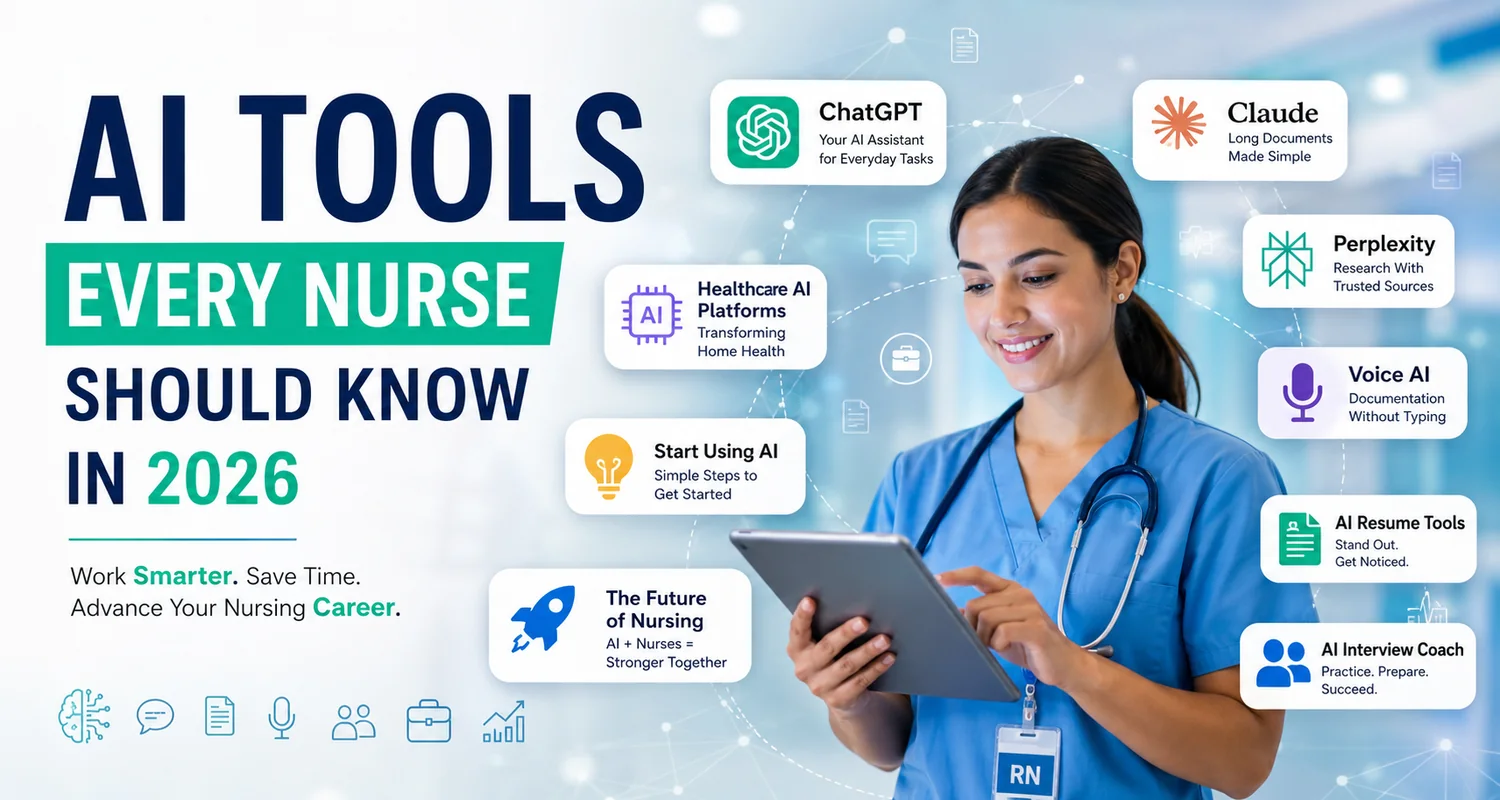
AI Tools Every Nurse Should Know in 2026
The best AI tools for nurses in 2026 include ChatGPT for learning and career prep, Claude for long documents, Perplexity for cited research, voice AI for documentation, AI resume and interview coaching tools for career transitions, and human-in-the-loop healthcare AI platforms like Copper Digital for home health documentation. You don't need a computer science degree to benefit from any of them.

How Ambient AI Is Changing Clinical Documentation
Ambient AI passively listens to patient-clinician conversations and automatically generates structured clinical documentation, using speech recognition, NLP, and large language models to capture symptoms, diagnoses, medications, and plans. It reduces after-hours charting and burnout while the clinician reviews and approves every note. In home health, it works best paired with an AI documentation agent that understands OASIS and referral workflows.

AI Careers for Nurses: How to Transition Beyond the Bedside
Nurses can transition into AI careers without learning to code. Clinical experience with workflows, patient safety, and documentation makes nurses valuable in roles like nurse informaticist, clinical AI consultant, healthcare AI product manager, and AI educator. The future of nursing isn't leaving healthcare, it's expanding what a healthcare career can look like.