
Clinician Burnout Is the Patient Experience Problem
Burnout isn't a yoga-and-pizza-party problem. Patient experience advisor Valerie Choniuk reframes clinician burnout as a system problem, and a patient experience problem, and explains how protecting presence (not just adding technology) is what actually heals care.
Key Takeaways
- Burnout is a system problem, not a resilience problem.
- Too much of a visit is spent typing instead of connecting.
- Patients feel clinician burnout before it shows up in scores.
- Reducing documentation burden improves both clinician and patient experience.
I started working in healthcare to take care of my grandmother, and that purpose is what drove me across 20 years of hospitals, home health agencies, nursing homes, medical groups, and a national value-based care organization. Early on, I used to say "patients come first" all the time. But the more I worked alongside administrators, physicians, and advanced practice professionals, the clearer it became that we had it backwards. The culture of any healthcare organization is based on how individuals are feeling, and that individual feeling creates the collective experience for everyone.
Clinician burnout isn't related to the patient experience problem. It is a patient experience problem.
It's Not a Resilience Problem
Most health systems treat burnout like an HR issue. They think the solution is yoga at lunch or pizza parties, and that's just not it. Burnout is not a product of someone's individual resilience. It is a product of the system.
📊 The U.S. Surgeon General called it "crisis levels": 35 to 54 percent of nurses and physicians reported burnout symptoms before the pandemic even hit.
In one organization where I analyzed CAHPS survey data alongside clinician engagement, the connection was impossible to miss: low engagement predicted low patient trust, every time. That was not a subtle finding.
40 Percent of the Visit Is Typing
I've shadowed many physicians, and the pattern is remarkably consistent:
| Share of the visit | What it goes to |
|---|---|
| 40% | Typing, not making eye contact with the patient |
| 30% | Navigating EHR prompts |
| 10% | Clarifying prior authorization requirements |
| ~20% | Left for being seen, heard, and cared for |
Physicians didn't train for decades to optimize ICD-10 codes or manage MIPS dashboards. What they trained to do is know when not to do something, when a patient just needs ten more minutes, or when silence is more powerful than a prescription. You can't exercise that judgment when your attention is locked on a screen.
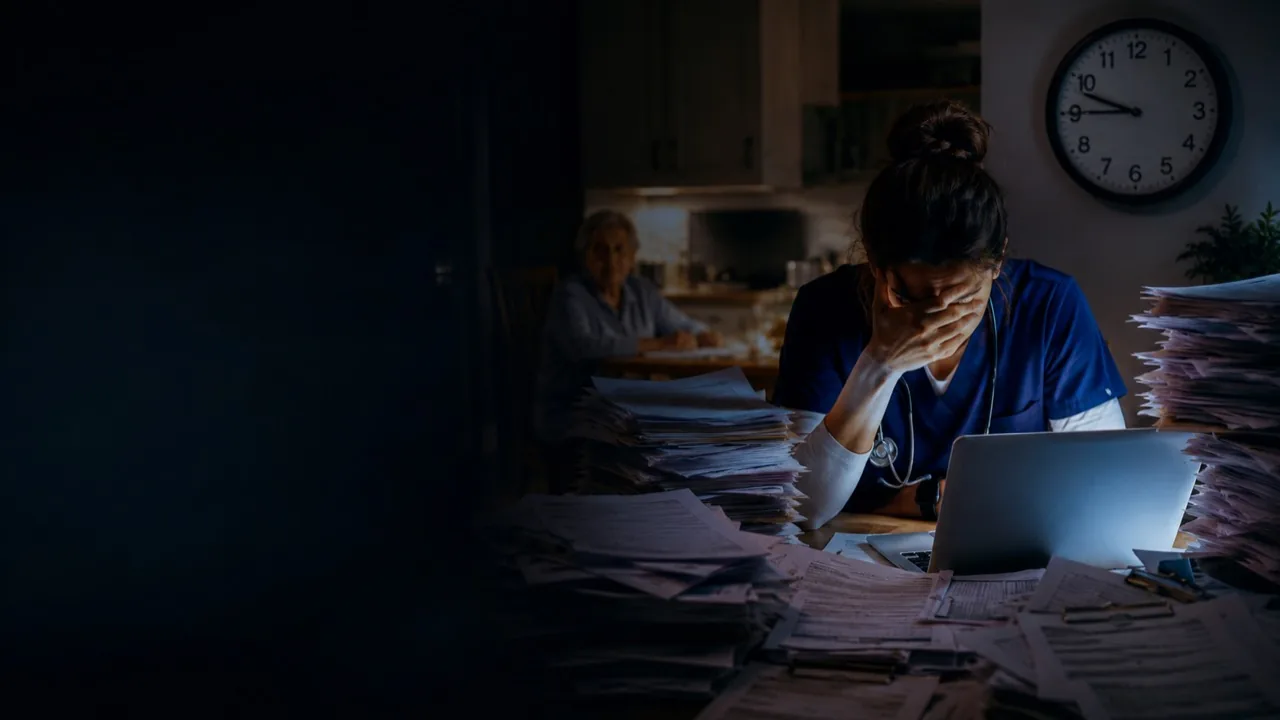
The same is true in home health. Nurses spend 40 percent of their shift on paperwork, sitting at kitchen tables at nine o'clock at night finishing charts. Colleagues have told me straight up, "This is not what I went to school for. I'm here to help human beings get better." Are we preserving that sacred human-to-human relationship, or is administration just protecting the system?
The Patient Feels It Before You Measure It
When a physician can't make eye contact, the patient doesn't think "my doctor is burned out." They think "my doctor didn't listen." When a home health nurse spends an hour at a kitchen table completing OASIS documentation, the patient thinks she doesn't care. Once trust erodes, it shows up everywhere: adherence, complaints, outcomes. This is why so many agencies find their clinical story doesn't make sense, the documentation says one thing, the patient's experience says another, and the gap is almost always a clinician who didn't have the space to be fully present.
Both Sides Are Saying the Same Thing
🧑 Patients: "Too many portals. Too many logins. I'm expected to navigate all of this with less guidance."
🩺 Clinicians: "Too many dashboards. Too many metrics. I'm expected to manage all of this with less time."
They're describing the same broken experience from two sides of the exam table. When we push technology the wrong way, leaning into transactional check-the-box work, we miss the big picture for both groups. The compounding damage may not show up immediately on a revenue report, but it defines whether you become a fast-growing agency or one that stagnates at 200 census.
53 Million Invisible Workers
👥 53 million Americans are serving as unpaid family caregivers right now, up nearly 10 million in five years.
I think about this personally. I don't have an NPI number. I don't show up on my parents' quality dashboards. But when my mom has anxiety and doesn't want to see a doctor, who does she tell? Me, her daughter. Then I'm the one coordinating her care, nudging her to close gaps, interpreting insurance letters, managing medications, acting as tech support. None of that shows up on any dashboard.
In my work with Medicare Advantage patients, those with strong caregiver support have fewer admissions, better adherence, and better preventive screening compliance. We measure HEDIS and CAHPS, but not caregiver strain. And when that caregiver burns out, the patient's outcomes decline. Same mechanism, same pattern.
The White Space Between Visits
A patient might have two home health visits per week, a few hours out of 168. What happens in the other 160 hours is where outcomes are actually decided. This is why AI-powered check-in calls between visits are so meaningful, even when they aren't billable. A new study shows loneliness makes seniors sicker than a lifetime of smoking, and there is something about connection and reassurance that drives healing beyond what any metric captures. How many times have I seen someone write in a survey, "I can't believe Dr. Smith followed up two weeks later just to see how I was"? Back to basics.
But it's not the technology that fails the senior, it's the poor sequencing. Seniors don't respond to uncontextualized texts. Start with something credible: a postcard with the provider's branding, plain language, a heads-up that a text will follow. Then layer in behavioral nudges. Trust is the gateway to adoption for anything.
The Double-Edged Sword of AI
The bad edge looks like AI that generates notes requiring heavy editing, where a physician reads the output and says, "This does not match real-world experience at all." Physicians want autonomy and trust, and when a tool creates more friction than it removes, they disengage fast. The solution is to include clinicians early in the build and get their feedback at ground zero. I've seen organizations sprint wildly without a single physician in the room and end up solving problems nobody actually has.
Automation is not the goal. Liberation of presence is the goal.
Heal Our Healers
The majority of patients are non-clinical. They can't evaluate whether the medical care they received was right or wrong, so the things they can evaluate are the humane aspects: are you listening, are you showing respect, are you spending time, are you helping them navigate? That makes experience the differentiator, because it's the only dimension most patients can actually judge you on.
💰 The lifetime value of a patient is now $1.8 million, up from $1.4 million. Revenue matters, but chasing the next dollar before your earnings call is not a long-term strategy.
This is a consumer-driven healthcare world. If you don't build that relationship and that foundation of trust from the beginning, nothing else is going to work. We have to heal our healers. How can we expect them to commit to caring for other human beings if we aren't doing the same for them? If we can design technology that protects presence rather than stealing it, we'll be in good shape, because when humanity erodes, no dashboard is going to bring it back.
If Your Clinicians Are Drowning in Paperwork, the Patient Experience Is Already Broken
The Start of Care visit that takes six hours isn't a documentation problem, it's a presence problem, and your intake process may be poisoning your clinical data before the nurse even arrives. Copper Digital eliminates the administrative burden so your clinicians can do the one thing they trained for: be human with another human. Explore pricing, browse more resources and podcast episodes, or see it in a real agency case study.
Bottom Line
Clinician burnout is the upstream cause of the patient-experience crisis: when much of a visit is spent typing, patients feel it before any survey measures it.

Watch the Full Conversation
Clinician Burnout is the Patient Experience Problem | AI in Healthcare, Caregiver Crisis
Valerie Choniuk reframes clinician burnout as the upstream cause of the patient experience crisis, and walks through what AI can, and cannot, do about it.

Valerie Choniuk has spent 20 years across hospitals, home health, nursing homes, medical groups, and a national value-based care organization. She advises the Beryl Institute Policy Forum and serves on the Journal of Patient Experience peer-review board.
Frequently asked
Frequently asked questions
Yes. Burnout changes how present a clinician can be, and patients feel that directly. When a clinician can't make eye contact or is buried in documentation, patients read it as "they didn't listen" or "they don't care." That erodes trust, which then shows up in adherence, complaints, and outcomes. Burnout isn't separate from patient experience; it's an upstream cause of it.
Join the conversation
Leave a comment
Related reading

Can AI Help Reduce Nurse Burnout?
Nurses now spend nearly as much time documenting care as delivering it, and the result is unprecedented burnout. AI can help, but only when it is designed to support nurses rather than replace them. This guide breaks down how AI reduces cognitive load, ambient documentation, predictive deterioration detection, human-in-the-loop safety, and what it means for retention and home health.
The Most Powerful Skill in Nursing No One Trains
Clinical intuition is not a mystical gift. It is pattern recognition operating faster than conscious thought, and it flags patient deterioration before the monitors catch up. Critical care nurse Desiree Paige on why the system silences the most powerful skill in nursing, and why reducing documentation burden is a patient safety intervention.

What 40 Years in Nursing Taught Me About Surviving a Broken System
67% of nurses report burnout. Those are not staffing metrics. Nurse leader Kimberly Maurer on the suitcase of unprocessed trauma every nurse carries, the lateral violence nobody names, and the third path between staying stuck and walking away.